Trainer Burnout Prevention: 10 Massive Metrics to Stop Failure
You feel like you are running a race where the finish line keeps moving and your legs are made of lead.
Let me be direct. If you are scaling a business and you are not tracking specific operational metrics, you are headed for a massive crash. Most founders look at their bank account or their total sales and think everything is fine. The reality is that revenue often masks a crumbling foundation that destroys your team from the inside out.
This is where Trainer Burnout Prevention becomes your most important strategy for long-term survival. I have seen this pattern dozens of times where a founder hits $100k a month only to realize their team is quitting and their quality is dropping. You need a scorecard that predicts problems before they become fires. Here is how you use Trainer Burnout Prevention to build a business that actually scales without killing your people.
Why Your Current Metrics Are Lying To You About Growth
The pattern is always the same. You see more money coming in and you assume your operations are working. You might even hire more people to handle the load. But if your processes are messy, hiring more people just adds more fuel to the fire. You are not scaling. You are just bloating. This is why Trainer Burnout Prevention must be baked into your weekly scorecard. Without it, you are just waiting for your best employees to hand in their notice.
Most small business owners focus on “lagging indicators.” These are numbers that tell you what already happened. Revenue is a lagging indicator. Profit is a lagging indicator. By the time these numbers look bad, it is often too late to fix the root cause. You need “leading indicators.” These are metrics that show you where the stress is building up in your engine. Effective Trainer Burnout Prevention requires you to look at the cracks in the dam before it breaks.
I know because I have watched founders lose their entire core team in a single month. They thought they were winning because sales were up 30 percent. In reality, their delivery team was working 60 hours a week to keep up. That is the opposite of Trainer Burnout Prevention. It is a recipe for a total operational collapse.
The logic is simple. If you cannot measure the strain on your operations, you cannot manage it. You cannot expect your team to just “work harder” forever. Real Trainer Burnout Prevention means having the data to know when to slow down, when to hire, and when to fix a broken process. It means moving from a reactive “firefighter” mode to a proactive “operator” mode.

The 10 Metrics for Trainer Burnout Prevention That Predict Scaling Problems
If you want to protect your sanity and your staff, you need to track these 10 metrics every single week. These are the core pillars of Trainer Burnout Prevention. If any of these numbers go out of range, it is a red flag that your scaling efforts are failing.
1. Total Team Overtime Hours
The reality is that overtime is a symptom, not a staffing problem. If your team is consistently working more than 45 hours a week, your Trainer Burnout Prevention score is in the red. Overtime leads to mistakes. Mistakes lead to re-work. Re-work leads to more overtime. It is a death spiral that ends with your best people leaving for a job that lets them see their families.
2. The Error and Re-work Rate
How many times does a job have to be done twice? If your error rate is climbing as you scale, your training systems are broken. High error rates are the fastest way to kill Trainer Burnout Prevention. It is demoralizing for a team to fix the same mistakes over and over again because the SOP was unclear or the handoff was messy.
3. Founder Hours on Low-Level Tasks
Are you still the one answering basic client questions or fixing formatting on a report? If you are spending more than 5 hours a week on tasks that pay $25 an hour, you are the bottleneck. You cannot focus on Trainer Burnout Prevention for your team if you are burnt out yourself. Your scorecard must track how much of your time is spent in the “CEO Zone” versus the “Worker Bee Zone.”
4. Client Onboarding Time
How long does it take from a signed contract to a happy client? If this number is increasing, your operations are lagging. When onboarding takes too long, the team feels the pressure of a growing backlog. This pressure is a direct threat to Trainer Burnout Prevention. You want a lean, fast onboarding process that does not require manual intervention from you every single time.
5. Employee Net Promoter Score (eNPS)
You likely ask your clients how they feel, but do you ask your team? A simple, anonymous weekly question like “How likely are you to recommend working here to a friend?” can save your business. This is the ultimate metric for Trainer Burnout Prevention. If the score drops, you need to stop selling and start fixing your internal culture immediately.
6. The “Question” Volume
Track how many times your team has to ask you a question to finish a task. If your Slack is blowing up with “How do I do X?” it means your documentation is failing. High question volume is the enemy of Trainer Burnout Prevention. It creates constant interruptions that prevent “deep work” and leave everyone feeling frazzled by the end of the day.
7. Task Completion Percentage (RACI)
Do you have a clear list of who owns what? If tasks are falling through the cracks, it is because roles are confused. When everyone is responsible, nobody is responsible. This confusion is a massive drain on Trainer Burnout Prevention. You need a scorecard that shows exactly which departments are hitting their marks and which ones are drowning.
8. Gross Profit per Full-Time Employee
This is a brutal honesty metric. If you are hiring more people but your profit per employee is going down, you are becoming less efficient as you grow. This often happens because you are adding “management layers” or “administrative bloat” instead of improving processes. True Trainer Burnout Prevention involves making the work easier, not just adding more bodies to a broken system.
9. Project Lead Time
This is the total time it takes to deliver your service. If your lead time is stretching out, your capacity is maxed. Trying to sell more when lead times are already too long is the opposite of Trainer Burnout Prevention. It puts your delivery team in an impossible position where they are always apologising to angry clients.
10. SOP Adoption Rate
It is not enough to have a folder full of Google Docs. Are people actually using them? You can track this by auditing how many tasks were completed according to the documented process. Low adoption means your systems are too complex or too hard to find. Fixing this is a core part of Trainer Burnout Prevention because it removes the guesswork from the daily grind.

The Pattern of Failure in Small Business Scaling
I have seen this happen in roofing companies, consulting firms, and digital agencies alike. The founder hits a “ceiling” around $75k or $100k a month. They try to push through it by working harder. They stay up until 2 AM answering emails. They expect their team to do the same. But without a focus on Trainer Burnout Prevention, the business eventually hits a breaking point.
The reality is that your business cannot grow past your ability to manage it. If you do not have a scorecard, you are flying a plane in a storm without any instruments. You might feel like you are moving fast, but you have no idea if you are about to hit a mountain. Trainer Burnout Prevention is your instrument panel. It tells you when you have enough altitude to speed up and when you need to level off to avoid a crash.
What happens next is usually a “mass exodus.” One key employee leaves because they are tired of the chaos. Then another follows. Suddenly, you are back to doing everything yourself, but now you have the overhead of a larger office and more software. This is why The Clarity Transformation is so vital for businesses at this stage. We stop the bleeding by implementing the metrics that actually matter.
Implementing The Clarity Transformation for Better Metrics
When we begin a Clarity Operational Partnership, the first thing we do is look at your data. Or, more often, we look at the lack of data. Most founders have a “gut feeling” about how things are going. A gut feeling is not a strategy for Trainer Burnout Prevention. We help you build a dashboard that gives you the truth in ten minutes or less every Monday morning.
Phase 1: The Audit
We look at your current workflow and identify where the “leaks” are. Are you losing money on re-work? Is your team wasting 10 hours a week on internal meetings that should have been an SOP? We identify the specific metrics that will drive Trainer Burnout Prevention for your unique business. This is a core part of The Clarity Transformation.
Phase 2: The Infrastructure
We do not just give you a list of numbers to track. We build the systems to track them automatically. This might mean setting up a project management tool like ClickUp or Asana properly. It might mean creating a simple Google Sheet that pulls data from your CRM. The goal is to make Trainer Burnout Prevention easy, not another chore on your to-do list.
Phase 3: The Execution
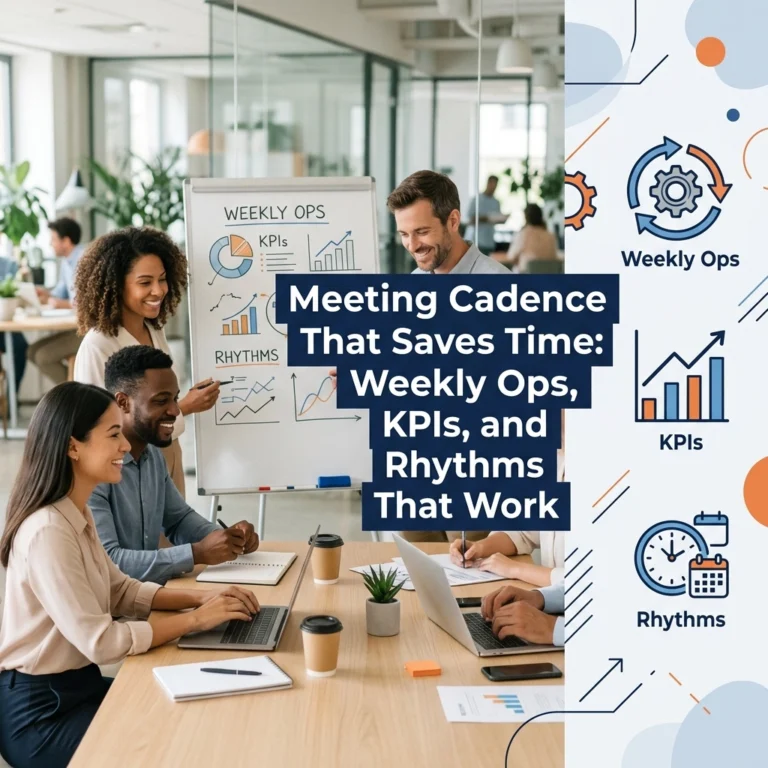
Once the metrics are live, we teach you how to read them. We help you lead “Level 10” meetings where you look at the scorecard and solve the problems it highlights. This is where the real change happens. You stop talking about “feeling busy” and start talking about “reducing lead time by 15 percent.” This shift in focus is essential for Trainer Burnout Prevention.
The Clarity Operational Partnership is designed to take the weight off your shoulders. You do not have to be the one building the scorecard. You just have to be the one using it to make better decisions. By the end of The Clarity Transformation, you will have a business that runs on systems, not on your personal adrenaline.

Why You Cannot Solve This With a New Hire
A common mistake is thinking that hiring an “Operations Manager” will fix everything. You think they will walk in and magically create your Trainer Burnout Prevention systems. The reality is that if you hire a manager into a messy system, they will just become another person caught in the chaos. They will eventually burn out too, and you will be out a $5k-$8k a month salary with nothing to show for it.
You need the framework before you hire the person. You need to know which metrics matter so you can tell the manager what to watch. This is why a Clarity Operational Partnership is often better than a full-time hire in the early stages. We bring the expertise to build the engine. Once the engine is running smoothly and your Trainer Burnout Prevention metrics are stable, then you can hire a lower-cost operator to maintain it.
Think about the math. A full-time Operations Manager costs $70k to $100k a year plus benefits. A Clarity Operational Partnership provides fractional COO leadership at a fraction of that cost. We focus on high-impact implementation that pays for itself by reducing waste and preventing expensive turnover. We are not just another “admin” hire. We are a strategic partner in your growth.
Goal: To move from founder-led chaos to a metric-driven machine that prioritizes team health.
What You Get With a Clarity Operational Partnership
When you work with us, we do not just give you advice and walk away. We get our boots on the ground and build the systems with you. Our focus is always on long-term sustainability and Trainer Burnout Prevention. Here is what you can expect from our time together:
- A custom Ops Scorecard built for your specific industry.
- A clear RACI matrix so everyone knows their role and ownership.
- Streamlined communication channels to reduce Slack and email noise.
- Documented SOPs for your core delivery processes.
- Weekly leadership coaching to help you transition from “Doer” to “CEO.”
The logic behind our approach is simple. A business that relies on the founder’s heroics is not a business. It is a high-stress job that you cannot quit. We help you build a real asset. By focusing on Trainer Burnout Prevention, we ensure that your growth is profitable and your team is happy.
Common Mistakes in Tracking Operational Metrics
You might think you can just start tracking 50 different things tomorrow. Do not do that. The pattern of failure involves “metric fatigue.” If you try to track too much, you will stop tracking anything within three weeks. Start with the three most critical numbers for Trainer Burnout Prevention and build from there.
Another mistake is using metrics to “punish” the team. If your employees think the scorecard is a tool for you to yell at them, they will manipulate the numbers. You must frame the scorecard as a tool for Trainer Burnout Prevention. Tell them, “We are tracking overtime because I want you to go home on time.” When the team sees that the data is there to protect them, they will embrace the system.
Finally, do not ignore the “Red Flags.” I have seen founders see a dropping eNPS score and say, “They are just having a bad week.” If the data says your Trainer Burnout Prevention is failing, listen to it. The numbers do not have an ego. They are just reporting the reality of your operations. If you ignore the warning signs, you are choosing to let your business break.

Frequently Asked Questions About Trainer Burnout Prevention
How do I know if my team is actually burnt out or just lazy?
The honest answer is to look at the data. If their performance used to be high and has recently dropped while their hours have increased, that is burnout. Lazy employees usually have a history of low performance regardless of the workload. Trainer Burnout Prevention is about protecting your “A-players” from the consequences of poor systems.
What is the single most important metric for a small business founder?
If I had to pick one for Trainer Burnout Prevention, it is “Founder Hours on Low-Value Tasks.” If you are stuck in the weeds, you cannot see the forest. You cannot lead your team if you are drowning in $20-an-hour work. Your time is the most expensive resource in the company.
Can I build an Ops Scorecard myself?
You can, but it will take you longer and you will likely track the wrong things at first. Most founders spend 20 to 30 hours trying to set up a dashboard that ends up being too complex. A Clarity Operational Partnership gets it done in a fraction of the time with a proven framework that has worked for dozens of other businesses.
How often should I review my Ops Scorecard?
You should look at it weekly. A monthly review is too late to catch scaling problems before they cause damage. A daily review is too much “micromanagement.” A weekly rhythm allows you to spot trends and make course corrections without losing your mind. This is a key part of Trainer Burnout Prevention.
Does tracking metrics kill company culture?
No, chaos kills company culture. Most employees actually feel safer when they know exactly how they are being measured. It removes the anxiety of not knowing if they are doing a good job. A clear scorecard is actually a massive boost for Trainer Burnout Prevention because it provides clarity and fairness.
The Honest Assessment: Are You Ready to Scale?
Let’s do a reality check. If you took a two-week vacation tomorrow and turned off your phone, would your business still be running when you got back? If the answer is no, you are not ready to scale. You are a bottleneck, and your lack of systems is the biggest threat to your team’s health. You need to prioritize Trainer Burnout Prevention before you spend another dollar on marketing.
Scaling a business without an Ops Scorecard is like trying to build a skyscraper on a foundation made of sand. It might look impressive for a while, but it will eventually sink under its own weight. I have seen it happen, and it is painful to watch. But it is also entirely preventable.
You have two choices. You can keep doing what you are doing, working harder and harder until something snaps. Or you can decide that you want a business that works for you, rather than the other way around. You can choose to implement a real strategy for Trainer Burnout Prevention and build a foundation that can actually support your dreams.
Take the First Step Toward Operational Clarity
If you are tired of the constant firefighting and you want to see the “math” of your business, we should talk. We specialize in helping founders move from “Chaos” to “Clarity” through hands-on implementation. We don’t just give you a report. We build the engine that drives your Trainer Burnout Prevention.
The first step is a 30-minute discovery call. We will look at your current situation, identify your biggest bottlenecks, and see if a Clarity Operational Partnership is the right fit for you. There is no high-pressure sales pitch. Just an honest conversation about how to fix your operations and protect your team.
Don’t wait until your best employee quits or you hit a wall. Start your Trainer Burnout Prevention journey today.
Click here to book your call: https://calendly.com/sdrobinson8/30min
I look forward to helping you build a business that scales without the stress.
Related Blogs:
- The $10K Monthly Cost of Being Your Own Bottleneck
- Why Strategy Always Loses to Firefighting
- Your Fractional COO Onboarding Checklist
- Overtime is a Symptom, Not a Staffing Problem
- Leading vs Lagging Indicators: 7 Metrics That Actually Matter
- How to Build an Ops Scorecard for Small Business
- Employee Burnout Signs: 10 Early Warning Metrics
- Why Revenue Growth Is a Dangerous Signal Alone
- Weekly Business Metrics Every Founder Should Track
- How to Measure Team Capacity Before Hiring
- The Real Reason Your Team Is Burning Out
- Overtime Tracking Systems That Prevent Turnover
- How to Reduce Rework and Error Rates in Operations
- Founder Time Audit: Where Your Hours Are Really Going
- Client Onboarding Bottlenecks: 5 Fixes That Work
- NPS Revenue Growth: 5 Incredible Ways to Master Profits
- Why Your Team Asks Too Many Questions
- RACI Charts Explained: Who Owns What in Your Business
- Profit Per Employee: The Metric That Predicts Growth
- Project Lead Time: How to Speed Up Delivery
- SOP Adoption: Why Your Team Ignores Documentation
- Scaling Without Breaking Your Team: 7 Key Strategies
- Operational Metrics That Predict Business Failure
- How to Build a KPI Dashboard That Actually Gets Used
- The Hidden Cost of Poor Internal Systems
- When to Stop Selling and Fix Operations First
- Why Hiring More Staff Doesn’t Solve Burnout
- Business Metrics That Prevent Founder Overload
- How to Identify Operational Bottlenecks Early
- Weekly Scorecard Meetings: How to Run Them Right
- Data-Driven Decision Making for Founders
- How to Track Team Productivity Without Micromanaging
- The Link Between Systems and Employee Retention
- Why Your Best Employees Are About to Quit
- Building a Metrics-Driven Company Culture
- Operational Efficiency Metrics for Scaling Businesses
- How to Reduce Slack Noise and Internal Interruptions
- Founder vs Operator: Tracking the Right Activities
- Early Warning Signs of Scaling Failure
- The True Cost of Employee Turnover in Small Business
- How to Build a Business That Protects Your Team
- From Gut Feel to Data: Running Your Business Smarter
- KPI Overload: What to Track and What to Ignore
- Creating a Weekly Rhythm Around Business Metrics