Overtime Is a Symptom, Not a Staffing Problem: 3 Best Ways
Your payroll is ballooning and your crew is exhausted. You assume the answer is to hire three more technicians to handle the load. The reality is that your business is leaking profit through poor scheduling and you are about to hire your way into even more chaos.
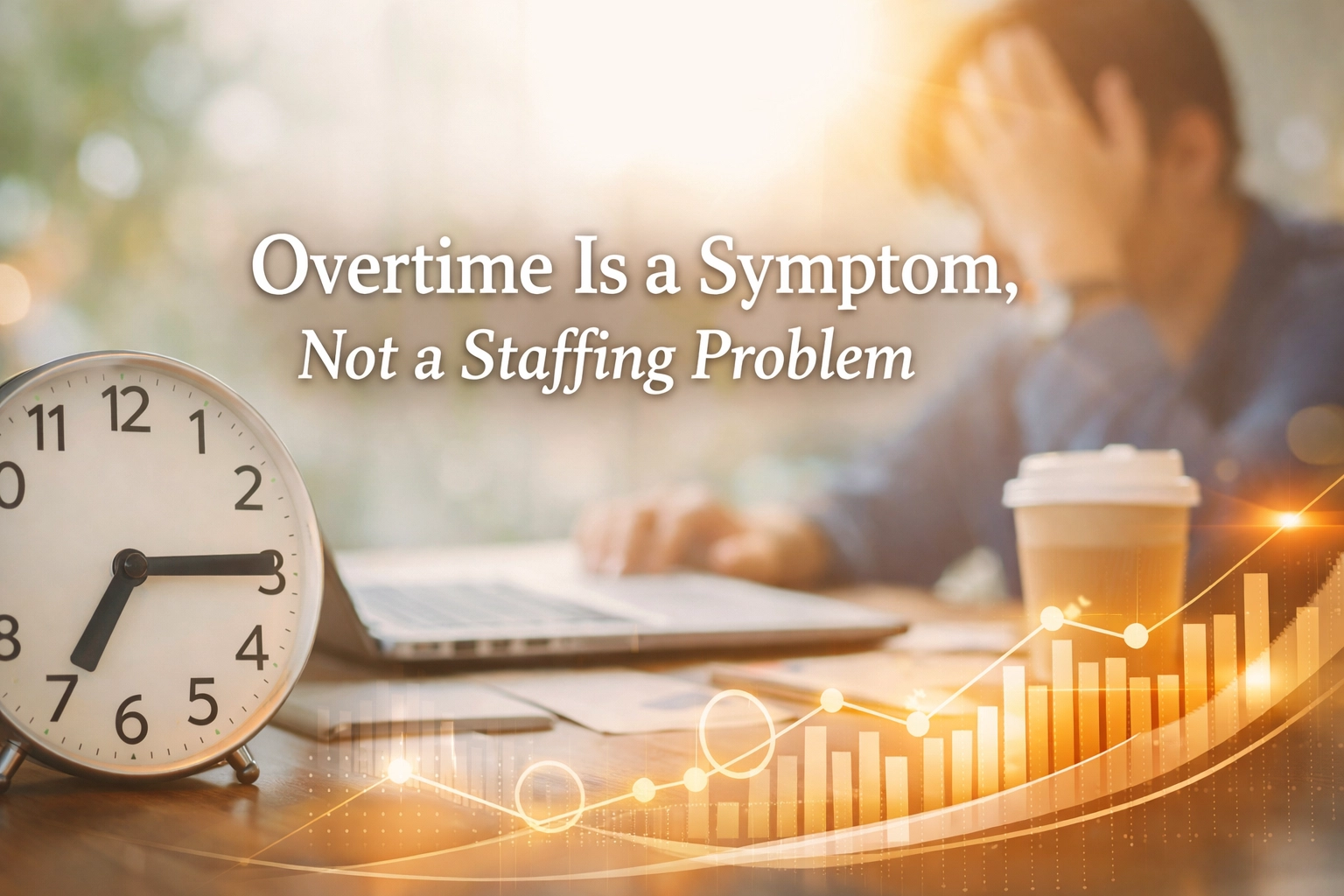
Let me be direct. If you are paying for constant extra hours while your net margins are shrinking, you do not have a labor shortage. You have a process failure. I have seen this pattern dozens of times in field service and technical businesses. Overtime Is a Symptom, Not a Staffing Problem because it reveals that your current resources are being mismanaged.
Hiring more people to fix a process problem is like trying to fill a bucket with a hole in the bottom by turning up the faucet. You might get more water in the bucket for a moment. Eventually, the hole just gets bigger and the waste becomes more expensive. Here is what nobody tells you: adding headcount to a chaotic system only scales the chaos.
I can tell you exactly what will happen if you hire right now. Your overhead will skyrocket. Your management burden will double. Your profit per job will drop because your new hires will be just as inefficient as your old ones. Overtime Is a Symptom, Not a Staffing Problem that requires a surgical look at your operations rather than a new stack of resumes.
The Chaos Tax and the True Cost of Extra Hours
Most owners look at the time-and-a-half rate and think that is the only cost of staying late. The reality is much worse. You are paying a “Chaos Tax” that quietly destroys your growth. When Overtime Is a Symptom, Not a Staffing Problem, the financial drain extends far beyond the payroll line item.
Think about the quality of work. A technician in their 55th hour of the week is not performing at the same level as they were in their 20th hour. Mistakes happen. Callbacks increase. One preventable mistake can wipe out the profit of three successful jobs.
Then there is the burnout factor. Your best people will eventually leave for a company that respects their time. High turnover is the ultimate indicator that Overtime Is a Symptom, Not a Staffing Problem. When you lose a lead tech, you lose years of institutional knowledge and thousands of dollars in recruiting costs.

Why You Cannot Hire Your Way Out of Poor Scheduling
You might think that adding another truck will solve your scheduling bottleneck. It rarely does. The pattern I see involves a lack of clear priority frameworks. Without a system to triage jobs, the loudest customer gets the attention while the most profitable jobs sit in the queue.
When Overtime Is a Symptom, Not a Staffing Problem, the root cause is usually decision latency. Your office staff is waiting for answers from the field. Your crews are waiting for parts from the warehouse. Every minute of waiting in the field translates to an extra minute of overtime at the end of the day.
The honest assessment is this: your business is likely operating at 60 percent efficiency. If you could move that to 80 percent, you would suddenly find that your current staff can handle more work than you ever thought possible. Overtime Is a Symptom, Not a Staffing Problem because it masks the idle time hidden in your daily schedule.
The 70-80 Percent Capacity Rule
If you schedule your crews at 100 percent capacity, you are guaranteed to have overtime. One flat tire or one missing part will push the entire day into the evening. Overtime Is a Symptom, Not a Staffing Problem that stems from a refusal to account for the “known unknowns” of service work.
I recommend scheduling for 80 percent capacity. This allows your team to handle emergencies without breaking the bank. It gives them the breathing room to do the job right the first time. In my experience, a crew scheduled at 80 percent often produces more revenue than a crew scheduled at 110 percent because they have fewer errors.
The Clarity Transformation: Fixing the Operational Foundation
This is where we stop guessing and start measuring. The Clarity Transformation is a hands-on implementation process designed to find the leaks in your labor margin. We do not just give you a report and leave. We build the systems that eliminate the need for constant extra hours.
In the first phase of The Clarity Transformation, we map your existing workflows. We look for the friction points where time is lost. We often find that technicians are spending 10 to 15 hours a week on tasks that should be automated or handled by office staff. When we remove those burdens, the need for overtime disappears.
We then implement a diagnostic dashboard. This allows you to see labor efficiency in real time. You will know exactly which jobs are dragging down your profit. Overtime Is a Symptom, Not a Staffing Problem that becomes visible and manageable once you have the right data at your fingertips.
Finally, The Clarity Transformation builds a culture of accountability. Your team will understand that finishing on time is a metric of success, not just a suggestion. We provide the tools they need to be productive so they can go home to their families.

How a Clarity Operational Partnership Solves the Labor Leak
If you are a CEO who is already working 60 hours a week, you do not have time to rebuild your dispatch system. This is where a Clarity Operational Partnership provides the most value. We act as your fractional COO to implement the changes while you focus on high-level strategy.
Under a Clarity Operational Partnership, we take ownership of the process cleanup. We analyze your job costing data to see where the hours are actually going. We often find that “staffing problems” are actually just “pricing problems” or “material management problems.”
When we engage in a Clarity Operational Partnership, we look at your loaded labor rate. Most owners get this number wrong. They do not account for the hidden costs of overtime, like increased insurance premiums and equipment wear. We fix the math so your pricing reflects the reality of your operations.
Goal: To move your business from a state of reactive firefighting to proactive management where overtime is an exception, not the rule.
The Reality of Job Costing and Margin Leaks
If you do not know the exact profit margin of every job, you cannot say you have a staffing problem. Overtime Is a Symptom, Not a Staffing Problem because it usually hides in the jobs that were bid incorrectly. You are essentially paying your team extra money to lose you profit on a bad job.
The pattern:
- A job is underbid or mismanaged.
- The crew stays late to finish the work.
- You pay overtime for a job that was already low-margin.
- The owner sees the backlog and decides to hire more people.
The truth: if you had better job costing, you would have seen that the job was a loser from the start. You do not need more people to do more losing jobs. You need better filters to ensure you are only taking on work that your current team can execute profitably. Overtime Is a Symptom, Not a Staffing Problem that indicates a lack of job-level visibility.

Scaling Without the Staffing Headache
Everyone wants to scale to the next level of revenue. But scaling a business with broken processes is the fastest way to go bankrupt. Overtime Is a Symptom, Not a Staffing Problem that must be resolved before you add more headcount. If you add 10 people to a 10 percent margin business, you just have a bigger, more stressful low-margin business.
I have seen companies double their revenue and decrease their headcount simply by improving their operational flow. They stopped wasting time on the wrong jobs. They automated their communication. They empowered their foremen to make decisions in the field.
This is the core of our Clarity Operational Partnership approach. We prepare your infrastructure for growth. We ensure that when you finally do hire that next technician, they are entering a system that maximizes their productivity from day one. Overtime Is a Symptom, Not a Staffing Problem that we solve by building a scalable foundation.
What You Won’t Have: More Excuses
When you fix the underlying process, you lose the ability to blame the labor market for your stress. Overtime Is a Symptom, Not a Staffing Problem that places the responsibility squarely on the shoulders of leadership. It is harder to fix a process than it is to place a job ad, but the results are permanent.
3 Best Ways to Identify Operational Gaps
If you are ready to stop the bleeding, you need to look at three specific areas of your business. These are the primary reasons why Overtime Is a Symptom, Not a Staffing Problem in most small businesses.
- Decision Latency: Look at how long a crew waits for a response from the office. If a technician is sitting in a truck for 30 minutes waiting for a change order approval, that is 30 minutes of overtime you will pay later.
- Material Availability: Check your “run to the store” frequency. Every time a tech leaves the job site for a part, your labor efficiency drops by 40 percent for that hour.
- Information Flow: Do your crews have everything they need to finish the job before they leave the shop? If they have to call the office for a gate code or a customer phone number, your system is failing them.
Overtime Is a Symptom, Not a Staffing Problem because these small friction points aggregate into hours of wasted time every single week. Fixing these three things is usually cheaper and more effective than hiring a new employee.

Frequently Asked Questions About Overtime and Operations
Why does my team want overtime if it burns them out?
Your team might want the extra money in the short term, but they will resent the business in the long term. Reliance on overtime pay also makes them less efficient because they know they have “all night” to finish. When Overtime Is a Symptom, Not a Staffing Problem, it can actually incentivize slower work.
How do I tell my crew we are cutting back on extra hours?
Frame it as a productivity win. Tell them you are fixing the systems so they can get their work done in 40 hours and go home. Most high-quality employees value their time more than the extra pay, provided they are paid a fair base wage.
Is some overtime normal in a seasonal business?
Yes, minor fluctuations are expected during peak seasons. However, if you are running 10+ hours of overtime per person every week for months at a time, you are in the danger zone. Overtime Is a Symptom, Not a Staffing Problem when it becomes a permanent part of your business model.
How long does it take to see results from process changes?
You can usually see a reduction in wasted time within 30 days of implementing basic scheduling changes. A full Clarity Transformation typically takes 12 weeks to fully bake into the culture and produce significant margin improvements.
Can I fix this myself without a consultant?
You can, but it requires you to step away from the daily operations for 10 to 20 hours a week. Most owners find they are too close to the problem to see the obvious solutions. This is why a Clarity Operational Partnership is often the faster path to profitability.
The Path Forward: Stop the Bleeding
You have a choice. You can keep posting job ads and hope that the next hire magically fixes the chaos. Or you can admit that Overtime Is a Symptom, Not a Staffing Problem and start fixing the way your business actually works.
If you are tired of seeing your profit evaporate into labor costs, it is time for a change. We help service business owners reclaim their time and their margins by installing the operational engines that work. We don’t just talk about it. We do the work with you.
Ready to see where your business is leaking? Let’s talk.
Book your Operational Strategy Call here
Related Blogs
- HVAC Scheduling Chaos: Why Your Best Technicians Feel Unproductive
- The Chaos Tax: How Operational Gaps Quietly Destroy Profit
- Weekly Margin Review: A 30-Minute Ritual That Stops Profit Drift
- Why Hiring More People Is Making You Less Profitable
- Why Overtime Is Usually a Process Problem, Not a Staffing Problem
- The Hidden Costs of Excessive Overtime in Small Businesses
- How to Reduce Overtime Without Hiring More Employees
- Why Your Team Is Always Working Late
- Building Workflows That Eliminate Unnecessary Overtime
- Capacity Planning: The Key to Reducing Overtime
- Why Poor Scheduling Creates Overtime Costs
- How to Identify the Root Cause of Employee Overtime
- Overtime Tracking Metrics Every Business Should Monitor
- Why More Employees Won’t Fix Broken Operations
- How to Build a Labor Planning System That Works
- Overtime vs Productivity: What the Numbers Really Say
- Why Your Labor Costs Keep Increasing
- How to Reduce Overtime Through Better Process Design
- Employee Workload Balancing Strategies That Actually Work
- Why Your Team Is Busy but Not Productive
- Building Operational Capacity Without Increasing Payroll
- How to Eliminate Workflow Bottlenecks That Cause Overtime
- Why Last-Minute Work Is Driving Up Labor Costs
- Labor Efficiency Metrics Every Business Owner Should Track
- How to Improve Throughput Without Increasing Hours
- Why Overtime Is a Warning Sign of Operational Chaos
- Building Daily Work Planning Systems That Reduce Overtime
- How to Forecast Staffing Needs More Accurately
- Why Reactive Scheduling Hurts Profit Margins
- Overtime Reduction Strategies for Service Businesses
- How to Build a Sustainable Workforce Without Burnout
- Why Your Best Employees Are Burning Out First
- Building Team Capacity Instead of Adding Headcount
- How to Reduce Payroll Costs Without Cutting Staff
- Why Operational Bottlenecks Create Expensive Overtime
- Workforce Planning Systems That Improve Profitability
- How to Create Predictable Workloads for Your Team
- Why Labor Efficiency Matters More Than Labor Hours
- Building Operations That Scale Without Constant Overtime
- From Overtime Dependency to Operational Efficiency
- Turning Overtime Data Into Better Business Decisions
- How to Build a Business That Doesn’t Depend on Employee Overwork
- Why Process Improvements Beat Hiring Every Time
- Eliminating Overtime by Fixing the Work, Not the Workforce