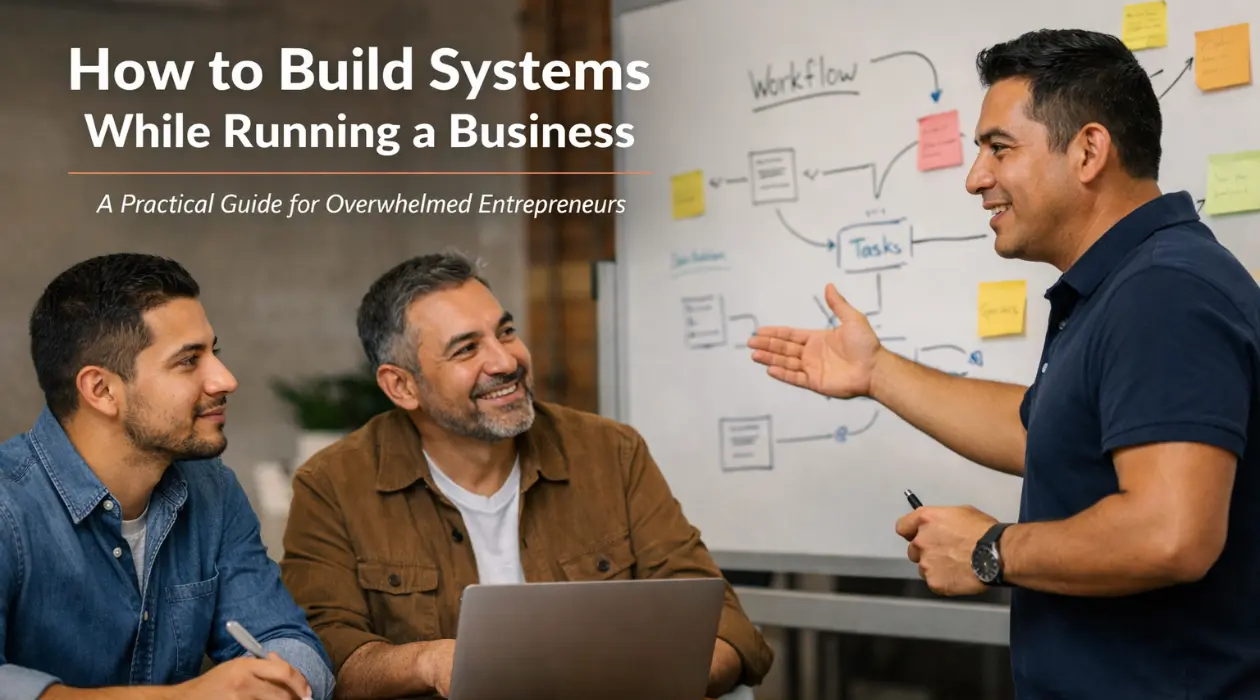
How to Build Systems While Running a Business: A Practical Guide for Overwhelmed Entrepreneurs
You know you need systems. Everyone keeps telling you that to scale your business, you need documented processes, repeatable workflows, and operational clarity. But here’s the problem: you’re drowning in the day-to-day work of actually running your business. How are you supposed to build systems while running a business when you barely have time to respond to all your emails?
This is the paradox nearly every small business owner faces. You’re caught in a loop where you need systems to free up time, but you need time to build the systems. Meanwhile, revenue is coming in, clients need attention, team members have questions, and the idea of stepping back to document anything feels impossible.
The truth? Learning how to build systems while running a business isn’t about finding more time. It’s about approaching systematization differently, in ways that work with your reality, not against it. This isn’t theory from someone who’s never been in the trenches. This is a practical roadmap for business owners who are hands-on, busy, and ready to build something sustainable without bringing operations to a halt.
Why Most Advice About Building Systems Doesn’t Work
Before we get into how to build systems while running a business effectively, let’s address why most guidance falls flat.
Traditional advice tells you to:
- Block off a week to document everything
- Hire a consultant to observe and map your processes
- Stop what you’re doing and focus on “working on the business, not in it”
- Create comprehensive process manuals before implementing anything
For a business owner managing a team of 2-20 people with monthly revenue between $20K and $100K, this advice is useless. You can’t afford to stop revenue-generating work. You don’t have the luxury of stepping away for a week. And frankly, hiring an expensive consultant to watch you work isn’t feasible.
The reality of how to build systems while running a business looks different. It’s incremental. It’s messy. It happens in the margins of your already-packed schedule. And that’s exactly how it should be.
The Real Cost of Not Having Systems
Before diving into the how, let’s be honest about what’s at stake. Running a business without systems isn’t just inconvenient, it’s expensive.
Without systems, you’re dealing with:
- The “only you can do it” trap: You’re the bottleneck for every decision, every client interaction, every problem that arises
- Revenue ceiling: You can only take on as much work as you personally can handle
- Team frustration: Your employees keep asking the same questions because nothing is documented
- Quality inconsistency: Client experience varies depending on who’s handling it and what mood everyone’s in
- Burnout trajectory: You’re working 60+ hour weeks with no end in sight
- Unscalable operations: Every new client or team member adds exponential complexity instead of manageable growth
The question isn’t whether you can afford to learn how to build systems while running a business. It’s whether you can afford not to.
The Incremental Approach: How to Build Systems While Running a Business
Here’s the framework that actually works for busy business owners. This is how to build systems while running a business without sacrificing revenue, abandoning your team, or burning out in the process.
Phase 1: Identify Your Highest-Impact Bottlenecks
You can’t systematize everything at once, so don’t try. Start by identifying where the lack of systems is costing you the most.
Action step: For one week, keep a simple tally every time you:
- Answer the same question twice
- Do a task you’ve explained to someone else before
- Make a decision that feels like you’ve made it a dozen times
- Fix an error that could have been prevented
- Drop a ball because information wasn’t captured somewhere
These are your bottleneck indicators. They’re showing you exactly where to start learning how to build systems while running a business in your specific situation.
Common bottlenecks we see:
- Client onboarding chaos
- Invoicing and payment follow-up
- Project handoffs between team members
- Quality control and revision cycles
- Meeting prep and follow-up
- Communication workflows (who needs to know what, when)
Pick ONE bottleneck to address first. Not three. Not five. One. This is crucial to understanding how to build systems while running a business sustainably, you’re building momentum through small wins, not overwhelming yourself with massive overhauls.
Phase 2: Capture, Don’t Create (Yet)
The biggest mistake business owners make when learning how to build systems while running a business is trying to design the perfect process from scratch. Instead, capture what you’re already doing.
The Screen Recording Method: Next time you do the task you’ve identified, record your screen while you do it. Talk through what you’re doing and why as you work. This takes zero extra time beyond the task itself.
Tools that work:
- Loom (free version works fine)
- QuickTime screen recording on Mac
- Built-in screen recording on Windows
- Your phone recording you working if it’s a physical process
After recording, watch it back (at 1.5x speed to save time) and jot down the actual steps you took. Not the theoretical ideal steps, the real ones you actually performed.
This is how to build systems while running a business in practice: you’re not inventing processes, you’re documenting reality.
Phase 3: Create a “Good Enough” Draft
Here’s where people get stuck. They think documentation needs to be perfect, comprehensive, and beautifully formatted. It doesn’t.
Your first draft of any system should be a working document that answers:
- What are we trying to accomplish?
- What are the actual steps?
- What tools/access/information are needed?
- What does good output look like?
- What are the common mistakes to avoid?
That’s it. Write this in plain English. Use bullet points. Include screenshots if they help. Skip the fancy formatting.
This draft should take you 30-60 minutes maximum. If it’s taking longer, you’re overthinking it. Remember, this is how to build systems while running a business, function over perfection.
Storage tip: Keep all your working documents in one place. Google Docs, Notion, even a shared drive folder works. The tool matters less than having a single source of truth your team can access.
Phase 4: Test With Your Team (This Is Where the Magic Happens)
Here’s the reality check: you won’t know if your system actually works until someone else tries to follow it.
The Handoff Test: Next time that task comes up, have someone else do it using your documented process. Watch what happens. Where do they get stuck? What questions do they ask? What assumptions did you make that aren’t obvious?
This is how you learn how to build systems while running a business that actually function. Your team members are your quality control. They’ll immediately show you what’s missing, unclear, or unrealistic.
Important: Frame this as a collaborative improvement process, not a test they can fail. “I documented how I do this, but I need your help making it better. Can you follow these steps and tell me what’s confusing?” This approach gets buy-in and generates better feedback.
Update your documentation based on what you learn. This is version 2. It’s better than version 1, but it’s still not final. And that’s fine.
Phase 5: Make It Repeatable
Once you’ve tested your system with one team member, it’s time to make it truly repeatable. This means anyone on your team should be able to follow it and get consistent results.
The 80% Rule: Your system should work correctly 80% of the time without intervention. The other 20% will have edge cases, unusual circumstances, or situations requiring judgment. That’s normal. Don’t try to document every possible scenario, focus on the common path.
This phase of how to build systems while running a business involves:
Creating decision trees for common variations: “If the client is new, do X. If they’re returning, do Y.”
Documenting where to find information: “Client preferences are tracked in the CRM under ‘Notes'”
Clarifying ownership and timelines: “Sarah reviews all output within 24 hours. If she hasn’t responded, ping her on Slack.”
Building in quality checkpoints: “Before sending to client, verify that sections 1-4 are complete and proofread”
You’re not trying to remove all thinking from the process. You’re removing the need to remember how to do the process from scratch each time.
Phase 6: Create Your Maintenance Rhythm
Here’s what nobody tells you about how to build systems while running a business: building the system is only half the work. Keeping it current is the other half.
Systems decay. Processes change. Tools get updated. If you don’t maintain your documentation, it becomes useless within months.
Practical maintenance approach:
Quarterly system reviews: Every 90 days, pick 3-5 of your documented systems and review them. Are they still accurate? Has anything changed? Do they need updates?
Real-time flagging: Create a simple way for team members to flag outdated or confusing documentation. This could be as simple as a Slack channel called #systems-feedback or comments in your documentation platform.
Process owners: Assign someone to own each major system. It’s their job to keep it current, not yours. This is how you truly scale, by distributing the responsibility of maintenance.
Understanding how to build systems while running a business includes accepting that this is ongoing work, not a one-time project. Build the maintenance rhythm from the start.
The Seven Systems Every Growing Business Needs
As you’re learning how to build systems while running a business, you might wonder where to focus beyond your immediate bottlenecks. Here are the seven operational areas that, when systematized, create the foundation for scalable growth:
1. Client Acquisition System
From first contact to signed contract, this system should answer:
- How do leads find you?
- What’s your qualification process?
- How do you conduct sales conversations?
- What’s the proposal/contracting workflow?
- How are new clients transitioned to delivery?
Why it matters: Inconsistent sales processes mean unpredictable revenue and poor client-fit rates.
2. Client Onboarding System
The first impression sets the tone for the entire relationship. This system covers:
- Welcome communication and expectations setting
- Information gathering and documentation
- Tool access and setup
- Initial meeting/kickoff structure
- First deliverable timeline
Why it matters: Clients who feel confused or neglected during onboarding are 3x more likely to churn or become high-maintenance.
3. Service Delivery System
This is your core work, how you actually deliver value to clients. Document:
- Step-by-step delivery process
- Quality control checkpoints
- Communication protocols with clients
- Revision/feedback handling
- Timeline management
Why it matters: This is where inconsistency kills your reputation and profit margins.
4. Project Management System
How work moves through your business. This covers:
- Task assignment and tracking
- Priority management
- Deadline setting and monitoring
- Internal communication standards
- Handoff protocols between team members
Why it matters: Without this, everyone works in silos and balls get dropped constantly.
5. Team Communication System
Surprisingly, this is often the most broken system in growing businesses. Document:
- Which communication happens where (email vs. Slack vs. meetings vs. project management tool)
- Response time expectations
- Meeting rhythms and agendas
- How decisions get made and communicated
- How urgent issues get escalated
Why it matters: Poor communication is the root cause of almost every operational issue.
6. Financial Operations System
Money management beyond just bookkeeping:
- Invoicing process and timing
- Payment follow-up protocol
- Expense approval workflow
- Cash flow monitoring
- Financial reporting rhythm
Why it matters: Even profitable businesses fail due to cash flow problems caused by poor financial operations.
7. Client Offboarding System
How relationships end matters as much as how they begin:
- Notice period handling
- Final deliverables and documentation
- Knowledge transfer
- Feedback collection
- Referral/testimonial requests
Why it matters: How you end relationships determines whether clients refer others or leave neutral/negative reviews.
As you figure out how to build systems while running a business, tackle these seven areas incrementally. Each one you systematize reduces chaos and increases capacity.
Common Mistakes When Building Systems (And How to Avoid Them)
Learning how to build systems while running a business means learning from others’ mistakes. Here are the biggest traps we see:
Mistake #1: Making Systems Too Rigid
The problem: You create such detailed, prescriptive processes that there’s no room for judgment or adaptation.
The fix: Build in decision points and flexibility. Your systems should guide thinking, not replace it. Include phrases like “use your judgment based on…” and “consider factors such as…” This is especially important when figuring out how to build systems while running a business in service industries where client needs vary.
Mistake #2: Creating Systems Nobody Can Find
The problem: You document processes in random places, some in Google Docs, some in emails, some in your head.
The fix: One centralized location for all operational documentation. Whether it’s Notion, a shared drive, or a wiki, pick one place and train everyone to use it. Part of how to build systems while running a business is making those systems accessible.
Mistake #3: Writing for Yourself Instead of Your Team
The problem: Your documentation makes sense to you because you already know the context. To anyone else, it’s confusing.
The fix: Have someone unfamiliar with the task read your documentation before you consider it done. Watch them try to follow it. This reality check is essential to understanding how to build systems while running a business that others can actually use.
Mistake #4: Trying to Systematize Everything at Once
The problem: You get ambitious, try to document 20 processes simultaneously, burn out, and abandon the effort.
The fix: One system at a time. Master the method on a single process before expanding. This patient approach is the real secret to how to build systems while running a business successfully.
Mistake #5: Creating Systems Without Team Input
The problem: You build processes in isolation, then get frustrated when your team doesn’t follow them.
The fix: Involve your team in the creation process. They do the work daily, they know what actually works and what sounds good in theory but fails in practice. Understanding how to build systems while running a business means recognizing that the best systems are collaborative.
Mistake #6: Forgetting to Update Documentation
The problem: You create great documentation, but six months later it’s outdated and nobody trusts it anymore.
The fix: Build maintenance into your operational rhythm. Quarterly reviews. Process owners. Real-time feedback channels. Treating how to build systems while running a business as ongoing work, not a one-time project.
The Time Investment Reality
Let’s be realistic about how to build systems while running a business from a time perspective.
Initial documentation of a single system: 2-4 hours
- 30 minutes to identify and scope the process
- 60-90 minutes to capture (via recording or observing yourself)
- 60-90 minutes to draft initial documentation
- 30 minutes to review and organize
Testing and refinement: 2-3 hours across 2-4 iterations
- Time during normal operations as team members test it
- 15-30 minutes after each test to update based on feedback
Total time to create one working system: 4-7 hours spread over 2-4 weeks
Ongoing maintenance per system: 30-60 minutes quarterly
If you systematize one process per month using this approach, you’ll have 12 robust systems by the end of the year. That’s a complete operational transformation, and it only required about 4-7 hours per month.
This is the realistic math behind how to build systems while running a business. It’s not fast, but it’s sustainable. And it compounds over time.
Signs Your Systems Are Working
How do you know if you’re successfully implementing how to build systems while running a business? Look for these indicators:
Team members stop asking you the same questions: When your documentation answers common questions, interruptions decrease dramatically.
Onboarding new people gets faster: Each new hire or contractor gets up to speed more quickly because information is documented, not tribal knowledge.
Quality becomes consistent: Client deliverables have similar quality regardless of who does the work.
You can take a day off: If you can step away without operations falling apart, your systems are carrying weight.
Mistakes decrease: When processes are clear, preventable errors become rare.
You can scale revenue without linear effort increase: This is the ultimate indicator. You can take on 20% more clients without working 20% more hours.
Team members improve systems proactively: When your team starts suggesting improvements to documentation, you’ve built a culture of operational excellence.
These aren’t just nice-to-haves. They’re the tangible results of understanding how to build systems while running a business correctly.
Technology Tools That Actually Help
Part of how to build systems while running a business effectively is using the right tools without getting distracted by shiny objects. Here are the categories that matter:
Documentation Platform
Options: Notion, Google Docs, Confluence, SharePoint What to look for: Easy to search, supports collaboration, accessible on mobile, allows templates
Screen Recording
Options: Loom, QuickTime, OBS, Screencastify What to look for: Simple to use, shareable links, doesn’t require installation for viewers
Process Mapping (Optional)
Options: Lucidchart, Miro, Draw.io, Whimsical What to look for: Visual flowchart creation, easy to edit, shareable Reality check: Most businesses don’t need this. Written documentation with screenshots works fine for 90% of processes.
Project Management
Options: Asana, Monday, ClickUp, Trello What to look for: Task tracking, due dates, assignments, status updates, integrations with other tools
Communication Hub
Options: Slack, Microsoft Teams, Discord What to look for: Channels for organization, search functionality, file sharing, integration with other tools
The golden rule: Pick tools and stick with them. Tool-hopping is the enemy of how to build systems while running a business. Consistency matters more than features.
How Clarity Engine Ops Can Help
You’ve just learned the framework for how to build systems while running a business. You understand the phases, the common mistakes, and the realistic time investment. But knowing and doing are different things.
Here’s where most business owners get stuck: finding the time and mental space to actually implement this approach while managing everything else. You’re still the one putting out fires, responding to clients, managing your team, and trying to grow revenue.
This is exactly why Clarity Engine Ops exists.
The Clarity Transformation: Systems Built With You, Not For You
Our 3-month Clarity Transformation program is specifically designed for business owners who need to learn how to build systems while running a business in their specific operational reality.
We don’t disappear with your processes and come back with a manual nobody will use. Instead, we work alongside you to:
Weeks 1-4 (Assessment Phase):
- Identify your highest-impact bottlenecks through operational analysis
- Map your current reality (not theoretical ideals)
- Prioritize which systems to build first based on your actual constraints
- Create your customized systematization roadmap
Weeks 5-8 (Implementation Phase):
- Build systems one at a time using the capture-test-refine method
- Train your team on new processes as we create them
- Establish documentation standards and centralized storage
- Implement quality checkpoints and feedback loops
Weeks 9-12 (Training & Handoff Phase):
- Transfer system ownership to designated team members
- Create maintenance rhythms that don’t depend on you
- Build your team’s capability to improve and update systems independently
- Establish ongoing operational metrics to track system effectiveness
Throughout all three phases, your business keeps running. Revenue keeps coming in. Clients get served. This is how to build systems while running a business with expert guidance, the transformation happens within your normal operations, not separate from them.
Clarity Operational Partnership: Ongoing System Support
For businesses that need continuous operational support beyond the initial transformation, our Clarity Operational Partnership provides fractional COO services that evolve with your business.
What this looks like:
- Regular operational audits to catch system decay before it becomes critical
- Ongoing documentation updates as your processes evolve
- Strategic planning support for scaling operations sustainably
- Team training on new systems and tools
- Problem-solving partnership when operational challenges arise
This is particularly valuable for businesses actively scaling, when you’re adding team members, expanding service offerings, or increasing client load. Having ongoing support means you’re never alone in figuring out how to build systems while running a business through periods of growth.
Why Outside Help Makes Sense
You might wonder if you really need help with this. After all, this blog just gave you the framework. Can’t you just do it yourself?
The honest answer: Yes, you probably can. The real question is whether you will.
Here’s what we see repeatedly: business owners who understand how to build systems while running a business intellectually but struggle to execute practically. Not because they’re not capable, but because:
- You’re too close to your own processes: What seems obvious to you isn’t obvious to others, but you can’t see that without an outside perspective.
- Urgent always beats important: Client crises will always feel more pressing than documentation, even though documentation prevents future crises.
- You don’t know what you don’t know: There are operational best practices, common pitfalls, and efficient approaches you won’t encounter until you’ve systematized dozens of businesses.
- Accountability matters: Having someone whose job is to ensure this gets done makes it actually get done.
- It’s lonely at the top: Having a partner who understands operational challenges, can pressure-test your ideas, and helps you think through complex decisions is invaluable.
Working with Clarity Engine Ops means you get the framework, the accountability, the expertise, and the partnership to transform your operations without sacrificing your business growth.
Taking the Next Step
You now have a comprehensive understanding of how to build systems while running a business. You know the incremental approach, the seven critical systems to focus on, the common mistakes to avoid, and the realistic time investment required.
The question now is: what’s your next move?
If You’re Ready to Do This Yourself
Start with the Phase 1 action from earlier in this article: identify your highest-impact bottleneck by tracking repeated tasks for one week. Pick one bottleneck and document it using the capture method. Test it with one team member. Refine based on their feedback.
Then repeat the cycle with your next bottleneck.
Remember, learning how to build systems while running a business is a marathon, not a sprint. One system per month means 12 systems per year. That’s a complete operational transformation.
If You Want Guidance and Partnership
In 30 minutes, we’ll:
- Identify your top operational bottlenecks
- Assess your readiness for systematization
- Determine if The Clarity Transformation is the right fit for your business
- Provide actionable next steps regardless of whether we work together
There’s no sales pressure, no bait-and-switch, and no obligation. Just a straightforward conversation about your operational reality and how to improve it.
If You’re Not Sure Yet
That’s completely fine. Start by implementing one small system using this framework. See how it feels. Experience the relief of having one less decision to make, one fewer question to answer, one more thing your business can handle without you.
Then, when you’re ready for more, you’ll know exactly what’s possible, and you’ll have proven to yourself that learning how to build systems while running a business is both achievable and valuable.
The Bottom Line on Building Systems While Running a Business
Here’s what it comes down to: how to build systems while running a business isn’t about finding extra time you don’t have or implementing some massive organizational overhaul. It’s about a practical, incremental approach that works with your reality instead of against it.
You don’t need to shut down operations for a week. You don’t need to hire expensive consultants to observe your every move. You don’t need perfect documentation that covers every edge case.
You need to:
- Identify one bottleneck at a time
- Capture what you already do
- Document it simply
- Test it with your team
- Refine based on reality
- Make it repeatable
- Maintain it over time
Do this consistently, one system at a time, and within a year you’ll have transformed your operations. Your team will have clarity about how things get done. Your clients will experience consistent quality. Your revenue ceiling will lift because you’re no longer the bottleneck.
And you’ll finally be able to take a day off without your phone blowing up.
That’s not a fantasy. That’s the practical reality of understanding how to build systems while running a business and actually implementing the approach.
The chaos you’re experiencing right now isn’t permanent. It’s not a character flaw or a sign that you’re bad at operations. It’s simply the natural state of a business that hasn’t been systematized yet.
Every successful, scalable business you admire went through this exact phase. The difference between businesses that stay chaotic and businesses that become efficient isn’t talent or luck. It’s the decision to systematically build systems, and then following through on that decision one process at a time.
You’ve already taken the first step by reading this far. You understand how to build systems while running a business conceptually. The next step is taking action, whether that’s documenting your first process yourself or partnering with someone who specializes in operational transformation.
Your business is in its teenage years. It’s generating real revenue. It has a team that depends on you. It has clients who value what you do. Now it needs operational maturity to match its market success.
That maturity doesn’t happen overnight. But it absolutely can happen, one system at a time, while you continue running the business that’s depending on you right now.
Clarity for the Vision. Systems for the Mission.
That’s not just a tagline. It’s a promise that operational chaos doesn’t have to be permanent, and you don’t have to figure it all out alone.
Related Blogs
- The Founder Bottleneck: Why Everything Still Runs Through You
- Scaling Past $100K/month: 5 Proven Ways to Stop Founder Bottlenecks
- You’re Not Bad at Operations; You’re Just Too Close to Them
- The Hidden Cost of “I’ll Just Do It Myself” in a Growing Business
- How to Document Your First Business Process in 60 Minutes
- Extracting Founder Tribal Knowledge: 5 Steps to Scale
- Fractional COO Readiness: 12 Powerful Ways to Fix Chaos
- What “Good Enough” Documentation Actually Looks Like
- Why Your Team Keeps Asking You the Same Questions (And How Systems Fix It)
- From ‘Only You Can Do It’ to ‘Anyone Can Do It’: Operational Delegation Explained
- How to Test a System Without Breaking Client Delivery
- How to Scale Revenue Without Working More Hours
- What Changes First When Systems Start Working
- Signs Your Business Is Ready for Operational Maturity
- The Real Cost of Running a Business From Your Head
- Why Profitable Businesses Still Feel Broke (Operational Leakage Explained)
- Cash flow management: 7 brutal ways to stop losing profit
- When DIY Systems Stop Working and You Need Operational Support
- Fractional COO vs Doing It Yourself: What Changes and When It’s Worth It
- What an Operational Reset Actually Looks Like in the First 90 Days