Your newest cleaning tech just finished their third week. They still don’t know which products go on which surfaces. They’re texting you at 9 PM asking if they’re supposed to lock the office building. And they just mixed bleach with ammonia because nobody told them not to.
Let me be direct: if your employee onboarding takes longer than 30 days to get someone mostly productive, you don’t have a hiring problem. You have a systems problem.
Most cleaning company owners think employee onboarding is just “ride along for a few days and figure it out.” Then they wonder why new hires quit after two weeks, why callbacks spike, or why they’re still answering the same questions three months later.
Here’s what nobody tells you: the difference between a 90-day ramp and a 30-day ramp isn’t the quality of your people. It’s whether you built an actual employee onboarding system or you’re just winging it.
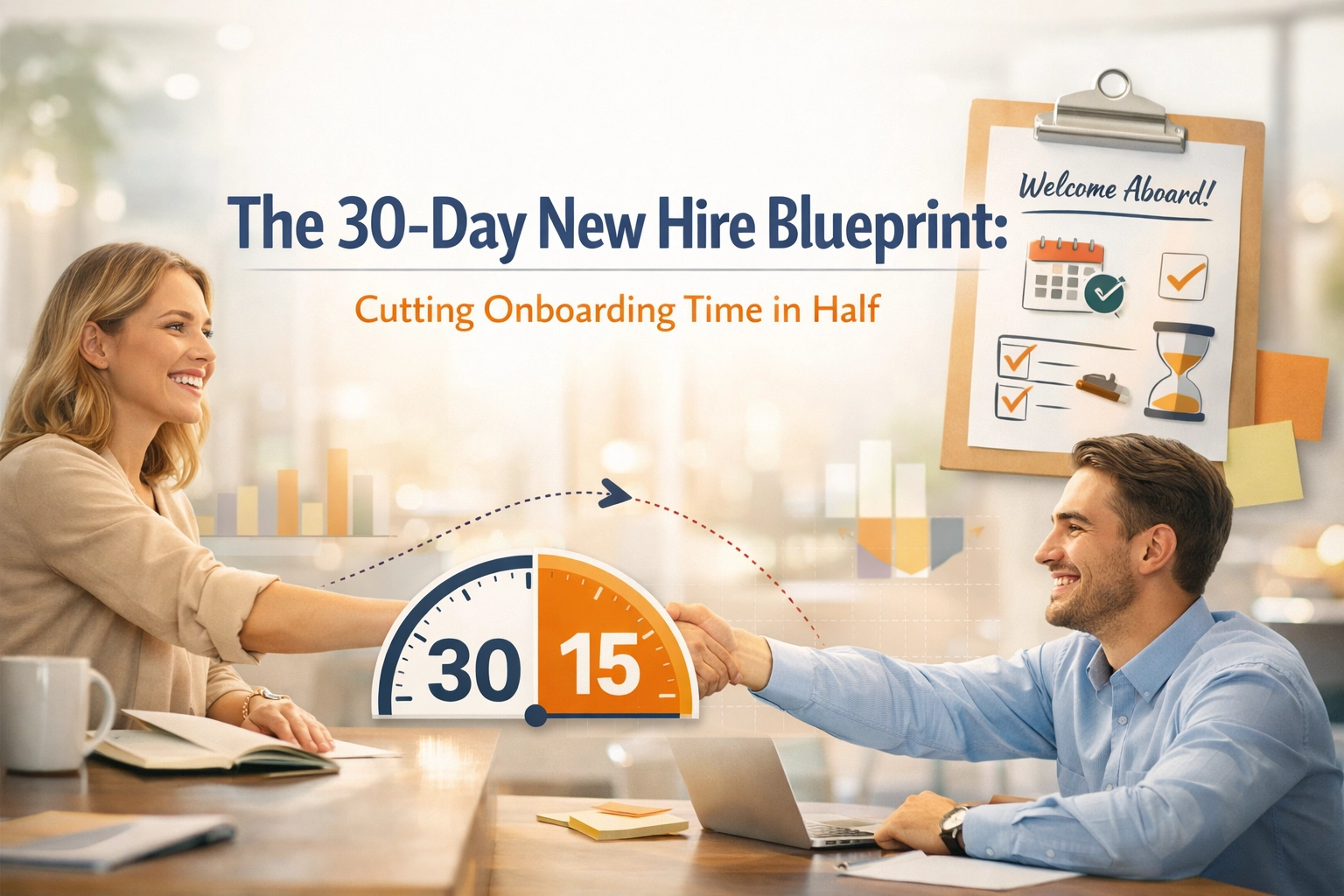
This is the 30-day blueprint that cuts employee onboarding time in half for cleaning companies. No fluff. No theory. Just the exact structure that gets new hires billing hours faster without destroying your reputation.
Why Employee Onboarding Takes So Long in Cleaning Companies

The pattern I see constantly: cleaning business owners hire someone, throw them in a van with their “best tech” for three days, and hope osmosis does the rest.
It doesn’t.
Here’s what’s actually happening during those painful first 60-90 days:
Week 1-2: New hire shadows someone who’s great at cleaning but terrible at explaining. They learn through observation, which means they’re guessing at half the processes.
Week 3-4: They’re sent to easier jobs solo. They call you six times asking basic questions because nothing was documented.
Week 5-8: Callbacks start happening. Clients complain. You realize they’re doing things wrong but you don’t have time to retrain properly.
Week 9-12: Either they quit from stress, you let them go because they’re not cutting it, or they finally start becoming useful but they’ve developed bad habits you now have to undo.
The real cost of broken employee onboarding:
- 40-60 hours of your time answering questions
- $2,000-$4,000 in callbacks and service recovery
- 15-20% higher turnover because new hires feel unsupported
- Lost revenue from jobs you can’t take because you don’t have trained capacity
Reality check: if you’re still the person new hires call with questions three weeks in, your employee onboarding system is just you working more hours.
What Breaking Employee Onboarding Actually Looks Like
Let’s get specific about the chaos:
Your newest hire doesn’t know:
- Which cleaning products are safe for which surfaces
- Your company’s quality standards (what “clean” actually means to you)
- How to handle client requests or complaints
- Your pricing structure or upsell opportunities
- Safety protocols and chemical handling
- How to stock their vehicle properly
- Your scheduling system or how to log hours
- Who to contact for different issues
You’re spending time on:
- Explaining the same thing to every new person
- Fixing their mistakes before clients notice
- Apologizing to clients for incomplete or incorrect work
- Re-cleaning jobs yourself
- Creating custom training on the fly for each person
Your team is dealing with:
- Slowed down productivity when training someone
- Inconsistent service quality across different cleaners
- Frustrated experienced techs who become reluctant mentors
- New hires who quit right when they’re getting useful
This isn’t an employee quality problem. This is an employee onboarding infrastructure problem.
The 30-Day Employee Onboarding Blueprint for Cleaning Companies
Here’s the framework that changes everything. Not theory. The actual structure.
Week 1: Foundation and Safety
Days 1-2: Paperwork, Culture, and Orientation
Get the administrative work done immediately:
- Employment paperwork and direct deposit
- Company handbook review (you need one, even if it’s 10 pages)
- Safety training and chemical handling certification
- Uniform and equipment issue
- Introduction to your scheduling/communication system
Goal: New hire understands who you are as a company and has everything they need to start learning the actual work.
Days 3-5: Product Training and Quality Standards
This is where most employee onboarding fails. You can’t just say “clean it well.”
What you need documented:
- Every cleaning product you use and what surfaces it goes on
- What “clean” means for different room types (kitchen vs bathroom vs office)
- Your quality checklist for each service type
- Before/after photo examples of your standards
- Safety protocols and what to do if something goes wrong
Format: Half-day classroom/video training, half-day shadowing while specifically watching for these protocols.
Common mistake: Rushing through this to get them “in the field” faster. You pay for it later in callbacks.
Week 2: Supervised Field Work
Days 6-10: Ride-Along with Structured Observation
The new hire is shadowing, but with a specific focus each day:
Day 6: Watch setup and breakdown processes. How to stock the vehicle, organize supplies, manage time between jobs.
Day 7: Focus on residential cleaning standards. Room-by-room walkthrough with your quality checklist in hand.
Day 8: Focus on commercial cleaning differences. Security protocols, after-hours procedures, client interaction.
Day 9: Watch problem-solving in action. How your experienced tech handles unexpected situations, difficult stains, client requests.
Day 10: Shadow a full day and ask questions. By now they should be anticipating next steps.
What the trainer needs: A one-page guide of what to demonstrate and explain each day. Without this, you get inconsistent training based on whatever happens that day.
End of Week 2 checkpoint: 30-minute check-in with you or your manager. What’s clicking? What’s confusing? Any red flags?
Week 3: Assisted Independence
Days 11-15: Working Jobs Together, New Hire Takes Lead
This is the transition week. The new hire is now doing the work while the experienced tech watches and corrects.
Structure:
- New hire leads the job using your quality checklist
- Trainer observes but doesn’t jump in unless safety issue
- After each job: 10-minute debrief on what went well, what to improve
- Trainer completes a simple evaluation form (3-5 questions)
What you’re watching for:
- Can they follow your process without being told each step?
- Are they meeting your time estimates for each job type?
- Do they recognize when something needs extra attention?
- Are they using products correctly and safely?
Days 16-17: First Solo Jobs (Easy Ones)
Send them to your simplest, most forgiving clients. Small residential cleanings where there’s room for error.
Critical piece: They have a “lifeline” number to text or call with questions. Usually the person who trained them, not you.
After each solo job: They complete a self-evaluation using the same quality checklist.
Week 4: Building Competence and Speed
Days 18-22: Increasing Complexity
Now they’re handling a normal rotation of jobs, but you’re still checking their work:
- Random quality spot-checks (you or a senior tech revisit after they finish)
- They’re added to your normal scheduling rotation for standard jobs
- They attend your weekly team meeting (if you have one)
- They start learning your client management system for notes and updates
What changes: They should be completing jobs in 80-90% of your estimated time by now. If they’re still taking twice as long, something broke earlier in training.
Days 23-25: Upsell and Client Interaction Training
This is when you teach them how to spot additional service opportunities:
- When to suggest deep cleaning
- How to notice issues that need attention
- How to communicate with clients professionally
- Your pricing for add-on services
Why this comes last: They need to be confident in core cleaning before you add sales pressure.
Days 26-30: Full Integration
They’re on the schedule like everyone else. They’re handling their job load. They know who to ask when they need help.
End of Day 30: Formal review meeting. What’s going well. What do they still need support on. Confirm they’re off probation (or extend if needed).

The Documentation That Makes This Actually Work
Here’s what you need created before you can run this employee onboarding process:
1. New Hire Checklist
A one-page list of everything that needs to happen Week 1-4. Who’s responsible for each item. When it’s due.
2. Quality Standards Document
Photos and descriptions of what “done” looks like for each service type. This is what they’re being trained to match.
3. Product Guide
Simple chart: Product name, what it’s for, what surfaces it’s safe on, safety notes. Laminated and kept in every vehicle.
4. Training Schedule Template
A fill-in-the-blank schedule for the 30 days showing what the new hire is doing each day and who’s responsible for training them.
5. Evaluation Forms
Simple 5-10 question forms for end of Week 2 and Day 30 reviews. Same questions every time so you can track improvement across hires.
6. Emergency Contacts and Protocols
Who to call for different situations. Client emergency, equipment failure, safety issue, scheduling question.
What you don’t need: A 100-page manual. Complexity kills adoption. Keep it simple enough that your team will actually use it.
Common Employee Onboarding Mistakes That Add 30-60 Days
Mistake 1: “They’ll figure it out”
No they won’t. They’ll develop their own methods, which may or may not match your standards. Then you’re re-training later.
Mistake 2: Assigning training to whoever has time
Different trainers teach different methods. New hire gets confused. Pick one primary trainer per new hire.
Mistake 3: Sending them solo too fast
You’re trying to add capacity quickly. I get it. But sending someone out before they’re ready creates more problems than it solves.
Mistake 4: No structured check-ins
If you’re only talking to them when something goes wrong, you’re missing opportunities to catch small issues before they become big ones.
Mistake 5: Skipping the documentation
You think you’ll remember to cover everything. You won’t. Neither will your trainers. Write it down.
Mistake 6: Not tracking time-to-productivity
If you don’t measure how long employee onboarding actually takes, you can’t improve it. Track it for every hire.
What This 30-Day Blueprint Actually Delivers
By end of Week 4, your new hire should be able to:
- Complete standard residential and commercial jobs independently
- Meet your quality standards with minimal callbacks
- Use all products and equipment correctly and safely
- Follow your scheduling and communication protocols
- Handle routine client interactions professionally
- Know when and how to escalate issues
- Work at 80-90% of your target speed
What they won’t have yet:
- Experience with your most difficult clients
- Mastery of complex specialty services
- The speed of your 3-year veterans
- Confidence handling every possible situation
That’s fine. They’re productive, profitable, and not creating chaos. That’s the goal at 30 days.
The alternative: another 60 days of hand-holding, expensive mistakes, and new hire turnover.
Why Most Cleaning Companies Can’t Build This
The honest answer: it requires time you don’t have and systems thinking you haven’t developed yet.
Creating this employee onboarding infrastructure takes:
- 12-15 hours to document your core processes
- 6-8 hours to create training materials and checklists
- 4-6 hours to build the schedule templates and evaluation forms
- 2-3 hours to train your existing team on how to use it all
And that assumes you already know what your standards and processes should be. If you’re still operating on “clean it how I clean it,” you have to figure that out first.
Most cleaning business owners:
- Are already working 60+ hour weeks
- Have never documented a process before
- Don’t know where to start with systematizing
- Keep putting it off because there’s always a fire to fight
So employee onboarding stays broken. Turnover stays high. You stay trapped training people instead of running your business.
How Clarity Ops Engine Builds Your Employee Onboarding System

This is exactly the type of infrastructure we build in The Clarity Transformation.
Here’s how it works for cleaning companies:
Week 1-2: Audit and Document Current State
We shadow your best cleaners and document what they actually do. We interview you about your quality standards. We map out the ideal process from your head onto paper.
Deliverable: Draft quality standards document and product guide.
Week 3-4: Build the Training Framework
We create your 30-day employee onboarding schedule, training checklists, and evaluation forms. We design them to be simple enough that your team will actually use them.
Deliverable: Complete new hire training package ready to implement.
Week 5-6: Train Your Team
We walk your existing staff through how to use the new system. We run through the trainer role with whoever will be onboarding future hires. We make adjustments based on their feedback.
Deliverable: Your team is ready to onboard the next hire using the system.
Week 7-8: Pilot with Next Hire
We support your team through running the first new hire through this process. We’re available for questions. We track what works and what needs tweaking.
Deliverable: Refined employee onboarding system based on real-world testing.
Week 9-12: Full Handoff
The system is yours. Your team knows how to run it. New hires are getting productive in 30 days instead of 90. You’re not spending 40 hours of your time per hire anymore.
This is implementation, not advice. We build the thing and make sure your team can run it.
Cost is typically $8,000-$12,000 depending on complexity. ROI is immediate when you calculate the cost of:
- Your time saved (40 hours at your opportunity cost)
- Reduced callbacks ($2,000-$4,000 per hire)
- Lower turnover (30-50% reduction is typical)
- Faster capacity scaling (hire three people in the time it used to take for one)
For cleaning companies doing $500K+ in revenue, broken employee onboarding is costing you $15K-$25K per year minimum. Usually more.
The Alternative Path
You could build this yourself. Here’s what that looks like realistically:
Timeline: 8-12 weeks of working on it in spare hours
Your time investment: 30-40 hours total
Risk: You don’t know what you don’t know, so you might miss critical pieces
Can you DIY this? Yes, if you have:
- Evenings and weekends free for the next 2-3 months
- Experience documenting processes before
- A clear picture of what “good” looks like already
- Willingness to test, fail, and iterate
Should you DIY this? Depends on your opportunity cost. If those 40 hours could generate $10K in additional revenue, the math doesn’t favor DIY.
Most cleaning company owners who successfully DIY this take 4-6 months because it keeps getting deprioritized for client emergencies.
What Changes After You Fix Employee Onboarding
Here’s what actually shifts:
In the next 30 days:
- Your next hire reaches basic competency in 4 weeks instead of 12
- You reclaim 20-30 hours of training time
- Callbacks from new hire mistakes drop 60-80%
In the next 90 days:
- You hire two more people using the same system
- Your team is confident training new hires because there’s a clear process
- You’re not the bottleneck for scaling anymore
In the next 12 months:
- You’ve added 50% more capacity without proportional chaos
- Employee retention improves because people feel supported from day one
- Your reputation stabilizes because service quality is consistent
What you get back: The mental space to think about growing your business instead of managing training disasters.

Start With One Good Hire
You don’t need to overhaul everything at once. Start with your next hire.
Document the 30-day process. Create the basic checklists. Assign one trainer. Track what works.
Then refine it for the hire after that.
Or bring in someone who’s done this dozens of times and compress the timeline from months to weeks.
The employee onboarding system you build now determines whether you can scale to $2M or stay stuck at $600K because you can’t train people fast enough.
Your move.
Ready to build an employee onboarding system that actually works? Book a 30-minute diagnostic call and we’ll map out exactly what needs to happen in your cleaning business to cut onboarding time in half.
Related Blogs
- How to Fix Chaotic Operations in 12 Weeks
- Systemize a Small Business: Build What You Need to Scale
- Stop Solving the Same Problem Twice: Building Systems That Stick
- Callbacks Are a Systems Problem: How to Reduce Re-Cleans by 60%
- Cleaning Quality Audits: The Simple Spot-Check System That Prevents Complaints
- Before/After Photo Standards: When Photos Help (And When They Create Drama)
- Client Expectations vs Reality: The Script That Prevents “It’s Not Clean” Calls
- How to Build a “Quality Score” for Each Tech Without Killing Morale
- The Hidden Cost of Service Recovery (And Why You’re Undercharging for It)
- Your “Clean” Standard Isn’t Universal: How to Define It by Service Type
- Why New Cleaning Hires Quit in the First 14 Days (And How to Stop It)
- The First 30 Days: How to Make New Hires Feel Supported Without Babysitting
- Mentor Burnout: How to Use Lead Techs Without Making Them Hate Training
- Pay Structure + Training: How Incentives Can Speed Up Competency
- The “Onboarding Confidence Gap”: Why Good People Leave When Training Is Messy
- The Real Cost of Turnover in Cleaning Companies (With Numbers, Not Opinions)
- Culture Isn’t Posters: How to Teach Standards Without Being “That Boss”
- Stop the After-Hours Texts: A Communication Protocol for Cleaning Crews
- Who Do I Call? Building an Escalation Chart for Every Common Issue
- Slack vs Text vs Calls: What Belongs Where for Field Teams
- The Daily Start/End Routine: How to Reduce Questions by 80%
- Client Requests: How Techs Should Handle “Can You Also…” Without Scope Creep
- The “Notes System”: Where Job Notes Live So No One Has to Guess
- Stocking the Cleaning Vehicle: The Par Levels That Prevent Mid-Job Panic
- Your Supply System Is Costing You Hours: How to Standardize Restocks
- The Cleaning Cart Setup That Makes New Hires Faster
- Equipment SOPs: Vacuums, Mops, Microfiber, and Maintenance Basics
- Why Your Best Tech Is Slow (It’s Usually Setup and Teardown Time)
- Time-to-Productivity: The Only Onboarding Metric That Matters
- Training Scorecards for Cleaning Techs: Simple, Fair, Repeatable
- Job Time Standards: How to Set Targets Without Guessing
- The Weekly Review System: How to Catch Problems Before Clients Do
- Training ROI: What Faster Onboarding Is Worth in Real Dollars
- Systemize a Small Business Without Writing a 100-Page Manual
- Founder Dependency in Cleaning Businesses: Why You’re Still the Help Desk
- How to Fix Chaotic Operations in 12 Weeks (Cleaning Company Edition)
- Task Handoff Systems for Cleaning Crews: Keys, Codes, Notes, and Accountability
- RACI for Cleaning Companies: Who Owns Training, Quality, Supplies, and Scheduling