Checklist and a Process for Success: 5 Vital Secrets
You feel like you are repeating yourself every single day because your team keeps missing the small details even though you told them exactly what to do.
Let me be direct. If you think a Checklist and a Process are the same thing, your operations are destined to fail. Most business owners use these terms interchangeably. They think that as long as there is a piece of paper or a digital document, the work will get done correctly. The reality is that confusing a Checklist and a Process creates a massive gap in execution that leads to errors, client churn, and owner burnout. In the next 12 weeks, you can bridge this gap and stop the daily firefighting.
I have seen this pattern dozens of times. A CEO hands a team member a list of five items and expects a perfect outcome. When the outcome is a mess, the CEO gets frustrated. The team member gets defensive. Everyone is working hard, but the business is not moving forward. Here is what nobody tells you: a list of tasks is not a strategy for execution. You need to understand the structural difference between a Checklist and a Process to scale from 50K to 100K a month without losing your mind.
The logic is simple. A checklist is about “what.” A process is about “how.” If you only give your team the “what,” they will make up their own “how.” That is where the chaos starts. Through The Clarity Transformation, I help owners separate these two functions so the business can run without them.
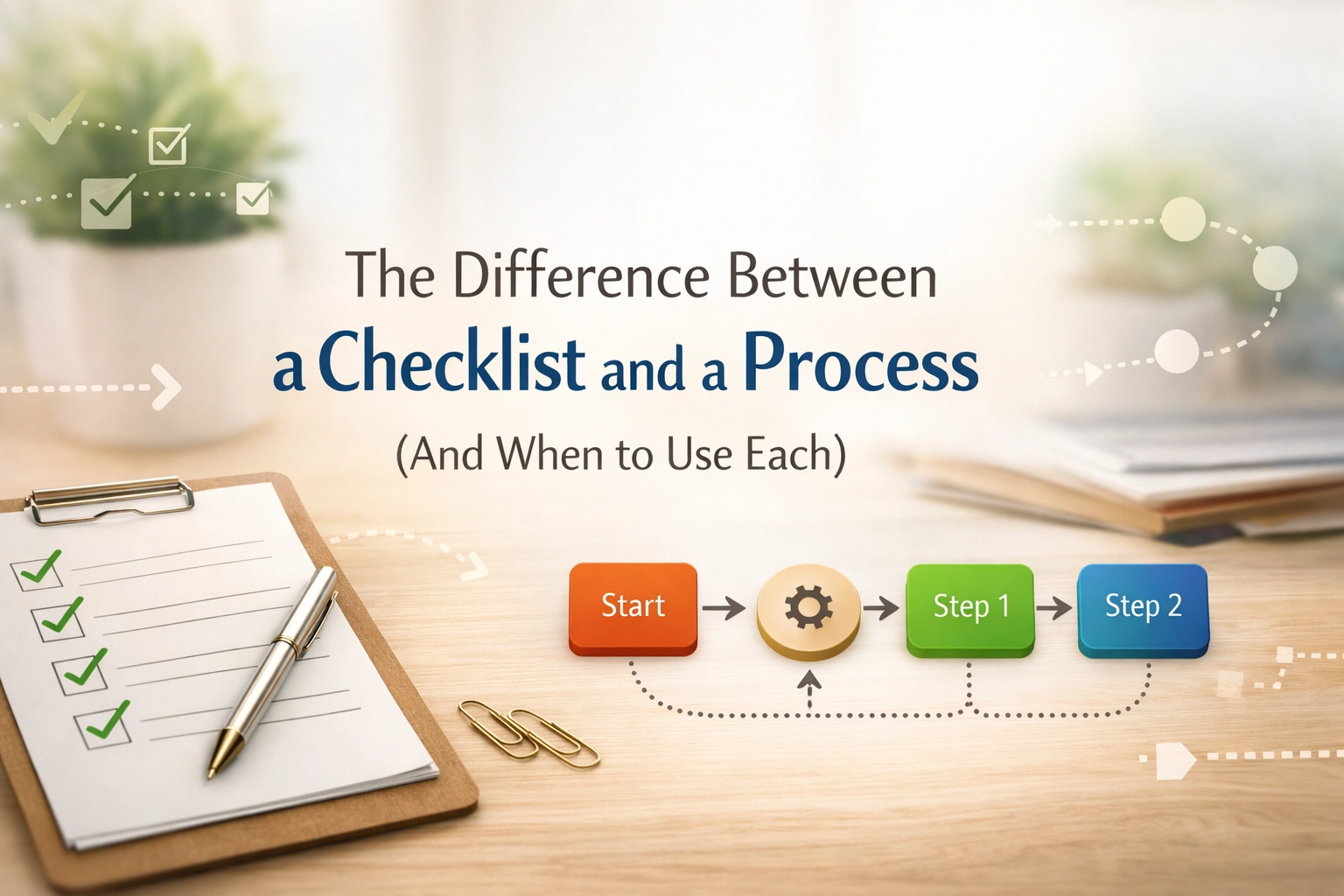
The Core Difference Between a Checklist and a Process
The pattern is always the same. You hire someone new and give them a bulleted list of things to do. You think you have built a system. In reality, you have built a reminder. To truly fix your operations, you must define the unique roles of a Checklist and a Process.
What a Process Actually Does
A process is a high-level map. It explains why a task exists, who owns it, and how it fits into the bigger picture of the company. It describes the sequence of events. It shows the dependencies between departments. If you are building a Checklist and a Process for your service business, the process is the blueprint of the house. It tells you where the walls go and why the plumbing needs to be installed before the drywall.
A process handles the logic. It includes:
- The start and end triggers for a workflow.
- The specific roles responsible for each stage.
- The tools and software required to finish the work.
- The standards for what “done” looks like.
What a Checklist Actually Does
A checklist is a tactical tool. It is a memory aid. Even the most experienced pilot uses a checklist before takeoff. They know how to fly the plane. They understand the process of flight. However, they use a checklist to ensure they do not skip a single critical step in the heat of the moment. When you combine a Checklist and a Process, the checklist becomes the final guardrail against human error.
A checklist handles the execution. It includes:
- A series of “yes or no” items.
- Specific data points that must be recorded.
- Short, punchy action items.
- Verification steps for quality control.
The truth is that you cannot have a high-performing team with only one of these. If you have a process but no checklist, people will get the big picture right but forget the small details. If you have a checklist but no process, your team will become robots who do not know what to do when something goes wrong. This is why a Clarity Operational Partnership focuses on building both layers of documentation simultaneously.

Why You Need Both a Checklist and a Process to Scale
When you are scaling from 50K to 100K a month, your margin for error disappears. At 50K, you can usually jump in and fix a mistake before a client notices. At 100K, there are too many moving parts. You cannot be everywhere at once. This is where the lack of a clear Checklist and a Process starts to cost you real money.
The Problem: The Chaos Tax
Without a documented Checklist and a Process, your business pays a “chaos tax.” This is the cost of re-doing work, refunding unhappy clients, and the time you spend answering questions that should have been clear in the documentation. I have seen businesses lose $3,800 to $5,000 every month just because their team was guessing at the “how” behind the tasks.
The reality: Most owners are too busy to write these things down. They think documentation takes too long. They would rather just do the work themselves. But if you do not define the Checklist and a Process, you are choosing to stay small. You are choosing to work 80 hours a week.
The Solution: Operational Clarity
By establishing a formal Checklist and a Process, you create a plug-and-play business model. You can hire a new technician or project manager and have them productive in 5 to 7 days instead of 3 to 4 weeks. You reduce the mental load on your brain. You stop being the bottleneck.
The Clarity Transformation is designed to take the knowledge out of your head and put it into a system that works. We do not just give you templates. We build the actual Checklist and a Process that fits your specific service business. This ensures that every team member knows exactly what is expected of them.
What Happens When You Integrate Them
When you integrate a Checklist and a Process, you get:
- Consistent Quality: Every client gets the same experience every time.
- Faster Training: New hires have a manual that actually makes sense.
- Measurable Performance: You can see exactly where a process is breaking down.
- Lower Stress: You can take a weekend off knowing the Checklist and a Process will guide the team.
Goal: To move from an owner-dependent business to a system-dependent business.
When to Deploy a Checklist and a Process in Your Workflow
Not every task needs a 50 page manual. Knowing when to use a Checklist and a Process is just as important as knowing how to write them. If you over-systematize simple tasks, you create bureaucracy. If you under-systematize complex tasks, you create chaos.
Use a Process for Cross-Departmental Work
If a task involves more than one person, you need a process. For example, the journey from a lead coming in to a job being scheduled involves sales, dispatch, and accounting. This is a complex workflow. You need a documented Checklist and a Process to ensure the handoff between these people is seamless.
Common findings: Most “dropped balls” happen during the handoff. Sales thinks Dispatch has the info. Dispatch thinks Sales already told the customer the price. A process defines who speaks to who and when.
Use a Checklist for High-Frequency Technical Tasks
If a technician is on a roof or in a crawlspace, they do not want to read a process manual. They need a checklist. They need to quickly verify they checked the flashing, cleared the debris, and took the “after” photos. In this scenario, the Checklist and a Process work together. The process is the training they received in the office. The checklist is the tool they use in the field.
Red Flags You Are Missing the Right Tool
- You hear “I didn’t know I was supposed to do that” more than once a week.
- Different employees do the same job in three different ways.
- You have to “double-check” work before it goes to the client.
- Simple mistakes are repeated even after you have a meeting about them.
- The team is busy but the main goals are not being met.
A Clarity Operational Partnership identifies these red flags in the first 2 weeks. We look at your current workflow and determine exactly where you need a Checklist and a Process. We don’t guess. We use operational forensics to find the leaks in your profit.

How The Clarity Transformation Fixes Your Documentation
Most business owners have tried to write SOPs before. They spend a weekend writing a 20 page document, and then no one ever looks at it again. That is a waste of time. The Clarity Transformation is different because we focus on implementation, not just documentation.
Phase 1: The Audit
We look at your current “way of doing things.” Usually, it is a mix of verbal instructions and half-finished notes. We identify the core functions of your business that require a robust Checklist and a Process. This stage usually takes 2 to 4 weeks of deep observation.
Phase 2: The Build
We don’t just tell you what to do. We build the systems for you. We create the high-level maps (the process) and the tactical tools (the checklist). We ensure that every Checklist and a Process is written at a level that a new hire can understand without asking you ten questions.
Phase 3: The Adoption
This is where most consultants fail. They hand you a folder and leave. In The Clarity Transformation, we stay to ensure the team actually uses the tools. We set up the digital environment: whether that is ServiceTitan, Jobber, or a custom project management tool: so the Checklist and a Process are baked into the daily workflow.
Success metrics:
- Owner involvement in daily tasks drops by 50 to 70 percent.
- Error rates on service calls drop by 80 percent.
- Employee satisfaction increases because they finally have clear expectations.
Building Systems with a Checklist and a Process
If you want to build a business that is an asset you can sell one day, you need a documented Checklist and a Process for everything. A buyer is not buying you. They are buying your systems. If the systems are all in your head, the business has very little value.
The Math of Systems
Think about a standard service call. If a technician forgets to collect a payment or a signature, it takes an office admin about 15 to 20 minutes to track that down later. If you do 100 service calls a month, that is 33 hours of wasted administrative time. At $25 an hour, that is $825 a month. Over a year, that is nearly $10,000 lost to a simple missing checklist. By implementing a Checklist and a Process, you reclaim that profit immediately.
Why Your Team Will Love It
You might think your team will resist a Checklist and a Process. You might think they will feel micromanaged. The reality: Good employees love clarity. They hate being yelled at for mistakes they didn’t know they were making. When you provide a clear Checklist and a Process, you are giving them the tools to be successful. You are removing the guesswork from their day.
A Clarity Operational Partnership isn’t about creating more work for your team. It is about creating less stress. When everyone knows the “how” and the “what,” the friction in the office disappears. You can stop being the “bad guy” who is always checking up on people and start being the CEO who leads the vision.

Common Mistakes When Creating a Checklist and a Process
I have seen people make the same errors over and over when trying to fix their operations. If you want to avoid the long, painful DIY route, watch out for these traps.
Mistake 1: Making Them Too Long
A Checklist and a Process should be as short as possible but as long as necessary. If a process is 40 pages long, nobody will read it. If a checklist has 50 items for a 10 minute task, people will just check the boxes without looking. You need to find the balance.
Mistake 2: Storing Them in the Wrong Place
If your Checklist and a Process are in a physical binder on a shelf, they are dead. They must be digital. They must be accessible on a phone or a tablet in the field. They must be right where the work is happening. Part of The Clarity Transformation is choosing the right technology stack to host your documentation.
Mistake 3: Never Updating Them
Your business is going to change. Your Checklist and a Process must change with it. I recommend an operational review every 6 months to ensure your documentation still matches your reality. This is a core part of what we do in a Clarity Operational Partnership. We help you build a “living” operations manual.
The Honest Answer: Can You Do This Yourself?
You can. But it will take you 12 to 18 months of trial and error. You will likely quit halfway through because the daily operations of the business will pull you back in. Or, you can bring in a professional to get it done in 12 weeks. The cost of hiring a Fractional COO is always lower than the cost of staying stuck in operational debt.
Frequently Asked Questions About a Checklist and a Process
What is the main difference between a checklist and a process?
The main difference is the level of detail and the objective. A process is a broad overview of a workflow, including the “why,” the timing, and the responsibilities. A checklist is a specific list of items to verify that the tasks within that process were completed correctly. You use a Checklist and a Process together to ensure both strategy and execution are handled.
Do I need a checklist and a process for every single task?
No. You should prioritize high-risk, high-frequency, or complex tasks. Focus on the 20 percent of activities that drive 80 percent of your results. If a task is simple and has a low impact if missed, you might not need a formal Checklist and a Process.
How do I get my team to actually use the checklist and a process?
Adoption starts with culture and ends with tools. You must make the Checklist and a Process easy to access. If it is harder to use the system than it is to skip it, people will skip it. We specialize in creating systems that team members actually want to use because it makes their lives easier.
What software should I use for my checklist and a process?
It depends on your industry. For service businesses, field service management software like ServiceTitan or Jobber is great for checklists. For high-level processes, tools like Trainual, Notion, or even a well-organized Google Workspace can work. During The Clarity Transformation, we help you select the best fit for your budget and goals.
Can a checklist and a process replace training?
No. A Checklist and a Process support training. They are the “open book” that employees use after they have been trained. They provide a safety net so that even a trained employee doesn’t have to rely 100 percent on their memory during a busy day.
Stop Guessing and Start Scaling
The difference between a business that makes money while the owner sleeps and a business that is a 24/7 prison is documentation. If you are tired of the mistakes, the missed deadlines, and the constant questions, it is time to formalize your Checklist and a Process.
You have two choices. You can keep doing what you are doing and hope that things get better as you grow. The reality is that growth without systems only leads to more chaos. Or, you can take a stand for your time and your profit. You can choose to implement a professional Checklist and a Process framework that allows your business to function at a high level without your constant intervention.
I am ready to help you make that shift. Through The Clarity Operational Partnership, I provide the hands-on implementation you need to transform your business in 12 weeks. We will define your Checklist and a Process, train your team, and build the foundation for your next stage of growth.
Look, you didn’t start a business to be a slave to a task list. You started it for freedom.
Let’s get that freedom back.
Are you ready to stop the chaos and start scaling with a clear Checklist and a Process?
Option 2: Review our solutions and methodology to see how we handle operational debt
Option 3: Keep reading our blog to learn more about the Fractional COO process