Growing Business Ops: 9 Smart Business Process Consultant Tips
You are working fourteen hour days but the business feels like it is standing still, and every time you try to step away for a weekend, your inbox explodes with “quick questions” from a team that should know what to do but clearly does not.
Let me be direct: your current operational model is not a system, it is a collection of high-stress habits that rely entirely on your physical presence to function. Most founders think they have a growth problem when they actually have a process problem. Here is what nobody tells you: you will never scale beyond your current revenue ceiling until you stop being the Chief Everything Officer and start acting like a strategist. I have seen this pattern dozens of times in companies making $50K to $100K a month. They hit a wall because their “processes” are stored inside the founder’s head instead of being documented in a way that others can execute.
The reality is that you cannot fix this by working harder. You fix this by getting serious about growing business ops so your business can run without your constant approval. Within 12 weeks, you can move from daily firefighting to high-level oversight, but only if you are willing to let go of the chaos you have mistakenly labeled as “hustle.”
The Pattern of the Foundational Bottleneck
What it looks like: You are the primary decision-maker for everything from high-level strategy to the specific font used on an invoice. Your team is talented, but they are hesitant to move without your approval. Every project takes twice as long as it should because of “clarity gaps.”
Why it happens: As you scaled from $0 to $500K, your intuition was your greatest asset. But as you push toward $1M and beyond, that same intuition becomes a liability. You have built a business around yourself, not around a scalable system. This is precisely why growing business ops becomes a non-negotiable requirement for growth.
The truth: If you disappeared for thirty days, your business would likely stall or collapse. That is not a business; it is a job you happen to own. To move to the next level, you need to transition from a “people-dependent” business to a “process-dependent” business.
Goal: To identify where your current workflows are leaking profit and energy so we can install a permanent operational engine.

Why You Specifically Need a Business Process Consultant for Small Business
Many small business owners try to DIY their operations. They buy a project management tool, set up a few folders in Google Drive, and call it “process documentation.” It never works.
The honest answer: You are too close to the problem to see the solution. You see “the way we’ve always done it” as the only way. A business process consultant for small business provides the external perspective required to identify the invisible friction points that are costing you hours every single week.
The Real Cost of Inefficiency
When you lack a structured operational framework, you aren’t just losing time; you are losing cold, hard cash.
- You pay for “re-work” because instructions were unclear.
- You lose clients because of slow response times or inconsistent delivery.
- You experience high team turnover because your staff is burnt out by the lack of structure.
By committing to growing business ops, you are not just buying advice; you are buying back your time. The math is simple: if your time is worth $300 an hour and you spend 10 hours a week on low-level operational “noise,” you are lighting $12,000 a month on fire. That is $144,000 a year in lost opportunity.
9 Smart Proven Tips for Implementing Process Improvement
Here is the exact framework I use for growing business ops to turn a chaotic service business into a streamlined machine. These are not suggestions; they are the requirements for a functional operations engine.
1. Conduct a Brutally Honest Process Review
The first step in growing business ops is a deep dive into the “current state.” You cannot fix what you have not mapped. This requires setting aside your ego and looking at the gaps.
The reality: Most of your current processes are likely “tribal knowledge.”
- Map out every step of your client journey from lead to offboarding.
- Identify where the ball gets dropped most frequently.
- Look for “single points of failure” where only one person (usually you) knows how to do a task.
Goal: To create a visual map of the chaos so we can begin the cleanup.
2. Engage Your Stakeholders Early and Often
You might think you know how your business runs, but your team knows where the bodies are buried. Growing business ops requires interviewing your team to find out where they are struggling.
What happens: The founder says “We use Slack for communication.” The team says “We use Slack, but half the instructions come through late-night texts and the other half are in the comments of a Trello card we haven’t checked in months.”
Success metrics:
- 100% team participation in the discovery phase.
- Identification of at least 5 “hidden” bottlenecks per department.
- Buy-in from the people who actually have to use the new systems.
3. Adopt a Structured Methodology for Everything
Stop winging it. Growing business ops uses frameworks like BPMN (Business Process Model and Notation) or Lean principles to ensure consistency.
Look, if your team has to guess what “done” looks like, they will get it wrong 50% of the time. You need a common language.
- Use standardized naming conventions for files.
- Use a consistent format for all SOPs.
- Create a clear hierarchy for decision-making (RACI matrix).
4. Master Visual Process Mapping
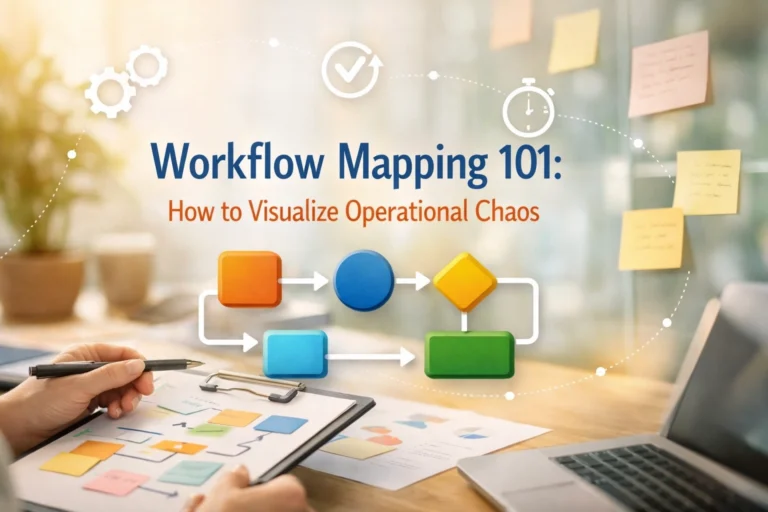
Text-heavy manuals are where processes go to die. Nobody reads a 40-page Word document. Growing business ops means creating flowcharts that show the “if/then” logic of your business.
The logic: If a team member can see the flow of a task visually, they are 70% more likely to execute it correctly on the first try. Visual mapping exposes redundancies that text hides. You might find you have three different people approving the same $50 expense. That is a waste of resources.

5. Build a Collaborative Team with Diverse Expertise
Operations is not a solo sport. To make growing business ops stick, you need to build a “Process Council” within your company.
You might think you can just hire a virtual assistant to “do the SOPs.” That is a mistake. You need:
- A strategist (the growing business ops lead).
- A subject matter expert (the person doing the work).
- A technical lead (to handle the software integrations).
6. Develop Clear and Detailed SOPs
Standard Operating Procedures (SOPs) are the DNA of your company. If they are vague, they are useless. Growing business ops means your SOPs pass the “Vacation Test.”
The Vacation Test: Can a reasonably competent person follow this document and achieve the desired outcome without calling you? If the answer is no, your SOP is a failure.
- Include screenshots.
- Include video walkthroughs (Loom is your best friend).
- Link to the specific tools or templates needed for the task.
7. Master Communication with Non-Technical Stakeholders
One of the biggest failures in operational change is the “Expert Gap.” Growing business ops only works if you can translate complex systems into plain English.
The reality: If your team feels like the new system is “too technical” or “too complicated,” they will quietly revert to their old, inefficient ways.
- Explain the “Why” behind every change.
- Provide training sessions that allow for “stupid” questions.
- Keep the interface of your tools as simple as possible.
8. Implement Change Management and Leadership
Process change is actually people change. Humans hate changing their habits. This is where growing business ops proves its worth.
Common finding: Most process implementations fail because of “cultural rejection.”
- You must lead from the front. If you don’t follow the new process, nobody else will.
- Celebrate small wins. When a project is completed faster because of the new system, call it out.
- Be firm on the “new way.” The old way is no longer an option.
9. Monitor Performance and Optimize Continuously
Operations is not a “one and done” project. It is a living system. Growing business ops requires KPIs (Key Performance Indicators) to track the health of your processes.
What to track:
- Lead-to-delivery time.
- Error rates in common tasks.
- Employee hours spent on specific workflows.
- Profit margin per project.
Goal: To create a feedback loop where the system identifies its own weaknesses so they can be fixed before they become crises.

How Clarity Ops Engine Fixes the Chaos
At Clarity Ops Engine, we don’t just give you a list of things to do and wish you good luck. We are not just another vendor that hands over a PDF and disappears. We provide hands-on implementation for growing business ops through our Clarity Business Operations Transformation.
The 12-Week Transformation Framework
I’ve seen this consistently: founders try to change everything in a week and give up. We use a structured 3-phase approach that builds momentum without breaking your business.
Phase 1: The Audit (Weeks 1-3)
We dive into your current mess. We look at your tech stack, your team structure, and your bank statements. We find the “leaks.”
What you provide: Full access to your team and your current (messy) documentation.
Phase 2: The Build (Weeks 4-8)
This is where growing business ops gets real. We build the dashboards, write the core SOPs, and streamline the workflows. We move your business into a centralized operations hub.
Deliverables: A fully customized Operations Manual and a streamlined Tech Stack.
Phase 3: The Integration (Weeks 9-12)
We train your team. We run “stress tests” on the new processes. We ensure that you, the founder, are actually stepping out of the day-to-day.
Goal: 70-80% reduction in founder-level operational “noise.”
Reality Check: Are You Ready?
You might think you can just focus on growing business ops and your work is done.
The honest assessment: If you are not willing to stop “winging it” and start following a system, this will not work. You have to be ready to give up the control you think you have to gain the freedom you actually want.
Red flags you’re not ready:
- You are unwilling to let go of any specific task.
- You think “systems” are for big companies, not yours.
- You are more addicted to the “fire” than the “fix.”
The Math: ROI of Hiring a Business Process Consultant for Small Business
Let’s look at a real-world transformation.
A service-based agency doing $80K a month was struggling with a 65-hour founder work week. The founder was the bottleneck for every client deliverable.
After committing to growing business ops, we:
- Automated 15 hours of manual data entry per week ($1,800/month in labor savings).
- Standardized the onboarding process, cutting it from 4 hours to 45 minutes.
- Reduced project delays by 60%, leading to a 15% increase in client retention.
The ROI: The founder moved to a 40-hour week while revenue grew to $110K a month within six months. The cost of growing business ops was paid back in the first 60 days just through recovered labor hours.

When to Hire a Fractional COO vs. a Business Process Consultant for Small Business
Sometimes you need more than just a process fix; you need a partner.
A business process consultant for small business is often a project-based role. They come in, fix the plumbing, and leave.
A Fractional COO (which is what we provide at Clarity Ops Engine) stays to manage the system.
You need a project-based business process consultant for small business if:
- You have one specific “messy” area (like sales or fulfillment) that needs documenting.
- You have a strong internal manager who just needs a roadmap.
- You are on a tight budget and need a “quick fix” for a specific bottleneck.
You need a Fractional COO if:
- You are scaling from $1M to $3M and the wheels are coming off.
- You need someone to manage the team so you can focus on vision.
- You have the systems but nobody is enforcing them.
The reality: Most of our clients start with a business process consultant for small business project and realize they never want to manage operations themselves again. That is where our ongoing partnership comes in.
Common Mistakes When Working with an Operations Expert
I’ve seen this dozens of times: a founder hires a business process consultant for small business and then undermines them.
Mistake 1: The “Exception” Rule
You tell the consultant to build a system, but then you tell your team, “In this one case, just do it the old way.” You just broke the system. Once you hire a business process consultant for small business, the new process is the law. No exceptions.
Mistake 2: Keeping Secret Processes
If you don’t tell the business process consultant for small business about the “side deals” or “special workflows” you have with certain clients, they cannot build a system that accounts for them. Transparency is the only way to get a result.
Mistake 3: Over-complicating the Tech
You don’t need a $2,000-a-month software suite to run a $1M business. A great business process consultant for small business will often simplify your tech, not add to it. If they suggest five new tools in the first week, they might be a “software implementation” person, not a true operations strategist.
The Logic: Why Now?
Why prioritize growing business ops today instead of next year?
Because complexity grows exponentially, not linearly.
If your business is “a little messy” at $50K a month, it will be a “total disaster” at $150K a month. You cannot scale chaos. You can only scale systems.
Look, you have two choices.
Option 1: You keep doing what you are doing, working 60+ hours, and hitting your head against the revenue ceiling while your health and relationships suffer.
Option 2: You commit to growing business ops to install the engine your business deserves so you can finally step into the role of a true CEO.
What You Won’t Have After This Transformation
Let’s manage expectations. Even with the best business process consultant for small business, you won’t have:
- A “passive income” machine that requires zero work (that doesn’t exist).
- A business that never has problems (problems just become higher-level).
- A team that never needs guidance (they just need less of it).
What you WILL have:
- A 40-hour (or less) work week.
- A business that is “sellable” because it doesn’t depend on you.
- Clarity on your profit margins and growth levers.
- A team that is empowered and confident in their roles.

Final Thoughts: The Cost of Waiting
Every day you delay growing business ops, you are paying an “inefficiency tax.” You are paying it in lost time, stressed-out employees, and missed revenue.
The pattern is clear: companies that invest in operations early win. Companies that wait until they are “big enough” often never get there because they burn out first.
At Clarity Ops Engine, we specialize in taking founders out of the weeds. We lead growing business ops and act as your operational partner to ensure that the systems we build actually stick.
Or you could still be answering the same “quick question” for the tenth time tomorrow morning. The choice is yours.
If you are ready to stop being the bottleneck and start scaling with ease, let’s talk.
Schedule your 30-minute Operational Strategy Audit here: https://calendly.com/sdrobinson8/30min
Related Blogs
- How to Fix Chaotic Operations in 12 Weeks
- When to Hire a Fractional COO
- What Does a Fractional COO Do?
- Scaling from 50K to 100K a Month
- Business Process Consultant for Small Business: 7 Hidden Profit Leaks Most Founders Miss
- Operational Transformation: 5 Brutal Truths Founders Learn Too Late
- Why Small Business Operations Break at 1 Million Revenue
- How to Build SOPs That Actually Get Used by Your Team
- Founder Bottleneck Fixes: 9 Systems That Remove Daily Interruptions
- Why Process Documentation Fails in Small Businesses
- Operations Manual for Small Business: What Must Be Included First
- How to Move from Founder-Led to Process-Led Operations
- Fractional COO vs Business Process Consultant: Which One Do You Actually Need?
- What a Fractional COO Builds That a Consultant Does Not Stay to Enforce
- When a Process Consultant Is Enough and When You Need Executive Operations Leadership
- Fractional COO Services for Founders Who Are Drowning in Decisions
- Why Process Improvements Fail Without Operational Leadership
- Scaling Small Business Operations Without Hiring Too Fast
- How Growing Business Ops Prevents Revenue Plateaus
- Why Your Team Still Asks Questions After You Wrote SOPs
- The 12-Week Operational Reset for Small Business Owners
- What Happens When Processes Stay in the Founder’s Head
- The True Cost of Operational Noise in a Growing Company
- How to Reduce Founder Interruptions by 70 Percent in 90 Days