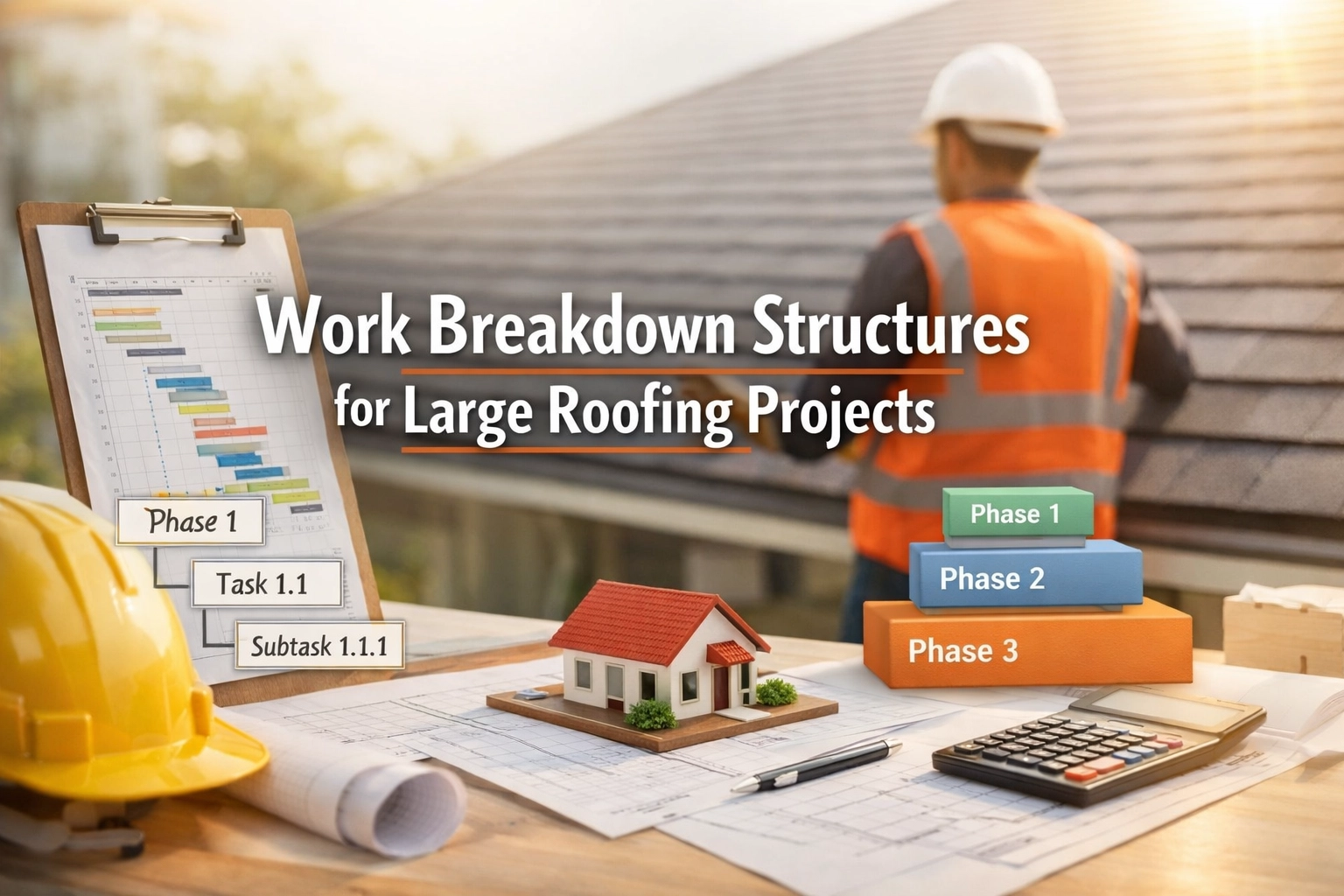
Work Breakdown Structures for Large Roofing Projects
You are standing on a job site with a forty-man crew and a three-million-dollar contract, but no one is quite sure who is responsible for the secondary drainage installation on the south wing today.
Let me be direct. If you are running large-scale commercial or industrial jobs without a formal roofing work breakdown structure, you are not managing a project. You are managing a series of expensive accidents. I have seen this pattern dozens of times. A contractor wins a massive bid, the excitement lasts about forty-eight hours, and then the crushing reality of logistics sets in. Without a clear roofing work breakdown structure, your profit margin does not just leak. It evaporates.
The timeline is simple. You can spend ten hours now building a proper roofing work breakdown structure, or you can spend three hundred hours over the next six months fixing mistakes, re-ordering materials, and apologizing to the building owner. Here is what nobody tells you: the biggest roofing companies in the country do not have better tools or faster crews. They have better systems for breaking down work.
The Chaos of Unstructured Roofing Projects
The reality is that most roofing owners keep the project plan in their heads. This works when you are doing three residential houses a week. It fails miserably when you are tackling a hospital roof or a multi-unit housing complex. When the plan stays in your head, your team becomes a collection of expensive order-takers who cannot move until you tell them what to do. This creates a massive bottleneck.
When you lack a roofing work breakdown structure, you experience specific symptoms:
- Double-ordering of materials because no one knew the staging area was already full.
- Crews sitting idle because the tear-off team finished early but the deck repair team is still across town.
- Scope creep that eats your profit because “extra” work was done without a change order.
- Safety violations that occur because high-risk tasks were not identified in the planning phase.
A roofing work breakdown structure is the antidote to this chaos. It is a hierarchical map of everything that must happen to finish the job. It is not a to-do list. It is a visual representation of the entire project scope. If it is not in the roofing work breakdown structure, it does not exist in the project.
What Exactly Is a Roofing Work Breakdown Structure?
Let’s look at the mechanics. A roofing work breakdown structure is a deliverable-oriented grouping of project elements. Think of it as the skeleton of your project. You start with the final goal at the top and break it down into smaller and smaller pieces until you have “work packages” that can be assigned to a specific person or crew.
The logic is simple: you cannot manage a five-hundred-thousand-dollar project, but you can manage a five-thousand-dollar work package. By using a roofing work breakdown structure, you turn an overwhelming mountain of work into a series of manageable hills.
In my experience, a roofing work breakdown structure for a major project should follow a five-level hierarchy. This ensures nothing is missed and every dollar of labor is accounted for.

Level 1: The Total Project Scope
This is the summit. If you are replacing the roof on a massive distribution center, the Level 1 item is “Distribution Center Roof Replacement.” This represents 100% of the work. Every single penny of your contract is contained in this top box.
The most common mistake I see is failing to define this top level correctly. If your roofing work breakdown structure starts too small, you leave money on the table. You must include everything: the planning, the materials, the labor, the cleanup, and the administrative closeout.
Level 2: Major Project Phases
Now we slice the pie into big pieces. For most large roofing jobs, your roofing work breakdown structure will have three to four major phases at Level 2:
- Preconstruction and Planning
- Site Preparation and Logistics
- Main Construction and Installation
- Project Closeout and Warranty
Each of these phases contains a massive amount of work. By separating them in your roofing work breakdown structure, you can track the health of the project in real-time. If you are 50% through the budget but haven’t finished the “Site Preparation” phase, you know you are in trouble before the first shingle or membrane is even laid. This is how you protect your roofing company operational cost from spiraling out of control.
Level 3: Deliverables by Phase
This is where the roofing work breakdown structure starts to look like a real plan. Under the “Main Construction” phase, your deliverables might include:
- Old Roof Removal (Tear-off)
- Deck Inspection and Repair
- Vapor Barrier Installation
- Primary Membrane Application
- Edge Metal and Flashing
Each deliverable is a milestone. When the “Tear-off” is done, you have reached a specific point of progress. A roofing work breakdown structure makes these milestones visible to everyone, not just the project manager.
Level 4: Work Packages (The Action Zone)
This is the most critical level of the roofing work breakdown structure. A work package is a specific unit of work that can be estimated for cost and time.
The rule of thumb I use is the 80-hour rule. No single work package in your roofing work breakdown structure should exceed 80 hours of labor. Why? Because if a task takes three weeks to finish, you won’t know you are behind until it is too late. If a work package is scheduled for 40 hours, you will know by Friday afternoon if the team is winning or losing.
For “Primary Membrane Application,” your work packages in the roofing work breakdown structure might be:
- Material Staging and Hoisting
- Field Membrane Welding (Section A)
- Field Membrane Welding (Section B)
- Detail Work and Curb Flashings
Level 5: Specific Tasks (Optional but Helpful)
For extremely complex projects, you might break the roofing work breakdown structure down even further. This level lists the exact steps to finish a work package. For example, “Material Staging” might include “Crane Setup,” “Safety Perimeter Flagging,” and “Pallet Distribution.”
Most contractors find that Level 4 is sufficient for management, while Level 5 is useful for training new crew leads. If you are struggling with documenting roofing business processes, Level 5 of your WBS is where that documentation actually lives.

The 100 Percent Rule in Your Roofing Work Breakdown Structure
This is a non-negotiable principle. The roofing work breakdown structure must represent 100% of the work defined by the project scope and capture all deliverables (internal, external, and interim) in terms of the work to be completed, including project management.
If the owner asks you to install a new skylight that was not in the original contract, it does not belong in your roofing work breakdown structure until a change order is signed. The 100 percent rule ensures that your team does not do “favors” that eat your profit. If it is in the WBS, it is paid for. If it is not in the WBS, we do not do it.
Why Granularity Matters for Roofing Profitability
I often hear contractors say that a roofing work breakdown structure is too much paperwork. They think they can just tell the crew to “go roof the building.”
The truth: Vague instructions lead to vague results.
When your roofing work breakdown structure is granular, you can perform accurate job costing. You can see exactly where you are losing money. If the “Edge Metal” package consistently takes 20% longer than you bid, you can adjust your future bids. Without a roofing work breakdown structure, that loss is buried in the “Labor” line item, and you will keep making the same mistake on every job.
Using the WBS to Prevent Timeline Collisions
In large projects, you often have multiple crews or subcontractors working at once. A roofing work breakdown structure allows you to see dependencies. You cannot start “Membrane Application” until “Deck Repair” is finished.
When you map this out in your roofing work breakdown structure, you can create a schedule that makes sense. You avoid the “timeline collision” where twenty guys are standing on one corner of the roof waiting for the crane, while the other side of the roof is wide open and ready for work.
Managing this flow is the difference between a project that feels like a symphony and a project that feels like a riot. This is why having robust roofing project management software systems is vital. The software holds the WBS, but the WBS is the logic that makes the software work.
Assigning Accountability with a RACI Matrix
Once your roofing work breakdown structure is built, you must assign ownership. I recommend using a RACI matrix alongside your WBS. RACI stands for Responsible, Accountable, Consulted, and Informed.
For every work package in your roofing work breakdown structure, you must name one person who is Accountable. If the “Vapor Barrier” fails an inspection, who is the one person I am calling? It shouldn’t be “the crew.” It should be “John.”
When you combine a roofing work breakdown structure with clear accountability, the culture of your company shifts. People take ownership of their specific “box” in the structure. They know what “done” looks like because the WBS defines the deliverable.
The Financial Impact of a Roofing Work Breakdown Structure
Let’s talk about the math. On a million-dollar project, a 5% error in labor efficiency is $50,000. That is the price of a new truck.
Most labor inefficiency comes from “micro-delays”: waiting for materials, clarifying instructions, or re-doing work that wasn’t done to spec the first time. A roofing work breakdown structure eliminates micro-delays by providing a clear map.
When I work with clients as a fractional COO, we often find that implementing a roofing work breakdown structure increases net profit by 3% to 7% on large jobs simply by reducing wasted movement. If you want to see how this fits into a larger strategy, look at our guide on roofing company scaling systems for profit.

How to Build Your First Roofing Work Breakdown Structure
You do not need fancy software to start. You can use a whiteboard, sticky notes, or an Excel sheet. The goal is to visualize the hierarchy.
- Start with the Contract: Read the scope of work. Every single “shall” and “will” in that contract needs to be a deliverable in your roofing work breakdown structure.
- Involve the Field Leads: Do not build this in a vacuum. Your foremen know the actual steps. Ask them: “If we are doing the flashing on the north wall, what are the three things that usually go wrong?” Use that info to create specific work packages.
- Number Everything: Use a decimal system. 1.0 is the project. 1.3 is Construction. 1.3.2 is Deck Repair. 1.3.2.1 is Plywood Replacement. This makes communication instant. “We are having an issue on 1.3.2.1” is much clearer than “the wood part of the roof is weird.”
- Review and Refine: Your first roofing work breakdown structure will not be perfect. That is okay. Use the “Project Closeout” phase to review what worked and what didn’t. Update your template for the next job.
The Reality Check: Why You Won’t Do This
Most roofing contractors will read this and think, “That sounds great for a big company, but I don’t have time.”
The honest answer: You are currently paying a “chaos tax.” You are paying it in overtime, in stress, and in lost opportunities. You think you are saving time by skipping the roofing work breakdown structure, but you are actually just pushing the work into the future where it will be more expensive and more stressful to solve.
If you are serious about about Shirley and how a Fractional COO helps, you need to understand that operational excellence is a choice. You choose to be organized, or you choose to be stressed. There is no middle ground in large-scale construction.
Common Mistakes in Creating a Roofing Work Breakdown Structure
I have seen people mess this up in two specific ways.
The first mistake is making the roofing work breakdown structure a list of activities instead of deliverables. An activity is “Welding seams.” A deliverable is “Waterproofed Section A.” Focus on the result. When you focus on the result, the crew can figure out the best way to get there, but you are still holding them to the standard of the “box” in the WBS.
The second mistake is making it too complex. If your roofing work breakdown structure has 500 levels, no one will read it. Keep it to 4 or 5 levels. It should fit on a single large sheet of paper or a standard screen. If it is too big to see at once, it is too big to manage.
Managing Subcontractors with a WBS
If you use subs, a roofing work breakdown structure is your best legal and operational defense. When you hand a sub a contract, attach the relevant section of the WBS.
“Your job is work packages 1.3.4 through 1.3.8.”
This eliminates the “I thought that was the other guy’s job” excuse. If it is in their assigned section of the roofing work breakdown structure, they own it. This level of clarity reduces friction and makes your company the “preferred” contractor for high-quality subs because they know exactly what is expected of them.
Phase 1: The 90-Day Implementation Plan
You cannot fix your entire company overnight. Here is how you roll out a roofing work breakdown structure over the next 90 days.
Weeks 1-4: Select one upcoming large project. Build the roofing work breakdown structure for just that project. Do it on paper first. Get the project manager and the lead foreman in a room for four hours. Map it out.
Weeks 5-8: Use the WBS during your weekly production meetings. Instead of asking “How’s the job going?”, ask “What is the status of work package 1.4.2?” Notice how the quality of the answers changes. You are no longer getting “It’s fine.” You are getting “We are at 80% on the underlayment.”
Weeks 9-12: Standardize your Level 2 and Level 3 items. Most roofing jobs follow the same basic flow. Create a template for your roofing work breakdown structure that you can copy and paste for every new bid. This will eventually cut your bidding time in half because the “structure” of the work is already defined.

How Clarity Ops Engine Fixes the Chaos
You might be thinking that building a roofing work breakdown structure for every job is impossible given your current workload. You are already working 60 hours a week just keeping the lights on.
This is where I come in. At Clarity Ops Engine, we do not just give you a template and wish you luck. We embed ourselves in your operations. As a fractional COO, I help you build these structures from the ground up. We look at your current projects, identify the points of failure, and build a customized roofing work breakdown structure system that your team can actually follow.
The Clarity Transformation is about moving from a “founder-dependent” business to a “system-dependent” business. When your projects are organized via a roofing work breakdown structure, you don’t have to be on the roof every day. You can look at a dashboard and see that Level 1.3.5 is delayed by two days, and you can call the right person to fix it before it becomes a crisis.
We handle the heavy lifting of process documentation and system implementation so you can focus on winning more contracts and growing the business. If you want to know more about the “how,” you can read about how the fractional COO process works.
Stop Guessing and Start Structuring
The smartest roofers in the country aren’t the ones with the most crews. They are the ones with the most control. A roofing work breakdown structure gives you that control. It gives your team clarity. It gives your customers confidence.
You have two choices. You can keep doing what you are doing: running from fire to fire, wondering where the profit went, and hoping the next big job doesn’t break your company. Or, you can implement a roofing work breakdown structure and start operating like a top-tier construction firm.
If you are ready to stop the chaos and start scaling with precision, let’s talk. We can look at your current project load and see exactly where a roofing work breakdown structure could have saved you time and money this month.
The math is simple: structure leads to clarity, clarity leads to efficiency, and efficiency leads to profit. Don’t leave your margin to chance.

Let’s Build Your System Together
If you are tired of the “Founder Bottleneck” and want to see how a professional roofing work breakdown structure can change your business, schedule a consultation. We will dive deep into your operations and find the hidden leaks in your project management.
You can book a 30-minute strategy session directly on my calendar here: https://calendly.com/sdrobinson8/30min
Let’s get your operations running as a high-performance engine.
Related Blogs
- Project Management Systems for Multi-Crew Roofing Companies
- How to Document Your Roofing Processes So Anyone Can Follow Them
- Operational Debt in Contracting: The Interest You Are Paying on Chaos
- Scaling a Roofing Business Without Adding Overhead
- RACI for Roofing Projects: Who Owns What on Every Job
- How to Plan Large Roofing Projects Without Losing Control
- Roofing Project Management Systems for Multi-Crew Commercial Jobs
- Why Large Roofing Projects Fall Apart Without a Clear Project Hierarchy
- The Commercial Roofing Planning Framework Smart Contractors Use
- How to Break Big Roofing Jobs Into Profitable, Manageable Pieces
- The 100 Percent Rule for Roofing Projects: What It Means for Profit
- Business Process Optimization: 5 Tips to Stop Delivery Chaos
- Roofing Deliverables vs Activities: Why the Difference Matters
- How to Build a Construction WBS That Field Teams Actually Follow
- Why Work Packages Matter More Than Broad Project Phases
- How Roofing Contractors Prevent Timeline Collisions on Large Jobs
- Roofing Scheduling Systems for Complex Commercial Projects
- Why Large Roofing Crews Sit Idle Without Better Planning
- How to Coordinate Tear-Off, Deck Repair, and Install Teams Without Chaos
- The Roofing Production Flow System That Protects Margin on Big Jobs
- RACI for Roofing Projects: How to Pair Accountability With the WBS
- Roofing Accountability Systems for Large Commercial Jobs
- How to Assign Ownership on Complex Roofing Projects Without Confusion
- Why “The Crew” Is Not a Real Owner of a Roofing Task
- How Better Task Ownership Improves Roofing Profit and Speed
- How a Roofing Work Breakdown Structure Improves Job Costing Accuracy
- Roofing Job Costing for Large Commercial Projects
- How to Find Profit Leaks Inside Big Roofing Jobs Before They Get Worse
- Why Large Roofing Projects Need Better Cost Tracking at the Work Package Level
- Roofing Operational Cost Problems Caused by Poor Project Planning
- How to Document Roofing Processes for Large Multi-Phase Jobs
- Roofing SOPs for Commercial Crews, Supervisors, and Subs
- Why Big Roofing Projects Need Better Process Documentation Before They Start
- The Roofing Operations Manual for Complex Commercial Projects
- How to Build Repeatable Roofing Systems for High-Dollar Jobs
- How Large Roofing Contractors Scale Projects Without Founder Chaos
- The Founder Bottleneck in Commercial Roofing Operations
- Why Big Roofing Jobs Expose Weak Operations Faster Than Small Ones
- How a Fractional COO Helps Roofing Companies Manage Large Projects Better
- From Roofer to Operator: Managing Big Projects With Systems Instead of Stress