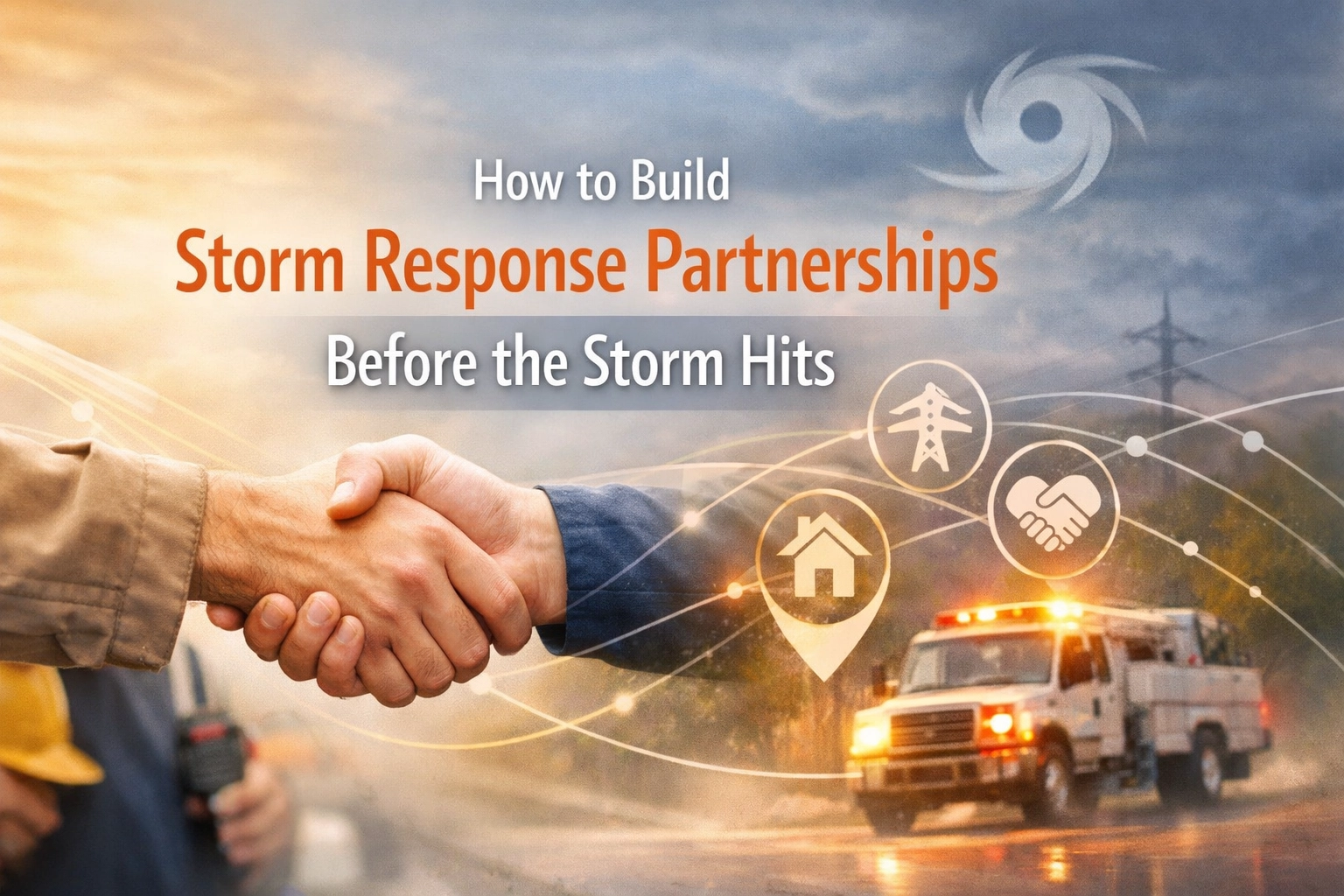
How to Build Storm Response Partnerships Before the Storm Hits
You are watching the weather radar and your stomach is in knots because you know the calls will start in twenty minutes and you have exactly zero extra crews ready to go.
Let me be direct. If you are waiting for the clouds to turn gray before you pick up the phone to call a subcontractor or a fellow contractor, you have already lost the season. The roofing industry is built on the ability to handle surge capacity, yet most owners operate as if every day will be a sunny Tuesday in May. When the hail hits, the chaos begins. You scramble to find warm bodies. You hire crews without vetting them. You pay too much for labor. Your quality drops. Your reputation takes a hit.
Here is what nobody tells you. The most profitable roofing companies do not win by having the most trucks in their own parking lot. They win because they have built storm response partnerships months before the first gust of wind ever happens. They have a network of trusted allies they can activate with one phone call. This is not about being lucky. This is about operational discipline.
I have seen this pattern dozens of times. A contractor thinks they can handle a storm on their own. They take on 50 jobs in a week. Within three weeks, they are drowning in paperwork, material shortages, and angry customers. They did not have storm response partnerships in place to offload the pressure. By the time they try to find a partner, every good crew in the state is already booked.
In this guide, I am going to show you exactly how to build storm response partnerships that actually work. We are going to move your business from reactive panic to systematic scaling.
The Reality of the Storm Scramble
The pattern: The storm hits on a Sunday. By Monday morning, your phone is ringing every 45 seconds. You feel a rush of adrenaline. You think about the revenue. You start saying yes to everyone.
The truth: Saying yes to a job you cannot produce is the fastest way to kill your profit. Without storm response partnerships, you are capped by your current internal capacity. If you have three crews and you sell thirty roofs, you have a major production bottleneck.
What happens when you lack storm response partnerships:
- You hire crews off the street who do not know your standards.
- You spend all your time putting out fires instead of leading the company.
- Your administrative team breaks under the weight of the new files.
- Your cash flow gets tight because you are paying out labor faster than insurance checks arrive.
This is why you need a strategy for storm response partnerships that is documented and ready to deploy. You cannot build a bridge while you are already drowning in the river. You build the bridge during the dry season so you can walk across it when the flood comes.
Phase 1: Identifying the Right Allies for Storm Response Partnerships
The logic: Not every contractor is a good fit for storm response partnerships. You are looking for businesses that complement your gaps, not just people with a hammer.
Common mistake: Only looking for local subcontractors. In a major storm, every local sub is going to be busy. The best storm response partnerships often involve companies from 200 miles away who are willing to travel when their own market is quiet.
What you are looking for in storm response partnerships:
- Financial stability: They should not be asking you for a draw before they even start the first tear-off.
- Quality alignment: Their “good enough” must match your “excellent.”
- Communication style: Do they answer the phone? Do they use a project management system?
- Red flags: They have no insurance, they change their company name every two years, or they cannot provide references from other storm response partnerships.
You might think you are creating your own competition by talking to other roofers. That is a small-minded way to run a business. The smartest operators realize that a competitor is just a potential partner in the right context. Building storm response partnerships with companies in neighboring regions is a professional way to ensure that when one area gets hit, everyone wins.

Phase 2: The Infrastructure of Storm Response Partnerships
The pattern: You agree to work together on a handshake. Then a problem happens. A skylight leaks. A homeowner claims a crew member broke a window. Suddenly, that handshake means nothing.
The reality: Storm response partnerships require formal documentation to survive the stress of a storm season. You need to treat these partnerships like a business merger, even if it is only for three months.
What you provide:
- A clear Scope of Work (SOW) for every job.
- Access to your project management systems so they can upload photos in real-time.
- A dedicated point of contact in your office who manages the storm response partnerships.
You should be looking into roofing project management software systems specifically to handle the influx of data from these external partners. If your internal systems are messy, adding storm response partnerships will only make the mess bigger.
The goal: To create a seamless transition where the homeowner cannot tell the difference between your internal crew and your partner crew.
Phase 3: Financial Agreements and Pricing Models
Here is the honest answer: If the money isn’t right, the partnership will fail. You need to decide on a pricing structure for your storm response partnerships long before the storm arrives.
The math:
Scenario A: You pay a flat rate per square.
Scenario B: You offer a percentage of the profit.
Scenario C: You act as a lead generator and take a referral fee while they handle the whole job.
In my experience, the most successful storm response partnerships use a standardized flat-rate sheet that is updated every six months. This prevents haggling during the storm. When the hail hits, both parties already know exactly what a 6/12 pitch pays.
Common finding: Contractors who do not discuss pricing for storm response partnerships in advance end up overpaying when they are desperate. This eats your margin and turns a high-revenue season into a low-profit headache. You can learn more about how this affects your bottom line by reviewing roofing company operational cost structures.
Phase 4: Setting the Ground Rules for Communication
The pattern: The storm hits and communication breaks down. Your partner crew is at 123 Main Street, but they can’t find the dumpster. They call you. You don’t answer. They leave.
To prevent this, storm response partnerships must include a communication protocol. This means setting specific times for daily check-ins and using standardized forms for job starts and completions.
The truth: If you are the only one who can answer questions, you are the bottleneck. You need to build systems so your storm response partnerships can function without your constant supervision. This is where documenting roofing business processes becomes a life-saver. If you have clear SOPs, you can simply hand a folder to your partner and say, “This is how we work.”
Timeline: (4-6 weeks before storm season)
- Draft the communication SOP.
- Train your office staff on how to support storm response partnerships.
- Test the communication loop with a small, non-storm project.
Phase 5: Legal and Insurance Verification
Look, this is the part everyone hates, but it is the most critical. You cannot have storm response partnerships without airtight insurance verification.
The reality check: If your partner’s crew gets hurt on your job site and their insurance has lapsed, it is your house that is on fire.
What you must verify for all storm response partnerships:
- General Liability insurance with you listed as additionally insured.
- Workers’ Compensation that is valid in the state where the work is being performed.
- Auto insurance for their fleet.
- An umbrella policy if the project size warrants it.
I have seen dozens of companies go under because they trusted a partner who lied about their coverage. Building storm response partnerships requires a “trust but verify” mindset. You should have an administrative system that automatically flags when a partner’s insurance is about to expire.

Phase 6: Training and Quality Control Integration
You might think that because they are pros, they don’t need training. You are wrong. Every company does things differently. To make storm response partnerships successful, you must integrate them into your quality standards.
The pattern: A partner crew uses the wrong underlayment because that is what they use back home. Now you have a warranty issue.
How to handle it:
- Create a “Quick Start Guide” for your storm response partnerships.
- Include photos of what a “Perfect Job Site” looks like.
- Set a requirement for a pre-job photo checklist and a post-job photo checklist.
- Conduct a “Trial Job” before the storm season hits to ensure they follow your rules.
When you are scaling a roofing business for profit, your brand is your most valuable asset. Do not let poorly managed storm response partnerships ruin a reputation that took you ten years to build.
Phase 7: Logistics and Resource Sharing
In a storm, everything is in short supply. Shingles, nails, dumpsters, and even hotel rooms for traveling crews. Successful storm response partnerships often involve shared logistics.
The logic: If you have a massive warehouse and your partner does not, you can order materials in bulk for both companies. This gives you more leverage with suppliers and ensures that your storm response partnerships actually have the materials they need to keep moving.
What you won’t have:
- Unlimited time to manage every delivery.
- The ability to find extra trucks at the last minute.
Success metrics:
- Material lead times are reduced because of collective bargaining.
- Partner crews stay on-site longer because you handled their lodging logistics.
- Total jobs completed per week increases by 40-60% through storm response partnerships.
Phase 8: Establishing the Activation Protocol
What happens when the storm actually hits? You need a “Go-No-Go” protocol for your storm response partnerships.
The pattern: You call your partner and say, “It hailed! Come down!” They say, “How much work do you have?” You say, “A lot!” This is too vague.
The honest assessment: A real professional won’t move their crews based on “a lot.” They need data. Your activation protocol for storm response partnerships should include:
- The number of signed contracts you currently have.
- The estimated duration of the work.
- The confirmed start date.
- The location of the staging area.
Goal: To have your partners rolling into town within 48 hours of a major weather event because the terms were already agreed upon.

Phase 9: Managing the Homeowner Experience
The reality: Homeowners are stressed after a storm. They are being hounded by “storm chasers.” When you bring in storm response partnerships, you must manage the perception.
Here is what nobody tells you: You should be transparent. Tell the homeowner, “We have activated our regional partner network to ensure your roof is repaired as quickly as possible. These crews operate under our strict quality standards.”
If you hide your storm response partnerships, and the homeowner sees a truck with a different area code, they will get suspicious. Honesty builds trust. Trust leads to referrals. Referrals are the highest margin jobs you will ever get.
You can improve this experience by using communication templates that explain the partnership process to the customer. Even though that link mentions plumbing, the logic of customer communication remains the same across all trades.
Phase 10: The Post-Season Debrief
The pattern: The storm season ends, everyone gets paid, and you don’t talk to your partners until next year.
The reality: This is the time to solidify your storm response partnerships. You need to sit down and ask:
- What went wrong?
- Where did we lose money?
- How was the communication?
- Do we want to do this again?
If you don’t do a debrief, you will make the same mistakes next year. Long-term storm response partnerships are built on continuous improvement.
Deliverables:
- A revised rate sheet for next year.
- Updated SOPs based on this year’s friction points.
- A stronger bond with your partner because you survived the chaos together.
How Clarity Ops Engine Fixes the Partnership Chaos
You might be reading this and thinking, “Shirley, I don’t have time to write SOPs, vet partners, and manage all this paperwork. I’m too busy trying to sell jobs.”
I know. I’ve seen it. You are the founder bottleneck. You are the one doing the selling, the estimating, and the project management. You are the one trying to build storm response partnerships on the fly.
This is where Clarity Ops Engine comes in. We don’t just give you a “how-to” guide and wish you luck. We provide hands-on implementation through our Clarity Business Operations Transformation. We act as your fractional COO for contractors to build the systems that make storm response partnerships possible.
What we do:
- Document your production processes so any partner crew can follow them.
- Set up your project management software to handle external partners.
- Create the insurance tracking systems so you never get stuck with a liability bill.
- Develop the financial models so you know exactly how much you can afford to pay your storm response partnerships.
The logic: You should be focusing on growth and high-level strategy. I focus on the engine. If your operational engine is broken, you cannot scale. By bringing in operational partners and fractional COO services, you are investing in the infrastructure that allows you to double or triple your revenue during a storm without doubling your stress.
We have a specific process for this. It isn’t a mystery. You can see how our fractional COO process works to understand how we move you from chaos to clarity.
The Choice: Proactive Systems or Reactive Panic
You have two options when the next storm hits.
Option 1: You can do what you’ve always done. You can scramble, fight with subcontractors, lose sleep over quality issues, and end the season exhausted with less profit than you expected. You can try to build storm response partnerships in the middle of a hail storm.
Option 2: You can build your systems now. You can identify your allies, sign your agreements, and document your processes while the sun is shining. You can have your storm response partnerships ready to go so that when the radar turns red, your business stays in the black.
If you are tired of the “Storm Scramble” and you want to build a business that scales without breaking you, let’s talk. I have helped dozens of contractors move from owner-operator chaos to systematic growth. We can build the framework for your storm response partnerships together.
The first step is a simple conversation. We will look at your current operations, identify your bottlenecks, and see if a fractional COO is the right fit for your growth goals.
Stop leaving your revenue to chance. The storms are coming. Whether you profit from them or get crushed by them depends entirely on the systems you build today. Building storm response partnerships is not a luxury. It is a fundamental requirement for any roofing company that wants to move beyond the $2M mark.
If you are ready to stop being the bottleneck and start being the CEO, I am ready to help you build the engine.
Let’s get your operations ready for the storm.
Book your 30-minute Clarity Consultation here
Keep Reading
- Geographic Expansion Strategies for Roofing Contractors
- How to Document Your Roofing Processes So Anyone Can Follow Them
- Scaling a Roofing Business Without Adding Overhead
- Project Management Systems for Multi-Crew Roofing Companies
- Roofing Storm Response Systems: How to Scale Fast Without Chaos
- How Roofing Contractors Handle Sudden Storm Demand Without Losing Control
- The Roofing Surge Capacity Plan Every Contractor Needs Before Hail Season
- Why Most Roofers Lose Profit During Storm Season Even When Revenue Spikes
- How to Prepare Your Roofing Business for the Next Major Weather Event
- Roofing Partnership Systems for Peak-Season and Storm Work
- How to Build a Trusted Roofing Crew Network Before You Need It
- Why Smart Roofers Pre-Vet Their Storm Crews Months in Advance
- How to Find Reliable Storm Crews Without Taking on Massive Risk
- Roofing Collaboration Systems for Emergency Production Capacity
- Storm Crew Agreements: What Roofers Must Put in Writing Before Work Starts
- How to Verify Insurance for Storm Response Subcontractors the Right Way
- Why Roofing Contractors Need Better Risk Controls During Storm Season
- Roofing Legal Agreements That Protect You During High-Volume Storm Work
- How to Avoid Lawsuits When Scaling Roofing Crews After a Storm
- How to Document Roofing Processes So Partner Crews Can Follow Your Standards
- Roofing SOPs for Storm Season: What Every Partner Crew Must Know
- How to Build a Plug-and-Play Storm Response Workflow for Roofers
- Why Roofing Chaos Gets Worse During Storm Season Without Better Systems
- Roofing Project Management Systems for Multi-Crew Storm Response
- How to Price Storm Labor Before Desperation Kills Your Margin
- Roofing Company Operational Cost During Storm Season: What Most Owners Miss
- Cash flow management: 7 brutal ways to stop losing profit
- Why Roofing Contractors Need Pre-Negotiated Storm Pricing Models
- How to Protect Roofing Margins When Demand Suddenly Explodes
- How to Explain Partner Crews to Homeowners Without Losing Trust
- Roofing Communication Systems for Storm Season Volume Surges
- Why Homeowner Communication Matters More During Storm Jobs
- How to Manage Customer Expectations When Outside Crews Help With Roofing Work
- Roofing Office SOPs for Handling Storm Calls, Scheduling, and Partner Routing
- How a Fractional COO Helps Roofers Build Storm-Ready Operations
- Why Roofing Owners Become the Bottleneck During Storm Season
- How to Scale a Roofing Business for Storm Work Without Breaking the Team
- From Local Roofer to Regional Storm Operator: What Has to Change
- How to Grow Roofing Revenue During Storm Season Without Doubling Overhead