Operational Capacity Audits: 6 Vital Decision Framework Tools for Growth
You are sitting at your desk looking at a quote from a software developer for eighty thousand dollars to build a custom field service tool because the three apps you already pay for do not talk to each other and your technicians hate using them.
Let me be direct. Operational capacity audits are not about working harder or buying more software. I have seen this pattern dozens of times. A founder gets frustrated with the limitations of off-the-shelf software and decides that the only solution is to build something custom. They believe that their business is so unique that no existing tool can handle their operations. This is almost always a lie you tell yourself to avoid the hard work of process discipline.
The reality is that custom code is a trap for most businesses scaling from $50K to $100K a month. You do not need a custom app. You need operational capacity audits so you can choose between building and buying without burning cash. Without consistent operational capacity audits, you will end up with a fragmented tech stack that requires a full-time developer just to keep the lights on.
Here is what nobody tells you. Most of the operational chaos you feel right now cannot be solved by a new piece of software. It is a process problem disguised as a technology problem. If your processes are broken, a custom build will just automate the chaos at a much higher price point. You need operational capacity audits that force you to be honest about your actual needs versus your ego-driven desires.
The pattern: Why the build vs buy choice breaks most businesses
What happens is simple. You sign up for a tool like Jobber or Housecall Pro. It does 90 percent of what you need. But that last 10 percent drives you crazy. Maybe the reporting is a bit clunky. Maybe the customer notification doesn’t look exactly how you want it. Instead of adapting your process to the tool, you decide to build a custom solution.
Six months and $50,000 later, you realize that building software is a never-ending nightmare. You are now a software company, whether you want to be or not. You have to manage bugs, updates, and security patches. This is the moment where a solid decision framework would have saved your business.
I know because I have had to clean up these messes. I have walked into companies where the founder is spending twenty hours a week managing a developer instead of growing the business. They didn’t have a decision framework to tell them when to stop.
Rule 1: Use the 80 percent functionality rule
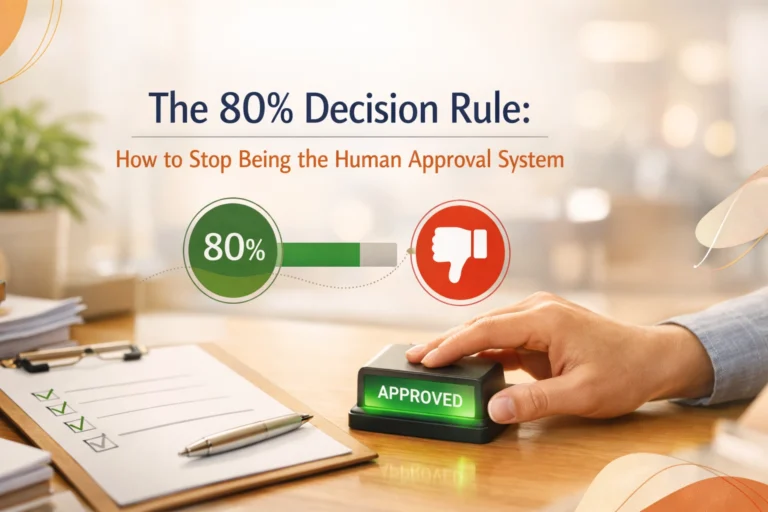
The first rule of any operational decision framework is the 80 percent threshold. If you find an off-the-shelf software that meets 80 percent of your requirements, you buy it. You do not build.
You might think that the remaining 20 percent is what makes you special. It usually isn’t. It is usually just a preference for how a button looks or a specific way you want to see a chart. In a professional decision framework, we prioritize speed and stability over perfection.
Buying a tool that is 80 percent perfect allows you to go live in days, not months. It means you get the benefit of thousands of other companies testing the software before you. When you use this decision framework, you are choosing to focus your energy on the 20 percent of your business that actually generates revenue.

Rule 2: The maintenance burden reality check
Every custom line of code you write is a future liability. This is a core truth in any decision framework for scaling businesses. When you buy software, the vendor is responsible for the maintenance. When you build it, you are responsible.
The math: If you spend $100,000 on a custom build, expect to spend $20,000 to $30,000 every single year just to keep it functioning. This includes server costs, security updates, and fixing things when an API changes. If your decision framework does not account for this long-term drag on your cash flow, you are making a bad decision.
A fractional COO uses a decision framework to evaluate the Total Cost of Ownership (TCO). We look at the 3-year and 5-year costs. Almost every time, the off-the-shelf solution wins on price and reliability. You want to be a roofing company or a plumbing company, not a software maintenance firm. Use a decision framework that keeps you focused on your core competency.
Rule 3: The competitive advantage test
Ask yourself this question as part of your decision framework: Does this custom software actually help me win more jobs or increase my margins in a way that my competitors cannot replicate?
If the answer is no, do not build it.
If you are building a custom CRM just to track leads, you are failing the decision framework test. Salesforce and Hubspot have spent billions of dollars perfecting lead tracking. You will not beat them. However, if you have a proprietary algorithm for estimating complex roofing jobs that gives you a 15 percent margin advantage, that might be worth building.
The logic: Reserve custom builds for the “secret sauce” of your business. Everything else should be a commodity. A smart decision framework identifies what is truly unique and what is just administrative overhead.
Rule 4: Integration over isolation
In the modern world, your software must talk to other software. A major red flag in any decision framework is when a custom build creates a data silo. If your custom tool cannot easily push data to your accounting software or your marketing platform, it is a liability.
Off-the-shelf tools are built to integrate. They have open APIs and Zapier connections. When you use a decision framework that prioritizes integration, you are building a flexible tech stack. Custom tools often become “islands of information.” You end up paying people to manually move data from the custom tool to QuickBooks. That is the opposite of operational efficiency.
Your decision framework should always ask: How does this connect to the rest of the engine? If the connection is expensive or fragile, the decision should be to buy a standard tool.

Rule 5: People over pixels
What you won’t have with a custom tool is a community of users and a library of training videos. When you hire a new office manager, they probably already know how to use common tools. If you use a custom tool, you have to spend weeks training them on something that only exists in your office.
This is a massive hidden cost that many founders ignore in their decision framework. The “People” element of operations is more important than the “Pixels” on the screen. A good decision framework accounts for the ease of onboarding.
If your team is constantly interrupting you to ask how the custom software works, you have created a new bottleneck. I have seen founders become the “IT Help Desk” for their own company because they ignored this rule in their decision framework.
Rule 6: The scalability horizon
How many users will you have in two years? If you have 10 users now and plan to have 100, your custom software might break. Most off-the-shelf software is built to scale from 1 to 10,000 users effortlessly.
A long-term decision framework looks at the horizon. It asks if the technology can handle the volume of a $5M or $10M company. If you build something small today, you might have to throw it all away and start over when you hit the next level of growth.
The reality: It is much easier to upgrade a subscription plan than it is to rewrite a database. Use a decision framework that protects your future self from the mistakes of your current self.
The truth: Why your current tech stack feels like chaos
The reason you feel overwhelmed is not because you lack custom software. It is because you lack a unified operational transformation. You have been adding tools one by one without a consistent decision framework.
Common findings:
- You have three tools that do the same thing.
- Nobody on your team knows the “official” way to enter data.
- You are paying for features you do not use.
- Your data is inaccurate because of manual entry errors.
This is what happens when you substitute technology for standard operating procedures. A piece of software is just a tool. If the person holding the tool doesn’t know the plan, the tool is useless. You need a decision framework to stop the bleeding and start building a real system.

How Clarity Ops Engine implements the decision framework
When I work with a client as a Fractional COO, the first thing we do is a technology audit. We apply a rigorous decision framework to every single subscription and custom tool in the business.
We look for the “Keep, Kill, Add” markers.
- Keep: Tools that fit the decision framework and provide clear ROI.
- Kill: Overlapping tools or expensive custom builds that are draining resources.
- Add: The missing links that will automate 80 percent of your manual work.
This is not a theoretical exercise. It is a 12-week sprint to clean up the mess. I do not just give you a list of suggestions. I step into the business and help you execute the decision framework. We build the integrations. We write the SOPs. We train the team.
The goal: To get you out of the software management business and back into the revenue-generating business.
What you get with a professional decision framework
Imagine a world where you don’t have to wonder if your data is right. Imagine knowing exactly what your margins are on every job because your tech stack works as a unified engine. This is what a business operations strategy provides.
By applying a strict decision framework, you gain:
- Financial Clarity: No more wasted thousands on unused software.
- Operational Speed: New tools are deployed in days, not months.
- Team Autonomy: Your staff knows exactly how to use the systems without asking you.
- Predictable Growth: Your systems are ready for the jump when scaling from 50k to 100k a month.
If you are currently debating a custom software build, stop. Before you sign that contract, you need a second opinion from someone who understands the operational impact. You need a decision framework that looks at the whole business, not just the code.
Phase 1: The Tech Audit (Weeks 1-3)
The first step in our process is mapping every tool currently in use. We look at the logins, the costs, and the actual usage rates. You might be surprised to find that your team only uses 10 percent of that “essential” custom tool you built two years ago.
During this phase, the decision framework is used to identify immediate “quick wins” where we can cut costs and simplify workflows.
Phase 2: The Process Extraction (Weeks 4-8)
We cannot fix the tech until we fix the process. I spend time extracting business processes from your head and putting them into clear, written SOPs. This is where the decision framework becomes really powerful. When the process is clear, the choice of software becomes obvious.
Phase 3: The Integration Build (Weeks 9-12)
Once we have the right tools and the right processes, we connect them. We use the decision framework to choose the best integration methods (Zapier, native integrations, or simple webhooks). By the end of this phase, your business operations are running as a smooth, automated engine.
The logic: Why you cannot do this alone
You are too close to the problem. As the founder, you have an emotional attachment to the “way things have always been done.” You need an objective expert to apply a decision framework without bias.
I don’t care about the shiny new features. I care about your profit margin and your sanity. If a custom build is going to hurt those things, I will tell you. If an off-the-shelf tool is going to save you 20 hours a week, I will make sure it gets implemented properly.
Most founders try to be their own Fractional COO, but they end up just being a high-paid admin. You should be making $500/hour decisions, not fighting with a software developer over a broken database. That is the point of a decision framework. It protects your time and keeps you out of the weeds.
Success metrics: What to expect
When we apply a professional decision framework to your operations, the results are measurable.
- Software spend reduction: Typically 15 to 30 percent within the first 90 days.
- Manual data entry reduction: Up to 80 percent by using better integrations.
- Onboarding time: Cut by half because the tools are standard and well-documented.
- Founder time recovery: 10 to 15 hours per week returned to high-level strategy.
This is the power of a disciplined decision framework. It stops the waste and starts the growth. And when the stakes are high, you do not want vibes. You want a repeatable decision framework you can run every time.
Final thoughts on the decision framework
You have a choice. You can continue to struggle with a fragmented, expensive, and fragile tech stack. You can keep hoping that the next custom feature will finally solve your problems. Or you can adopt a proven decision framework and build a scalable business operations engine.
The reality check: Custom builds are for companies with ten million dollars in the bank and a team of twenty developers. For everyone else, the decision framework says: Buy the best, configure the rest, and focus on your customers.
Stop guessing and start systematizing. Your business deserves a tech stack that supports your growth instead of hindering it. If you are ready to apply a real decision framework to your operations, let’s talk.

Ready to fix your operations?
If your business is stuck because your systems cannot keep up with your sales, you need more than just a new app. You need a complete operational transformation. We can help you implement the decision framework that finally brings order to the chaos.
Book a 30-minute consultation today to see how a Fractional COO can streamline your business:
https://calendly.com/sdrobinson8/30min
You could keep trying to figure this out yourself and likely waste another $20,000 on software you do not need. Or you could get the clarity you need to scale to the next level. The choice is yours.
Related Blogs
- What to Expect During an Operational Transformation
- Fractional COO vs Full Time COO: Which Do You Need?
- How to Fix Chaotic Operations in 12 Weeks
- When to Hire a Fractional COO
- Build vs Buy Software: 7 Expensive Mistakes Founders Make Too Early
- Tech Stack Decisions That Quietly Slow Growth
- Why Custom Software Becomes a Hidden Operating Expense
- Business Software Decisions: 5 Rules Before You Sign a Developer Contract
- When Off-the-Shelf Software Beats Custom Every Time
- Why Most Growing Companies Should Not Build Their Own App
- Business Technology Audits: 6 Tools That Expose Software Waste
- Tech Stack Optimization: 7 Costly Overlaps Founders Ignore
- Operational Efficiency Audits: 5 Workflow Problems Software Cannot Fix
- How to Audit Your Business Tools Before Buying Another Subscription
- The Real Cost of Fragmented Business Systems
- What a Fractional COO Looks for Before Approving New Software
- Fractional COO Services for Founders Stuck in Software Chaos
- Why Software Problems Usually Mean Operations Problems
- Operational Partners vs Software Consultants: Who Solves the Real Problem?
- How a Fractional COO Cuts Tech Waste in 12 Weeks
- Scaling From 50K to 100K Requires Better Systems, Not More Apps
- Why Growing Companies Need Fewer Tools Than They Think
- The 80 Percent Rule for Operational Software Decisions
- How to Build a Lean Tech Stack That Actually Scales