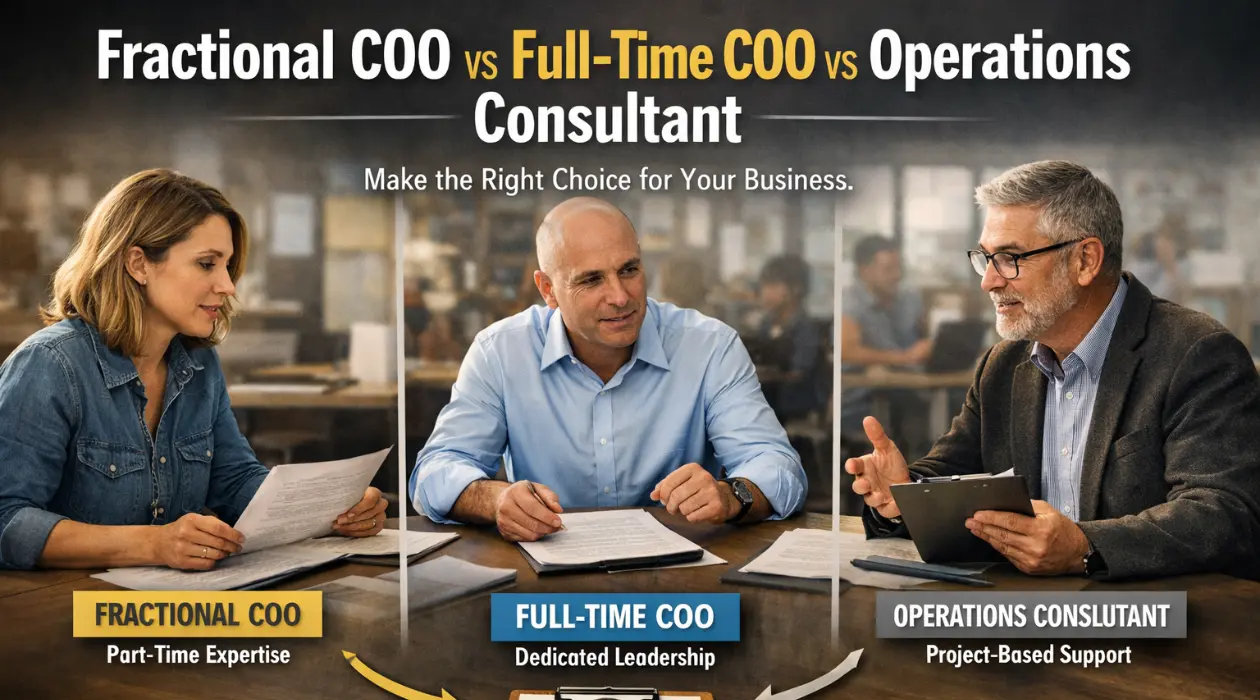
Fractional COO vs Full Time COO: 5 Smart Ways to Choose
You know you need operational help. The question isn’t if; it’s who, and that’s exactly why founders search fractional COO vs full time COO when they’re tired of guessing.
Most founders get stuck choosing between a fractional COO vs full time COO, or hiring an operations consultant. On the surface, they all sound like “operations help.” In reality, they solve very different problems, at very different costs, with very different outcomes, which is what makes fractional COO vs full time COO such an important decision point.
Choose correctly, and operations stop holding your business back.
Choose wrong, and you burn cash, time, and momentum, and the fractional COO vs full time COO choice gets more expensive the longer you wait.
This guide breaks down fractional COO vs full time COO vs consultant in practical terms, not theory, so you can make the right decision for your business stage. If you’ve been circling the same question for weeks, this is your fractional COO vs full time COO answer key.
Three Solutions That Are Not Interchangeable
Here’s the biggest mistake business owners make with fractional COO vs full time COO:
They assume a fractional COO, a full time COO, and an operations consultant are the same role with different price tags.
They’re not.
They’re fundamentally different approaches to solving operational problems. Different cost structures. Different time commitments. Different results. Different use cases, and that’s the whole point of comparing fractional COO vs full time COO instead of lumping them together.
Choosing the wrong one costs you, either in wasted money (hired too expensive), missed results (hired too light), or frustration (hired wrong fit). In other words: the wrong fractional COO vs full time COO move creates a second problem while you’re trying to solve the first.
This guide breaks down all three options through the same fractional COO vs full time COO lens:
- What each one actually is (beyond surface-level definitions)
- Cost comparison (real numbers, not ranges)
- Pros and cons for each (so fractional COO vs full time COO is clearer)
- When each makes sense (and when it doesn’t)
- Decision framework to choose the right one
- Real examples of right choice vs wrong choice
By the end, you’ll know exactly which option fits your business, and why. You’ll stop second-guessing the fractional COO vs full time COO decision.
Let’s start with the quick summary, then dive deep into each option.
Quick Summary (TL;DR)
If you only read one section, read this. It’s the fast version of fractional COO vs full time COO plus the consultant option.
Fractional COO
- Part time operational executive (10–80 hours/month)
- Cost: $2,750–$16,000/month
- Best for: $20K–$100K/month businesses needing leadership and execution
- Builds systems, implements them, trains the team, and stays involved
Full Time COO
- Full-time executive (40–60 hours/week)
- Cost: $180K–$310K/year fully loaded
- Best for: $100K+/month businesses with ongoing operational complexity
- Owns all operations internally
Operations Consultant
- Project-based advisor
- Cost: $10K–$75K per project
- Best for: One-time assessment when internal team can execute
- Delivers recommendations, implementation is on you
The core difference (and the clearest way to understand fractional COO vs full time COO):
A consultant advises.
A fractional COO implements alongside you.
A full time COO owns everything.
That distinction is the heart of the fractional COO vs full time COO decision.
Option 1: Fractional COO (Deep Dive)
What a Fractional COO Actually Is
A fractional COO is a senior operational executive who works with your business part-time. Unlike consultants, they don’t stop at recommendations. Unlike full-time COOs, they don’t require a six-figure salary commitment. Which is why fractional COO vs full time COO often comes down to how much operational leadership you need right now.
In the fractional COO vs full time COO comparison, this role sits in the middle, executive-level thinking without full-time overhead.
What a Fractional COO Does
- Diagnoses operational breakdowns
- Designs systems and workflows
- Implements those systems
- Trains your team
- Provides ongoing operational leadership
- Acts as a true member of your leadership team
Time & Cost Structure
Typical tiers:
- 10 hrs/month – $2,750
- 20 hrs/month – $5,000 (most common)
- 40 hrs/month – $9,000
- 80 hrs/month – $16,000
Engagements are usually month-to-month, allowing flexibility as your needs evolve, a major advantage in the fractional COO vs full time COO decision.
Common working rhythms:
- Weekly check-ins (30-60 minutes)
- Monthly strategy sessions (90 minutes)
- Quarterly planning (2-4 hours)
- Between-meeting work (building systems, documentation, analysis)
- Email/Slack support for questions
Engagement structure:
- Month-to-month agreement (no long-term contract)
- 30-day cancellation notice
- Can scale up or down tiers as needs change
- Flexible based on business cycles
Pros
- Expertise immediately: You get experienced COO without long hiring process
- Affordable compared to full-time: $33K-$192K/year vs $180K-$250K+ for full-time
- Flexible commitment: Scale up/down as needed, cancel with 30 days notice
- Faster results: Hit ground running, no 3-6 month ramp-up period
- Outside perspective: See problems you’d miss internally
- No benefits/overhead: No health insurance, 401k, paid time off costs
- Proven systems: Bring expertise from working with multiple businesses
- Implementation focus: Don’t just recommend, actually build systems
Cons
- Not full-time: Only 10-80 hours/month, not 160+ hours
- Limited availability: Not in office every day, response time varies by tier
- Works with other clients: You’re not their only focus
- Less embedded: Not in daily team dynamics as much
- Month-to-month: Can leave with 30 days notice (though rare)
Best Fit
- Revenue: $20K-$100K/month
- Team: 1-20 people
- Stage: Past startup, before corporate
- Need: Ongoing operational leadership, not 40+ hours/week
- Budget: $3K-$15K/month sustainable
- Situation: Operations need fixing OR ongoing strategic guidance
Typical duration:
- Transformation: 12 weeks to fix foundation
- Partnership: Ongoing months/years as operational partner
- Common: Start with transformation, transition to partnership
This is the sweet spot for most businesses comparing fractional COO vs full time COO.
Option 2: Full-Time COO (Deep Dive)
What a Full-Time COO Actually Is
A full-time COO is a permanent executive hire responsible for all operational functions. They are deeply embedded, manage teams directly, and operate at scale.
In the fractional COO vs full time COO conversation, this option represents maximum ownership and maximum commitment.
Time commitment:
- 40-60 hours/week (salaried, not hourly)
- Available during business hours
- Occasional evenings/weekends as needed
- Full-time dedication to your business only
Common structure:
- Reports directly to CEO/Founder
- Usually has team reporting to them (Ops Manager, Director of Ops, etc.)
- Part of executive leadership team
- Often #2 or #3 in company hierarchy
Hiring process:
- 2-4 month search (longer for good candidates)
- Expensive recruitment (often use executive recruiter)
- 3-6 month ramp-up period (learning your business)
- Significant onboarding investment
PROS of Full Time COO:
- Dedicated full-time: 40+ hours/week focused only on your operations
- Deeply embedded: In daily operations, knows everything intimately
- Team leadership: Can manage operations team directly
- Long-term ownership: Owns operations evolution over years
- Internal culture fit: Part of company culture, builds with team
- Immediate availability: In office, can handle anything real-time
- Single focus: Only thinking about your business
- Scalable with growth: Can own increasingly complex operations
CONS of Full Time COO:
- Expensive: $120K-$250K+ salary plus $30K-$60K benefits
- Fixed cost: Same salary whether you need 20 or 60 hours of work
- Hiring risk: Takes 2-4 months to find, might be wrong fit
- Ramp-up time: 3-6 months before fully effective
- Limited outside perspective: Only sees your business, no outside experience
- Hard to terminate: Firing C-level executive is expensive and disruptive
- Geographic constraints: Usually need someone local or willing to relocate
Best for:
- Revenue: $100K+/month consistently ($1.2M+/year)
- Team: 20+ people
- Complexity: Operations require 40+ hours/week dedicated attention
- Budget: Can sustain $180K-$310K/year total cost (salary + benefits + overhead)
- Stage: Established business with stable operations funding
- Need: Full-time operational ownership and leadership
NOT best for:
- Under $80K/month revenue (can’t sustain cost)
- Operations don’t require 40+ hours/week attention
- Want flexibility to scale commitment up/down
- Uncertain if you need COO long-term
- Can’t sustain fixed $180K+ annual cost
Typical compensation:
Base salary ranges:
- Small business ($1-5M revenue): $100K-$150K
- Mid-size ($5-20M revenue): $150K-$200K
- Larger ($20M+ revenue): $200K-$300K+
Plus benefits:
- Health insurance: $15K-$25K/year
- 401k match: $5K-$15K/year
- Paid time off: ~4 weeks
- Bonus potential: 10-30% of salary
The full-time COO sweet spot: Established businesses with $100K+/month revenue and operational complexity that requires dedicated 40+ hours/week leadership.
Option 3: Operations Consultant (Deep Dive)
What a Consultant Actually Does
An operations consultant evaluates, diagnoses, and recommends. They do not stay to execute.
This is where many businesses misunderstand the fractional COO vs full time COO comparison; consultants are neither.
What Operations Consultant Actually Does:
- Assess current operations (deep analysis)
- Identify problems and inefficiencies
- Provide recommendations (written report)
- Present findings to leadership
- Maybe: Create implementation roadmap
- Then: Leave
What they DON’T do:
- Implement the recommendations (that’s on you)
- Train your team
- Stick around for execution
- Provide ongoing support
Time commitment:
- Project-based: 4-12 weeks typical engagement
- Varies: Could be 20 hours total or 200+ hours depending on scope
- Front-loaded: Most work happens during assessment phase
- Ends: Once report is delivered and presented
Common engagement types:
Type 1: Assessment only
- Assess operations, deliver report
- Cost: $10K-$30K
- Timeline: 4-8 weeks
Type 2: Assessment + Roadmap
- Assess operations, deliver report, create implementation plan
- Cost: $20K-$50K
- Timeline: 6-12 weeks
Type 3: Assessment + Light Implementation Support
- Assess, recommend, help kick off first systems
- Cost: $30K-$75K
- Timeline: 8-16 weeks
Billing structure:
- Hourly: $150-$500/hour (depends on experience)
- Project: Fixed fee for defined scope
- Retainer: Monthly fee for defined hours (less common)
PROS of Operations Consultant:
- Outside expertise: Fresh perspective, pattern recognition across businesses
- Project-based: Fixed scope, clear end date
- No long-term commitment: Engagement ends when project ends
- Specialized knowledge: Often expert in specific operational area
- Faster assessment: Can complete deep analysis quickly
- Written deliverables: Get comprehensive report to reference
- Lower total cost: $10K-$50K one-time vs ongoing monthly costs
CONS of Operations Consultant:
- No implementation: They leave, you have to do the work
- Knowledge transfer gap: Report ≠ execution capability
- No follow-up: If implementation fails, they’re gone
- Generic recommendations: May not understand your business deeply
- Expensive hourly: $200-$500/hour adds up fast
- Implementation often fails: Most companies don’t execute consultant recommendations
- Pay twice: Pay consultant for report, then pay someone else to implement
Best for:
- One-time specific project
- Need expert assessment of current state
- Have internal capability to implement
- Want recommendations, not implementation
- Budget: $10K-$50K for project, can implement internally
- Timeline: 4-12 weeks for deliverable
NOT best for:
- Need implementation, not just advice
- No internal capacity to execute recommendations
- Want ongoing operational support
- Can’t afford both assessment AND implementation
- Need someone to train your team
Success rate reality:
Industry studies show: 60-70% of consultant recommendations are never fully implemented.
Why:
- Team too busy to execute
- Recommendations unclear in practice
- No accountability after consultant leaves
- Lack internal expertise to implement
- Other priorities take precedence
The consultant sweet spot: Businesses that need expert assessment and have strong internal capability to execute recommendations without ongoing support.
Side-by-Side Fractional COO vs Full Time COO vs Consultant Comparison
| Category | Fractional COO | Full Time COO | Consultant |
|---|---|---|---|
| Cost | $33K–$192K/year | $180K–$310K/year | $10K–$75K/project |
| Implementation | Yes | Yes | No |
| Time | 10–80 hrs/month | 40–60 hrs/week | Project-based |
| Flexibility | High | Low | Medium |
| Ownership | Shared | Full | None |
This table alone clarifies the fractional COO vs full time COO decision for most founders.
12-Month Fractional COO vs Full Time COO vs Consultant Cost Comparison:
| Category | Fractional COO | Full Time COO | Consultant |
|---|---|---|---|
| Monthly | $5,000 | $12,500 | $35,000 |
| Annual | $60,000 | $150,000 + $30,000 (Bonus) | – |
| Benefits | None | $25,000 | None |
| Overhead | None | $15,000 | None |
| Recruitment | None | $30,000 | None |
| Total | $60,000 | $250,000 | $35,000 |
Cost difference:
- Full-Time vs Fractional: $190,000 more per year
- Full-Time vs Consultant: $215,000 more per year
- Fractional vs Consultant: $25,000 more per year
But wait, the consultant only delivered a report. For apples-to-apples (including implementation):
Consultant + Implementation:
- Consultant report: $35,000
- Hire fractional to implement: $50,000 (10 months at foundation tier)
- Total: $85,000
Now fractional COO looks cheaper than consultant + implementer.
ROI Analysis:
Scenario: Business at $60K/month revenue with operational problems costing $5K/month:
Option 1 – Fractional COO:
- Investment: $60,000/year
- Operational savings: $60,000/year (12 months × $5K/month)
- Net: Break-even Year 1, positive ROI ongoing
Option 2 – Full-Time COO:
- Investment: $250,000/year
- Operational savings: $60,000/year
- Net: -$190,000 Year 1 (expensive unless operational problems cost $20K+/month)
Option 3 – Consultant only:
- Investment: $35,000
- Implementation: You do it (400 hours of your time)
- Operational savings: $0-$60,000 (depends if you execute)
- Net: Only positive if you actually implement
The cost decision: Match cost to operational complexity and business size.
- Under $50K/month: Fractional or DIY
- $50K-$100K/month: Fractional (sweet spot)
- $100K+/month: Consider full-time
- One-time project: Consultant makes sense
- Ongoing operations: Fractional or full time
Decision Framework
Decision Framework: Which One Is Right for You?
Use this framework to choose:
STEP 1: Assess Your Revenue Stage
Under $20K/month: None of these (focus on revenue first)
$20K-$50K/month: Fractional COO or DIY
$50K-$100K/month: Fractional COO (strong fit)
$100K+/month: Fractional COO OR Full Time COO (depends on complexity)
STEP 2: Assess Hours of Work Needed
10-30 hours/month of operational work: Fractional COO (Foundation or Standard tier)
30-80 hours/month: Fractional COO (Standard or Advanced tier)
80-160+ hours/month: Full Time COO (can’t get 160 hours from fractional)
One-time project only: Consultant
STEP 3: Assess Your Implementation Capability
Can your team implement recommendations?
- Yes: Consultant might work
- No: Need fractional or full time (implementation included)
Do you have operations expertise internally?
- Yes: Consultant or fractional
- No: Need fractional or full-time (bring expertise)
STEP 4: Assess Your Budget
Can sustain $3K-$10K/month: Fractional COO
Can sustain $180K-$310K/year: Full Time COO
Have $10K-$50K for one-time project: Consultant
Can’t sustain ongoing cost: Consultant (but know you’ll have to implement yourself)
STEP 5: Assess Your Commitment Preference
Want flexibility (scale up/down, cancel if needed): Fractional COO
Want long-term dedicated ownership: Full Time COO
Want one-and-done project: Consultant
STEP 6: The Decision Matrix
Choose Fractional COO if:
- Revenue: $20K-$100K/month
- Need: Ongoing operational leadership
- Hours: 10-80 hours/month
- Budget: $3K-$15K/month sustainable
- Preference: Flexibility, month-to-month
Choose Full Time COO if:
- Revenue: $100K+/month consistently
- Need: 40+ hours/week operational ownership
- Complexity: Operations require full-time dedicated attention
- Budget: $180K-$310K/year sustainable
- Preference: Long-term internal ownership
Choose Consultant if:
- Need: One-time assessment/project
- Capability: Can implement recommendations yourself
- Budget: $10K-$50K for project
Preference: Project-based, no ongoing commitment
Still not sure? Ask yourself:
- Do I need ongoing execution or a one-time answer?
- How many hours per month does operations truly require?
- Can my business sustain a $180K+ fixed cost?
- Can my team actually implement recommendations?
Most businesses between $20K–$80K/month land firmly on fractional COO vs full time COO; and fractional wins.
Common Mistakes
Here are the mistakes I see businesses make:
Mistake #1: Hiring consultant when they need implementation
What happens: Pay $30K for consultant report. Get great recommendations. Team too busy to implement. Report sits on shelf. Wasted $30K.
The fix: If you need implementation, hire fractional or full-time, not consultant.
Mistake #2: Hiring full time COO too early
What happens: Business at $40K/month hires full-time COO at $150K+. Can’t sustain cost. Operations don’t require 40 hours/week. Expensive mistake.
The fix: Be honest about hours of work needed. Under $80K/month usually doesn’t need full-time.
Mistake #3: Expecting fractional to be full time
What happens: Hire fractional COO but expect 40-hour weeks. Get frustrated when they’re only available 20 hours/month (because that’s what you paid for).
The fix: Understand what you’re buying. Fractional = part-time. Full time = full time. Don’t conflate.
Mistake #4: Not defining success criteria
What happens: Hire help but don’t define what success looks like. No clear goals. Can’t tell if it’s working.
The fix: Define success upfront. What needs to be fixed? By when? How will you know it’s working?
Mistake #5: Choosing based on cost alone
What happens: Pick consultant because cheapest upfront. Ignore that implementation will cost more. End up spending more total.
The fix: Look at total cost to solve problem, not just initial price.
Mistake #6: Waiting too long to decide
What happens: Spend 6 months ‘evaluating options’ while operational problems cost $5K-$10K/month. Decision paralysis costs $30K-$60K in lost opportunity.
The fix: Evaluate quickly. Make decision. Adjust if wrong. Action > analysis paralysis.
Making the Right Choice
So, fractional COO vs full time COO vs consultant, which is right?
The honest answer: It depends on your situation.
For most growing businesses:
- Fractional COO delivers the best balance of cost, execution, and flexibility
- Full-time COO makes sense only when complexity demands it
- Consultants work only when internal execution is strong
The right choice aligns with your current reality; not your aspirational one.
If this comparison helped clarify which option you need:
If you think fractional COO is right:
Book a free Clarity Call. Let’s discuss your operations and determine if fractional COO vs full time COO services are the right fit.
Learn more about services:
The Clarity Transformation (12-week operational overhaul)
Clarity Operational Partnership (ongoing fractional COO support)
What to Do Next
If you recognized yourself in this article:
Step 1: Take the self-assessment
Figure out if your operational problems are DIY-fixable or if you need help.
Step 2: Book a free Clarity Call
Let’s talk about your specific situation. I’ll tell you honestly what I think you need, whether that’s working with me, hiring someone, or fixing it yourself.
30 minutes. No sales pitch. Just clarity about what’s broken and how to fix it.
Step 3: Read how fractional COO services work
Understand the process of fixing operations professionally.
Ready to stop firefighting and start systematizing?
Keep Reading
Related posts you might find helpful:
- When to Hire a Fractional COO
- What Does a Fractional COO Actually Do?
- How to Fix Chaotic Operations in 12 Weeks
- When to Hire Fractional COO: Complete Decision Guide
- What Does a Fractional COO Actually Do Day to Day?
- Is It Too Early to Hire a COO? A Founder’s Reality Check
- Fractional COO Pricing Explained: What You’re Really Paying For
- Full-Time COO: When the Cost Finally Makes Sense
- Operations Consultant vs Operator: Why Advice Alone Usually Fails
- Why Fractional Leadership Beats Full-Time Hires in Early Growth
- Founder Opportunity Cost: The Hidden $10K Monthly Loss
- Operational Chaos Is Not a Phase: It’s a Bottleneck
- Why Your Business Feels Harder at $50K/Month Than $20K
- How Long Does It Take to Fix Business Operations? (And Why It Depends on Who You Hire)
- What a 12-Week Operational Transformation Actually Looks Like
- Why Most Operational Fixes Fail After Month 3
- How to Work With a Fractional COO Without Wasting Money
About Shirley

Shirley is the founder of Clarity Engine Ops, a fractional COO service for small businesses stuck in operational chaos. She helps businesses in their “teenage years” ($20K-$100K/month) fix broken operations and build systems that scale.