You spent your morning answering questions you’ve already answered twelve times this month. Your team treats you like Google. They interrupt your critical work to ask where files live, how to handle client exceptions, and what the policy is on refunds. You are not running a business. You are a human search engine burning hours on repeat explanations while revenue opportunities rot in your inbox.
Let me be direct.
If your team asks you the same questions over and over, the problem is not your team. The problem is your infrastructure. You have knowledge locked in your brain instead of stored in accessible systems. Every interruption is a symptom of missing operational architecture. Every repeated question is proof you need centralized knowledge management.
When you hire a COO, you stop being the Answer Machine and start building systems that scale. This is the real shift when you hire a COO. You are no longer the default help desk because the business finally has an owner for operational clarity. If you want fewer interruptions, faster onboarding, and consistent answers, you hire a COO and let them turn your messy, scattered knowledge into an actual system.
This post covers five proven solutions to eliminate the question cycle. You will learn what the Human Search Engine trap looks like, why it happens, and exactly how to hire a COO who builds knowledge infrastructure that runs without you. You will also see what changes specifically because you hire a COO, what you should expect in the first 30-90 days after you hire a COO, and how to tell if you hire a COO at the right stage of growth.

Alt text: Business owner overwhelmed by constant team questions showing the need to hire a COO for knowledge management systems
The Answer Machine Bottleneck
Here is what nobody tells you: The reason your team keeps asking the same questions is because answers live in one place, your head. This is why the fix is not another meeting or another Slack reminder. The fix is to hire a COO who takes what is trapped in your brain and moves it into systems the team can use without you. If you keep postponing and do not hire a COO, you stay the bottleneck by default.
You have built a business where institutional knowledge exists exclusively in your memory. There is no documentation. There is no centralized knowledge base. There is no FAQ system. When someone needs an answer, they interrupt you because you are the only source of truth.
Pattern: At $30K-$50K/month, this works. You answer questions in Slack, you clarify during team meetings, you handle exceptions on the fly. At $75K-$100K/month, this becomes a massive operational tax. You spend 15-20 hours per week answering questions that should be answered by systems, not by you. This is the point where most founders either burn out or they hire a COO. The founders who hire a COO stop paying the interruption tax. The founders who do not hire a COO keep rebuilding the same answers in real time, every day.
The cost is not just your time. The cost is delayed decisions, inconsistent answers, and new hires who take 60-90 days to get productive because training lives in your brain instead of in documentation.
If you want to scale past $100K/month, you must hire a COO who builds knowledge infrastructure. Not eventually. Now. If you hire a COO at this stage, you buy back time and consistency. If you delay and do not hire a COO, your growth ceiling becomes your availability, not your market.
What It Looks Like
This is what it looks like right before you hire a COO. Your day starts with Slack messages:
- “Hey, quick question about the refund policy?”
- “Can you remind me how we handle this client exception?”
- “Where do I find the onboarding checklist?”
- “What’s our pricing for this scenario?”
You answer. Twenty minutes later, someone else asks a similar question. You answer again. By 2 PM, you have spent three hours answering questions instead of closing deals or building partnerships. This is the moment where the smartest move is to hire a COO. When you hire a COO, you stop treating interruptions like a leadership requirement and start treating them like a systems failure that can be fixed.
Your calendar is shredded by interruptions. You cannot focus for more than 30 minutes without someone needing clarification. New hires ask the same questions your existing team asked six months ago. You have answered “Where is the client contract template?” fourteen times this quarter.
You think this is just part of being a leader. It is not. This is what happens when you have not built knowledge systems. It is also why you hire a COO instead of trying to personally document everything between client calls. You hire a COO so the business can answer questions without dragging you into every detail.
Why It Happens
You grew fast. You hired quickly. You trained people through verbal explanations and Slack messages instead of written documentation. Every process lives in your head. Every policy is communicated on the fly. There is no central repository where answers live permanently.
Common mistake: You think documentation takes too long. You tell yourself, “It is faster to just answer the question than to write it down.”
That logic costs you hundreds of hours annually. Answering the same question once takes two minutes. Answering it fifty times takes 100 minutes. Writing it down once takes ten minutes and eliminates all fifty future interruptions.
Reality: You have never prioritized knowledge management because you were focused on revenue growth. Now your lack of systems is the bottleneck preventing further growth. This is why revenue growth and ops maturity finally collide, and why you hire a COO to keep momentum without chaos. When you hire a COO, the knowledge work becomes a real project with an owner, timelines, and accountability.
How to Handle It
You hire a COO who builds centralized knowledge infrastructure. Not a virtual assistant who organizes your files. Not a project manager who tracks tasks. You need someone who architects how information flows, gets stored, and gets accessed across your organization. If you are serious about getting out of the Answer Machine role, you hire a COO and you give them the authority to standardize, document, and enforce the new way. That is what changes when you hire a COO instead of delegating bits and pieces.
Here is what that looks like in practice.

Alt text: Centralized knowledge base system created by fractional COO to eliminate repeated team questions and interruptions
Solution 1: Build a Centralized Knowledge Base
When you hire a COO, the first priority is creating a single source of truth where all operational knowledge lives. This is not a Google Drive folder with random documents. This is a structured, searchable system where every team member finds answers without interrupting you. If you hire a COO and they do not push for one home base for knowledge, you did not really hire a COO. You hired a task-doer. The real win when you hire a COO is that knowledge stops being scattered across Slack, inboxes, and your memory.
What It Looks Like
Your COO audits every recurring question from the past 90 days. They identify the top 50 questions your team asks repeatedly. Then they build documentation that answers those questions permanently.
The knowledge base includes:
- Standard operating procedures (SOPs) for every repeated task
- Policy documentation for client exceptions and edge cases
- Onboarding guides that train new hires without your involvement
- FAQ sections organized by department and role
- Video walkthroughs for complex processes
Important: You can build pieces of this yourself, but it will drag on for months because you are also running sales and delivery. If you want it done quickly and correctly, you hire a COO and make knowledge infrastructure part of their core scorecard. This is one of the clearest reasons to hire a COO in the first place.
Example: Instead of explaining your refund policy twelve times per month, your COO writes a 400-word policy document with decision trees for edge cases. When someone asks about refunds, your team links to the document. You are not involved. This is the tangible outcome when you hire a COO: fewer interruptions, fewer inconsistencies, and less stress because the business has a documented answer.
Why It Happens
You never had time to build this yourself. You were too busy answering questions to document the answers. When you hire a COO, they have the bandwidth and operational expertise to systematize knowledge. That is the trade: you hire a COO so the company can finally stop relying on your brain as the database. If you keep waiting to hire a COO, you keep paying for it in interruptions and rework.
Your COO does not just write documents. They build the architecture for how knowledge gets created, updated, and accessed. They choose the platform (Notion, Confluence, Google Sites). They design the taxonomy. They train your team to search before asking.
How to Handle It
Phase 1 (Weeks 1-3): Your COO interviews you and captures the top 50 recurring questions. They document your answers in clear, searchable formats.
Phase 2 (Weeks 4-6): They build the knowledge base structure. Categories are organized by department, role, and process type. Every document follows a standard template for consistency.
Phase 3 (Weeks 7-8): They train your team to use the knowledge base. They implement a “search first, ask second” culture. Interruptions drop 60-70% in the first month. This is what it looks like when you hire a COO who owns adoption, not just documentation. When you hire a COO, you get enforcement, coaching, and follow-through, not a pile of docs nobody reads.
Goal: By end of Week 8, your team finds 80% of answers without asking you.
Solution 2: Create Decision-Making Frameworks
The second reason your team asks constant questions is because decision-making authority is unclear. They do not know when they can decide independently and when they need approval. So they ask you about everything. This is another spot where it pays to hire a COO, because you need someone who can translate your preferences into clear guardrails. When you hire a COO, you are not just delegating tasks, you are delegating decision design.
What It Looks Like
Your team interrupts you for decisions that should be made at their level:
- “Should I give this client a discount?”
- “Can I approve this expense?”
- “Do we need your sign-off on this vendor?”
You spend your day making micro-decisions that should be delegated. Your team is capable of deciding. They just do not have clarity on their decision-making authority.
Why It Happens
You have never defined decision boundaries. You have never told your team, “You can decide X independently, but you need approval for Y.” Without frameworks, every decision feels risky to them, so they escalate to you.
Reality: This is a documentation problem, not a people problem. When you hire a COO, they build decision-making frameworks that clarify authority levels. When you hire a COO, you also get a person who can hold the line when someone tries to escalate decisions that are already defined. That enforcement is why founders hire a COO instead of trying to police decision-making themselves.
How to Handle It
Your COO creates a decision matrix:
Level 1 Decisions (Team Member Authority):
- Client requests under $500
- Schedule adjustments within guidelines
- Standard vendor purchases under $200
Level 2 Decisions (Manager Approval Required):
- Client exceptions between $500-$2,000
- Process changes affecting other teams
- Vendor contracts under $5,000
Level 3 Decisions (Your Approval Required):
- Client exceptions over $2,000
- Major process overhauls
- Vendor contracts over $5,000
Your COO documents these frameworks in the knowledge base. They train your team on decision authority. Interruptions for routine decisions drop 50-60% immediately. This is one of the fastest wins after you hire a COO, because you remove daily uncertainty.
Goal: Your team makes 70-80% of decisions without your involvement. That is what “not being the bottleneck” actually means when you hire a COO.

Alt text: Decision-making framework and authority matrix implemented by COO to reduce leadership bottlenecks in growing business
Solution 3: Systemize Training and Onboarding
The third driver of constant questions is inconsistent training. New hires learn through shadowing, scattered Slack messages, and interrupting you. They ask the same questions every previous hire asked because training is not documented. If you want onboarding that does not consume you, you hire a COO to build training as a repeatable system. Most owners do not hire a COO until they are already exhausted, but onboarding is exactly where you should hire a COO sooner.
What It Looks Like
You hire someone new. You spend 15-20 hours in their first two weeks explaining processes, showing them where files live, and answering questions about how things work. Ninety days later, they are still asking clarification questions because training was incomplete and undocumented.
Every new hire repeats this cycle. You spend 60-80 hours per year training people on information that should be captured in onboarding systems.
Why It Happens
You trained people verbally because you thought documentation would take too long. Now every new hire is a massive time drain because knowledge transfer happens through your calendar instead of through systems.
When you hire a COO, they build onboarding systems that train new hires without your involvement. That is the point. You hire a COO so training stops being a personal project you do between emergencies. If you can hire a COO, you can stop re-teaching the same basics every quarter.
How to Handle It
Your COO creates a 30-day onboarding program:
Week 1: Foundation
- Pre-recorded welcome video from you (record once, use forever)
- Company values and culture documentation
- Tools setup checklist with video walkthroughs
- Role-specific reading list from knowledge base
Week 2: Role Training
- Department-specific SOPs with video demonstrations
- Shadowing schedule with documented observation checklists
- Practice scenarios with clear success criteria
- Daily check-ins with manager (not you)
Week 3: Supervised Execution
- New hire completes tasks with manager review
- Feedback loops documented in onboarding tracker
- Questions answered by knowledge base or manager
Week 4: Independent Execution
- New hire operates independently
- Manager spot-checks for quality
- Final onboarding review and role certification
Your involvement: Zero hours after the initial 2-hour video recording. Your COO runs onboarding. New hires reach productivity in 30 days instead of 90 days. Your time investment drops from 60-80 hours per year to 2 hours per year. This is the kind of ROI that shows up quickly when you hire a COO. It is also why many founders hire a COO right after they notice onboarding taking longer than delivery.
Goal: New hires reach 80% productivity by Day 30 without interrupting you.
Solution 4: Implement Asynchronous Communication Standards
The fourth reason your team asks constant questions is because your communication culture defaults to interruption. Slack messages demand immediate responses. Team members treat every question as urgent. You have trained your team to interrupt you instead of problem-solving independently. This is where founders get stuck because changing communication norms feels awkward. It gets a lot easier when you hire a COO to design the rules and reinforce them. If you hire a COO, you are no longer the only person protecting your time.
What It Looks Like
Your Slack is a constant stream of:
- “Quick question…”
- “When you get a chance…”
- “Need your input on…”
Each message feels small. Cumulatively, they destroy your focus and consume 10-15 hours per week. You cannot complete deep work because interruptions fragment your attention every 20 minutes.
Why It Happens
You responded to every Slack message immediately for years. You trained your team that you are always available and that asking you is faster than searching for answers. This worked at $40K/month. At $100K/month, this is unsustainable.
When you hire a COO, they implement asynchronous communication standards that protect your focus time. This is not theoretical. When you hire a COO, they can set expectations, build templates, and require that questions come with context and a proposed answer. If you do not hire a COO, you usually keep defaulting back to instant replies because the pressure is on you.
How to Handle It
Your COO establishes communication protocols:
Synchronous (Immediate Response Required):
- Client emergencies affecting revenue
- System outages blocking operations
- Legal or safety issues
Asynchronous (Response Within 24 Hours):
- Process questions answered in knowledge base
- Non-urgent decisions within team authority
- Status updates and routine check-ins
Your COO documents these standards. They train your team to search the knowledge base first, check documented decision frameworks second, and message only for true emergencies.
They implement “Focus Blocks” on your calendar where you are unavailable for non-emergency questions. Your team learns to batch questions for weekly office hours instead of interrupting constantly.
Result: Your available focus time increases from 10-12 hours per week to 25-30 hours per week. Interruptions drop 70-80%. Revenue-generating work gets prioritized. This is what changes after you hire a COO who treats attention as an operational resource. When you hire a COO, you get your brain back.
Goal: You have 20+ uninterrupted hours per week for strategic work.

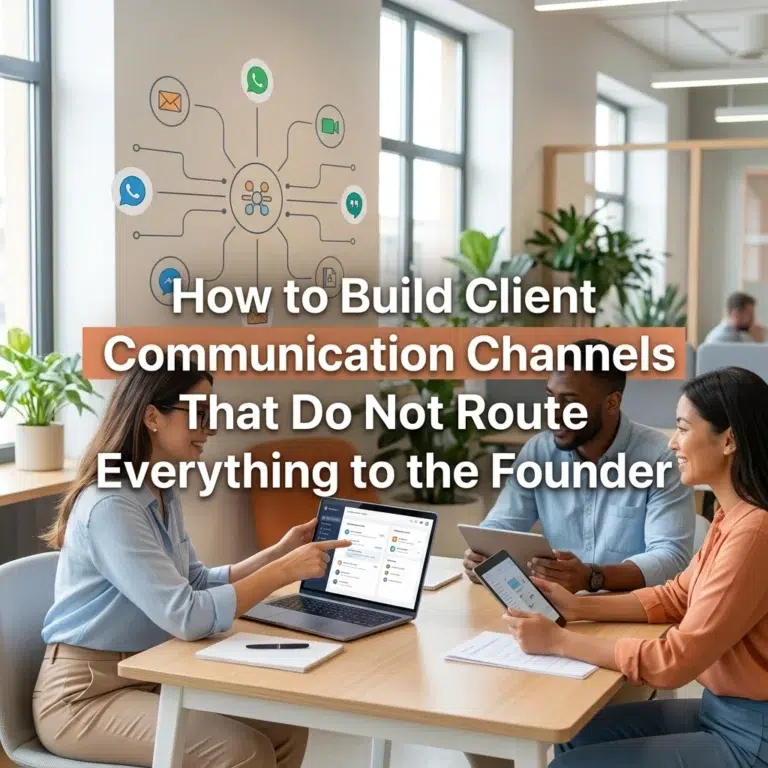
Alt text: Asynchronous communication standards and focus time blocks protecting CEO productivity after hiring COO for operations
Solution 5: Build a Self-Service Operations Manual
The fifth solution is creating a comprehensive operations manual that documents every process, policy, and procedure in your business. When you hire a COO, they build this manual so your business can run without you. This is a huge reason owners hire a COO instead of trying to duct-tape documentation together. If you hire a COO, the manual becomes a living system with an owner, not a one-time file you forget exists.
What It Looks Like
Your COO creates a 50-70 page operations manual covering:
- Company vision, mission, and values
- Organizational structure and reporting lines
- Department-specific processes and workflows
- Client lifecycle from onboarding to offboarding
- Financial procedures and approval workflows
- Technology stack and system access protocols
- Emergency procedures and contingency plans
This is not a document that sits in Google Drive and gets ignored. This is the operating system for your business. Every team member references it. Every new hire reads it. Every process change updates it.
Why It Happens
You never built this because you thought your business was too small or too fast-changing. The truth: businesses that scale have operations manuals. Businesses that stay stuck do not.
When you hire a COO, they have the operational expertise to build this manual in 8-12 weeks while you focus on revenue growth. That timeline is realistic because you hire a COO to run the project end to end. If you do not hire a COO, the same manual often takes 6-12 months and still ends up incomplete.
How to Handle It
Phase 1 (Weeks 1-4): Your COO interviews department heads and documents current-state processes. They map workflows, identify gaps, and capture tribal knowledge.
Phase 2 (Weeks 5-8): They write the operations manual. Each section follows a standard format: Purpose, Process Steps, Decision Criteria, Troubleshooting, and Success Metrics.
Phase 3 (Weeks 9-12): They train your team on the manual. They implement version control and update protocols. The manual becomes the source of truth for how your business operates.
Maintenance: Your COO updates the manual quarterly. Process changes are documented within 48 hours. The manual evolves with your business instead of becoming outdated.
Goal: Your business operates consistently whether you are present or not.
Red Flags You Are Not Ready to Hire a COO
Before you hire a COO, assess these red flags. Yes, I know this is ironic in a post telling you to hire a COO, but timing matters when you hire a COO:
- You are below $30K/month in revenue: You cannot afford a fractional or full-time COO yet. Focus on basic documentation first.
- You have not documented any processes: A COO needs something to work with. If you have zero systems, start with basic SOPs before hiring.
- You want someone to just execute your ideas: That is an integrator or operations manager, not a COO. A COO builds systems and strategy, not just execution.
- You are not willing to delegate decision-making: If you need to approve everything, you do not need a COO. You need a personal assistant.
- You do not have budget for $3K-$8K/month (fractional) or $120K-$200K/year (full-time): Hiring the wrong level of support wastes money and creates frustration.
Honest assessment: If you have fewer than five employees and less than $50K/month revenue, hire an operations manager first. Build basic systems. Then hire a COO when you are scaling past $100K/month and need strategic operational leadership.
Success Metrics After You Hire a COO
How do you know your investment is working after you hire a COO? Track these metrics. If you hire a COO and you cannot measure the shift, you are guessing:
Time Reclaimed:
- Interruptions drop by 60-80% in first 90 days
- Your focus time increases from 10-12 hours/week to 25-30 hours/week
- New hire training time drops from 60-80 hours/year to 2-5 hours/year
Knowledge Systems:
- 80% of team questions answered by knowledge base without your involvement
- Onboarding time reduces from 90 days to 30 days for new hires to reach productivity
- Decision-making happens at appropriate levels without constant escalation
Operational Consistency:
- Processes are documented and followed 90%+ of the time
- Client delivery quality improves and becomes predictable
- Team operates effectively during your absence (vacation, strategic work)
Revenue Impact:
- Your available time for revenue-generating activities increases 150-200%
- You close more deals because you have focus time for sales conversations
- Operational costs decrease 10-20% due to process efficiency
Timeline: Expect measurable improvements in 60-90 days when you hire a COO. Full transformation takes 6-12 months as systems mature. When you hire a COO, the first 60-90 days should feel like pressure coming off your calendar, not more chaos. If you hire a COO and your week gets worse, you likely have a mismatch in scope or authority.

Alt text: Business operations manual and knowledge systems created by fractional COO showing documented processes and procedures
How Clarity Ops Engine Fixes the Human Search Engine Trap
At Clarity Ops Engine, we specialize in building knowledge infrastructure for growing businesses stuck in the Answer Machine cycle. When you work with us as your fractional COO, we implement the five proven solutions outlined in this post. If you want to hire a COO but you are not ready for a full-time salary, this is the gap we fill. You hire a COO level brain and execution, without hiring a full-time headcount.
Here is exactly what we do:
Phase 1: Knowledge Audit (Weeks 1-2)
We identify every recurring question your team asks. We interview you and your department heads. We capture the top 50-80 questions consuming your time. We document current-state chaos so we know exactly what needs systematizing.
Phase 2: Knowledge Base Build (Weeks 3-6)
We build your centralized knowledge base. We write SOPs for repeated tasks. We document policies for client exceptions. We create decision-making frameworks that clarify authority levels. We record training videos so new hires learn without interrupting you.
Deliverables:
- Searchable knowledge base with 50-100 documented answers
- Decision authority matrix for three levels of approval
- 30-day onboarding program with video walkthroughs
- Operations manual covering core business processes
Phase 3: Implementation and Training (Weeks 7-8)
We train your team to use the knowledge base. We implement “search first, ask second” culture. We establish asynchronous communication standards. We protect your focus time with calendar blocks and communication protocols.
Phase 4: Maintenance and Evolution (Ongoing)
We update documentation as processes change. We add new content based on emerging questions. We conduct quarterly knowledge audits. Your systems evolve with your business instead of becoming outdated.
The result: You reclaim 15-20 hours per week. Your team operates independently. New hires reach productivity in 30 days instead of 90 days. You scale past $100K/month without becoming the bottleneck.
Our clients typically see 60-80% reduction in interruptions within 60 days. We do not just tell you to hire a COO and build systems. We are the COO who builds the systems for you. If your goal is to hire a COO who will actually implement, document, and train, that is exactly how we operate. You can hire a COO in theory, or you can hire a COO who will get it done.
This is hands-on implementation, not consulting advice.
Stop Being the Answer Machine
You have two choices.
Option 1: Keep answering the same questions. Spend 15-20 hours per week as your team’s human search engine. Watch new hires take 90 days to get productive. Stay stuck at your current revenue because your time is consumed by interruptions instead of growth.
Option 2: Hire a COO who builds knowledge infrastructure. Reclaim your time. Scale your business. Build systems that run without you. This is the option where you hire a COO and stop negotiating with chaos. You hire a COO so the business can grow without eating you alive.
The pattern is consistent: Businesses that scale past $100K/month have documented knowledge systems. Businesses that stay stuck keep answers locked in the founder’s brain.
If you are tired of being interrupted fifty times per week with questions you have already answered, it is time to systemize your knowledge.
Book a 30-minute strategy session and we will show you exactly how to build the five proven knowledge solutions covered in this post. We will audit your current question patterns and map out a 90-day plan to eliminate the interruption cycle.
Schedule here: https://calendly.com/sdrobinson8/30min
Or you could still be answering “Where is the client contract template?” for the fifteenth time next month.
Your choice.
Related Blogs
Looking for more insights on building operational systems? Check out these related posts:
- Systemize a Small Business: 7 Critical Growth Steps
- How to Fix Chaotic Operations in 12 Weeks
- Founder Opportunity Cost: 5 Hidden Revenue Killers
- Scaling from 50K to 100K a Month: 8 Essential Systems
- Centralized Knowledge Management: The Missing System in Growing Businesses
- How to Build a Company Wiki That Your Team Actually Uses
- Extracting Founder Tribal Knowledge: 5 Steps to Scale
- From Slack Chaos to Structured Systems: Replacing Verbal Ops With Documentation
- Why Your SOPs Are Not Reducing Questions (And What to Fix)
- Decision Fatigue Is Killing Your Focus: How to Design Authority Levels
- Founder Bottleneck Syndrome: Signs You’re the Operational Ceiling
- When to Hire a COO vs an Operations Manager
- Why Delegation Fails Without Decision Frameworks
- Micro-Decisions vs Strategic Decisions: What CEOs Should Actually Own
- Why Your New Hires Take 90 Days to Get Productive
- How to Build a 30-Day Onboarding System That Runs Without the Founder
- Training That Scales: Building Repeatable Learning Systems
- Stop Re-Teaching the Same Things: Document Once, Train Forever
- Asynchronous Communication: How to Protect 20+ Hours of CEO Focus Time
- Slack Is Not a Knowledge Base: Why Instant Messaging Kills Scale
- Focus Blocks, Office Hours, and Escalation Rules: CEO Time Protection Framework
- Are You Ready to Hire a COO? Revenue-Based Readiness Signals
- Scaling Past $100K/month: 5 Proven Ways to Stop Founder Bottlenecks
- Why Revenue Growth Collides With Operational Maturity
- The Interruption Tax: Calculating the Real Cost of Constant Questions
- Founder Opportunity Cost: What 15 Hours Per Week Is Really Worth
- How Operational Infrastructure Increases Profit Margins 10–20%
- The 90-Day Knowledge Infrastructure Build (What Actually Happens)
- What Changes in the First 30 Days After You Hire a COO
- Why Most Businesses Stay Stuck at $75K/Month
- Cleanup Mode vs Scale Mode: Which One Are You In?
- Human Search Engine Syndrome: The Founder’s Silent Growth Killer
- Knowledge Infrastructure vs Task Delegation: The Real Difference
- Operational Architecture: The Backbone of Scalable Companies