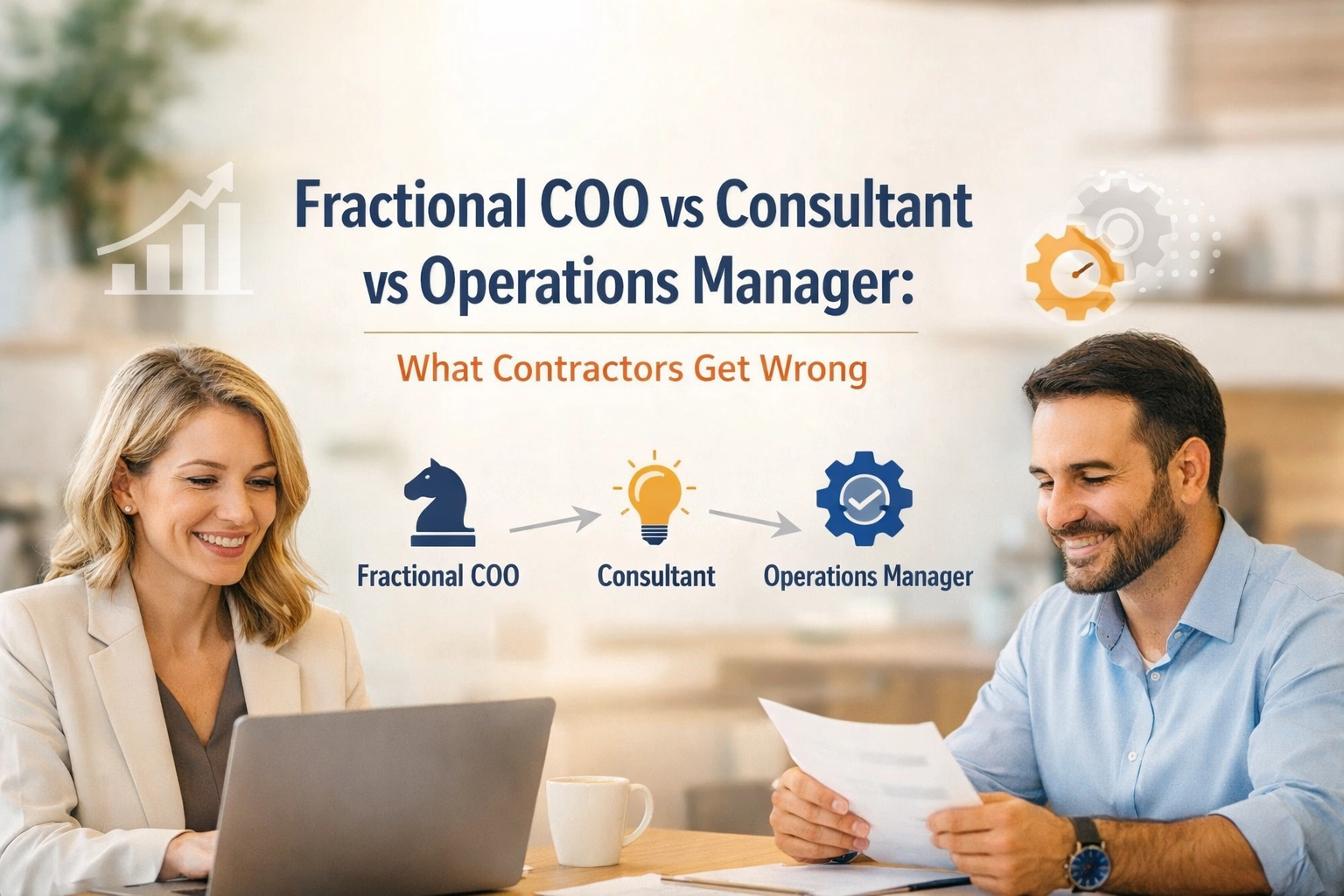
Fractional COO vs Consultant vs Operations Manager: 3 Critical Mistakes
You are working seventy hours a week because your team cannot make a single decision without your input.
Let me be direct. You are trying to hire your way out of chaos but you are choosing the wrong person for the job. Most contractors think a Fractional COO vs Consultant vs Operations Manager choice is just about price. It is not. Here is what nobody tells you. Hiring the wrong one will actually increase your workload instead of reducing it. I have seen this pattern dozens of times. You hire a manager to take work off your plate. Six months later you are still managing the manager and the original problems are still there.
The reality is that your business is stuck because of structural constraints. You do not just need more hands. You need a different level of thinking. You need to understand the fundamental differences in a Fractional COO vs Consultant vs Operations Manager before you sign another offer letter or contract.
I know because I have watched founders spend fifty thousand dollars on the wrong hire. They end up right back where they started. Only now they are more frustrated and have less cash. This post will break down exactly which one you need based on your revenue and your current level of chaos. We will look at why the Fractional COO vs Consultant vs Operations Manager debate matters for your bottom line.
The Consultant: The Architect Who Does Not Build
A consultant is a professional observer. They come into your business and look at your books. They interview your team. They gather data for three weeks. Then they give you a beautiful sixty page operations manual. In the Fractional COO vs Consultant vs Operations Manager landscape the consultant is the architect. They draw the blueprints.
The problem is that blueprints do not build houses. Most contractors have a stack of “Standard Operating Procedures” sitting in a digital folder that no one ever opens. That is the result of hiring a consultant when you actually needed an implementer. The consultant identifies the problem but they do not stay to fix it. They provide advice but they do not provide execution.
The pattern:
- They audit your current state.
- They create a plan for future state.
- They leave the implementation to you.
If you are already overwhelmed you do not need a plan. You need someone to execute the plan. When comparing a Fractional COO vs Consultant vs Operations Manager remember that a consultant adds to your to-do list. They tell you what is wrong. Now you have to find the time to fix it. If you have no time then the consultant was a waste of money.
The logic:
A consultant is best when you have a high-performing team that just needs a new map. If your team is struggling to follow basic instructions a consultant will not help you. You cannot solve a leadership gap with a PDF manual. In the world of Fractional COO vs Consultant vs Operations Manager the consultant is the most passive option.

The Operations Manager: The Foreman of the Office
An Operations Manager is a tactical hire. They are the person who keeps the trains running on time. In the Fractional COO vs Consultant vs Operations Manager hierarchy the Operations Manager sits at the medium level. They handle project management. They oversee the office staff. They make sure the technicians have what they need for the day.
This is a great hire for a business doing between five hundred thousand and one million dollars a year. You need someone to handle the day-to-day friction. But here is the reality check. An Operations Manager follows the existing system. They do not build new ones. If your existing system is broken an Operations Manager will just manage the broken system more efficiently.
What it looks like:
- They manage the schedule.
- They handle basic hiring and firing.
- They report on weekly numbers.
In the Fractional COO vs Consultant vs Operations Manager comparison the Operations Manager is an employee. They look to you for the vision. They look to you for the strategy. If you are still the one deciding how the company should scale then you are still the bottleneck. You have simply hired someone to help you stay in the bottleneck longer.
Common mistake:
Contractors hire an Operations Manager and expect them to act like an owner. They expect the manager to fix the profit margins and find new revenue streams. That is not their job. They are there to execute your instructions. If you stop giving instructions the work stops. This is a key distinction in the Fractional COO vs Consultant vs Operations Manager debate.
The Fractional COO: The Strategic Partner
A Fractional COO is a different animal. They are not an employee and they are not just an advisor. They are an executive partner. In the Fractional COO vs Consultant vs Operations Manager spectrum the Fractional COO is the person who builds the engine. They do not just drive the car. They look at the structural integrity of your business.
They focus on high-level strategic planning. They focus on cross-functional team leadership. They look at profit optimization. They identify the decision bottlenecks that are keeping you from scaling. A Fractional COO brings an outside perspective with an inside level of commitment. They are time-bound and precision-focused.
The pattern:
- They identify structural constraints.
- They remove delegation failures.
- They build accountability gaps.
- They drive the execution of the strategy.
When comparing a Fractional COO vs Consultant vs Operations Manager understand that the COO is there to replace your brain in the operations. They do not ask you what to do. They tell you what needs to be done. They take the weight of the “how” off your shoulders. This is why a Fractional COO vs Consultant vs Operations Manager choice is so critical for founders who want to step back from the daily grind.
Goal:
To build an operating model that does not require the founder to be present for every single decision.

What Contractors Get Wrong About These Roles
The biggest mistake I see is misidentifying a Fractional COO as a cheaper part-time hire. A Fractional COO is not a discounted version of a full-time executive. They are a high-level intervention. You are paying for their experience and their ability to see what you cannot see. In the Fractional COO vs Consultant vs Operations Manager decision process you must look at the value of the outcome not the cost of the hour.
Another error is confusing planning with implementation. Many contractors hire a consultant and get frustrated when things do not change. The consultant did their job. You just did not have the capacity to do yours. This is where The Clarity Transformation comes into play. It bridges the gap between having a plan and actually seeing it work in the field.
The reality:
You cannot hire your way out of chaos if you do not know where the chaos is coming from. If you hire an Operations Manager into a chaotic environment they will burn out in six months. If you hire a consultant they will give you a list of things you do not have time to do. If you hire a Fractional COO you are hiring someone to clean up the mess.
The truth:
Hiring before clarity exists always fails. You need to understand your true operational constraints. Are you losing money on labor? Is your sales process disconnected from your production? Is your overhead too high? A Fractional COO vs Consultant vs Operations Manager choice should be based on these answers.
When to Choose Each Role
Let’s be specific. You need to know which stage of growth you are in. Your revenue and your team size dictate your needs in the Fractional COO vs Consultant vs Operations Manager framework.
Choose a Consultant if:
- You have a specific problem to solve like tax strategy or a legal audit.
- You have a strong internal team that can take a plan and run with it.
- You need a one-time expert opinion on a specialized topic.
Choose an Operations Manager if:
- You are doing $500K to $1M in revenue.
- You have a working system but you are tired of doing the data entry and scheduling.
- You need someone to hold the team accountable to existing rules.
Choose a Fractional COO if:
- You are scaling from 50K to 100K a month or more.
- Your business feels like it is about to break under the weight of new work.
- You want to transition from a “working owner” to a “true CEO.”
- You need a Clarity Operational Partnership to drive actual change.
In the Fractional COO vs Consultant vs Operations Manager battle the Fractional COO is for the owner who is ready to let go of the steering wheel. It is for the person who wants to focus on growth while someone else ensures the engine can handle the speed.

The Cost of the Wrong Choice
What happens when you get the Fractional COO vs Consultant vs Operations Manager decision wrong? You lose more than just the salary. You lose time. If you hire an Operations Manager when you need a COO you will spend the next year frustrated that they “don’t think like an owner.” You will still be answering text messages at nine o’clock at night.
If you hire a consultant when you need a manager you will have a very expensive binder on your shelf. You will feel guilty every time you look at it. You will think that you are the problem. But the reality is that the intervention was wrong for your current stage.
The math:
- Consultant cost: $5,000 – $15,000 for a project.
- Operations Manager cost: $60,000 – $90,000 per year plus benefits.
- Fractional COO cost: $3,000 – $7,000 per month for high-level results.
In the Fractional COO vs Consultant vs Operations Manager comparison the Fractional COO often provides the highest ROI because they fix the structural issues that cause waste. They find the three thousand dollars a month you are losing in labor efficiency. They find the five thousand dollars a month you are losing in unbilled change orders.
How The Clarity Transformation Fixes the Chaos
At Clarity Ops Engine we do not just give advice. We provide a Clarity Operational Partnership. This is the middle ground that contractors actually need. We act as the Fractional COO to build the systems. Then we help you transition those systems to an Operations Manager.
We look at your business through a specific lens. We identify the “Hand-Off Tax” where information gets lost between sales and production. We look at your “Operational Debt” which is the collection of all the shortcuts you took when you were smaller. These shortcuts are now costing you money. In the Fractional COO vs Consultant vs Operations Manager discussion we focus on the implementation.
The Clarity Transformation is a twelve week process. We do not take a year to show results. We identify the biggest leak in your boat and we plug it first. Then we build the pumps. By the end of the engagement your business operates with a level of predictability you have never had before.
Success metrics:
- Reduction in owner working hours by 10-20 hours per week.
- Increase in net profit margin by 5-10 percent.
- Elimination of decision bottlenecks.

Why Implementation is the Only Thing That Matters
The biggest differentiator in the Fractional COO vs Consultant vs Operations Manager world is execution. Anyone can tell you that you need better processes. Very few people can actually build them with you. A Clarity Operational Partnership means we are in the trenches with you. We are not just looking at spreadsheets. We are looking at how your guys in the field actually do the work.
If your processes are only in your head they do not exist. If they are in a manual that no one reads they do not exist. They only exist when they are the path of least resistance for your team. This is why the Fractional COO vs Consultant vs Operations Manager choice is so important. You need someone who understands how to change human behavior in a construction or service environment.
The pattern of failure:
- Step 1: Owner gets overwhelmed.
- Step 2: Owner hires a “manager” to fix it.
- Step 3: Manager asks owner what to do every day.
- Step 4: Owner fires manager and says “it’s easier to do it myself.”
We break this cycle. We do not wait for you to tell us what to do. We analyze the operation and tell you what we are going to fix. That is the power of a true Fractional COO vs Consultant vs Operations Manager strategy.
What to Expect During the First 90 Days
When you choose the right partner in the Fractional COO vs Consultant vs Operations Manager debate the first ninety days are transformative. You stop guessing and start knowing. You move from reactive chaos to proactive management.
Phase 1: Extraction.
We get the knowledge out of your head. We document how things actually get done. This is the foundation of The Clarity Transformation. We identify the gaps where money is falling through the cracks.
Phase 2: Optimization.
We fix the broken parts. We automate the repetitive tasks. We simplify the communication. In the Fractional COO vs Consultant vs Operations Manager context this is where the COO shines. We are making the business more efficient.
Phase 3: Delegation.
We train the team on the new systems. We create accountability. We ensure that if you go on vacation for two weeks the business does not stop. This is the ultimate goal of the Fractional COO vs Consultant vs Operations Manager investment.

Fractional COO vs Consultant vs Operations Manager FAQ
What is the main difference between a Fractional COO and an Operations Manager?
The main difference in a Fractional COO vs Consultant vs Operations Manager is the level of authority and strategy. A Fractional COO builds the systems and sets the strategy. An Operations Manager follows the systems and executes the daily tactics. The COO is an architect and builder. The Manager is a foreman.
Why wouldn’t I just hire a full-time COO?
A full-time COO for a service business can cost $150,000 to $250,000 per year. Most businesses scaling from 50K to 100K a month do not need forty hours a week of executive leadership. They need ten hours of high-impact leadership. In the Fractional COO vs Consultant vs Operations Manager choice the Fractional COO gives you executive talent at a fraction of the cost.
Can a consultant help me scale my roofing or electrical business?
A consultant can provide a great roadmap. However in the Fractional COO vs Consultant vs Operations Manager comparison a consultant usually lacks the implementation phase. If you do not have someone on your team who can build what the consultant recommends the plan will fail.
How do I know if I am ready for a Fractional COO?
You are ready when the “chaos” is preventing you from taking on more work. If you are turning down jobs because you cannot manage the current workload you need a system. In the Fractional COO vs Consultant vs Operations Manager decision this is the primary indicator.
What is the ROI of hiring a Fractional COO vs Consultant vs Operations Manager?
The ROI of a Fractional COO is usually found in recovered time and increased margins. If a COO saves you ten hours a week and increases your profit by 5 percent the role pays for itself in months. A manager is a cost center. A COO is a profit center.
Choosing Your Next Move
You have a choice to make. You can keep doing what you are doing and hope that things get better. Or you can admit that the current structure of your business cannot support your goals. The Fractional COO vs Consultant vs Operations Manager debate is not just academic. It is the difference between a business that owns you and a business that you own.
If you are tired of being the only person who knows how to fix a problem then you need a partner. You need someone who has seen these patterns before and knows the way out. You need a Clarity Operational Partnership to give you back your life.
Stop trying to manage the chaos. Start building a system that eliminates it. Whether you need a Fractional COO vs Consultant vs Operations Manager depends on your goals. But if you want to scale without losing your mind the choice is clear.
Let’s talk about how to fix your operations in the next twelve weeks. I have helped dozens of contractors move from chaos to clarity. I can help you too.
Ready to see how this works for your specific business?
Book a consultation here: https://calendly.com/sdrobinson8/30min
Related Blogs
- Why Your First Ops Hire Adds Work Instead of Reducing It
- The Difference Between a Written Policy and a Working Process
- Operational Debt: The Hidden Growth Killer
- You Can’t Hire Your Way Out of Chaos (Here’s Why)
- Fractional COO vs Full-Time COO: Making the Right Choice