Delivery Chaos Scorecard: 5 Critical Reasons You Are Failing
You feel like you are winning because the phone is ringing and the trucks are moving, but at the end of the month, the bank account does not reflect the effort your team put in.
Let me be direct. If you cannot tell me your order accuracy rate or your on-time shipping percentage right now, your business is running on luck. Most service founders are so busy putting out fires that they never stop to look at the wreckage. A delivery chaos scorecard is the only way to see the truth about your operations. I have seen this pattern dozens of times where a founder thinks they have a sales problem when they actually have a delivery problem. You are leaking profit through a thousand tiny holes.
Here is what nobody tells you about scaling a service business. You can sell all day long, but if your fulfillment is a mess, growth will actually kill your company. You need a delivery chaos scorecard to identify where the friction is before you try to add more volume. My recommendation is to stop guessing and start measuring. Within the next 12 weeks, you could have total visibility into your margins. The reality is that without a chaos scorecard, you are just guessing.
Why Your Business Needs A Delivery Chaos Scorecard Right Now
The pattern is always the same. A founder manages everything by feel until they hit about $50k a month. Then things start to slide. You notice that parts are missing from the trucks or that crews are arriving late to job sites. This is when the delivery chaos scorecard becomes your most valuable management tool. It moves you from “I think we are doing okay” to “I know exactly why we lost money on Tuesday.”
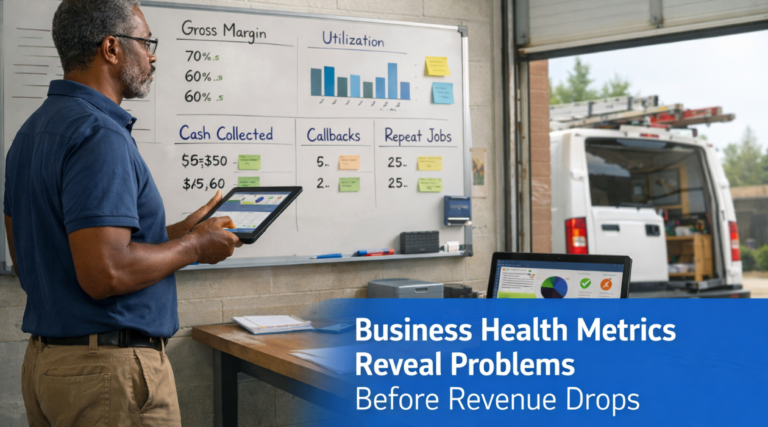
When you perform operational capacity audits, you often find that your team is working at 60 percent efficiency. That means you are paying for 40 percent of their time just to walk around and ask questions. A chaos scorecard quantifies this waste. It forces you to look at the numbers you have been avoiding. Look, you cannot fix what you do not track.
The logic is simple. If your delivery chaos scorecard shows an accuracy rate below 95 percent, you are losing at least $50 per order in rework and customer service time. That adds up to thousands of dollars every single month. By using a delivery chaos scorecard, you stop the bleeding. You start seeing the gaps in your process that were previously invisible.

The 4 Core Metrics Of A Delivery Chaos Scorecard
A real delivery chaos scorecard focuses on four specific areas: accuracy, speed, inventory, and communication. These are the pillars of a healthy service operation. If any one of these is off, the whole system feels heavy. You might think you have a “bad team,” but the chaos scorecard usually proves you have a bad system.
First, let’s talk about accuracy. World-class operations maintain an accuracy rate of 99.5 percent or higher. If your delivery chaos scorecard shows you are at 90 percent, you are failing. Every wrong part sent to a job site is a profit killer. The chaos scorecard highlights these errors so you can find the root cause. It might be a labeling issue or a training gap.
Second, the delivery chaos scorecard must track speed. This is not just about driving fast. It is about the time from the moment a client says “yes” to the moment the job is finished. If your chaos scorecard shows a lag in your scheduling, your cash flow will suffer. Speed is a byproduct of clear processes.
Third, inventory integrity is a massive part of the delivery chaos scorecard. If your systems say you have a water heater in stock but the shelf is empty, your schedule collapses. A delivery chaos scorecard tracks your cycle count accuracy. You should be aiming for 98 percent accuracy here. Anything less means you are over-ordering or losing track of your assets.
Finally, communication is the “soft” metric on the delivery chaos scorecard. How long does it take for an on-site tech to get an answer from the office? If it is more than two hours, your delivery chaos scorecard will show a breakdown in efficiency. Communication friction is the silent killer of growth.
Red Flags Your Delivery Chaos Scorecard Will Reveal
What happens when you actually run the numbers? Most founders are shocked by what their delivery chaos scorecard reveals. They realize they have been paying for “heroics” instead of systems. The reality is that if your business requires you to be a hero every day, your delivery chaos scorecard is going to be a disaster.
Common finding: your techs are self-reporting issues that should have been caught by a manager. This shows up on the delivery chaos scorecard as high cost variance. You quoted the job for 10 hours, but it took 15. Why? Without a delivery chaos scorecard, you will never know if it was a bad quote or a slow tech.
Another red flag is “phantom inventory.” This is a standard finding during operational capacity audits. Your chaos scorecard will show that you are buying parts you already own because no one can find them. This is pure profit going out the window. The delivery chaos scorecard makes this waste impossible to ignore.
The truth is that most small service businesses are operating in a state of constant emergency. A chaos scorecard turns down the volume on the noise. It tells you exactly where to focus your energy. You might find that one specific service line is dragging down your entire delivery chaos scorecard.

How The Clarity Transformation Fixes Your Scorecard
Fixing a broken operation is not about working harder. It is about changing how the work gets done. This is where The Clarity Transformation comes into play. We do not just give you a list of things to do. We implement the systems that make your delivery chaos scorecard look better every week.
The Clarity Transformation is a 12-week process designed to take the weight off the founder’s shoulders. We look at the data from your delivery chaos scorecard and build processes that eliminate the errors. We move you from reactive chaos to proactive management. By the end of The Clarity Transformation, your delivery is a predictable machine.
We start by identifying the bottlenecks that are tanking your delivery chaos scorecard. Often, it is a lack of documentation or a “hand-off tax” between departments. During The Clarity Transformation, we extract the knowledge from your head and put it into a working system. This ensures that the chaos scorecard stays green even when you are not in the office.
Moving Toward A Clarity Operational Partnership
If you want ongoing support to ensure your metrics stay on track, a Clarity Operational Partnership is the solution. This is not a consulting gig where we just give advice. A Clarity Operational Partnership means you have a fractional COO who is actually in the weeds with you. We own the delivery chaos scorecard so you can focus on high-level strategy.
In a Clarity Operational Partnership, we review your chaos scorecard every week. We look for trends and adjust the systems before they become major problems. This level of oversight is how you scale from $50k to $100k a month without burning out. The Clarity Operational Partnership provides the accountability that most founders lack.
The logic is that you should not be the one checking every invoice and every inventory count. A Clarity Operational Partnership puts a leader in place to manage those details. We use the delivery chaos scorecard as our roadmap for improvement. If the numbers aren’t moving, we change the strategy.

Scaling Your Operations With A Delivery Chaos Scorecard
Scale is just a multiplier. If your delivery chaos scorecard is bad at $1 million in revenue, it will be a catastrophe at $5 million. You cannot hire your way out of a bad delivery chaos scorecard. In fact, adding more people to a broken system just creates more chaos.
The pattern: founders think they need more techs, but the chaos scorecard shows they actually need better routing. You might be spending 20 percent of your labor cost on drive time. A delivery chaos scorecard helps you see that you are losing money on “quick jobs” across town. You need to use operational capacity audits to find these hidden leaks.
Once your chaos scorecard is stable, you can scale with confidence. You know exactly what it costs to deliver your service. You know your margins are protected. This is the difference between a business that owns you and a business that you own. A healthy delivery chaos scorecard is the foundation of a sellable asset.
Common Mistakes When Building Your Scorecard
You might think you can just track everything in a spreadsheet, but that is a mistake. The chaos scorecard needs to be automated as much as possible. If it takes you four hours to update your delivery chaos scorecard, you will eventually stop doing it. The reality check is that manual tracking is just another form of operational debt.
Another common mistake is tracking too many things. Your delivery chaos scorecard should focus on the metrics that actually drive profit. Do not get distracted by “vanity metrics” that don’t help you make decisions. Stick to the core pillars of the delivery chaos scorecard. Accuracy and speed are usually enough to start.
Don’t wait for the “perfect” time to start your delivery chaos scorecard. There is no such thing. Your business will always be a little bit messy. The point of the delivery chaos scorecard is to see the mess clearly. Start with whatever data you have today and refine it over time.
FAQ: Understanding The Delivery Chaos Scorecard
How often should I run a delivery chaos scorecard?
You should review your delivery chaos scorecard weekly. This allows you to catch errors before they compound into major losses. Monthly reviews are too slow for a fast-moving service business.
What is the most important metric in the delivery chaos scorecard?
Order accuracy is usually the most critical metric. If you aren’t delivering what you promised, nothing else matters. A high accuracy score on your chaos scorecard is the foundation of customer trust.
Can a delivery chaos scorecard help with labor costs?
Yes. By tracking billable hours versus total hours, your chaos scorecard reveals your real utilization rate. Most founders find they are only 50-60 percent billable, which is a major profit leak.
Why do founders ignore the results of a chaos scorecard?
Honest assessment: the numbers can be painful to see. It is easier to believe things are “fine” than to face the reality of a failing delivery chaos scorecard. However, ignoring the data only delays the eventual breakdown.
Does a chaos scorecard work for small teams?
It is actually more important for small teams. When you have fewer resources, you cannot afford to waste any of them. A delivery chaos scorecard ensures your small team is working on the right things.
What happens if my delivery chaos scorecard shows I am failing?
This is actually good news because you finally have a map to fix the problem. You can start a process like The Clarity Transformation to systematically address each red flag on your delivery chaos scorecard.
Your Binary Choice For Operational Health
At this point, you have two options. You can continue managing by feel and hope that the chaos doesn’t eventually sink your ship. Or, you can implement a delivery chaos scorecard and finally get the visibility you need to scale. Look, the chaos isn’t going to fix itself. It only gets worse as you grow.
The reality is that you are either building a system or you are the system. If you are the system, you can never stop working. A delivery chaos scorecard is your first step toward freedom. It gives you the data you need to stop being a hero and start being a CEO. Within 12 weeks, your business could look completely different.
If you are tired of the constant fires and the missing profits, let’s talk. We specialize in taking service companies from chaos to clarity. Whether you need The Clarity Transformation to overhaul your processes or a Clarity Operational Partnership to lead your team, we have a path for you.
Stop guessing about your margins. Start measuring with a chaos scorecard. Your future self will thank you for the clarity.
Click here to schedule a 30-minute consultation to fix your delivery chaos scorecard