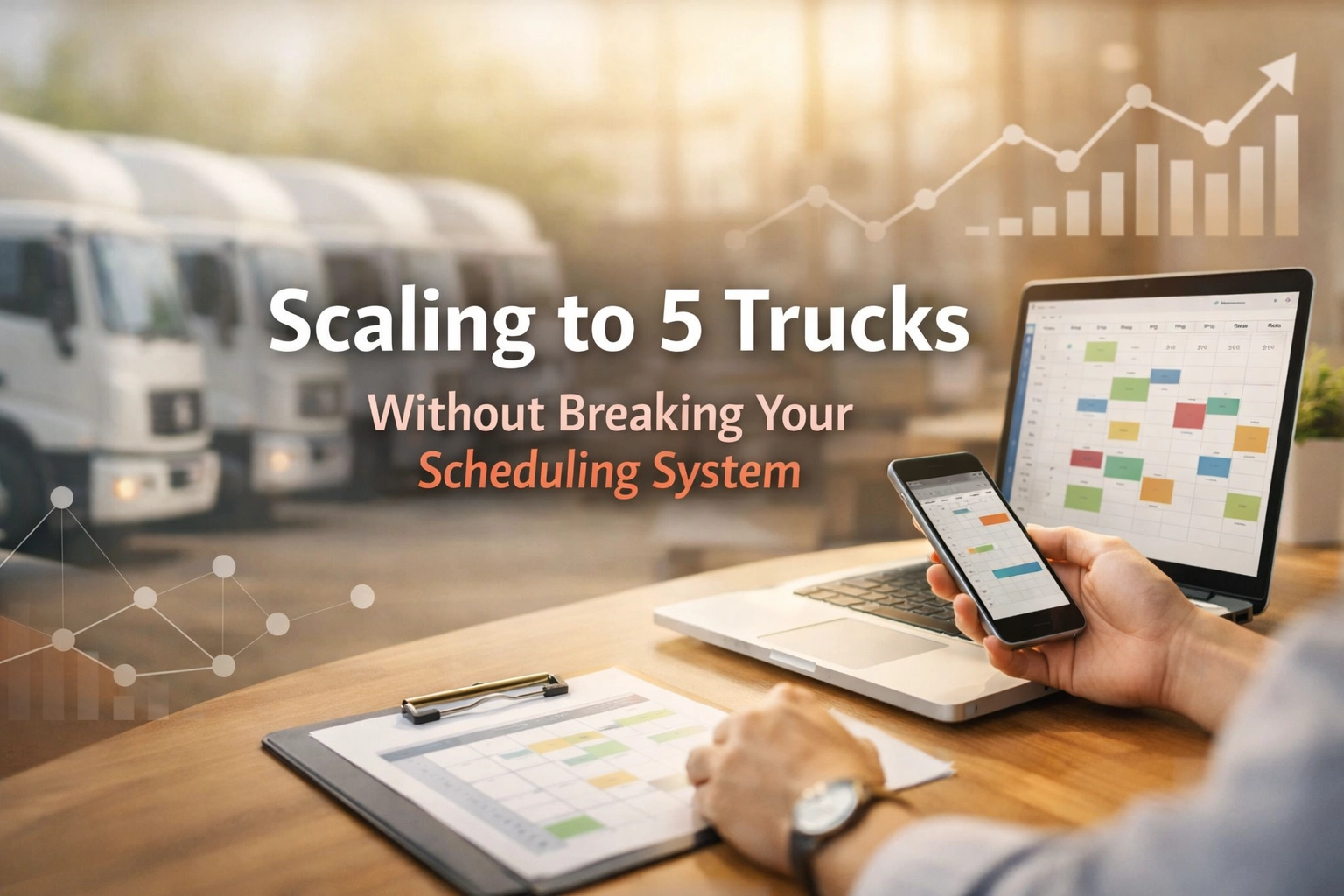
Scaling to 5 Trucks: 5 Proven Ways
You feel like you are playing a high-stakes game of Tetris every morning, but the blocks are $100,000 service vehicles and the game board is a whiteboard that is rapidly running out of space.
Let me be direct. Scaling to 5 Trucks Without Breaking Your Scheduling System is the exact moment where your “gut feeling” management will fail you. I have seen this pattern dozens of times in field service businesses. When you have two or three trucks, you can keep the schedule in your head. You know where Joe is, you know what Mrs. Smith needs, and you know how long the install should take. But when you hit that fifth truck, the math changes. The complexity does not just double. It grows exponentially.
Here is what nobody tells you: the jump from three trucks to five trucks is the hardest leap in the service industry. Most owners think the answer is just working harder or answering the phone faster. It isn’t. The answer is Scaling to 5 Trucks Without Breaking Your Scheduling System through rigid HVAC dispatch optimization and documented dispatcher scheduling SOPs. If you try to push past five trucks without these, you will not grow. You will just break. You can have a fully professionalized operation in 12 weeks, but you have to stop doing things the old way.
Why Scaling to 5 Trucks Without Breaking Your Scheduling System Is the Ultimate Growth Test
The logic is simple. At three trucks, you are still a “small” shop. You can pivot on a dime. At five trucks, you are becoming a fleet. This is where the “Chaos Tax” starts to eat your profit. Scaling to 5 Trucks Without Breaking Your Scheduling System requires a shift from personal oversight to systematic control.
The pattern:
- You add a fourth truck and things start to feel tight.
- You add a fifth truck and suddenly parts are being forgotten.
- Your best technician is stuck in traffic across town while a high-value emergency call sits in his backyard.
- You spend four hours a day on the phone just coordinating who goes where.
This is the reality of growth without systems. Scaling to 5 Trucks Without Breaking Your Scheduling System means you have to stop being the “Chief Everything Officer” and start being the architect of your operations. If you are still the only one who knows the “logic” behind the schedule, you are the bottleneck. You are the reason the company cannot grow.
Goal: To move the scheduling logic out of your brain and into a repeatable system that a dispatcher can run without calling you every ten minutes.
The Core Elements of HVAC Dispatch Optimization
When we talk about HVAC dispatch optimization, we are talking about maximizing your “wrench time.” Every minute a truck is idling or driving is a minute you are not making money. Scaling to 5 Trucks Without Breaking Your Scheduling System requires you to look at your service area differently. You cannot afford to send Truck 1 to the north side of town and Truck 2 to the south side if their calls could have been swapped.
What it looks like:
- Route Density: Grouping calls by zip code to minimize drive time.
- Skill Matching: Ensuring the tech with the highest conversion rate is on the biggest potential sales call.
- Parts Staging: Ensuring the truck is stocked for the specific jobs on the schedule before it leaves the shop.
Scaling to 5 Trucks Without Breaking Your Scheduling System is impossible if your dispatch is reactive. Reactive dispatching is waiting for the phone to ring and sending the first available guy. Proactive HVAC dispatch optimization is looking at the board 48 hours in advance and “shuffling the deck” to ensure maximum efficiency.

Implementing Dispatcher Scheduling SOPs to Prevent Operational Rot
You might think that hiring a dedicated dispatcher solves the problem. It doesn’t. If you hire a dispatcher but don’t give them dispatcher scheduling SOPs, you have just moved the chaos from your desk to theirs. They will make the same mistakes you did, but they won’t have your years of experience to “feel” their way out of it.
The honest answer: a dispatcher without an SOP is just an expensive secretary.
Scaling to 5 Trucks Without Breaking Your Scheduling System requires a manual for how to handle the board. This manual should answer questions before they are asked.
- What happens when a technician runs over on a job?
- Which customers get priority during a heatwave?
- How do we handle “no-shows” without blowing up the afternoon schedule?
Your dispatcher scheduling SOPs should include a “Triage Framework.” Not every call is equal. Scaling to 5 Trucks Without Breaking Your Scheduling System means teaching your staff how to prioritize high-margin work and maintenance agreement customers over one-off “tire kickers.”
How The Clarity Transformation Professionalizes Your Field Service Operations
This is where most owners get stuck. They know they need systems, but they are too busy running the business to build them. This is why I created The Clarity Transformation. We don’t just give you a list of things to do. We go into the guts of your business and build the HVAC dispatch optimization protocols for you.
When you engage in a Clarity Operational Partnership, we start by looking at your current data. Most owners who are struggling with Scaling to 5 Trucks Without Breaking Your Scheduling System are actually losing 15-20% of their billable capacity to poor scheduling. That is the equivalent of having one truck sit idle all day, every day.
The Clarity Transformation is designed to find that leaked revenue and plug the hole. We implement the dispatcher scheduling SOPs that allow you to step away from the phones. Imagine waking up on a Monday morning and knowing the schedule is set, the techs know where they are going, and you don’t have to check the GPS every thirty seconds. That is what a Clarity Operational Partnership provides.
Moving From Chaos to Control With a Clarity Operational Partnership
Look, the “Busy but Broke” trap is real. It happens when your revenue goes up but your overhead climbs even faster because your systems are inefficient. Scaling to 5 Trucks Without Breaking Your Scheduling System is the only way to avoid this trap.
During The Clarity Transformation, we focus on three specific areas:
- Technology Stack: Ensuring your FSM (Field Service Management) software is actually being used correctly, not just as a digital notepad.
- Communication Loops: Establishing exactly how and when dispatch talks to techs.
- Performance Metrics: Tracking the “Jobs per Day” and “Revenue per Lead” so you know if the system is working.
A Clarity Operational Partnership is not a “consultancy” where we leave you with a 50-page PDF and a “good luck” wish. We are operational partners. We help you hire the right dispatcher or train the one you have. We build the dispatcher scheduling SOPs alongside your team. This is hands-on implementation.

The ROI of Scaling to 5 Trucks Without Breaking Your Scheduling System
The math is simple. If HVAC dispatch optimization saves each of your 5 techs just 30 minutes of drive time per day, you have gained 2.5 hours of production daily. Over a 5-day week, that is 12.5 hours. At a $200 hourly rate, that is $2,500 a week in “found” money. That is $130,000 a year.
Scaling to 5 Trucks Without Breaking Your Scheduling System literally pays for itself.
By the end of The Clarity Transformation, you won’t just have 5 trucks. You will have a scalable engine. You will have the infrastructure to go to 10 trucks or 20 trucks because the foundation is solid. This is why a Clarity Operational Partnership is an investment, not an expense. You are buying back your time and securing your profit margins.
The reality: you can keep doing it yourself and stay capped at 3-4 trucks while burning out. Or you can commit to Scaling to 5 Trucks Without Breaking Your Scheduling System and finally build the business you envisioned when you started.
Red Flags Your Scheduling Is Already Broken
Before you add that 5th truck, look for these warning signs:
- Technicians are calling the office more than three times a day for “clarification.”
- Your “Drive Time” percentage is higher than 25% of the total workday.
- You are consistently missing arrival windows for your “preferred” customers.
- The dispatcher (or you) feels “overwhelmed” by 10:00 AM.
- You have no written dispatcher scheduling SOPs that a stranger could follow.
If you see these red flags, Scaling to 5 Trucks Without Breaking Your Scheduling System is currently impossible. You are adding fuel to a fire that is already out of control. You must fix the internal mechanics first.
Phase 1: The Audit of Your HVAC Dispatch Optimization
The first step in The Clarity Transformation is the Audit. We look at the last 30 days of your schedule. We look for “zigzagging” where trucks are crossing paths. We look at “dead time” between jobs.
Common findings:
- Techs are going home for lunch or parts because the schedule wasn’t tight.
- Two trucks are in the same neighborhood at different times of the day.
- Small jobs are being scheduled in the middle of the day, blocking out the possibility of larger, high-margin installs.
Scaling to 5 Trucks Without Breaking Your Scheduling System starts with data, not guesses. Once we have the data, we can build the HVAC dispatch optimization plan.

Phase 2: Building Your Custom Dispatcher Scheduling SOPs
In Phase 2, we document everything. We create the “If/Then” logic for your office.
- If a tech finishes early, then they call the “On-Deck” customer.
- If an emergency call comes in, then we pull the tech with the shortest remaining time on their current job.
These dispatcher scheduling SOPs become the law of the land. They remove the emotional stress from the dispatcher. They no longer have to worry about making you mad because they followed the protocol you approved. Scaling to 5 Trucks Without Breaking Your Scheduling System is about creating a predictable environment for your team.
Phase 3: The Rollout and Training
The final phase of a Clarity Operational Partnership is the rollout. We don’t just dump new rules on your techs. We explain the “why.” We show them how HVAC dispatch optimization helps them get home earlier and make more in performance pay because they are more efficient.
Scaling to 5 Trucks Without Breaking Your Scheduling System requires buy-in from the field. When they see that the new dispatcher scheduling SOPs mean less time fighting traffic and more time doing the work they are good at, the “mutiny” factor disappears.
Common Questions About Scaling to 5 Trucks Without Breaking Your Scheduling System
How much does HVAC dispatch optimization really matter for a small fleet?
It matters more for a small fleet than a large one. A 50-truck fleet can absorb a few hours of waste. A 5-truck fleet cannot. One inefficient truck represents 20% of your total revenue capacity. Scaling to 5 Trucks Without Breaking Your Scheduling System is the difference between a 15% net profit and a 5% net profit.
Can I use software to handle my dispatcher scheduling SOPs?
Software is a tool, not a system. If you put garbage data into a high-end FSM, you will get garbage results. You must define your dispatcher scheduling SOPs on paper first. Only then can you automate them with software. Scaling to 5 Trucks Without Breaking Your Scheduling System is about the logic, not the app.
What is the biggest mistake owners make when scaling to 5 trucks?
The biggest mistake is thinking they need another office person before they need a better system. They hire a second dispatcher because the first one is “stressed,” but both dispatchers are just working inefficiently. Scaling to 5 Trucks Without Breaking Your Scheduling System usually requires better processes, not more payroll.
How long does it take to implement HVAC dispatch optimization?
With The Clarity Transformation, we typically see significant results in 4 to 6 weeks, with full systemization complete by week 12. It takes time for the “muscle memory” of the team to change, but the financial impact is almost immediate.
Will my technicians hate these new dispatcher scheduling SOPs?
Technicians hate chaos. They hate being sent to a job only to find out it was canceled, or being sent 40 miles away at 4:30 PM. Good technicians love Scaling to 5 Trucks Without Breaking Your Scheduling System because it makes their day predictable and organized.
The Reality of Your Next Growth Phase
You are at a crossroads. You can continue to “muscle” your way through the day, staying late to fix the schedule and waking up at 5:00 AM to answer tech questions. Or you can decide that Scaling to 5 Trucks Without Breaking Your Scheduling System is a priority for your sanity and your bank account.
The Clarity Transformation is the bridge between where you are now (overwhelmed and plateaued) and where you want to be (profitable and free). A Clarity Operational Partnership gives you the professional-grade systems that the big franchises use, but tailored for your independent business.
Don’t let your scheduling system be the ceiling of your success. Scaling to 5 Trucks Without Breaking Your Scheduling System is possible, but it won’t happen by accident. You have to build it.
The honest answer: if you don’t fix this now, adding a 6th or 7th truck will feel like a nightmare, not a victory.
Let’s Fix Your Operations
If you are tired of the daily scheduling headache and ready for real HVAC dispatch optimization, let’s talk. I have helped businesses just like yours navigate Scaling to 5 Trucks Without Breaking Your Scheduling System without losing their minds.
You don’t need more “hustle.” You need better engines.
Book your 30-minute Clarity Consultation here
Related Blogs
- The Foreman Playbook: Standardizing Execution Across Crews
- HVAC Scheduling Chaos: Why Your Best Technicians Feel Unproductive
- Operational Dashboards: Measuring What Actually Changes Behavior
- The 70-80 Percent Rule for Roofing Contractors Who Want Less Chaos
- When to Hire (or Promote) an Operations Manager in a Service Business
- How to Scale a Service Business From 1 Truck to 5
- What to Fix Before Adding Your Second Service Truck
- Why More Trucks Do Not Always Mean More Profit
- How to Know When Your Business Is Ready for Another Truck
- The Hidden Costs of Expanding a Service Fleet
- How to Calculate the Revenue Each Truck Needs to Produce
- Why Fleet Growth Exposes Broken Business Processes
- How to Build Systems Before Expanding Your Fleet
- What Every New Service Truck Should Have Before Its First Job
- How to Standardize Tools and Inventory Across Multiple Trucks
- Why Technicians Waste Time Looking for Parts and Equipment
- How to Create a Restocking System for Service Vehicles
- How to Reduce Lost Tools Across a Growing Fleet
- The Best Way to Assign Jobs Across Multiple Trucks
- How Poor Scheduling Reduces Revenue per Truck
- How to Improve Route Planning for Field Service Teams
- Why Adding Technicians Can Create More Work for the Owner
- How to Train New Technicians Without Slowing Down Your Best Employees
- What to Document Before Hiring Your Next Field Technician
- How to Create Consistent Service Across Every Truck
- Why Customers Have Different Experiences With Different Technicians
- How to Build a Quality-Control Process for Field Service Work
- How to Track Technician Performance Without Micromanaging
- What Service Businesses Should Measure for Each Truck
- How to Increase Revenue per Truck Without Adding More Jobs
- The Difference Between a Busy Truck and a Profitable Truck
- How Callbacks and Rework Hurt Fleet Profitability
- How to Reduce Repeat Visits in a Service Business
- Why Your Office Systems Must Grow With Your Fleet
- How to Improve Communication Between Dispatchers and Technicians
- When a Growing Service Business Needs a Dispatcher
- When to Hire a Service Manager Instead of Another Technician
- How to Build a Field Service Business That Runs Without the Owner
- Why Owners Become the Bottleneck as Their Fleet Expands
- How to Delegate Daily Fleet Management
- How to Prepare Your Service Business for 10 Trucks
- What to Fix Before Expanding Into a New Service Area
- How to Prevent Fleet Growth From Draining Cash Flow
- How to Create a Fleet Expansion Budget
- How a Fractional COO Helps Service Businesses Scale Their Fleets