You’re bringing in more jobs than ever, but somehow your bank account isn’t reflecting the growth. Every new crew you add seems to create more chaos instead of more profit. You’re working 70-hour weeks just to keep the operation from falling apart, and the thought of scaling further feels impossible.
Let me be direct: roofing company scaling systems are the difference between a business that grows profitably and one that collapses under its own weight.
I’ve seen dozens of roofing contractors hit $1 million, $2 million, even $3 million in revenue only to realize they’re making less money than when they were smaller. The pattern is consistent. They scale revenue without scaling the operational infrastructure underneath. They hire more crews, take on bigger projects, and expand into new markets, but they never build the roofing company scaling systems that actually generate profit.
Here’s what nobody tells you: growth without systems is just expensive chaos.
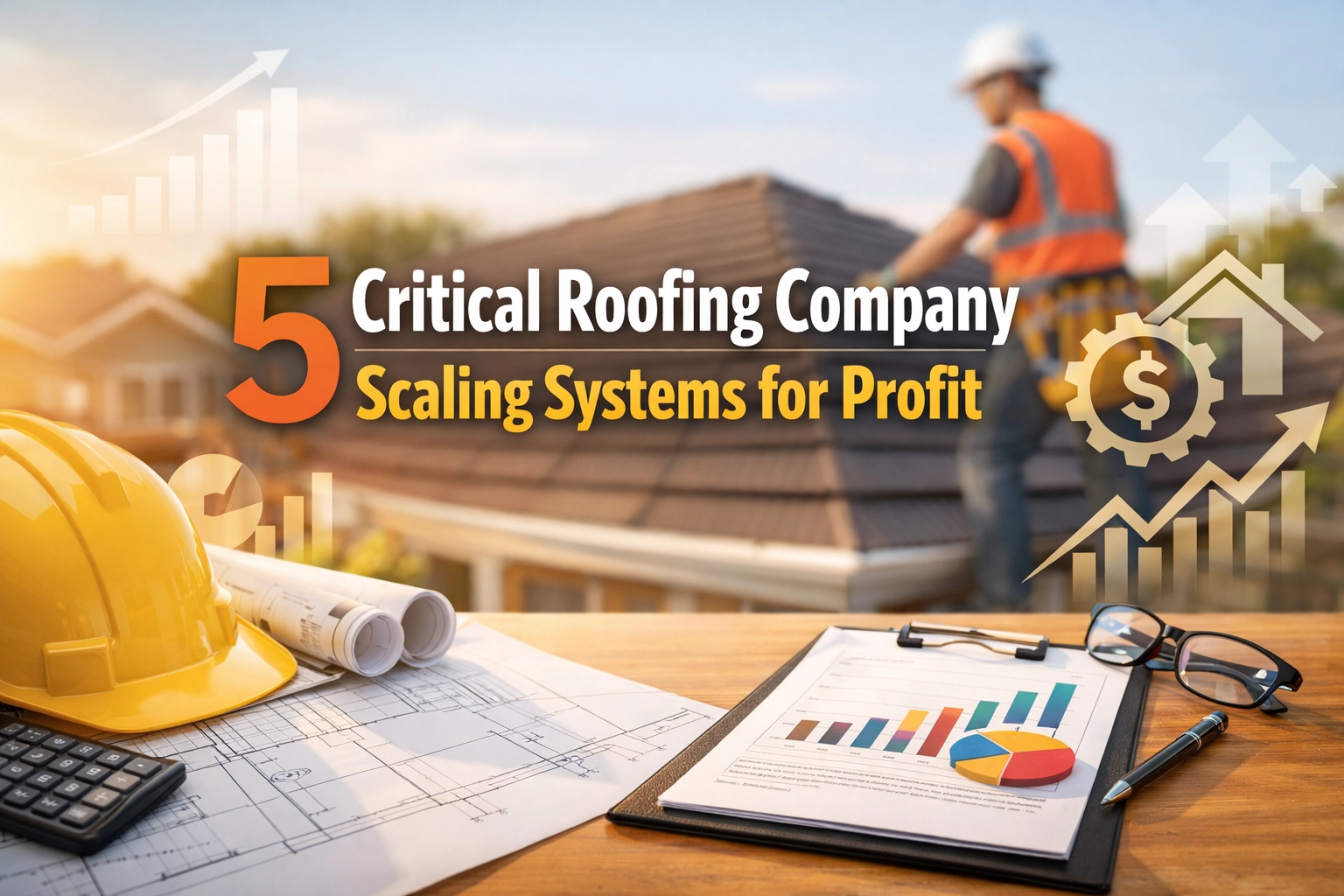
This post breaks down the five critical roofing company scaling systems that separate profitable roofing companies from those drowning in revenue. These aren’t theoretical frameworks. These are the exact systems I implement with roofing contractors who want to scale without losing their minds or their margins.
The Real Problem With Scaling a Roofing Company
Most roofing companies approach scaling backwards.
They think scaling means more trucks, more crews, more jobs. So they chase top-line revenue growth without understanding what’s happening to their margins. They take on any project that comes through the door because they’re focused on keeping everyone busy. They expand geographically before they’ve systematized their local operations.
Roofing company scaling systems fix this problem by creating operational leverage. Instead of adding proportional overhead with every new crew, you build systems that allow you to grow revenue without proportionally growing costs.
The reality: a roofing business doing $2 million at 15% EBITDA is worth significantly more than one doing $3 million at 5% EBITDA. You’re not scaling for vanity metrics. You’re scaling for actual profit and eventual exit value.

System 1: Profit Engineering Systems
Here’s the pattern I see consistently: roofing contractors track revenue obsessively but have no idea what they’re actually making on individual jobs.
They know they closed $400K in sales last quarter. They don’t know that three of those jobs lost money, two broke even, and only two were actually profitable. By the time they figure it out, they’ve already paid their crews, ordered materials, and moved on to the next batch of estimates.
Profit engineering systems solve this by implementing job-costing discipline at every stage of your operation.
What Job-Costing Discipline Actually Looks Like
You need to know your gross profit on every single job before you close it, during execution, and after completion. Not ballpark estimates. Actual numbers.
This means tracking:
- Material costs per job with vendor-specific pricing
- Labor hours and crew productivity rates per roof type
- Equipment usage and depreciation allocated to each project
- Subcontractor costs and their actual completion timelines
- Overhead allocation based on job size and complexity
Most roofing companies guess at these numbers. They use industry averages or what they think materials cost. Then they wonder why their margins are shrinking even as revenue grows.
Roofing company scaling systems for profit engineering require you to benchmark your EBITDA margins against industry standards. For roofing, that’s typically 15-20%. If you’re below that, you have a margin problem, not a revenue problem.
Why This System Matters for Scaling
When you implement profit engineering systems as part of your roofing company scaling systems, you make better decisions about which jobs to take and which to pass on.
You stop competing on price alone because you understand your actual costs. You start targeting the types of projects that generate the highest margins. You identify which crew leaders are most efficient and which ones are burning through your profit.
Pattern: Roofing contractors with proper job-costing discipline typically discover they’re losing 10-15% on certain job types they thought were profitable. They’re subsidizing bad jobs with good ones without realizing it.
The math is straightforward. If you’re doing $2 million in revenue at 8% EBITDA, you’re making $160K. If you implement profit engineering systems and improve to 15% EBITDA at the same revenue, you’re now making $300K. That’s $140K more profit without adding a single new job.
System 2: Technology and Automation Systems
You cannot scale a roofing company on spreadsheets and text messages.
I know this because I’ve seen roofing contractors try. They’re running five crews, managing 20+ active jobs, and their entire operation lives in someone’s inbox and a collection of random Excel files that only one person understands.
Technology and automation systems create the operational backbone that allows you to scale without adding proportional administrative overhead.
The Core Technology Stack for Roofing Companies
Here’s what your roofing company scaling systems need from a technology perspective:
CRM Software: You need one central system where every lead, estimate, and customer interaction lives. Small businesses that implement CRM software see sales increase by 29% and productivity by 34%. That’s not because the software is magic. It’s because they stop losing leads, forgetting follow-ups, and duplicating work.
Project Management Platform: Tools like JobNimbus or similar roofing-specific platforms let you track job status, crew assignments, material orders, and customer communications in one place. When you’re managing multiple crews across multiple jobs, this becomes non-negotiable.
Automated Proposal Generation: Your estimators should be able to generate professional, detailed proposals in minutes, not hours. The system should pull pricing, calculate labor, apply your margin requirements, and output a branded proposal without manual calculation.
Scheduling and Dispatch Tools: Automated job assignments that sync with crew calendars, weather forecasts, and material delivery schedules eliminate the chaos of manual dispatch.
Financial Integration: Your project management system should feed directly into your accounting software so you’re not manually entering the same data twice.
Why Most Roofing Companies Resist Technology Systems
The pushback I hear consistently: “We’re not a tech company, we’re a roofing company.”
That’s exactly the problem.
Roofing company scaling systems built on technology aren’t about being a tech company. They’re about eliminating the manual, repetitive work that prevents you from scaling. Every hour your office manager spends manually updating spreadsheets is an hour not spent on higher-value work.
Reality: You’re already using technology. You’re just using it poorly. Random apps that don’t talk to each other, personal text messages for business communication, email threads that turn into chaos.
The goal of technology and automation systems is to centralize and systematize so that scaling doesn’t require hiring three more administrative people.

System 3: Production Management Systems
Here’s what happens when roofing companies scale without production management systems: Sales increases, job volume goes up, and suddenly installation quality becomes inconsistent.
Customers start complaining about delays. Jobs run over budget because crews are doing things differently. Your best crew lead quits and takes all the tribal knowledge with him. You realize you don’t actually have documented processes for anything.
Production management systems create repeatable, documented workflows for every aspect of your installation and service work.
What Belongs in Your Operations Manual
Your roofing company scaling systems need a comprehensive operations manual that covers:
Installation Protocols by Roof Type: Step-by-step processes for shingle, metal, flat, and tile installations. Material requirements, crew size recommendations, typical timelines, quality checkpoints.
Safety Procedures and Compliance: OSHA requirements, fall protection protocols, job site setup standards, equipment inspection schedules.
Quality Control Checkpoints: What gets inspected, when it gets inspected, who inspects it, and what happens when something fails inspection.
Customer Communication Standards: When customers get updates, what information they receive, how complaints get handled, follow-up schedules after completion.
Material Management Processes: How materials get ordered, delivered, stored, and tracked across multiple job sites.
Why Documentation Matters for Scaling
Pattern: Roofing companies that fail to systematize production often face delays, budget overruns, and declining customer satisfaction as volume increases.
You can’t train new crew members effectively without documented processes. You can’t hold people accountable when expectations aren’t clear. You can’t maintain quality when everyone is doing things their own way.
Roofing company scaling systems for production management ensure that quality and consistency scale with volume. When you hire your tenth crew, they’re following the same protocols as your first crew. When a crew lead leaves, their replacement can reference the operations manual instead of guessing.
The goal: Anyone with roofing experience should be able to pick up your operations manual and execute a job to your standards without needing to ask a dozen questions.
System 4: Cash Flow Management Systems
Sixty-one percent of small businesses fail due to poor cash flow management.
For roofing companies, this problem is amplified by seasonal fluctuations, weather delays, and the timing gap between material purchases and customer payments.
Cash flow management systems as part of your roofing company scaling systems create the financial predictability you need to weather slow seasons and invest in growth opportunities.
The Core Components of Cash Flow Systems
You need structured processes for:
Payment Scheduling: Clear terms for deposits, progress payments, and final payments. Most roofing companies are too lenient here. You should be collecting significant deposits upfront, not financing projects for customers.
Accounts Receivable Management: Automated invoicing, systematic follow-up on overdue payments, and clear consequences for non-payment. Too many roofing contractors are informal about collecting money.
Expense Timing and Vendor Relationships: Negotiated payment terms with suppliers that align with your customer payment schedules. Managing when cash actually leaves your account.
Cash Reserve Targets: Maintaining specific reserves for seasonal downturns, emergency equipment repairs, and growth investments. Not treating your operating account like a personal piggy bank.
Financial Forecasting: 13-week rolling cash flow forecasts that show you exactly when money comes in and goes out so you’re not surprised by shortfalls.
Why Cash Flow Kills Scaling Efforts
Here’s what I see consistently: Roofing contractors land a major commercial project that could transform their business. They buy materials, pay crews, rent additional equipment. Then the payment terms drag out. Suddenly they can’t pay their other bills on time. They scramble for emergency financing at terrible rates. The “opportunity” becomes a crisis.
Roofing company scaling systems for cash flow prevent this scenario by creating visibility and control. You know exactly how much cash you have available at any moment. You can model the cash flow impact of taking on a new project before you commit. You have reserves to bridge timing gaps.
The reality: You can be profitable on paper and still go out of business due to cash flow. Scaling amplifies this risk because you’re committing more capital upfront across more projects simultaneously.

System 5: Predictable Revenue Systems
Most roofing companies operate entirely on one-off project revenue.
They land a big job, revenue spikes. Then there’s a gap while they hunt for the next one. Revenue drops. The cycle repeats. This makes cash flow planning nearly impossible and business valuation significantly lower.
Predictable revenue systems create recurring income streams that stabilize your business and increase its value.
Building Recurring Revenue in Roofing
The opportunity: Service contracts and maintenance agreements.
Commercial properties need regular roof inspections and maintenance. Residential customers need gutter cleaning, minor repairs, and periodic assessments. These aren’t one-time transactions. They’re recurring relationships.
Roofing company scaling systems for predictable revenue include:
Annual Maintenance Agreements: Customers pay a fixed fee for scheduled inspections, minor repairs, and priority service. You get predictable monthly revenue. They get peace of mind and catch problems before they become expensive.
Service Plans for Commercial Clients: Multi-year contracts for regular maintenance, seasonal preparations, and guaranteed response times for emergencies.
Post-Installation Warranties with Service Components: Instead of just offering a warranty, bundle it with annual inspections and maintenance that generate ongoing revenue.
Referral and Inspection Programs: Partnering with property managers, insurance companies, and real estate firms to become their go-to roofing resource.
Why Recurring Revenue Transforms Business Value
Here’s what nobody tells you: Roofing companies with recurring service contracts often fetch 1-2x higher EBITDA multiples when they sell.
Buyers pay more for predictable revenue because it reduces risk. A business that knows it has $50K per month in recurring service contracts is fundamentally more valuable than one that starts at zero every month hoping to land projects.
Roofing company scaling systems focused on recurring revenue also smooth out seasonal fluctuations. When new installation work slows down in winter, your service contracts keep revenue flowing.
The goal isn’t to replace project revenue. It’s to diversify your income streams so you’re not dependent on landing the next big job to make payroll.
How Clarity Ops Engine Implements Roofing Company Scaling Systems
Here’s the pattern I see when roofing contractors reach out: They know they need systems, but they don’t have the time or expertise to build them while running the business.
They’ve tried DIY approaches. They’ve read articles, bought templates, attended workshops. Nothing sticks because implementation requires sustained focus and operational expertise they don’t have in-house.
This is exactly what Clarity Ops Engine solves through our Fractional COO service.
The Implementation Process for Roofing Company Scaling Systems
We don’t hand you a manual and wish you luck. We implement the roofing company scaling systems directly into your operation.
Phase 1: Operational Audit and System Design (Weeks 1-4)
We assess your current state across all five system areas. Where are you losing profit? What technology gaps exist? Which processes are documented and which are tribal knowledge? What’s your actual cash flow pattern?
Then we design the specific roofing company scaling systems your business needs. Not generic frameworks. Custom systems built for your revenue level, crew structure, and market.
Phase 2: System Implementation (Weeks 5-12)
We roll out each system with hands-on implementation:
- Setting up your job-costing processes and training your estimators
- Implementing your technology stack and migrating your data
- Documenting your production processes with your crew leads
- Building your cash flow forecasting model and payment procedures
- Designing your service contract offerings and sales process
This isn’t consulting where we tell you what to do and leave. We’re in your operation making it happen.
Phase 3: Optimization and Scale (Weeks 13+)
Once systems are live, we optimize based on real performance data. We identify bottlenecks, refine processes, and prepare you for the next stage of growth.
By the end of 12 weeks, you have functioning roofing company scaling systems that actually work in your business, not just binders on a shelf.
What Makes This Different From DIY
Reality: You could build these systems yourself. It would take 18-24 months of sustained effort while you’re simultaneously trying to run your roofing company. Most contractors start and stall out repeatedly.
Or you could have someone with operational expertise implement them in 12 weeks while you focus on running jobs and closing sales.
The math: If improving your EBITDA from 8% to 15% generates an additional $140K in profit on $2 million in revenue, the ROI on operational systems implementation is immediate and massive.
Why Roofing Companies Choose Fractional COO Over Full-Time Hire
You don’t need a full-time COO at $150K-$200K plus benefits. You need operational expertise for 10-20 hours per week focused specifically on building roofing company scaling systems.
That’s the Fractional COO model. You get senior-level operational leadership without the full-time overhead. We implement the systems, train your team, and create the infrastructure that allows you to scale profitably.
Then you run with it.

The Timeline for Implementing Roofing Company Scaling Systems
Let’s be specific about what this looks like in practice.
Weeks 1-4: Assessment and Design
- Complete operational audit across all five system areas
- Identify highest-impact opportunities for margin improvement
- Design custom roofing company scaling systems for your business
- Get buy-in from key team members on changes
Weeks 5-8: Core Systems Implementation
- Roll out job-costing processes and train estimators
- Implement CRM and project management platform
- Begin documenting production processes with crew input
- Set up cash flow forecasting and payment procedures
Weeks 9-12: Optimization and Training
- Refine systems based on initial performance data
- Train additional team members on new processes
- Launch service contract offerings
- Establish performance metrics and reporting
Week 13+: Scale and Expand
- Systems are running with minimal direct oversight
- Focus shifts to optimization and growth strategy
- Prepare for next stage of scaling (new markets, additional crews, etc.)
By end of Week 12, you have operational infrastructure that supports profitable scaling. Not just documented processes, but systems that are actually running in your business with your team trained on them.
Common Mistakes When Building Roofing Company Scaling Systems
Here are the red flags I see that indicate you’re building systems wrong:
Copying templates without customization. Generic operations manuals and process documents don’t work because every roofing company operates slightly differently. Your systems need to reflect your actual operation.
Implementing technology without process design. Buying software doesn’t create systems. You need to design the process first, then implement the technology that supports it.
Building systems in isolation. Your five roofing company scaling systems need to work together. Job-costing feeds cash flow forecasting. Production management integrates with project management software. Predictable revenue impacts capacity planning.
Over-complicating processes. The best systems are simple enough that your team will actually use them. If your operations manual requires a PhD to understand, it’s not operational.
Failing to get team buy-in. Systems imposed from the top without crew input typically fail. Your crew leads and project managers need to be involved in building roofing company scaling systems so they take ownership.
Not measuring results. If you’re not tracking whether your systems are actually improving margins, reducing chaos, or increasing profit, you have no idea if they’re working.
What Success Looks Like With Roofing Company Scaling Systems
Here’s what changes when you implement proper roofing company scaling systems:
Your margins improve because you’re only taking profitable jobs and executing them efficiently. You know your actual costs and price accordingly.
Your operations run smoothly because everyone follows documented processes instead of reinventing approaches on every job.
Your cash flow becomes predictable because you have structured payment terms and forecasting that shows you what’s coming.
Your time frees up because systems handle routine decisions and your team isn’t constantly asking you what to do next.
Your business value increases because you have recurring revenue streams and operational infrastructure that makes the company transferable.
You can actually take a vacation without the business falling apart because the roofing company scaling systems keep things running without you.
That’s the goal. Not perfection. Not zero problems. Just operational infrastructure that allows you to scale profitably without working yourself to death.
Your Next Steps for Building Roofing Company Scaling Systems
You have three options:
Option 1: Keep running your roofing company the way you’re running it now. Stay stuck at your current revenue level or grow chaotically without improving profit. Work 70-hour weeks indefinitely.
Option 2: Try to build roofing company scaling systems yourself. Commit 18-24 months of sustained effort while simultaneously running the business. Start and stall repeatedly as operational crises demand your attention.
Option 3: Work with Clarity Ops Engine to implement the five critical roofing company scaling systems in 12 weeks with hands-on operational support.
If you’re serious about scaling profitably, not just growing revenue, the choice is straightforward.
We implement roofing company scaling systems with roofing contractors who are ready to build operational infrastructure that supports profitable growth. We’re not consultants who tell you what to do. We’re operational leaders who implement directly into your business.
Schedule a 30-minute operational assessment to discuss your current scaling challenges and how we would implement these five systems in your roofing company.
Or you could still be working 70-hour weeks, wondering why growth isn’t generating profit, and watching your best competitors implement the systems that allow them to scale while you stay stuck.
Related Blogs
- How to Systemize a Small Business Without Getting Overwhelmed
- Revenue vs Profit: Why 80% of Contractors Get This Wrong
- Overhead Allocation Made Simple for Trade Contractors
- RACI: The Accountability Framework That Actually Works
- Revenue Is Up, Profit Is Down: The Roofing Margin Leak Audit
- Job Costing for Roofers: Stop Guessing What You “Made”
- The 5 COGS Categories Every Roofing Company Must Track
- Why “Good Crews” Still Lose Money: Labor Efficiency Benchmarks
- Change Orders That Don’t Get Billed: The Silent Profit Killer
- Overhead Allocation for Roofing: The Simple Method That Works
- Gross Margin vs EBITDA for Roofers: What You Should Actually Track
- When to Fire a Job Type: Which Roofs Aren’t Worth Taking
- Roofing Production Management: The Install Checklist That Cuts Callbacks
- Jobsite Quality Control Without You: The Photo + Punchlist System
- The Roofing Scope Sheet That Prevents 80% of Rework
- Crew Lead Scorecards: How to Measure Production Without Drama
- Standardizing Flashing, Venting, and Cleanup: Consistency at Scale
- The “No Next Job Until This Is Done” Workflow for Roofing
- Warranty Claims: The Process That Stops Repeat Problems
- How to Build a Roofing Operations Manual That Crews Will Use
- The Most Expensive Roofing Mistake: Broken Sales-to-Production Handoffs
- What to Collect Before You Schedule a Roof (So Jobs Don’t Stall)
- Pre-Job Site Walk SOP: Catch Problems Before Materials Hit the Driveway
- Roofing Estimating Systems: Templates That Prevent Scope Drift
- The One-Page “Job Packet” That Keeps Crews Moving
- How to Stop Sales from Overpromising (Without Killing Close Rate)
- Roofing Capacity Planning: How Many Roofs Can You Actually Run Weekly?
- The Dispatch System for 3+ Crews: Stop Text-Message Operations
- Route Density for Roofing: Why Spread-Out Jobs Destroy Profit
- Weather Delays Without Chaos: Your Roofing Reschedule Playbook
- Production Calendar Design: The Weekly Rhythm That Prevents Backlog
- Hiring a New Crew Won’t Fix a Broken Schedule: Here’s What Will
- Material Ordering Systems: Prevent Shortages, Overages, and Theft
- The Supplier Relationship Playbook: Better Terms, Fewer Surprises
- Dumpster, Delivery, and Staging SOPs: The Hidden Cost Center
- “Parts on the Truck” vs “Parts on the Job”: Simple Tracking That Works
- How to Reduce Material Waste by 5–10% with Basic Controls
- Roofing Cash Flow Systems: Stop Funding Projects Out of Pocket
- Deposit and Progress Payment Terms That Customers Accept
- Accounts Receivable for Roofing: The Follow-Up System That Gets Paid
- The 13-Week Cash Forecast for Roofing Contractors
- Financing Offers and Payment Options: When They Help (and When They Hurt)
- Why You Feel Broke at $2M: The Timing Gap Explained
- The Roofing Org Chart at $1M, $2M, and $3M
- When You Need a Production Manager (and What They Must Own)
- RACI for Roofing Companies: Who Owns What When You Scale
- Crew Lead Training: How to Stop Promoting Your Best Roofer Into Failure
- The Accountability Cadence: Daily Huddles + Weekly Ops Review for Roofers
- Offboarding Bad Subcontractors Without Burning Bridges
- Best Roofing Software Stack: What to Use at $1M–$3M
- JobNimbus vs ServiceTitan vs AccuLynx: What Actually Matters
- CRM Hygiene for Roofers: The Follow-Up System That Saves Deals
- Proposal Automation: Faster Estimates Without Underbidding
- The “Single Source of Truth” Setup: One System, Not 9 Apps
- KPI Dashboards for Roofing: What to Track Weekly (and Why)
- Recurring Revenue for Roofers: Maintenance Plans That Actually Sell
- Property Manager Partnerships: The Roofing Referral Engine
- Post-Install Inspections as a Service: Turning Warranties Into Revenue
- How to Build a Roofing Service Department Without Losing Focus
- Seasonal Slumps: The Revenue Smoothing Strategy
- The Owner Bottleneck: Why Every Decision Still Routes Through You
- “Busy But Broke” Roofing: The Systems Diagnosis Checklist
- How to Step Off the Roof and Into CEO Mode (Without Losing Control)
- Scaling Past $1M Without Adding Office Chaos
- The 90-Day Roofing Systems Sprint: What to Build First