Process mapping for small business: 7 proven critical steps
You feel like you are drowning in your own success because every single decision has to run through your desk before anything actually gets done.
Let me be direct. You do not have a staff problem and you do not have a talent problem. You have a process problem that is killing your ability to scale. If you are stuck at $50,000 or $100,000 a month, the only way out is process mapping for small business. You cannot hire your way out of chaos if you do not know how the work actually gets done. Most owners think they have a handle on their operations until they try to write it down. Then they realize that three different people are doing the same task three different ways.
Here is what nobody tells you about growth. Your business will eventually outgrow your personal ability to manage it by memory. When that happens, you need a visual representation of your workflows. This is where process mapping for small business becomes your most valuable asset. It is the literal blueprint for your operational transformation. Without it, you are just guessing.
I have seen this pattern dozens of times in service based companies. The owner is the hero, the technician, and the customer service rep all at once. It works for a while. But eventually, the hero gets tired. The hero starts making mistakes. The hero becomes the bottleneck. Process mapping for small business is how you stop being the hero and start being the CEO.
Within the next 12 weeks, you can have every major workflow in your company documented and optimized. This guide will show you exactly how to begin the work of extracting processes from your brain and putting them into a system that works without you.
Why Your Head Is the Biggest Bottleneck in the Company
The reality is that your business currently lives inside your skull. That is a dangerous place for a multi-million dollar asset to reside. If you are sick for a week, does the revenue stop? If your lead technician quits, does the quality of work tank? If the answer is yes, you are lacking a formal process mapping for small business strategy.
You might think you are being efficient by “just handling it.” You are not. You are creating decision latency. This is the time wasted waiting for you to tell someone what to do next. When you commit to process mapping for small business, you eliminate that wait time. You give your team the authority to move forward because the path is already paved.

The pattern I see consistently is that owners fear documentation because it feels slow. They think they do not have time to sit down and map things out. The truth is that you do not have time not to do it. You are losing hours every day answering the same five questions. Extracting processes allows you to answer those questions once and then never again. This is the foundation of a real operational transformation.
Step 1: Select a Process That Is Currently Underperforming
Do not try to map the entire business in one afternoon. You will fail and you will quit. Start with the process that causes the most stress or the most customer complaints. For a roofing company, this might be the handoff from sales to production. For an HVAC company, it might be the billing and collections cycle.
When starting process mapping for small business, focus on one high impact area. Look for the bottlenecks. Look for where the money gets stuck. If your accounts receivable is bloated, that is your starting point. If your crews are showing up to jobs without the right materials, that is your starting point.
The goal here is a quick win. You want to see the power of process mapping for small business in action immediately. Once you fix one broken flow, the momentum will carry you through the rest. This is the first phase of The Clarity Transformation. We identify the leaks and we plug them with visual workflows.
Step 2: Define the Hard Boundaries of the Workflow
Every process needs a clear start and a clear end. If you do not define these, your map will grow into a monster that no one can follow. For example, if you are extracting processes for “Customer Onboarding,” where does it begin? Does it begin when the lead is captured or when the contract is signed?
In process mapping for small business, we call these “triggers” and “deliverables.” The trigger is the event that sets the work in motion. The deliverable is the final result that satisfies the customer or the next department. Be specific. A trigger is not “when we feel like it.” A trigger is “Signed contract uploaded to the CRM.”
A process without a boundary is just a suggestion.
When we work together in a Clarity Operational Partnership, we spend a significant amount of time defining these boundaries. It prevents “scope creep” within your own internal operations. You need to know exactly where one person’s job ends and the next person’s job begins. This is essential for a successful operational transformation.
Step 3: Gather the Real Truth from the People Doing the Work
This is where most owners mess up. They sit in their office and draw what they think happens. This is a mistake. The reality on the ground is often very different from the theory in the owner’s head. To succeed at process mapping for small business, you must talk to your team.
Interview your office manager. Sit with your lead tech. Ask them exactly what steps they take when a problem arises. You will likely find that they have created “workarounds” to fix bugs in your current system. These workarounds are gold. They show you exactly where the existing system is broken.

Extracting processes requires honesty. It requires a culture where employees feel safe saying, “Actually, Shirley, I don’t use that form because it takes too long, so I just text the client instead.” That text message is your new process. Now you just have to formalize it. This is how process mapping for small business stays grounded in reality.
Step 4: List Every Single Task and Decision Point
Now you get into the weeds. Write down every single action. Do not worry about the order yet. Just get the tasks out of the brain and onto paper. This is the heavy lifting of extracting processes. Include the “if/then” scenarios. If the permit is denied, what happens? If the customer is not home, what happens?
In process mapping for small business, these are called decision diamonds. They represent the forks in the road. Most small businesses fail because they only have a process for the “perfect day.” But businesses do not run on perfect days. They run on exceptions. You need to map the exceptions.
The logic is simple. If your team knows what to do when things go wrong, they do not have to call you. This is the core of operational transformation. You are building an autonomous machine. You are creating a business that can breathe without your constant CPR. This is why process mapping for small business is not optional for those scaling past $100k a month.
Step 5: Visualizing the Flow with Standard Symbols
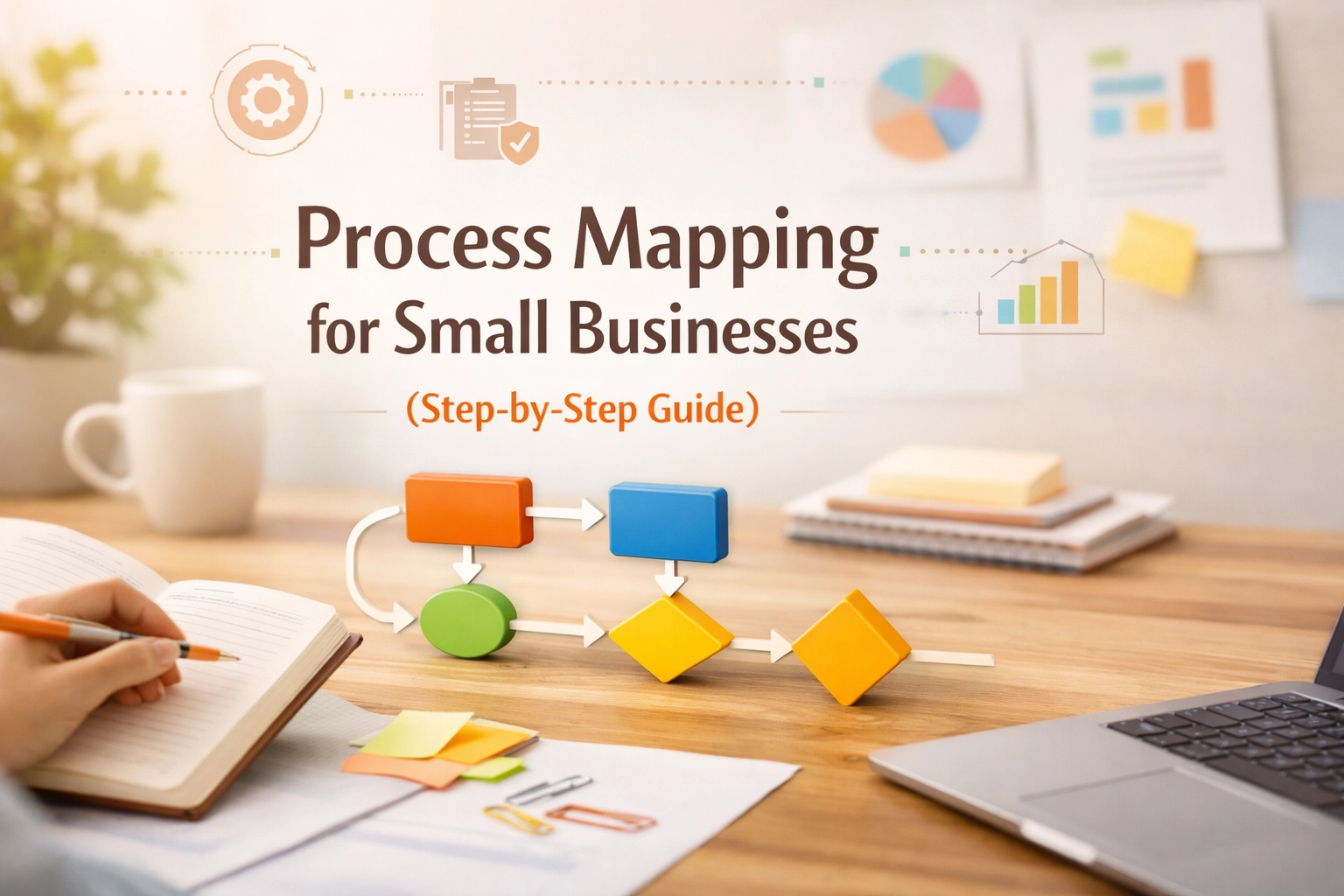
Now you take that list and turn it into a map. You do not need fancy software to start. Post it notes on a white wall work perfectly. Use squares for tasks and diamonds for decisions. Draw arrows to show the direction of the work. This visual component is the “mapping” part of process mapping for small business.
Humans are visual creatures. A ten page SOP is hard to read. A one page map is easy to follow. When your team can see the entire journey of a customer from lead to invoice, they understand their role in the bigger picture. They see how their delays affect the person downstream.
During The Clarity Transformation, we help you create these visuals so they are professional and clear. We take the mess of your daily operations and turn it into a clean, logical flow. This makes process mapping for small business feel less like a chore and more like a strategy. It is the visual language of your company’s future.
Step 6: Identify and Eliminate the Waste
Once the map is visible, the problems will jump off the wall at you. You will see steps that take too long. You will see redundant approvals that serve no purpose. You will see “dead ends” where information goes to die. This is the “optimization” phase of process mapping for small business.
The goal is to make the process as lean as possible. If a step does not add value to the customer or the company, kill it. If two people are doing the same job, consolidate it. This is where you see the real ROI of extracting processes. You are literally finding hidden profit by removing friction.
A successful operational transformation usually results in a 20-30% increase in efficiency without adding a single new employee. That is the power of process mapping for small business. You are not working harder; you are just removing the obstacles you accidentally built.
Step 7: Validate, Refine, and Deploy
Before you call it finished, run a “test” of the new map. Have someone who does not usually do the task try to follow the process map. If they get stuck, the map is not clear enough. Refine it until it is bulletproof. This is the final step in extracting processes.
Deploy the map where people can see it. Put it in your project management software. Print it and hang it in the breakroom. Process mapping for small business only works if the maps are used. A map in a drawer is just a piece of paper. A map in the field is a tool for growth.
When we establish a Clarity Operational Partnership, we do not just give you the maps and leave. We help you implement them. We ensure your team adopts the new way of working. This is the only way to ensure the operational transformation sticks long term.
The Reality of Operational Transformation
You cannot expect a different result by running the same chaotic plays every day. If you want to scale, you have to change how the work is handled. Process mapping for small business is the foundation of that change. It is the difference between owning a job and owning a business.
I have helped companies go from “hair on fire” daily emergencies to smooth, predictable growth. The secret is always extracting processes. It is about getting the brilliance out of your head and into a format that others can execute. That is what we do at Clarity Ops Engine.

We offer a hands on approach to operational transformation. We do not just consult; we implement. We become your Fractional COO to ensure that process mapping for small business actually happens. We take the burden of documentation off your plate so you can focus on leading.
How Clarity Ops Engine Fixes the Chaos
The truth is that you are probably too busy running the business to document the business. That is why The Clarity Transformation is designed to be done with you, not by you. We handle the heavy lifting of extracting processes while you provide the vision and the expertise.
In a Clarity Operational Partnership, we bring the frameworks. We bring the tools for process mapping for small business. We bring the outside perspective that sees the bottlenecks you have become blind to. We turn your chaotic “technician heavy” business into a streamlined “process heavy” machine.
Imagine waking up and knowing that every crew is following the exact same protocol. Imagine seeing your profit margins stay steady even as you add more volume. That is what a real operational transformation feels like. It starts with one map. It starts today.
Process Mapping for Small Business FAQ
How long does process mapping for small business take?
The initial map for a single workflow can be done in 2 to 4 hours. However, a full operational transformation covering all major departments typically takes 12 to 16 weeks of consistent effort. This includes extracting processes, testing them, and training the team.
Do I need expensive software for process mapping for small business?
No. You can start with a whiteboard, sticky notes, or simple tools like Lucidchart or Miro. The tool is less important than the logic of the flow. In a Clarity Operational Partnership, we help you select the right tools for your specific needs.
What if my processes change frequently?
That is exactly why you need process mapping for small business. When a map is documented, it is much easier to update. You simply change the step on the map and re-communicate it to the team. Without a map, changes are lost in a sea of “he said, she said” instructions.
Can I do process mapping for small business by myself?
You can, but it is difficult. Most owners are too close to the work to see the inefficiencies. Hiring an expert for extracting processes provides the objectivity needed for a true operational transformation. It also ensures the work actually gets finished instead of being pushed to the bottom of your to-do list.
What is the most common mistake in process mapping for small business?
The most common mistake is making the maps too complex. If a process map looks like a circuit board for a space shuttle, your team will not use it. Keep it simple. Focus on the 80% of tasks that happen every day. This is a core pillar of The Clarity Transformation.
How do I get my team to follow the new process maps?
Involvement is the key to adoption. When your team helps with extracting processes, they feel ownership over the result. They are not following “Shirley’s rules;” they are following the system they helped build. This is how we ensure a smooth operational transformation.
Stop Building Your Business on Sand
You have two choices. You can keep doing what you are doing, working more hours for the same amount of profit, and staying stuck in the founder bottleneck. Or you can commit to process mapping for small business and build a foundation that supports real, sustainable growth.
The chaos will not fix itself. Time will not make your operations smoother. Only a dedicated effort toward extracting processes and formalizing your workflows will give you the freedom you wanted when you started this company. This is the essence of The Clarity Transformation.
If you are ready to stop being the only person who knows how to run your business, let’s talk. We specialize in operational transformation for service based businesses just like yours. We don’t just give advice; we build the engine.

You can spend the next year trying to figure this out on your own, or you can get it done in the next 90 days with a Clarity Operational Partnership. The math is simple. The ROI on a streamlined business is infinite compared to the cost of staying stuck.
Ready to get the processes out of your head and into a system?
Book your 30-minute Clarity Consultation here
Now let’s get your business moving again.
Related Blogs
- How a Fractional COO Builds Roofing Partnership Systems
- Decision Latency: The Silent Revenue Killer
- What a Fractional COO Fixes in Technician-Heavy Businesses
- How Extracting Business Processes Increases Profit
- Process Mapping Mistakes That Create Operational Chaos
- Why Every Small Business Needs Process Maps Before SOPs
- How to Identify Workflow Bottlenecks Using Process Maps
- Process Mapping vs Workflow Documentation: What’s the Difference?
- How to Create Process Maps Your Team Will Actually Follow
- Why Your Team Keeps Doing the Same Task Differently
- Building Process Maps That Scale With Your Business
- How to Simplify Complex Business Processes
- Process Mapping Tools: Which Ones Are Worth Using?
- Why Your Business Has Hidden Workflow Gaps
- How to Turn Process Maps Into Actionable SOPs
- Process Mapping for Service-Based Businesses
- Why Operational Visibility Starts With Process Mapping
- How to Map Client Journeys From Lead to Completion
- Process Mapping for Multi-Department Businesses
- Why Your Processes Break During Growth
- Building Cross-Functional Process Maps That Improve Collaboration
- How to Reduce Rework Through Better Process Mapping
- Daily KPI Reviews: 5 Vital Steps for Proven Success
- Why Your Team Needs Visual Workflows Instead of Long Documents
- How to Build Process Maps That Support Automation
- Process Mapping for Better Customer Experience
- Why Every Business Process Needs a Clear Owner
- How to Standardize Work Across Multiple Teams
- Process Mapping for Remote and Hybrid Teams
- Why Poor Process Mapping Leads to Expensive Mistakes
- How to Improve Operational Efficiency With Visual Workflows
- Process Mapping Before Automation: Why It Matters
- Building Repeatable Workflows That Improve Profitability
- Why Every Business Needs End-to-End Process Visibility
- How to Use Process Maps to Train New Employees Faster
- Process Mapping Strategies That Reduce Bottlenecks
- Why Process Mapping Is the Foundation of Business Systemization
- Building a Process-Driven Culture Instead of a Personality-Driven Business
- From Sticky Notes to Scalable Process Maps
- Turning Process Maps Into a Competitive Advantage
- How to Build a Business That Runs on Clear Processes
- Why Process Mapping Is the First Step Toward Operational Excellence
- Creating Process Maps That Grow With Your Business
- How to Turn Operational Chaos Into Repeatable Workflows