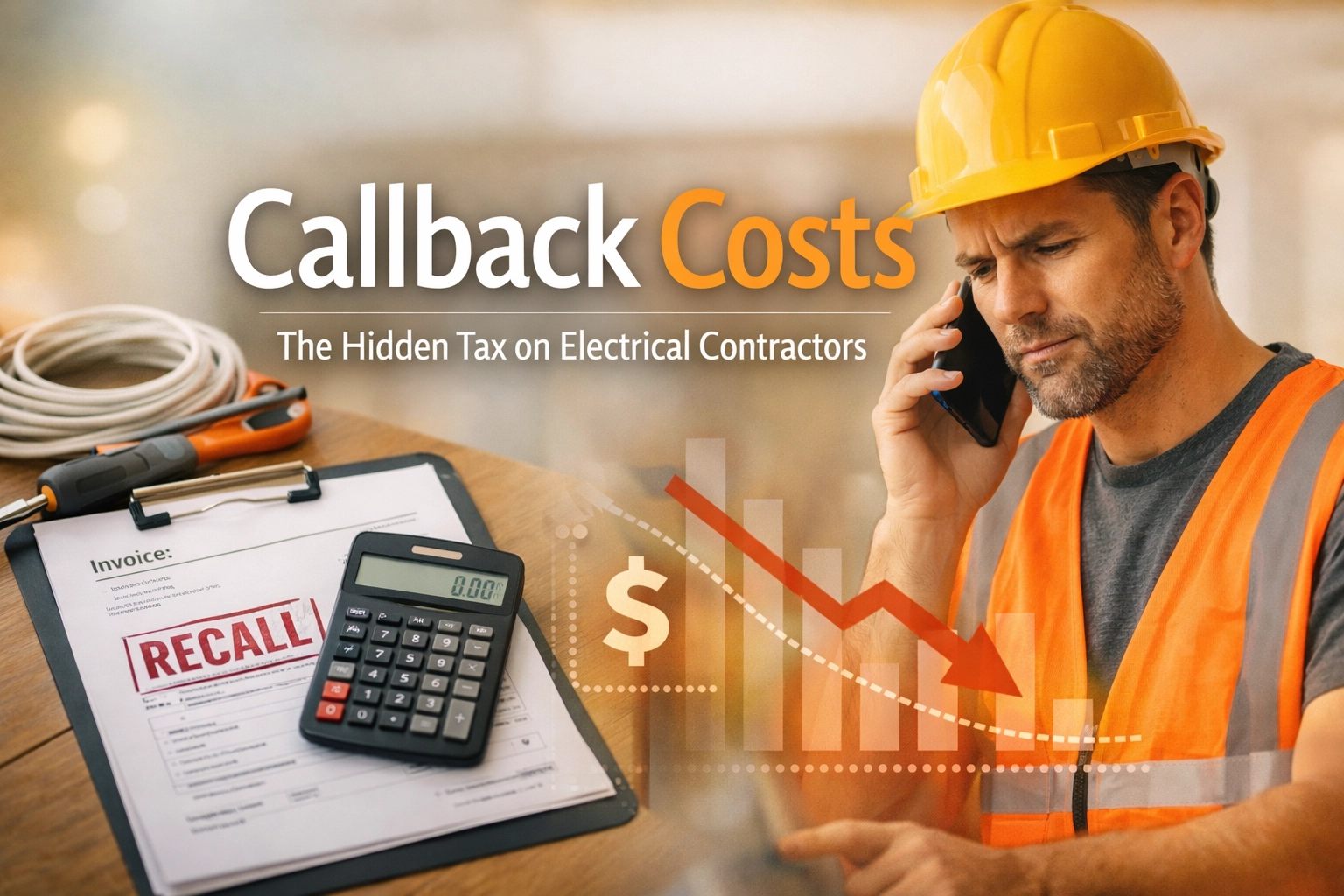
Callback Costs: The Hidden Tax on Electrical Contractors
You finished the job. Invoice is sent. Crew is already on the next site. Then the phone rings. The circuit keeps tripping. The customer isn’t happy. And now you’re sending someone back for free.
Let me be direct about callbacks: they are bleeding your electrical business dry, and most contractors have no idea how much they actually cost.
A single callback isn’t just the hour or two your electrician spends going back to fix something. It is the labor cost, the truck cost, the overhead allocation, the lost opportunity to work a paying job, and the hit to your reputation. When you add it all up, that “quick callback” just cost you $650 or more. For installation work, you are looking at $850 or higher.
And if you are running three callbacks per month per technician, you just lost $13,680 per year per person. Scale that across a crew of five electricians and you are hemorrhaging nearly $70,000 annually.
This is not about perfectionism. This is about operational efficiency. Callbacks represent a systemic breakdown in how work gets done, and fixing them requires building operational efficiency into every part of your process.
Here is what that actually looks like.
The Real Cost of a Callback (And Why You Are Underestimating It)
Most electrical contractors think a callback costs them an hour of labor. Wrong.
Let me walk you through what a callback actually costs:
Direct labor costs: Your electrician spends 2-3 hours driving back to the site, diagnosing the issue, and fixing it. At a loaded labor rate of $75/hour, that is $150-$225 right there.
Overhead expenses: You still have office staff coordinating the callback, dispatching the truck, managing the customer, and updating records. That is another $50-$100 in overhead allocation.
Opportunity cost: This is the killer. While your electrician is handling a callback, they cannot be working a job that generates revenue. If your average job brings in $500 in margin and takes half a day, you just lost $250 in foregone profit.
Total cost per callback: $650 minimum. Often more.

The pattern I see with electrical contractors is they track callbacks as a count, not as a dollar amount. You know you had “a few callbacks last month,” but you do not know that those callbacks cost you $3,200 in lost profit.
Operational efficiency starts with visibility. If you cannot measure the cost, you cannot manage it.
Why Callbacks Happen (The Operational Breakdown)
Callbacks are not random. They follow patterns, and those patterns reveal exactly where your operational efficiency is breaking down.
Here are the most common causes I see:
Rushed work from overburdened electricians: Your crew is running from job to job with no buffer time. They are cutting corners because they have three more stops today and it is already 3 PM. The work gets done, but it gets done fast, not right.
Incomplete job information: The electrician shows up without full details about what needs to happen. They make their best guess, finish the job, and later find out they missed a critical requirement the customer mentioned to the office.
Lack of quality checkpoints: No one is verifying work before the crew leaves the site. There is no checklist, no photo documentation, no final walkthrough. The electrician packs up, assumes it is good, and moves on.
Poor communication between office and field: The customer calls the office with a concern. The office relays it to the electrician. The electrician thinks they addressed it. The customer disagrees. Now you are scheduling a callback because no one confirmed what “fixed” actually means.
Inadequate training or onboarding: Newer electricians do not know your quality standards because you never documented them. They are doing their best, but “their best” is based on how they learned at their last company, not how you do things.
Every one of these causes is fixable. But fixing them requires operational efficiency baked into your systems, not just telling people to “be more careful.”
The Callback Tax Compounds Fast
Let me show you how this scales.
Scenario A: You run a crew of four electricians. Each electrician averages two callbacks per month. At $650 per callback, that is $1,300 per electrician per month, or $5,200 total per month. Over a year, you just lost $62,400 to callbacks.
Scenario B: You have the same crew, but callback rates climb to three per month during busy season (because rushed work increases). Now you are at $7,800 per month, or $93,600 annually.
That is real money. That is a truck. That is another electrician. That is the profit margin you thought you had but cannot find at year-end.
Here is what happens when operational efficiency is missing: your business grows, job volume increases, and callback rates climb with it. You are scaling chaos, not systems.
Building Operational Efficiency to Cut Callback Rates
The solution is not “try harder.” The solution is systems that make callbacks structurally difficult to produce.
Here is how to build operational efficiency that actually reduces callbacks:
1. Create Job Completion Checklists
Every type of job you run (service call, panel upgrade, new installation, troubleshooting) needs a checklist. Not a mental checklist. A physical or digital checklist that gets completed before your electrician leaves the site.
What it includes:
- All work scope items completed (circuit tested, breaker labeled, cover plate installed)
- Customer walkthrough completed and signed off
- Photos of finished work uploaded to job file
- Site cleaned and tools accounted for
This is operational efficiency at the task level. You remove the guesswork and replace it with a documented standard.
2. Implement Pre-Job Briefs
Before your electrician leaves for a job, they get a 5-minute brief from dispatch or the project manager. This brief covers:
- Exact scope of work
- Any customer concerns or special requests
- Site access details
- Expected completion time
Operational efficiency means your crew shows up knowing exactly what success looks like. No assumptions, no surprises.
3. Track Callback Data by Technician and Job Type
You need a simple tracking system that logs every callback: who did the original job, what type of work it was, what caused the callback, and what the fix required.
Review this data monthly with each technician. Not as punishment, but as pattern recognition. If one electrician has a high callback rate on panel upgrades, they need more training on panel upgrades. If service calls consistently generate callbacks around a specific issue, your process for that issue is broken.
Operational efficiency requires feedback loops. You cannot fix what you do not measure.
4. Build Buffer Time into Schedules
Overburdened electricians produce callbacks. If your crew is scheduled wall-to-wall with no margin for traffic, complex jobs, or unexpected issues, they will rush. Rushed work is low-quality work.
Add 15-20% buffer time into daily schedules. Yes, this reduces billable hours in the short term. But it also reduces callbacks, which increases net profit in the long term.
This is operational efficiency in scheduling. More billable hours do not matter if you are spending half of them on callbacks.

5. Standardize Customer Communication
Callbacks often happen because the customer expected one thing and got another. Clear communication solves this.
Before the job: Confirm scope in writing. Send a summary of what will be done, what will not be done, and what the customer should expect.
During the job: If anything changes (additional work needed, timeline shifts), document it and get customer approval.
After the job: Walk the customer through what was completed. Ask if they have any questions. Get their signature on the completion checklist.
Operational efficiency includes how you manage customer expectations, not just how you manage your crew.
What This Looks Like in Practice
Here is a real example from an electrical contractor I worked with:
The situation: They were running 8-12 callbacks per month across a team of five electricians. Callbacks were costing them roughly $6,000/month, or $72,000/year. The owner knew callbacks were a problem but had no system to prevent them.
The operational efficiency build: We implemented job completion checklists, pre-job briefs, and a callback tracking system. We added buffer time to daily schedules and trained the office team on how to brief electricians before they left for jobs.
The result: Within 90 days, callback rates dropped to 2-3 per month. Annual callback costs went from $72,000 to under $20,000. The crew was less stressed because they had time to do the job right the first time. Customer satisfaction scores improved because fewer issues required follow-up.
That is $52,000 in recovered profit from operational efficiency alone.
How Clarity Ops Engine Builds Operational Efficiency Into Your Electrical Business
You can try to build these systems yourself. Most contractors do. They create a checklist, use it for two weeks, then abandon it when things get busy. The systems do not stick because there is no one enforcing them, refining them, or holding people accountable.
This is exactly what Clarity Ops Engine fixes.
Here is how we build operational efficiency that reduces callbacks:
Week 1-2: Callback cost analysis and root cause mapping: We pull your callback data (or start tracking it if you are not), calculate the real cost per callback, and identify the top three causes. This is where we find the operational breakdowns.
Week 3-4: Build job completion systems: We create customized checklists for every job type you run. These checklists get built into your workflow so electricians cannot close a job without completing them. We train your team on how to use them and why they matter.
Week 5-6: Implement pre-job brief process: We document exactly how jobs get briefed before your crew leaves. This includes what information gets communicated, who is responsible for the brief, and how it gets documented. Your electricians stop showing up to jobs confused about what they are supposed to do.
Week 7-8: Build callback tracking and review cadence: We set up a simple system to log callbacks, assign them to root causes, and review them weekly with your team. This creates the feedback loop that turns callbacks from recurring problems into one-time fixes.
Week 9-12: Scheduling optimization and team accountability: We adjust your scheduling process to include buffer time, reduce overburdening, and ensure quality work. We also establish accountability structures so your crew knows callback reduction is a measurable performance goal.

By the end of 12 weeks, you have:
- A documented callback tracking system that shows cost per callback and trends over time
- Job completion checklists embedded into your workflow for every service type
- A pre-job brief process that eliminates confusion before work starts
- Scheduling processes that give your crew time to do the job right the first time
- Monthly callback review sessions that drive continuous improvement
Operational efficiency is not something you implement once and forget. It is a system that gets refined, enforced, and improved over time. That requires someone who knows how to build it and someone who sticks around to make sure it works.
That is what a fractional COO does. That is what Clarity Ops Engine delivers.
The Callback Tax Is Optional
Callbacks feel inevitable when you are running an electrical business. Jobs are complex, customers are demanding, and electricians are human. Mistakes happen.
But the frequency of callbacks is not inevitable. The cost of callbacks is not inevitable. Both are the result of missing operational efficiency, and both can be fixed with the right systems.
You can keep running your business the way you are running it now, losing $50,000 to $80,000 per year to callback costs, wondering why your margins never improve despite higher revenue.
Or you can build operational efficiency into your operations so callbacks become rare exceptions instead of weekly occurrences.
Most electrical contractors wait until callback rates get unbearable before they fix this. By then, they have lost hundreds of thousands of dollars and burned out their best electricians.
You do not have to wait that long.
If you want to see exactly how we would reduce your callback costs and build operational efficiency into your electrical business, book a 30-minute call. We will walk through your current callback rates, calculate what they are actually costing you, and show you the system that fixes it.
Book a 30-minute strategy call here.
12 weeks from now, you could be running a business where callbacks are the exception, not the rule. Where your crew has time to do quality work. Where your profit margins reflect the revenue you are bringing in.
Or you could still be sending electricians back to fix jobs they already finished, wondering where your profit went.
Related Blogs
- Job Costing for Electrical Contractors
- How to Fix Chaotic Operations in 12 Weeks
- Dispatch Systems
- Job Costing for Electrical Contractors: Know Profit Per Job in 48 Hours
- Revenue vs Profit: Why $800K in Revenue Still Feels Broke
- Estimating Accuracy: The 15% Profit Leak You Can’t See
- Overhead Allocation: The Hidden Cost Inside Every Callback
- The 7% Profit Wall: Why Growing Revenue Isn’t Fixing Your Margins
- Dispatch Systems That Actually Work for Electrical Contractors
- Buffer Time Strategy: Why 85% Capacity Is More Profitable Than 100%
- Billable Efficiency: When More Jobs Mean Less Profit
- Overloaded Crews: The Hidden Cost of Running Hot
- Task Handoff Systems: How Miscommunication Creates Callbacks
- Job Completion Checklists for Electrical Work: The System That Protects Profit
- Pre-Job Briefs: The 5-Minute Meeting That Saves $5,000 a Month
- Photo Documentation SOP: Protect Yourself from “You Didn’t Fix It” Claims
- Scope Confirmation Scripts: How to Prevent Expectation Gaps
- Change Orders Done Right: Stop Fixing Scope Creep for Free
- Callback Tracking by Technician: Data Without Drama
- Onboarding Electricians: Build Standards, Not Just Skills
- Performance Metrics That Matter: Profit Per Tech, Not Just Revenue Per Tech
- Weekly Operations Review Meeting Agenda for Contractors
- RACI for Field Teams: Who Owns Quality Before the Truck Leaves?