Your lead technician just finished a water heater install and moved to the next zip code when his phone buzzes with a photo of a slow drip from a compression fitting he just tightened.
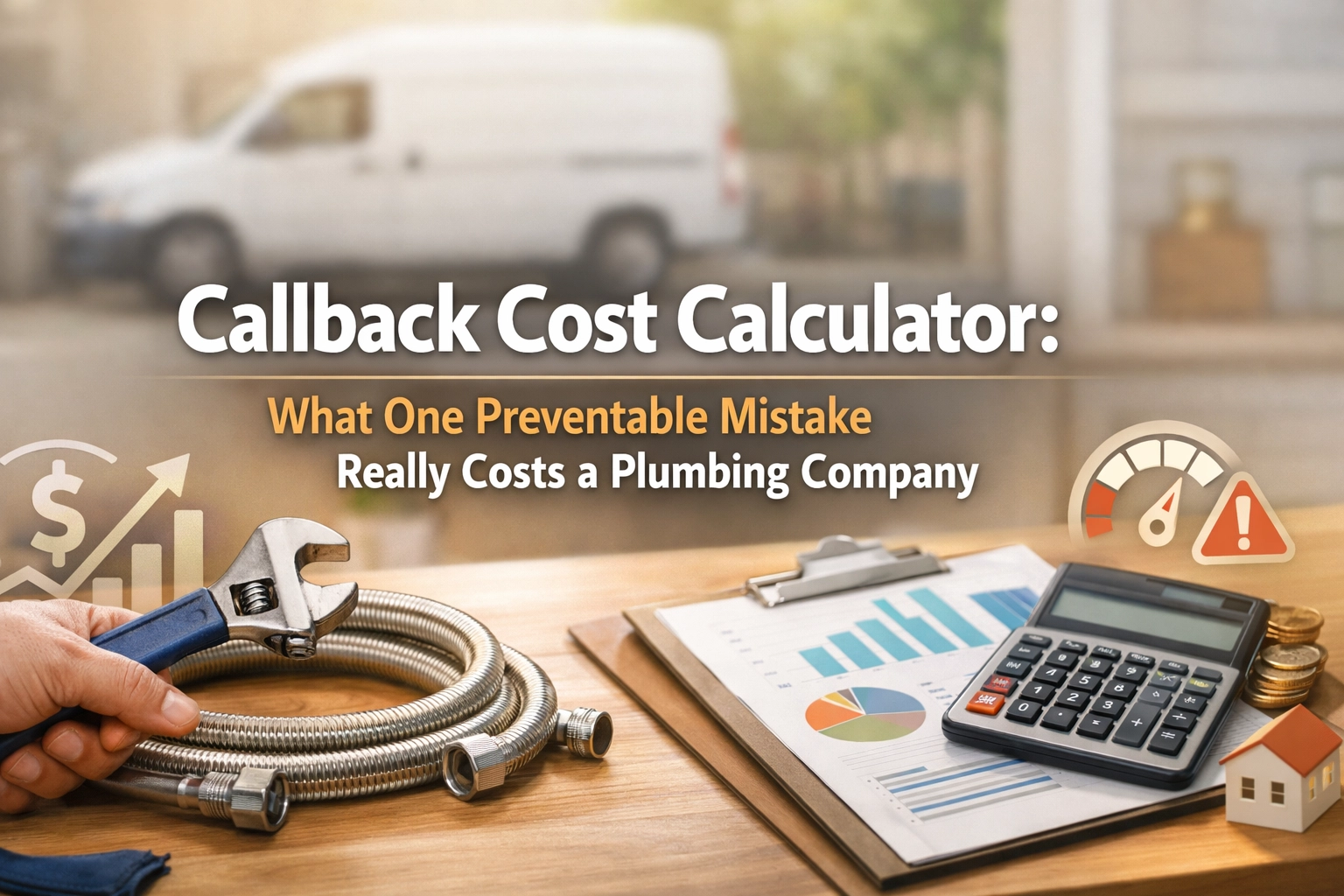
Let me be direct. This is not just a minor annoyance or a quick five minute fix. This is a leak in your profit margin that is likely costing you thousands of dollars every single month without you even realizing it. The cost of callbacks is the silent killer of plumbing companies trying to scale past the founder stage.
If you are tired of playing “whack-a-mole” with technician errors, you are in the right place. Here is what nobody tells you about the true cost. You can solve this in 12 weeks with the right systems, but first, you have to understand the math of your own failure.
The Reality of Operational Debt in Plumbing
Most plumbing owners view a callback as a “part of the business.” They think it is just the price of doing work. The reality is that frequent errors are actually operational debt signs that show your business is built on a shaky foundation.
When you ignore these operational debt signs, you are essentially taking out a high-interest loan against your future growth. You might be getting the jobs done today, but the rework is eating your ability to hire new people tomorrow.
The cost of callbacks is not just the hour your tech spends driving back to the job site. It is the cumulative weight of every system you did not build and every technician you did not train properly. If you see your team making the same mistakes twice, you have a system problem, not a people problem.

Phase 1: Calculating the Direct Cost of Callbacks
Let’s look at the hard numbers. I have seen this pattern dozens of times in service businesses. You look at the labor cost and think it is fine. It is not fine.
To calculate the true cost, you need to look at four specific areas:
- Direct Labor Waste: If your plumber earns $90 per hour and spends two hours on a callback including travel, that is $180 gone.
- Vehicle Expenses: Fuel, wear and tear, and insurance for that extra truck roll usually average $50 to $75 per trip.
- Materials: If the mistake requires new parts or specialized sealants, add that to the total.
- Administrative Overhead: Your dispatcher has to reschedule, the office manager has to handle the complaint, and you have to hear about it.
The cost for a single “minor” leak can easily top $300 in direct expenses. If your team has three callbacks a week, you are flushing $900 down the drain every single week. That is nearly $47,000 a year in pure waste.
The Hidden Opportunity Cost
Here is the part that really hurts. The cost includes the job you didn’t do while your tech was fixing a mistake. If your average ticket is $650, every hour spent on a callback is an hour not spent generating new revenue.
The cost of callbacks essentially doubles when you factor in lost opportunity. You paid a tech to do a job twice for the price of one. Meanwhile, a new customer called a competitor because your tech was busy fixing a leaky p-trap from Tuesday.
When you start looking at operational debt signs, look at your schedule. Are you constantly moving appointments? Are your techs always “running behind”? This is what happens when the cost of callbacks starts to dictate your calendar instead of your strategy.

Why Plumbing Consistency Training is Mandatory
You cannot “hope” your way to better quality. You need plumbing consistency training that standardizes how every single nut is turned and every pipe is prepped. Most owners hire for experience but forget to train for their specific standards.
The cost drops significantly when you implement a “Checklist for Completion” for every service call. This is not about micromanaging. This is about protecting your profit and your reputation.
Plumbing consistency training ensures that a junior tech and a senior lead perform the same task to the same quality level. If you don’t have this, you have chaos. The cost of callbacks is simply the price you pay for that chaos.
Identifying the Top 5 Operational Debt Signs
How do you know if your business is drowning in debt? Look for these operational debt signs immediately:
- High Warranty Ratios: If more than 3% of your jobs result in a return visit, your systems are failing.
- Technician Burnout: Your best people get tired of fixing the mistakes of your worst people.
- Bad Reviews: Customers don’t care how busy you are; they care that the job wasn’t done right the first time.
- Stagnant Profit: You are doing more work but taking home the same amount of money.
- Owner Overwhelm: You are the one who has to go out and “fix” the big mistakes because you don’t trust the team.
If you recognize these operational debt signs, you are likely losing 15% to 20% of your gross revenue to the cost of callbacks and general inefficiency. It is time to stop the bleed.

The Clarity Transformation: Fixing the Foundation
This is where I come in. I don’t just give you a list of things to do. I help you implement the systems that eliminate the cost forever. Through The Clarity Transformation, we map out every single process in your plumbing business.
We look at the dispatch flow, the technician handoff, and the post-job inspection. We identify exactly where the operational debt signs are hiding. Then, we build the plumbing consistency training modules your team needs to succeed without you being on every job site.
By the end of The Clarity Transformation, you will have a business that runs on a repeatable engine. You will know your exact cost of callbacks and watch it drop month over month. This is the difference between owning a job and owning a company.
Implementing a Clarity Operational Partnership
If you are doing $1M to $3M in revenue, you probably don’t need a full-time COO yet. But you do need a Clarity Operational Partnership. This gives you the high-level strategy and the boots-on-the-ground implementation to fix your broken processes.
During a Clarity Operational Partnership, we focus on the metrics that actually change behavior. We track the cost of callbacks per technician. We implement plumbing consistency training that is mandatory for every new hire.
We look for the operational debt signs in your financial statements and your CRM. We don’t just talk about it. We build the dashboards and the SOPs so you can step back from the day-to-day firefighting.

The Math: Scenario A vs. Scenario B
Let’s look at the numbers to see how the cost changes your trajectory.
Scenario A (The Status Quo):
- Revenue: $100,000 / month
- Callback Rate: 8%
- Average cost of callbacks (Direct + Opportunity): $700
- Total Loss: $8,400 / month
- Annual Loss: $100,800
Scenario B (After The Clarity Transformation):
- Revenue: $100,000 / month
- Callback Rate: 1%
- Average cost of callbacks: $700
- Total Loss: $700 / month
- Annual Loss: $8,400
In this scenario, fixing your operational debt signs through plumbing consistency training literally puts $92,400 back into your pocket. That is the salary of a new technician or a massive marketing budget. The cost of callbacks is the most expensive thing you are currently paying for.
Why You Can’t Fix This Alone
You might think you can just tell your techs to “be more careful.” The truth is, that never works. Without a systematic approach to plumbing consistency training, your words are just noise to a busy crew.
You need a third party to see the operational debt signs that you have become blind to. This is the value of a Clarity Operational Partnership. I see the patterns because I have seen them in dozens of other companies just like yours.
The cost is a symptom of a deeper operational disease. If you don’t treat the cause, the symptoms will just keep coming back. You need a structured plan like The Clarity Transformation to move from chaos to control.
Building Your Callback Prevention System
To lower the cost of callbacks, you need three things:
- The Standard: A clear, written definition of what a “finished job” looks like.
- The Training: A repeatable plumbing consistency training program for every new hire.
- The Audit: A system for checking the work after it is done, even if it is just via photo verification.
When these are in place, the operational debt signs begin to disappear. Your team gains confidence. Your customers leave better reviews. Most importantly, your cost of callbacks stays near zero.

Success Metrics for Your Plumbing Business
Once we implement the Clarity Operational Partnership, we track your progress using specific KPIs. We don’t just look at revenue. We look at the health of your engine.
- First-Time Fix Rate: The percentage of jobs finished without a return visit.
- Training Hours: How many hours your team spends in plumbing consistency training.
- Rework Expense: The actual dollar amount identified as the cost of callbacks.
- Customer Satisfaction Score: Tracking how customers feel about the quality of the work.
When you see these numbers improve, you know you are paying down your debt. You are removing the operational debt signs and building a company that is actually worth something if you ever decide to sell it.
Common Mistakes in Handling Callbacks
I see owners making these mistakes all the time. First, they blame the technician without looking at the training. If the tech wasn’t taught the right way, the cost of callbacks is the owner’s fault.
Second, they don’t track the cost of callbacks. If you don’t measure it, you can’t manage it. You need to know exactly how much money is leaving the building every time a truck turns around.
Third, they ignore the operational debt signs until it is too late. They wait until they are losing money or losing their best employees before they decide to act. Don’t wait for a crisis to fix your systems.
FAQ: Everything You Need to Know About the Cost of Callbacks
How do I calculate my exact cost of callbacks?
You must add up the labor hours spent on rework, the fuel and vehicle wear, the cost of any wasted materials, and the lost revenue from the job the technician could have been doing instead. For most plumbing companies, this totals between $400 and $800 per incident.
What is the most common cause of plumbing callbacks?
The pattern is almost always a lack of standardized plumbing consistency training. Techs take shortcuts because they haven’t been given a clear, mandatory checklist for finishing a job. This is a classic example of operational debt signs.
How long does it take to see a reduction in the cost of callbacks?
With The Clarity Transformation, we typically see a 50% reduction in callbacks within the first 6 to 8 weeks as we implement standardized processes and verification systems.
Is it worth it to hire a Fractional COO to fix this?
If your cost of callbacks is exceeding $2,000 a month, a Clarity Operational Partnership will pay for itself almost immediately. You are currently losing more money to inefficiency than you would spend on professional operational help.
Can I use software to track operational debt signs?
Yes, your CRM (like ServiceTitan or Housecall Pro) can track “return visits” or “warranty calls.” This is the best way to quantify the cost of callbacks across your entire fleet.
Stop Flushing Your Profits
The cost of callbacks is not an unavoidable reality of the plumbing industry. It is a choice you are making every day that you choose not to systemize your business. Every time you ignore operational debt signs, you are making your business harder to run and less profitable to own.
You can continue to deal with the stress of unhappy customers and wasted labor. Or, you can invest in plumbing consistency training and a solid operational foundation. The choice is yours, but the clock is ticking on your profit margins.
If you are ready to eliminate the cost of callbacks and finally see what your business is capable of, let’s talk. We can identify your operational debt signs and start The Clarity Transformation today.
Option 1: Continue struggling with callbacks and shrinking margins on your own.
Option 2: Book a 30-minute consultation to see how we can fix your operations together.
Click here to schedule your operational strategy session