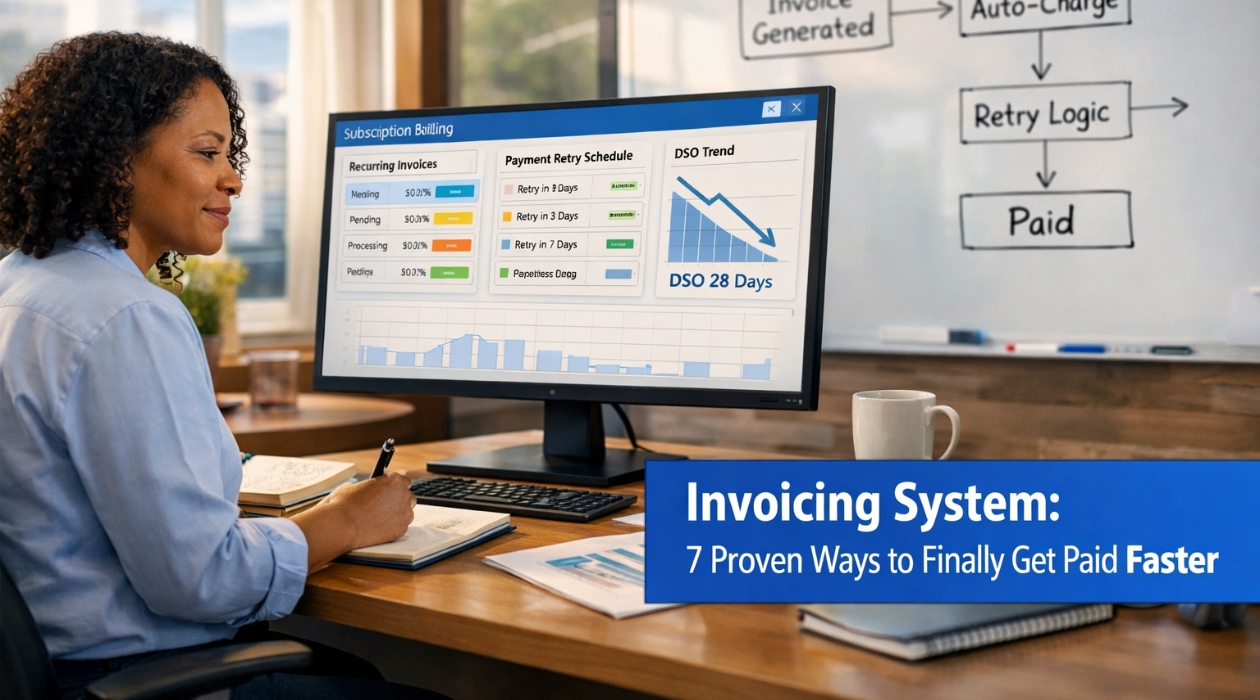
Invoicing System: 7 Proven Ways to Finally Get Paid Faster
Late payments are killing your SaaS company’s cash flow, and your current invoicing system is probably making it worse. The average B2B invoice takes 41 days to get paid, but SaaS companies face unique challenges that traditional system solutions simply cannot handle.
Your subscription model needs more than basic invoice generation. You need an system specifically designed for recurring revenue, automated payment collection, and the complex billing scenarios that come with different subscription tiers, usage-based pricing, and mid-cycle changes.
This comprehensive guide reveals exactly how to build an system that gets you paid on time, reduces manual work, and scales with your SaaS business without constant intervention.
Why Your Current Invoicing System Is Costing You Money
Most SaaS founders start with whatever invoicing system seems easiest, usually a basic tool like QuickBooks or FreshBooks. These platforms work fine for one-time transactions, but they create massive problems for subscription businesses.
Your system should automatically handle recurring billing cycles, proration calculations, and payment retries. When you are manually generating invoices each month, you are losing time and creating opportunities for errors that delay payment.
The wrong invoicing system forces you into reactive mode. You are chasing down late payments, manually processing refunds, and spending hours reconciling accounts instead of growing your business.
Consider what happens when a customer upgrades mid-cycle. A proper system calculates the prorated amount, generates the correct invoice, and processes the payment automatically. A basic invoicing system requires manual intervention, creating delays and potential billing errors.
The 7 Critical Components of a High-Performance Invoicing System
1. Automated Recurring Billing
Your system must automatically generate and send invoices based on subscription schedules. Manual invoice creation for recurring customers is a waste of time that introduces human error into your billing process.
The best invoicing system solutions create invoices automatically at the start of each billing period, send them to customers immediately, and attempt payment collection without any action from your team.
This automation ensures consistent timing. Customers receive their invoices on the same day each cycle, creating predictable payment patterns that improve your cash flow forecasting.
Set your invoicing system to generate invoices 5-7 days before the payment due date. This gives customers time to review charges and resolve any questions before payment processing begins.
2. Smart Payment Retry Logic
Failed payments are inevitable, but your invoicing system should handle them intelligently. A sophisticated system attempts multiple payment retries using smart timing and different payment methods.
Configure your invoicing system to retry failed payments after 3 days, then 7 days, then 14 days. This staged approach catches temporary issues like insufficient funds without annoying customers with daily retry attempts.
Your system should also automatically update customers about failed payments and provide easy ways to update payment information. Automated email sequences that explain the issue and offer simple solutions recover 40-60% of failed payments without manual intervention.
The system you choose should support multiple payment methods. When a credit card fails, the ability to quickly switch to ACH transfer or another card can save the customer relationship.
3. Flexible Payment Terms and Options
Different customers need different payment arrangements, and your invoicing system must accommodate these variations without creating administrative nightmares.
Your system should support net-30, net-60, and custom payment terms for enterprise clients while maintaining standard payment schedules for smaller customers. This flexibility allows you to close bigger deals without complicating your operations.
Payment plans are another critical feature. When a customer wants to pay a larger invoice in installments, your invoicing system should automatically split the amount, create the payment schedule, and process each installment without manual tracking.
The modern system also supports multiple payment methods including credit cards, ACH transfers, wire transfers, and digital wallets. Giving customers payment options reduces friction and speeds up collections.
4. Automated Payment Reminders
Your invoicing system should handle all payment reminder communication automatically. Manual reminder emails are inconsistent, time-consuming, and easy to forget when you are busy.
Configure your system to send reminders at strategic intervals. A typical sequence includes a friendly reminder 7 days before the due date, a courtesy notice on the due date, and escalating reminders at 3, 7, and 14 days past due.
The tone of these automated messages matters. Your system templates should start friendly and gradually become more direct without being aggressive. Professional, clear communication from your invoicing system maintains customer relationships while encouraging prompt payment.
Advanced system platforms allow you to customize reminder sequences based on customer segments. High-value customers might receive more personalized communication, while smaller accounts get standard automated messages.
5. Accurate Proration and Usage Tracking
SaaS billing gets complicated when customers change plans, add users, or consume more resources mid-cycle. Your invoicing system must handle these calculations accurately and automatically.
A proper invoicing system calculates prorated charges when customers upgrade or downgrade, ensuring they pay the correct amount for the exact time they used each service level. Manual proration calculations are error-prone and create billing disputes.
For usage-based pricing models, your system needs to track consumption data, apply your pricing structure, and generate accurate invoices that clearly show how charges were calculated. Customers should see exactly what they are paying for without confusion.
Your invoicing system should also handle credits and refunds automatically. When you need to credit an account, the system should apply it to the next invoice or process a refund based on your configured policies.
6. Comprehensive Reporting and Analytics
Your system is a goldmine of financial data, but only if you can access and understand it. The right system provides detailed reports that help you optimize your billing operations.
Track days sales outstanding (DSO) through your invoicing system dashboard. This metric shows how long it takes to collect payment after invoicing and helps you identify problems in your collection process.
Your system should also report on failed payment patterns, showing you which customer segments have the highest failure rates, which payment methods are most reliable, and when failures typically occur.
Revenue recognition reports from your invoicing system help you understand your true financial position. These reports show you earned revenue versus billed revenue, critical information for SaaS companies with annual contracts.
Monitor customer payment behavior through your system. Identify which customers consistently pay late and which always pay early. This data helps you make better decisions about payment terms and credit limits.
7. Seamless Integration with Your Tech Stack
Your system cannot exist in isolation. It needs to connect with your CRM, accounting software, subscription management platform, and payment processors to create a unified billing operation.
Integration between your invoicing system and CRM ensures that sales teams have visibility into customer payment status. They can see who is past due, who has failed payments, and who might need special attention during renewal conversations.
Your accounting software integration with your system automates reconciliation and eliminates duplicate data entry. When an invoice is paid, the transaction automatically records in your accounting system with the correct revenue recognition.
Payment processor integration allows your invoicing system to securely store payment methods, process transactions, and handle the complex requirements of PCI compliance without you needing to become a payments expert.
Subscription management platform integration ensures your system always has current plan information, usage data, and customer details needed to generate accurate invoices.
How to Choose the Right Invoicing System for Your SaaS
Not all invoicing system platforms are created equal, and choosing the wrong one can set your business back months while you migrate data and retrain your team.
Evaluate Subscription Billing Capabilities
Your invoicing system must be built for recurring revenue, not adapted from a traditional invoicing model. Look for native support of subscription billing cycles, automatic invoice generation, and recurring payment processing.
Test how the invoicing system handles mid-cycle changes. Create a test subscription, upgrade it halfway through the month, and see if the system correctly prorates charges and generates an accurate invoice.
Assess Payment Recovery Features
Ask potential invoicing system providers about their payment retry logic. How many retries? What timing? Can you customize the sequence? Do they support dunning management with automated customer communication?
The best system solutions recover 50-70% of failed payments automatically. Systems with weak retry logic leave money on the table every month.
Consider Scalability
Your invoicing system needs to grow with your business. Platforms that work well for 50 customers might collapse under the weight of 5,000 customers processing millions in monthly recurring revenue.
Ask about volume limits, performance at scale, and pricing tiers. Some system providers charge based on transaction volume or revenue processed, which can become expensive as you grow.
Review Integration Options
Make a list of your critical business systems and verify that your potential invoicing system integrates with each one. Pre-built integrations are vastly superior to custom API work that requires ongoing maintenance.
Pay special attention to how the system handles data synchronization. Real-time updates are essential for accurate billing, especially when customer information changes frequently.
Test the User Experience
Your team will use this invoicing system daily, and your customers will interact with the invoices it generates. Both experiences matter enormously.
Set up a trial account and actually use the system. Generate invoices, process payments, handle refunds, and create reports. Is the interface intuitive? Can you find what you need quickly?
Review sample invoices from the invoicing system. Are they clear and professional? Do they include all necessary information? Can customers easily understand what they are being charged for?
Implementation Strategy for Your New System
Choosing an system is just the first step. Successful implementation requires careful planning and execution to avoid disrupting your cash flow or customer relationships.
Phase 1: Data Migration and Setup
Begin your invoicing system implementation by migrating customer data, payment methods, and historical billing information. Clean your data before migration to avoid importing errors that will plague your new invoicing system.
Configure your system settings including payment terms, retry logic, email templates, and integration connections. Test each configuration thoroughly before going live.
Create customer segments in your invoicing system based on payment behavior, contract size, or industry. This segmentation allows you to apply different billing rules and communication strategies to different customer types.
Phase 2: Parallel Processing
Run your new system alongside your old system for at least one billing cycle. This parallel processing lets you verify that the new invoicing system generates correct invoices and processes payments properly.
Compare invoices from both systems for a sample of customers. Check amounts, dates, and line items to ensure your new invoicing system produces accurate results.
Monitor payment processing closely during this phase. Verify that your new invoicing system successfully charges payment methods and properly handles failed payments.
Phase 3: Full Transition
Once you have verified accuracy, transition completely to your new invoicing system. Communicate the change to customers if they will notice any difference in their invoice format or payment process.
Continue monitoring closely for the first 2-3 billing cycles. Watch for any issues with payment processing, invoice generation, or customer complaints.
Document all processes for using your new system. Create guides for common tasks like processing refunds, updating payment methods, and handling billing disputes. This documentation speeds up team training and ensures consistency.
Optimizing Your System for Maximum Collection Speed
Having a good invoicing system is not enough. You need to configure and use it strategically to minimize days sales outstanding and maximize cash flow.
Invoice Timing Strategy
Configure your system to send invoices as early as possible while respecting contractual payment terms. For net-30 terms, send the invoice immediately when the service period ends rather than waiting until closer to the due date.
Your invoicing system should send invoices at optimal times for customer attention. Tuesday through Thursday mornings tend to have higher open rates than Monday mornings or Friday afternoons.
Payment Method Optimization
Use your system data to identify which payment methods have the highest success rates and fastest processing times. Encourage customers to use these methods through incentives or strategic communication.
ACH transfers typically have lower failure rates than credit cards but take longer to process. Your invoicing system should support both and let customers choose based on their preferences.
Configure your system to automatically update expired payment methods by sending proactive notifications to customers before their cards expire. This prevents failed payments before they happen.
Communication Customization
Personalize automated messages from your invoicing system based on customer segments. Enterprise customers might appreciate more formal language, while small business customers respond better to friendly, casual communication.
Use your invoicing system to send payment confirmation immediately after successful processing. This simple communication reduces customer support inquiries and reinforces positive payment behavior.
Configure your invoicing system to highlight the specific value customers received during the billing period in each invoice. This reminder of value reduces payment resistance and disputes.
Common Invoicing System Mistakes That Delay Payment
Even with a sophisticated system, certain configuration errors and operational mistakes can sabotage your collection efforts.
Mistake 1: Unclear Invoice Details
Your invoicing system might generate invoices automatically, but if customers cannot easily understand what they are being charged for, they will delay payment while seeking clarification.
Configure your system to include clear line-item descriptions, service periods, and quantity details on every invoice. Customers should never need to contact support to understand their bill.
Mistake 2: Complicated Payment Process
If your system makes it difficult to submit payment, customers will procrastinate. The best system platforms include a “pay now” button in the invoice email that takes customers directly to a secure payment page.
Remove unnecessary steps from your payment process. Each additional click or form field reduces payment completion rates.
Mistake 3: Inconsistent Invoice Sending
Your invoicing system should send invoices on exactly the same day each billing cycle. Inconsistent timing trains customers to ignore invoices because they never know when to expect them.
Set up your system to generate and send invoices automatically at a specific time. Consistency creates predictability, and predictable invoices get paid faster.
Mistake 4: Weak Follow-Up Sequences
Your invoicing system reminder sequence might be too aggressive or too passive. Too many reminders annoy customers, while too few let invoices slip through the cracks.
Configure your system with a balanced reminder sequence that gently escalates. Start with friendly reminders and gradually increase urgency without becoming threatening.
Mistake 5: Ignoring Failed Payment Data
Your invoicing system collects valuable data about payment failures, but many companies never analyze it. Failed payments follow patterns based on customer segments, payment methods, and timing.
Review your system reports monthly to identify patterns. If credit cards fail most often on the 15th of the month (payday for many customers), consider adjusting billing dates for affected customers.
Measuring Success with Your Invoicing System
Your invoicing system should make collections faster and more predictable. Track these metrics to verify you are getting the expected results.
Days Sales Outstanding (DSO)
Your invoicing system should reduce DSO by at least 20% within the first three months of implementation. If you were averaging 41 days to collect payment, a good invoicing system should bring that down to 33 days or less.
Calculate DSO monthly using data from your invoicing system. Track the trend to ensure continuous improvement rather than one-time gains.
Collection Effectiveness Index (CEI)
This metric from your invoicing system shows what percentage of available receivables you actually collected during a period. A healthy SaaS company should maintain a CEI above 95%.
Your invoicing system should provide the data needed to calculate CEI automatically. If it does not, you will need to pull reports manually and calculate externally.
Failed Payment Recovery Rate
Track what percentage of failed payments your system successfully recovers through automated retries and dunning communication. The best invoicing system implementations recover 60-70% of failed payments.
If your recovery rate is below 50%, review your system retry configuration and dunning email templates. Small changes to timing or messaging can significantly improve results.
Customer Payment Behavior Changes
Monitor whether customers are paying faster after you implement your new invoicing system. Compare payment timing before and after to quantify the improvement.
Your system should show you average days to payment by customer segment. Use this data to identify which customer types need different billing approaches.
The Future of Your Invoicing System
Your system is not a “set it and forget it” tool. As your business evolves, your billing operations need to evolve with it.
Regularly review your system configuration to ensure it still matches your business model. As you add new pricing tiers, payment options, or customer segments, update your invoicing system accordingly.
Stay current with system platform updates. Providers regularly add new features that could improve your collections or reduce manual work.
Consider advanced invoicing system capabilities as you scale. Features like predictive payment analytics, AI-powered dunning optimization, and advanced revenue recognition might not be necessary today but could become valuable as you grow.
Your system should become more intelligent over time, learning from your customer payment patterns and automatically optimizing for better results.
Taking Action on Your Invoicing System
You now understand exactly what makes an invoicing system effective for SaaS companies and how to implement one that gets you paid on time.
The gap between knowing what to do and actually doing it is where most companies fail. You can have all the system knowledge in the world, but without proper implementation and ongoing optimization, you will continue struggling with late payments and cash flow problems.
If you are ready to fix your invoicing system but do not have the time or expertise to handle implementation yourself, book a Clarity Call. We will analyze your current billing operations, identify the specific system solution that fits your needs, and create an implementation plan that gets you to faster collections within 90 days.
This is not about buying expensive software you do not need. This is about configuring the right invoicing system correctly so it actually solves your payment collection problems instead of creating new ones.
FAQ Section
What is the best invoicing system for a SaaS company? The best invoicing system for SaaS companies includes automated recurring billing, smart payment retry logic, and native subscription management features. Popular options include Stripe Billing, Chargebee, and Recurly, each with different strengths depending on your specific needs.
How can an system reduce late payments? An invoicing system reduces late payments through automated reminder sequences, smart payment retry logic, and multiple payment method support. Companies typically see a 40-60% reduction in late payments within three months of implementing a proper system.
Should I build my own invoicing system or buy one? Building your own system only makes sense if billing is your core competitive advantage and you have significant development resources. For most SaaS companies, purchasing a proven invoicing system is faster, cheaper, and more reliable than custom development.
How much does a good system cost? A quality invoicing system for SaaS companies typically costs between $200-$1,000 per month depending on transaction volume and features needed. Most platforms charge based on revenue processed or number of active subscriptions rather than flat monthly fees.
Can my invoicing system integrate with my existing accounting software? Most modern system platforms integrate with major accounting software including QuickBooks, Xero, and NetSuite. These integrations automate reconciliation and ensure your invoicing system data syncs properly with your financial records.
What features are essential in an invoicing system for subscription billing? Essential invoicing system features for subscription billing include automated recurring invoice generation, proration calculations, payment retry logic, dunning management, usage-based billing support, and detailed revenue recognition reporting.
How long does it take to implement a new invoicing system? Implementing a new invoicing system typically takes 4-8 weeks including data migration, configuration, testing, and team training. More complex businesses with custom billing rules may need 10-12 weeks for full implementation.
Will changing my invoicing system disrupt customer payments? Changing your system does not need to disrupt customer payments if you plan properly. Run both systems in parallel for one billing cycle, migrate payment methods securely, and communicate any customer-facing changes clearly.
How can I tell if my current invoicing system is working? Your current invoicing system is working if your days sales outstanding is below 30 days, you recover more than 60% of failed payments automatically, and your team spends less than 5 hours per week on billing administration.
What is the ROI of upgrading my invoicing system? Upgrading your system typically delivers ROI within 3-6 months through reduced DSO, higher payment recovery rates, and decreased administrative time. Companies often see a 5-10x return in the first year from improved cash flow alone.