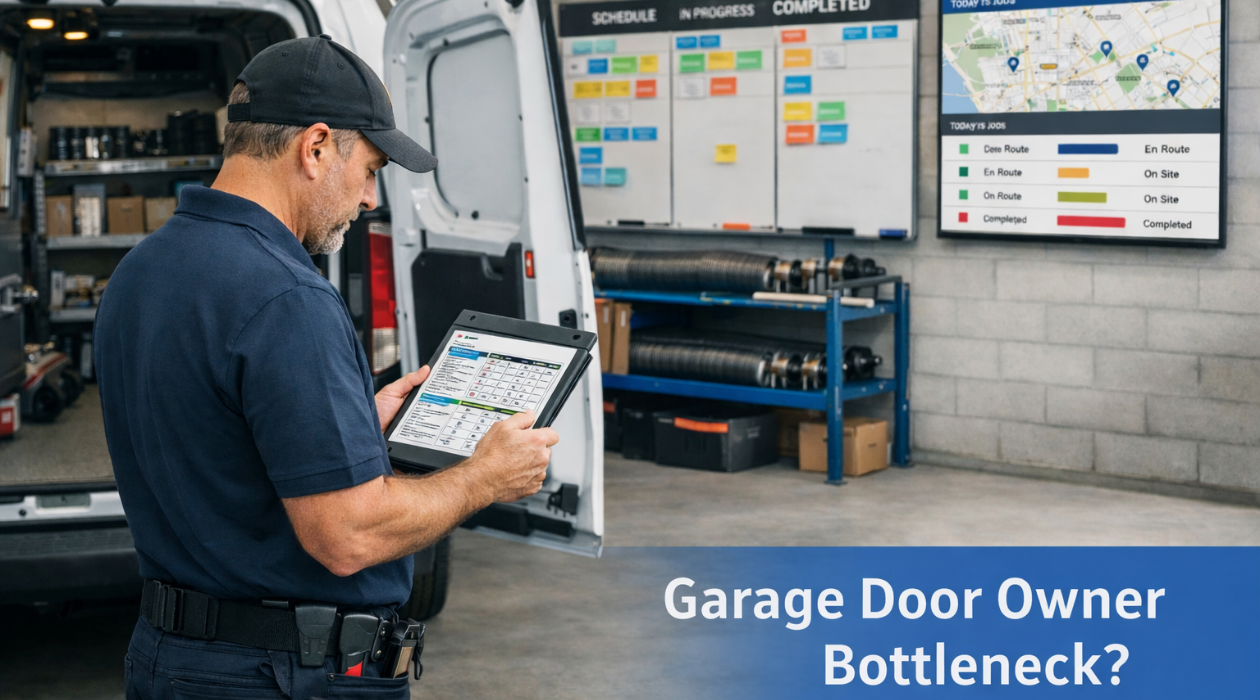
Garage Door Owner Bottleneck 5 Brutal Reasons You’re Trapped
You hired technicians. You brought on an office person. You even got that kid to answer phones on weekends. So why are you still the garage door owner bottleneck in every single decision, every estimate, every supplier call, and every customer complaint?
Here’s the uncomfortable truth: hiring people doesn’t fix a garage door owner bottleneck. It just gives you more people to manage while you’re still doing everything important yourself. You’re not understaffed; you’re under-systematized.
Most garage door company owners hit this wall between $30K and $80K monthly revenue. You’ve grown past the one-truck operation, but you haven’t built the operational infrastructure that lets your garage door company operations actually run without you. Your technicians can install a door, but they can’t make decisions. Your office person can answer calls, but they route everything to you. You’re not running a business; you’re running an expensive hobby that owns you.
This isn’t about working harder or hiring better people. The garage door owner bottleneck exists because you’ve built a business that structurally requires you for everything. And until you address the five specific systems gaps that create this operational bottleneck garage door companies face, hiring more help just multiplies your problems.
Let’s break down exactly why you’re still trapped, and what actually fixes it.
You Hired Bodies, Not Systems (And Bodies Need Instructions)
Your new technician can replace springs and install doors beautifully. But can they handle a customer who wants to negotiate price? Can they make a judgment call when a door frame needs unexpected repairs? Can they order parts without calling you?
No. Because you hired someone to execute tasks, not to operate within a garage door business system.
The garage door owner bottleneck persists because most owners hire for hands, not for independent operation. You bring on technicians and expect them to “figure it out” or “use common sense” without documented processes, pricing authority, or decision frameworks. Then you’re frustrated when they call you for every judgment call.
Here’s what’s actually happening: Your team isn’t incompetent. They’re operating in an information vacuum. Without clear processes for common scenarios, they default to asking you because that’s safer than guessing wrong. You’ve accidentally trained them that you’re the answer to everything.
The missing piece: Documented standard operating procedures for garage door company operations that cover not just “how to install a door” but:
- What to do when the customer’s frame is rotted
- How to handle pricing objections on-site
- When to call for backup versus handling it yourself
- How to document unexpected conditions requiring additional work
- What qualifies as an emergency versus next-day service
When Clarity Engine Ops works with garage door companies stuck in this garage door owner bottleneck pattern, we start by documenting the 15-20 decision points that currently run through the owner, then building frameworks that let technicians handle 80% of those decisions independently using clear criteria rather than judgment calls.
You need process documentation that captures your expertise and makes it transferable. Not a giant manual nobody reads; practical job aids and decision trees your team actually uses in the field.
Your Pricing Lives in Your Head (And Customers Know It)
Why does every estimate still require your approval? Because your garage door business systems don’t include documented pricing logic that accounts for the variables your team encounters.
You know how to price a straightforward door replacement in your sleep. But what about when the customer wants premium hardware? When the existing framing needs reinforcement? When they want a rush install? When it’s a commercial property versus residential? Your pricing adjusts for dozens of factors based on years of experience.
Your technicians don’t have that experience. So they take measurements, snap photos, and tell customers “the owner will call you with a price.” The customer feels like they’re getting the runaround. You spend your evening calculating estimates. And the garage door owner bottleneck tightens because you’re the only person who can translate a job into a number.
This is exceptionally common in garage door business management. Most owners can quote accurate prices instantly because they’ve internalized all the variables:
- Material costs and supplier pricing tiers
- Labor time multipliers for different door types
- Difficulty factors (second story, tight garage, custom sizes)
- Competitive positioning by neighborhood
- Margin requirements by job size
That’s not a skill problem. That’s an undocumented system living in your brain.
The solution: Pricing matrices that codify your logic. When Clarity Engine Ops helps garage door companies break this garage door owner bottleneck, we build tiered pricing frameworks with clear adjustment factors. Basic residential door: base price. Add 15% for custom size. Add $200 for frame repair. Add 20% for commercial. Add rush fee for same-day. Suddenly your experienced technicians can provide accurate quotes on-site, customers get immediate answers, and you’re only reviewing exceptions rather than every single estimate.
The goal isn’t perfect pricing; it’s empowering your team to quote 85% of jobs accurately without you. That alone eliminates hours of daily back-and-forth and dramatically improves customer experience.
You’re Still the Quality Control Department of One
Every completed job flows through you for approval. Every customer issue gets escalated to you. Every warranty claim requires your decision. Why? Because you haven’t defined what “done right” actually means in measurable terms.
Your technicians finish an installation. It works. The door opens and closes. But is it done to your standards? They don’t know, so they check with you. The customer calls with a minor adjustment request three days later. Your office person doesn’t know if that’s normal or a problem, so they loop you in. The garage door owner bottleneck exists because “quality” lives in your gut feeling rather than in objective standards.
This creates a vicious cycle in garage door company operations. Your team knows you’ll catch mistakes, so they’re less careful about self-checking. You know you have to review everything, so you do, which reinforces their dependency. Nobody develops quality instincts because you’re the quality instinct for everyone.
Here’s the operational reality: You can’t scale garage door company growth when quality control requires your personal inspection of every job. You’ll hit a hard ceiling around 8-10 installations per week because that’s your inspection capacity, regardless of how many technicians you hire.
What actually works: Quality checklists and photo documentation requirements that define “complete installation” in 12-15 objective criteria:
- Proper weather stripping installed and tested
- All hardware tightened to spec
- Balance verified with door disconnected
- Safety sensors tested three times
- Tracks level and properly aligned
- Customer walkthrough completed with signature
When Clarity Engine Ops implements quality systems for garage door businesses facing this owner bottleneck garage door pattern, we document what you already check for, then make that checklist the technician’s responsibility with photographic proof. You shift from inspecting every job to auditing random samples and reviewing flagged exceptions.
This isn’t about trusting your team more. It’s about giving them the tools to verify their own work to your standards, which builds actual competence instead of learned helplessness.
Your Technicians Manage Tasks, Not Customer Relationships
Your technician shows up, installs the door, collects payment, and leaves. The customer had three questions they wanted to ask. Your technician answered one and said “call the office” for the other two. Now you’re fielding a call from a customer who feels like they got a transaction instead of service.
The garage door owner bottleneck extends beyond operations into customer relationship management. Your technicians view their job as technical execution; they install doors. You view their job as customer experience; they represent your brand and build relationships that generate referrals and reviews.
This gap exists because you’ve never explicitly defined what customer interaction should look like. You haven’t trained technicians on the conversational elements that turn a job into a relationship. And you haven’t empowered them to handle the predictable questions and requests that currently get routed back to you.
Common scenarios your technicians punt to you:
- Customer asks about maintenance schedules
- Customer wants to know about upgrading their opener next year
- Customer mentions their neighbor needs a door
- Customer asks about your warranty
- Customer wants to add something to the job
Every single one of these is an opportunity your technician could handle, or at least advance, without your involvement.
When Clarity Engine Ops works with garage door service business owners to solve this dimension of the garage door owner bottleneck, we develop customer interaction scripts and empowerment guidelines. Not rigid phone-tree scripts, but conversation frameworks for common situations. “When customer asks about maintenance, explain the annual service option and offer to schedule it before you leave.” “When customer mentions a referral, get contact info and offer our $50 referral bonus on the spot.” “When customer wants to add work, use this quick-quote formula for common additions, or schedule a follow-up visit for complex changes.”
You’re not trying to turn technicians into salespeople. You’re equipping them to handle the relationship moments that naturally occur during service, so those moments don’t all flow back through you.
No One Owns Outcomes Except You
Your office person schedules jobs. Your technician completes installations. Your part-time bookkeeper processes invoices. Everyone has tasks. Nobody owns outcomes.
When a customer complains about communication gaps, who’s responsible? When a job runs over-budget, who answers for it? When the schedule falls apart because of a supplier delay, who owns the solution? You. Because you’ve hired task-executors without defining accountability for results.
This is the deepest form of garage door owner bottleneck, and the hardest to recognize because it masquerades as “being the boss.” You believe you need to own outcomes because you own the business. But that’s confusing ownership of the entity with ownership of operational results.
In a properly structured garage door business system, someone other than you owns these outcomes:
- Scheduling efficiency and utilization rates
- Customer satisfaction scores and review generation
- Inventory accuracy and parts availability
- Revenue per installation and margin protection
- First-call resolution and callback rates
These aren’t vague responsibilities; they’re specific outcomes with measurable targets and clear authority to make decisions that impact those outcomes.
Right now, your team executes tasks and you own whether those tasks add up to business success. That’s why everything still runs through you. Your office person doesn’t own “schedule efficiency”; they just book appointments when customers call. So when the schedule is a disaster, they wait for you to fix it. Your technician doesn’t own “customer satisfaction”; they just install doors. So when a customer is unhappy, they wait for you to handle it.
Delegating in garage door business contexts fails when you delegate tasks without delegating authority and accountability for outcomes. Clarity Engine Ops helps garage door company owners redesign organizational structure around outcome ownership. Your lead technician owns installation quality scores and has authority to implement quality improvements without approval. Your operations person owns schedule efficiency and has authority to adjust booking rules to optimize utilization. You shift from managing tasks to reviewing outcomes and coaching the people responsible for them.
This is the transition from owner-operator to actual owner. It’s uncomfortable because it requires trusting people with real authority. But it’s the only path to a garage door business that runs without you in every decision.
The Real Problem: You Built a Job, Not a Business
Here’s what nobody tells you when you’re scaling from one truck to three trucks to five: hiring people doesn’t build a business. Systems build businesses. People execute systems.
You’re experiencing the garage door owner bottleneck because you’ve scaled the job you do without building the operational infrastructure that makes that job replicable by others. You can install a garage door in 90 minutes. You’ve hired three technicians who can also install a door in 90 minutes. But you haven’t built the decision-making systems, pricing frameworks, quality standards, customer interaction protocols, and accountability structures that let those technicians operate independently at your level.
So you’ve got four people who can install doors, but only one person (you) who can run the business. The math doesn’t work. You hit a ceiling because your capacity isn’t limited by installation hours; it’s limited by decision-making hours. And all the decisions flow through you.
Most garage door business systems projects fail because owners approach them as documentation exercises. They create a procedures manual, put it on a shelf, and wonder why nothing changes. Documentation is necessary but insufficient. You need operational systems that embed decision-making authority into roles, create feedback loops that surface problems before they’re emergencies, and build competency development paths that help people grow from task-executors to outcome-owners.
This is exactly what The Clarity Transformation addresses for garage door companies stuck in the garage door owner bottleneck trap. We spend 12 weeks systematically building the five systems that create operational independence:
- Documented decision frameworks that capture your expertise
- Transparent pricing logic your team can apply independently
- Measurable quality standards anyone can verify
- Customer interaction protocols that build relationships
- Outcome-based accountability that distributes ownership
The deliverable isn’t a manual. It’s a business that operates to your standards when you’re not there, because the systems carry your expertise and judgment.
What Actually Breaks the Garage Door Owner Bottleneck
You need five specific systems, implemented in this order:
1. Decision Authority Matrix
Document the 30-40 decisions that currently run through you. Categorize them by frequency and risk. Delegate 60% immediately using simple decision trees. Delegate another 25% with approval thresholds (e.g., “pricing adjustments under $500 don’t need approval”). Keep 15% that genuinely require owner judgment.
When Clarity Engine Ops implements this for garage door companies, we typically find owners are making 50+ daily decisions that could be handled by others with a simple framework.
2. Dynamic Pricing System
Build pricing matrices that account for your variables:
- Job complexity and installation difficulty
- Material costs and supplier pricing
- Labor time estimates by door type
- Profit margin targets by job category
- Competitive positioning factors
Include adjustment factors for common situations (rush fees, commercial multipliers, volume discounts, seasonal pricing). Give experienced technicians authority to quote within the matrix. Reserve only custom/complex jobs for owner review. This single system eliminates 70% of the estimate bottleneck immediately.
3. Quality Verification Protocol
Define completion standards in observable, measurable terms. Create photo documentation requirements that prove standards were met. Shift quality control from owner inspection to technician verification with spot-checks. Build corrective action processes that solve problems systematically rather than reactively.
The goal is catching your own mistakes becoming a core competency of your team, not just you catching theirs.
4. Customer Interaction Framework
Script the common relationship moments:
- Referral requests and neighbor conversations
- Maintenance offers and annual service packages
- Upsell opportunities for openers and accessories
- Complaint handling and service recovery
- Warranty explanations and coverage details
Give technicians language and authority to advance these conversations productively. Train your team to recognize when they need owner involvement versus when they can handle it. This transforms technicians from installers into relationship-builders who happen to install doors.
5. Outcome Accountability Structure
Assign ownership of measurable results to specific people. Schedule efficiency belongs to your operations person. Customer satisfaction belongs to your lead technician. Revenue per job belongs to your estimator/sales role.
You remain accountable for overall business performance, but you’re coaching outcome-owners rather than executing outcomes yourself. This is the structural shift from operator to owner.
These aren’t quick fixes. Building robust garage door business management systems takes 8-12 weeks of focused implementation. But it’s the only path from garage door owner bottleneck to garage door company operations that scale beyond your personal capacity.
Many garage door business owners attempt these systems implementations on their own. Some succeed, usually over 6-12 months of trial and error. Others get stuck because building systems while running daily operations is like rebuilding your truck engine while driving down the highway.
The Clarity Operational Partnership exists specifically for garage door companies in this situation; you get fractional COO support to design and implement these systems without taking you away from customer-facing work that generates revenue.
The Owner-Independent Garage Door Company Is Possible
Your garage door owner bottleneck isn’t permanent. It’s the predictable result of scaling revenue without scaling operational infrastructure. You don’t need different people. You need systems that make your current people dramatically more capable.
The garage door companies that break through this ceiling don’t have magical teams. They have operational frameworks that capture owner expertise and make it accessible to everyone. They have pricing systems that codify judgment calls. They have quality standards that anyone can verify. They have customer protocols that anyone can execute. They have accountability structures that distribute ownership of results.
When these systems exist, hiring help actually helps. Your new technician has decision frameworks to follow. Your office person has clear authority boundaries. Your lead tech has outcome metrics they own. And you shift from “person who does everything” to “person who coaches people who own outcomes.”
That’s what operational independence looks like. Not a business that runs without you entirely, but a business where your involvement is strategic and optional rather than tactical and mandatory. Where you spend time on growth initiatives rather than approving estimates. Where a week-long vacation doesn’t create a crisis. Where scaling from three trucks to six trucks means hiring people who operate within systems, not hiring more people you have to micromanage.
If your garage door business is generating $20K-$100K monthly and you’re still the garage door owner bottleneck in every decision, you’re at the exact inflection point where systems implementation creates exponential leverage. You can keep hiring bodies and hoping they magically become independent. Or you can build the operational infrastructure that actually makes independence possible.
The constraint isn’t your team’s capability. It’s whether your business has systems that enable capability to flourish.
FAQ: Breaking the Garage Door Owner Bottleneck
Q: How long does it realistically take to stop being the garage door owner bottleneck in my company?
Most garage door businesses need 90-120 days to implement the core systems that eliminate 70-80% of owner dependency. You’ll see meaningful progress within 30 days as decision frameworks and pricing systems go live. Complete operational independence typically takes 6-9 months including team training and refinement.
Q: Can I fix the garage door owner bottleneck by just hiring better people?
No. Better people execute better within systems, but they can’t create systems that don’t exist. Your current team probably has 60-70% more capacity than you realize; they’re limited by lack of frameworks, not lack of ability. Build systems first, then evaluate whether you need different people.
Q: What’s the first system I should implement to reduce the garage door owner bottleneck?
Start with a decision authority matrix. Document the 30-40 decisions that currently require your involvement, then delegate 60% using simple decision trees. This creates immediate relief and shows your team that systematic delegation is possible.
Q: How do I document pricing logic when every garage door job is different?
Build pricing matrices with base rates and adjustment factors rather than trying to document every scenario. Capture the variables you consider (job complexity, materials, labor time, margin targets) and create multipliers for each. Your goal is empowering 85% of quotes, not perfect coverage.
Q: Should I involve my team in building systems to break the garage door owner bottleneck?
Involve them, but you own the frameworks. Your team provides input on practical constraints and gaps in current processes. You make decisions about standards and authority levels. When Clarity Engine Ops implements systems, we facilitate workshops that leverage team knowledge while maintaining owner control.
Q: What if my technicians aren’t interested in taking on more responsibility?
Some won’t be, and that’s useful information. Task-executors who resist ownership of outcomes probably aren’t your long-term team. But most technicians welcome clear authority and frameworks because it makes their job easier and more professional. Position it as career development, not more work.
Q: How much time does systems implementation require from me weekly?
Expect 5-8 hours weekly during active implementation (90 days), then 2-3 hours weekly for maintenance and refinement. This feels impossible when you’re already maxed out, which is why fractional COO support exists; someone else drives implementation while you provide expertise and decisions.
Q: Will implementing systems slow down my garage door company operations initially?
Yes, for 2-4 weeks while your team learns new processes. This is normal and temporary. The alternative is staying trapped in the garage door owner bottleneck indefinitely. Most garage door companies recoup the implementation time within 60 days through efficiency gains.
Q: How do I know if I need fractional COO help or can break the garage door owner bottleneck myself?
If you have 10-15 hours weekly to dedicate to systems development and you’re energized by operational design, DIY is viable. If you’re already working 60+ hours and drowning in daily fires, bringing in fractional COO support for 90-180 days accelerates results and prevents half-finished implementation.
Q: What’s the ROI of breaking the garage door owner bottleneck?
Direct ROI: 15-25 hours returned to you weekly within 90 days. Indirect ROI: 30-50% revenue growth capacity without adding owner hours. Team retention improves 40-60% because people prefer working within clear systems. Customer satisfaction typically increases 20-30% due to consistency.
Related Blog Topics
- The Real Reason You Can’t Scale Your Garage Door Business Past $75K/Month – Discover the three structural barriers that trap garage door companies under $1M annually, and the specific systems upgrades that break through each ceiling. Perfect for owners hitting growth plateaus despite strong demand.
- How to Build a Pricing System Your Garage Door Technicians Can Actually Use – Step-by-step guide to documenting your pricing logic in matrices and decision trees that field teams can apply on-site without owner involvement. Includes templates specific to variable-pricing service businesses like garage door companies.
- From Owner-Operator to Actual Owner: The 90-Day Transition Plan for Garage Door Companies – The exact sequence of systems implementations that shift you from “person who does everything” to “person who coaches people who own outcomes.” Includes timeline, milestones, and common roadblocks for garage door service businesses.
- Quality Control Without You: Building Self-Verifying Garage Door Installation Teams – How to transition from personal inspection of every job to team-owned quality verification using checklists, photo documentation, and spot-audit protocols. Reduces owner QC time 80% while maintaining standards in garage door operations.
- 5. Why Your Garage Door Team Keeps Asking Permission (And How to Fix It) – The psychology and systems behind learned helplessness in small business teams, plus the decision authority frameworks that rebuild independent judgment and accountability in garage door companies.
- The $10K/Month Garage Door Owner’s Dilemma: Too Small to Hire, Too Big to Do It All – Navigate the uncomfortable growth phase where you’ve outgrown solo operation but can’t yet afford full-time management. Systems-based solutions for the $10K-$30K monthly revenue stage.
- How to Train Garage Door Technicians to Handle Customer Objections Without Calling You – Complete conversation frameworks for the six most common customer objections garage door technicians face, with scripts, pricing authority guidelines, and confidence-building training methods.
- Scheduling Chaos: Why Your Garage Door Calendar is Always a Disaster (And the System That Fixes It) – The operational reasons garage door companies struggle with scheduling efficiency, plus the booking rules, utilization metrics, and buffer protocols that create predictable, profitable schedules.
- The Hidden Cost of Being the Only Person Who Can Quote Jobs in Your Garage Door Business – Calculate how much revenue you’re losing to slow estimate turnaround, plus the pricing matrices and quote automation that let technicians provide same-day numbers customers actually accept.
- How to Get Your Garage Door Business Ready to Sell (Even If You’re Not Selling) – Build the operational independence and documentation that makes your garage door company attractive to buyers or investors, creating exit optionality whether you plan to sell or not.
- Emergency Call Protocol: Stopping After-Hours Chaos in Your Garage Door Business – Decision trees and triage systems that let your team handle 90% of after-hours emergencies without waking you up, while maintaining customer satisfaction and protecting margins.
- The Technician-to-Lead Tech Transition: Growing Leaders in Your Garage Door Company – How to identify high-potential technicians and develop them into operational leaders who own outcomes, manage peers, and reduce owner dependency through systematic leadership development.
- Parts Inventory Management for Garage Door Companies: The System That Stops the Chaos – Move from “hope we have it on the truck” to predictable parts availability using min-max inventory systems, truck stock protocols, and supplier relationship management for garage door operations.
- Customer Communication Standards: Why Your Garage Door Clients Feel Ghosted (And How to Fix It) – The communication gaps that destroy customer experience in garage door businesses, plus the automated touchpoints, response time standards, and update protocols that build trust and generate referrals.
- Hiring Your First Office Manager: What Garage Door Owners Get Wrong (And Right) – When to hire administrative support, what responsibilities to delegate first, how to structure the role for success, and the systems that need to exist before you bring someone on.
- The Warranty Call Protocol: Turning Service Callbacks into Profit Opportunities – Stop losing money on warranty work by implementing clear warranty policies, technician training on coverage determination, and upsell frameworks that turn service calls into additional revenue.
- How to Fire Yourself from Daily Operations in Your Garage Door Business (Without Everything Falling Apart) – The week-by-week plan for transferring operational responsibilities, building backup systems, and testing your team’s independence before you actually step back from daily involvement.
- Route Optimization for Garage Door Companies: Stop Burning Fuel and Technician Time – Geographic scheduling strategies, travel time tracking, and route planning systems that reduce windshield time by 25-40% while increasing jobs completed per day.
- The Real Numbers: What Garage Door Companies Actually Need to Track (And What’s Just Vanity Metrics) – Cut through dashboard overwhelm with the 8-12 metrics that actually predict garage door business success, plus simple tracking systems and weekly review protocols that drive profitable growth.
- Seasonal Planning for Garage Door Businesses: Systems for Surviving Slow Months and Capitalizing on Busy Seasons – Revenue forecasting, capacity planning, marketing calendars, and cash flow management strategies specific to the seasonal demand patterns garage door companies experience throughout the year.
Stop Being the Garage Door Owner Bottleneck. Start Building the Business.
You didn’t start a garage door company to spend your life approving estimates and fixing scheduling conflicts. You built this to create income, build equity, and have flexibility. The garage door owner bottleneck is stealing all three.
Systems implementation isn’t glamorous. It’s not a quick hack. It takes 90-120 days of focused work to build operational infrastructure that genuinely reduces owner dependency by 70-80%. But it’s the only path from where you are (trapped in operations) to where you want to be (running a scalable business).
Clarity Engine Ops specializes in breaking the garage door owner bottleneck for service businesses generating $20K-$100K monthly. We’ve seen dozens of garage door companies stuck in exactly this pattern; growing revenue, hiring people, still doing everything themselves. The Clarity Transformation is our 12-week operational overhaul that builds the five systems that create owner independence: decision frameworks, pricing logic, quality standards, customer protocols, and outcome accountability.
You’ll walk away with documented systems your team actually uses, not binders gathering dust. We implement these systems alongside you, training your team and refining processes until they work in your real-world garage door company operations.
Ready to stop being the garage door owner bottleneck in your business?
Schedule a Clarity Call (45-minute diagnostic conversation where we map your current owner dependencies and outline the specific systems implementations that would create the most immediate operational relief for your garage door business.)
The garage door owner bottleneck isn’t a personality flaw. It’s a systems gap. Let’s fix it systematically.