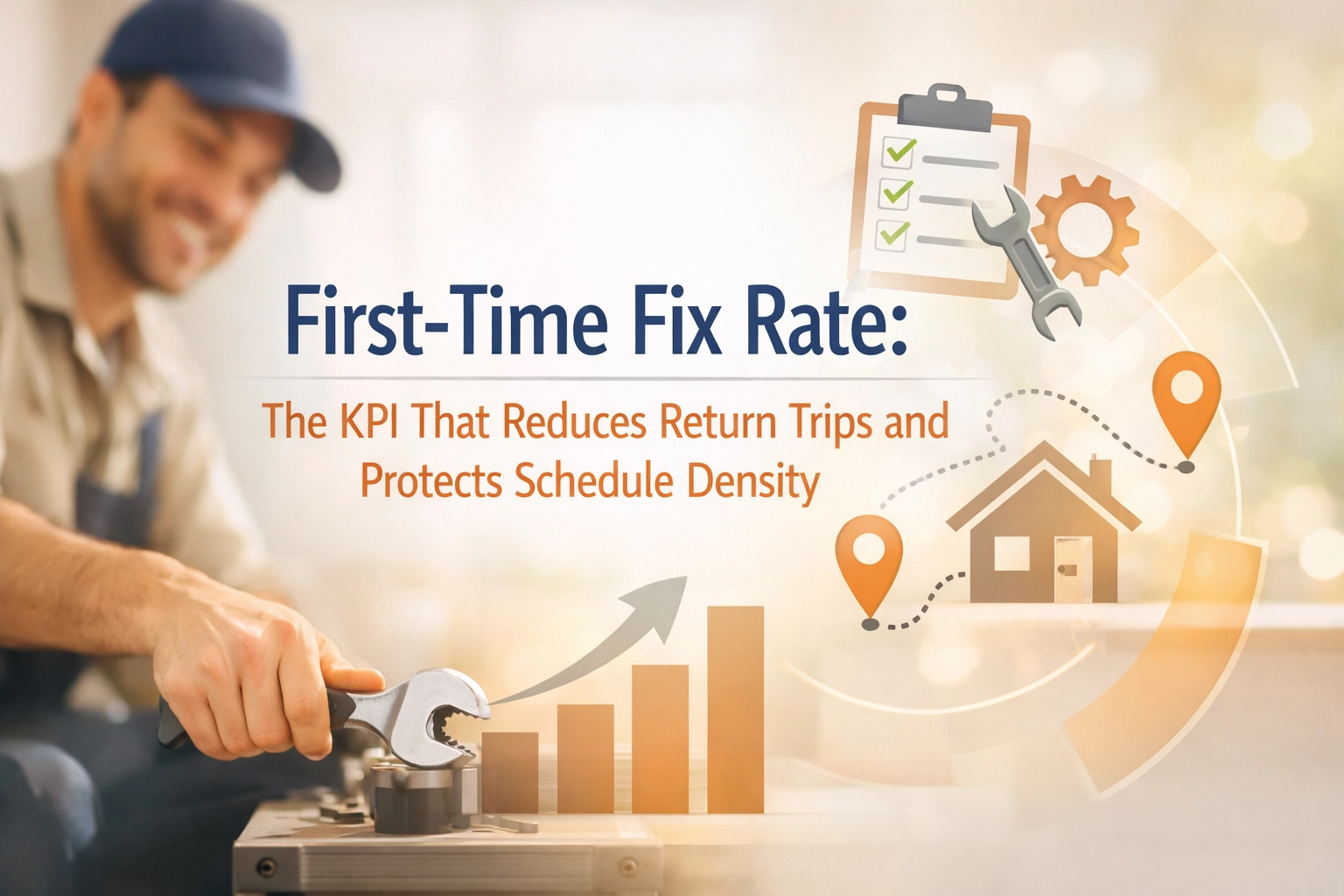
First-Time Fix Rate: 7 Ways to Maximize Profits
You are staring at the GPS tracker watching three different trucks drive back to job sites they were at yesterday while your new service calls sit in the queue and your phone rings with frustrated customers.
Let me be direct. If your technicians are visiting a site twice for a single problem, you are lighting money on fire. Here is what nobody tells you. A poor First-Time Fix Rate is not a technician problem. It is an operational failure. I have seen this pattern dozens of times in service companies. You think you have a labor shortage or a lead generation problem. The reality is that you have a capacity problem caused by wasted motion.
Your First-Time Fix Rate is the single most important metric for protecting your margins and your sanity. When a technician fixes the issue on the first visit, you get paid. When they have to go back, you pay them to fix your own mistake. My recommendation is to stop looking at total revenue and start looking at how much it costs you to earn that revenue. In the next 12 weeks, you can transform your bottom line by focusing on this one KPI.
The promise is simple. Improving your Fix Rate unlocks hidden capacity in your current team. You do not need to hire more people to grow. You need to make sure the people you have are not doing the same work twice.
The Financial Reality of a Low First-Time Fix Rate
Let’s look at the math. A typical truck roll costs a service business anywhere from $200 to $500 before the technician even turns a wrench. This includes fuel, insurance, vehicle wear, and the hourly loaded labor rate. If your Fix Rate is 65 percent, it means 35 out of every 100 jobs require a second trip.
The pattern is clear. Those 35 return trips are pure overhead. You cannot bill the client twice for the same repair in most cases. You are losing the direct cost of that second trip. But you are also losing the opportunity cost of the new job that technician could have been doing instead.
The reality: A 10 percent increase in your First-Time Fix Rate can lead to a 20 percent increase in net profit. This is because that 10 percent goes straight to the bottom line without any additional customer acquisition cost. When you focus on Fix Rate, you are focusing on efficiency.
Too many founders ignore the First-Time Fix Rate because they are too busy putting out fires. They see the chaos as a sign of growth. It is not. It is a sign of operational debt. If you want to scale from $50K to $100K a month, you cannot carry that debt with you. You must fix the First-Time Fix Rate now or you will burn out your best techs.

Why Your Current HVAC Dispatch Optimization Is Failing
You might think you have a scheduling problem. You think a better software will fix your HVAC dispatch optimization. The truth is that software only automates your current mess. If your data is bad, your Fix Rate will remain low regardless of the tool you use.
HVAC dispatch optimization requires more than just dragging and dropping boxes on a screen. It requires a deep understanding of schedule density. Schedule density is the art of minimizing travel time while maximizing billable hours. But you cannot have true schedule density if your technicians are constantly breaking the schedule to handle return trips.
The logic: Every time a tech has to go back to a job, it creates a ripple effect.
- The afternoon appointments get pushed.
- The technician gets rushed.
- Because they are rushed, they miss a detail on the next job.
- That creates another failed First-Time Fix Rate event.
- The cycle repeats.
I have seen businesses where 40 percent of the daily schedule is just “fixing yesterday’s problems.” This is an operational failure. To achieve real HVAC dispatch optimization, you must protect the integrity of the initial visit. You must prioritize the First-Time Fix Rate over the number of calls booked.
Common mistake: Booking more calls than your team can handle leads to a lower First-Time Fix Rate. The technicians feel the pressure. They take shortcuts. They do not have the right parts on the truck because the warehouse team was too rushed to restock. Your First-Time Fix Rate drops and your profit evaporates.
The Three Silent Killers of Your First-Time Fix Rate
What happens: You send a tech out. They arrive. They diagnose the problem. Then they realize they do not have the part. Or they realize they do not have the right ladder. Or they realize they do not have the technical expertise for that specific model.
The pattern:
- Van Inventory Chaos: If the technician has to drive to a supply house, you have failed the Fix Rate. Every trip to a supply house is a 60-to-90-minute loss of billable time.
- Information Gaps: If the office does not get the right model number or symptoms during the intake call, the tech arrives blind. This kills your First-Time Fix Rate before the truck even leaves the driveway.
- Skill Mismatch: Sending a junior tech to a complex commercial job is a recipe for a return trip. Your Fix Rate depends on matching the right person to the right problem.
The reality check: You cannot manage what you do not measure. Most founders do not even know their current First-Time Fix Rate. They just know they feel “busy.” Busy is not a metric. Busy is a trap.
To improve your Fix Rate, you need to track why jobs fail. Was it a part? Was it a lack of training? Was it a lack of time? Once you have the data, you can apply The Clarity Transformation to build systems that prevent these failures.
Goal: Achieve an 85 percent First-Time Fix Rate within 90 days.
Implementing The Clarity Transformation for Field Operations
This is where most consultants just give you a list of ideas and walk away. That is not how I work. The Clarity Transformation is about hands-on implementation. We don’t just talk about the First-Time Fix Rate. We build the workflows that force it to happen.
The Clarity Transformation involves looking at your intake process first. Who is answering the phone? Are they following a script that extracts the necessary data to ensure a high First-Time Fix Rate? If they aren’t, your techs are starting from behind.
Next, The Clarity Transformation looks at your inventory management. We create “truck kits” based on the most common repairs. If 80 percent of your calls are for five specific issues, those five kits must be on every truck at all times. This is how you protect your First-Time Fix Rate.
Finally, we address the “return trip” protocol. In many companies, a tech just tells the office “I need to go back.” In a high-performing company, every failed First-Time Fix Rate requires a post-mortem. Why did we fail? How do we prevent it next time?

Scaling Through a Clarity Operational Partnership
If you are a founder doing $1M to $3M a year, you probably do not have time to sit in your warehouse and audit truck stock. You are too busy closing deals or managing high-level fires. This is why a Clarity Operational Partnership is effective. I step in as your Fractional COO to manage these details for you.
A Clarity Operational Partnership means I am in the trenches with your team. I am looking at the dispatch logs. I am interviewing the techs to find out why their First-Time Fix Rate is lower on Tuesdays. I am building the reporting dashboards that show you exactly how your First-Time Fix Rate is impacting your cash flow.
What you provide: Access to your team and your data.
What I provide: The systematic overhaul of your service delivery.
Through a Clarity Operational Partnership, we turn the First-Time Fix Rate from a random occurrence into a predictable outcome. We stop the “hero culture” where you have to jump in to save a job because a tech didn’t have a part. We build a business that runs on systems, not on your personal energy.
A Clarity Operational Partnership is designed for the business owner who is tired of being the bottleneck. You want to scale, but your current operations can’t handle the load. By fixing the First-Time Fix Rate, we create the breathing room you need to lead.
How Schedule Density Protects Your Technicians from Burnout
Let’s be honest about technician burnout. It is not usually the work that kills morale. It is the frustration of being set up to fail. When a tech has a low First-Time Fix Rate because they weren’t given the right tools, they feel like they are failing the customer.
High schedule density combined with a high Fix Rate creates a winning environment. Technicians get to do their jobs well. They finish on time. They don’t have to deal with angry “callback” customers.
The logic:
- High First-Time Fix Rate = Fewer callbacks.
- Fewer callbacks = More predictable schedules.
- Predictable schedules = Better schedule density.
- Better schedule density = More profit with less stress.
If you want to keep your best people, you must respect their time. Protecting the First-Time Fix Rate is the most practical way to show that respect. It shows that you have spent the time to build a system that supports their success in the field.
Honest assessment: If your techs are constantly complaining about the office, it is likely because the office is failing to support the First-Time Fix Rate. The office is just “filling the schedule” without regard for the logistics of a successful fix.
The Role of Technology in Protecting Your First-Time Fix Rate
Technology should be a servant to your process, not the other way around. To improve your First-Time Fix Rate, you need mobile tools that give techs instant access to parts manuals, repair history, and inventory levels.
But tools alone are not enough. You need a process for using those tools. I have seen companies spend $50,000 on field service software only to have their First-Time Fix Rate stay exactly the same. Why? Because they didn’t change the underlying process.
In a Clarity Operational Partnership, we evaluate your tech stack. We ensure that your HVAC dispatch optimization features are actually being used. We make sure the data flowing from the field back to the office is accurate.
The reality: Your First-Time Fix Rate will only improve if your team uses the tools correctly. This requires training, accountability, and clear documentation. We build the “How We Use This” manual so there is no confusion.

Frequently Asked Questions About First-Time Fix Rate
What is a good industry benchmark for First-Time Fix Rate?
Most service industries see an average First-Time Fix Rate of 70 to 80 percent. However, world-class organizations aim for 85 percent or higher. If you are below 70 percent, you are losing significant profit to inefficiency.
How do I calculate my First-Time Fix Rate accurately?
Take the number of service calls resolved in a single visit and divide it by the total number of service calls completed in a given period. Then multiply by 100. Be careful to exclude maintenance visits that are designed to be multi-step processes.
Will focusing on First-Time Fix Rate slow down my technicians?
In the short term, it might take a few extra minutes to follow the checklist or verify parts. However, the time saved by eliminating return trips far outweighs those extra minutes. A high First-Time Fix Rate actually increases your overall capacity.
Can First-Time Fix Rate be improved without buying new software?
Absolutely. Most improvements to the First-Time Fix Rate come from better communication, standardized truck stock, and improved intake scripts. While software helps, the process is what drives the results.
How does First-Time Fix Rate impact customer reviews?
It is the number one driver of positive or negative sentiment. Customers hate waiting for a second appointment. A high First-Time Fix Rate shows you respect their time, which leads to better reviews and more referrals.
What is the fastest way to see an improvement in First-Time Fix Rate?
Audit your top 10 most common parts. If your techs don’t have those parts on their trucks 100 percent of the time, fix that first. This simple change can bump your First-Time Fix Rate by 5 to 10 percent almost overnight.
Phase 1: The First 30 Days of Improving Your First-Time Fix Rate
The first phase is always about visibility. You cannot fix what you cannot see. We start by tagging every return trip in your system. We categorize the reason for every failed First-Time Fix Rate attempt.
The pattern usually emerges within two weeks. You will see that Tech A always misses the same type of repair. Or you will see that you are constantly out of a specific $20 capacitor. This is the low-hanging fruit.
Timeline:
- Week 1: Implement tracking for every “return trip.”
- Week 2: Analyze the “reason for failure” data.
- Week 3: Update the intake script to collect model numbers.
- Week 4: Standardize the top 5 “truck stock” items.
By the end of the first month, you should see a measurable uptick in your First-Time Fix Rate. You will also notice a slight decrease in the “chaos” level in the office because the dispatchers aren’t rearranging the schedule as often.
Phase 2: Building the Systems for Permanent Change
Once we have the data, we move into the structural phase of The Clarity Transformation. We build the inventory replenishment systems so that “out of stock” is no longer an excuse for a failed First-Time Fix Rate.
We also look at your training. If your First-Time Fix Rate is low because of technical errors, we implement “Tech-to-Tech” mentoring or micro-training sessions. We make it easy for your team to do the right thing.
The reality: People will follow the path of least resistance. If it is easier to “just go back tomorrow” than to fix it today, they will go back tomorrow. We change the system so that fixing it today is the easiest and most rewarded path.
Goal: Establish a system where inventory and information are always ahead of the truck.
The Bottom Line on Schedule Density and Profit
You are in business to make a profit and have a life. You cannot do either if your operations are a tangled mess of return trips and inefficient routing. Improving your First-Time Fix Rate is the fastest path to operational freedom.
When you protect your schedule density, you protect your time. You stop working 60-hour weeks just to keep up with the rework. You start running a business that works for you, rather than you working for it.
The logic is simple. More fixes, fewer trips, more profit. But simple does not mean easy. It requires discipline and a systematic approach. It requires looking at your business through the lens of operations, not just sales.
If you are ready to stop the bleeding and start scaling properly, we need to talk. You can keep trying to “hustle” your way out of this, or you can build a system that fixes the problem for good.

Your Next Step Toward Operational Clarity
You have a choice. You can continue to watch your margins get eaten by wasted truck rolls and failed First-Time Fix Rate attempts. Or you can decide that today is the day you take control of your operations.
I have helped dozens of service companies move from chaos to clarity. I know exactly how to diagnose your operational bottlenecks and implement the systems that drive a high First-Time Fix Rate.
Option 1: Continue struggling with a 65 percent First-Time Fix Rate and wonder why you aren’t more profitable.
Option 2: Schedule a consultation and start your journey toward an 85 percent First-Time Fix Rate.
The path to a $100K month is paved with efficient operations. Let’s build that path together.
Ready to transform your service operations? Let’s get to work.
Book your 30-minute Clarity Consultation here:
https://calendly.com/sdrobinson8/30min
Related Blogs:
- The 5 Core Systems Every $100K/Month Business Needs
- Why Your First Ops Hire Adds Work Instead of Reducing It
- How Roofing Companies Lose Money on Labor Without Realizing It
- Operational Debt: The Hidden Growth Killer