Execution vs Advice: 5 Massive Differences in Leadership
You are tired of paying for high-level strategy sessions that leave you with a longer to-do list than when you started.
Let me be direct. Most business consultants are selling you a map but refusing to drive the car. In the world of business growth, the conflict between Execution vs Advice is where most founders lose their momentum and their money. Here is what nobody tells you. Strategy is only 10 percent of the battle. The other 90 percent is the brutal, daily work of making sure people actually do what they said they would do.
I have seen this pattern dozens of times. A founder hires an expensive coach. The coach gives great advice about scaling. The founder is excited for exactly three days. Then, the reality of running the business sets in. The advice sits in a folder while the chaos continues. This is the fundamental failure of Execution vs Advice in the small business world. You do not need more ideas. You need someone to own the outcomes.
By the end of the next 12 weeks, you could have a business that runs on systems instead of your personal heroics. But that only happens if you choose the right side of the Execution vs Advice debate. This post will show you exactly how to stop buying advice and start buying results.

Why Advice Without Execution Creates Operational Debt
The pattern is always the same. You feel stuck at $50,000 a month in revenue. You know you need to reach $100,000 to be profitable, but you are already working 70 hours a week. You look for help. You find someone who offers “strategic consulting.” This is the first trap of Execution vs Advice that most founders fall into.
Advice tells you what is wrong. It identifies that your lead flow is inconsistent. It points out that your technicians are not following a checklist. It highlights that your billing is three weeks behind. But identifying a problem is not the same as fixing it. When you prioritize Execution vs Advice, you realize that knowing the problem is actually the easy part. Fixing it requires someone to sit down, write the checklist, train the team, and audit the results every single day.
When you only receive advice, you are actually increasing your workload. Now, you have the original problem plus a new “strategic initiative” to manage. This is how operational debt grows. You are paying interest on ideas you never implemented. The gap between Execution vs Advice becomes a canyon that swallows your profit.
The reality: You cannot “advice” your way out of a capacity problem. If your team is struggling to keep up with current orders, a new strategy for getting more orders will only break the business faster. You must understand the balance of Execution vs Advice to survive this stage. You need execution to create the capacity that the advice suggests you use.
How Real Operational Leaders Drive Outcomes
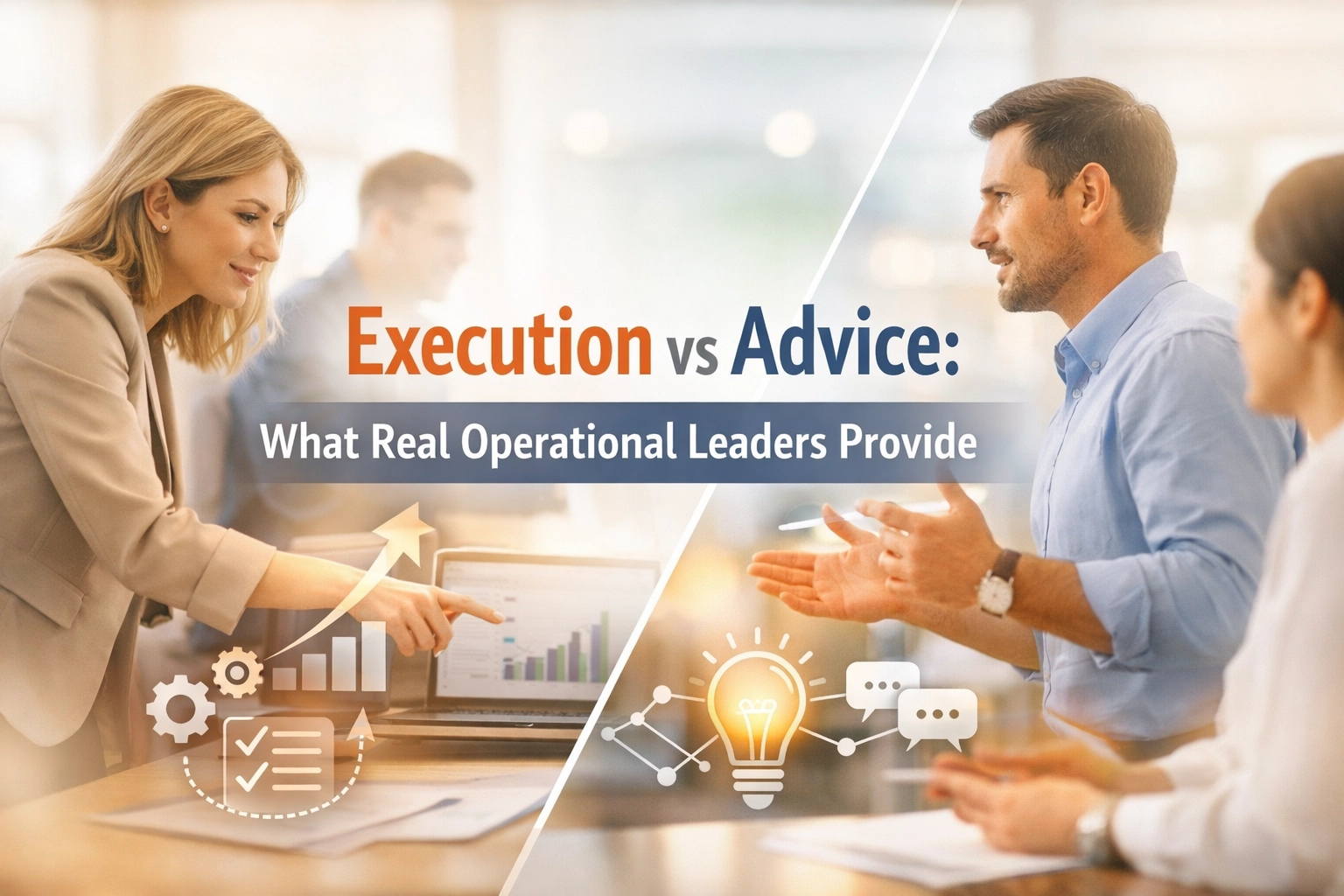
A real operational leader does not just sit in meetings and offer opinions. They manage the daily gears of the machine. When we look at Execution vs Advice, a leader focused on execution is measured by the delta in performance, not the quality of their slides. They own the accountability for the team.
The common findings in service businesses are that most owners are the single point of failure. If you are not there, decisions do not get made. An execution-focused leader fixes this by building a decision authority matrix. This is a primary example of Execution vs Advice in action. Advice says “you should delegate more.” Execution defines exactly what decisions a manager can make without calling you.
Real operational leadership involves:
- Managing daily workflows and specific team processes to hit revenue targets.
- Owning the accountability for KPIs instead of just reporting them.
- Implementing continuous improvements based on what is actually happening in the field.
- Ensuring that the energy of the company flows toward outcomes instead of firefighting.
If you are stuck choosing between Execution vs Advice, look at the deliverables. Advice delivers a recommendation. Execution delivers a working system. If the person you hired is not willing to log into your CRM or talk to your lead technician, you are getting advice. You are not getting execution.

The Difference Between a Consultant and an Operational Partner
The logic is simple. A consultant is an external observer. An operational partner is an internal engine. When you evaluate Execution vs Advice, you have to decide if you want someone on the sidelines or someone on the field. Most service companies need a teammate, not a spectator.
Consultants often leave when the work gets hard. They deliver the report and move to the next client. In the Execution vs Advice framework, this leaves the implementation risk entirely on the founder. If the plan fails, the consultant says you did not follow it correctly. If the plan succeeds, they take the credit.
An operational partner shares the risk. This is the core of the Clarity Operational Partnership. We do not just tell you that your fleet maintenance is costing you too much money. We build the maintenance schedule, find the vendors, and ensure the techs are reporting issues before the trucks break down. We settle the Execution vs Advice debate by doing the work.
What you provide: You provide the vision and the technical expertise of your trade. What we provide: We provide the structure and the management to make that vision a reality. This is how we move from chaos to clarity. We focus on the Execution vs Advice split by taking the execution off your plate.
Goal: To transition the founder from “Chief Everything Officer” to a true visionary leader.
Implementing The Clarity Transformation in Your Business
We use a specific process called The Clarity Transformation to fix broken operations. This is not a vague set of ideas. It is a 12-week intensive implementation plan. We solve the Execution vs Advice problem by staying in the trenches with you until the systems are stable.
The first phase is always discovery and stabilization. We look for the “leaks” in your bucket. Most service businesses lose $3,000 to $8,000 a month simply because of poor hand-offs between sales and production. By focusing on Execution vs Advice, we stop talking about the leaks and start plugging them. We implement the software, train the admin staff, and monitor the first 20 jobs to ensure the new process sticks.
The second phase is process extraction. You have the business in your head. That is a bottleneck. We solve the Execution vs Advice dilemma by extracting that knowledge and turning it into SOPs that a Grade 7 reader can follow. We do not just give you a template. We write your specific manuals.
The third phase is scale-ready management. Once the systems are running, we monitor the data. We look at utilization rates and labor efficiency. This is where the Execution vs Advice distinction becomes most profitable. We do not just tell you that labor efficiency is low. We find the specific crew that is dragging the average down and fix their workflow.
Through The Clarity Transformation, we ensure that your business can grow from $50,000 to $100,000 a month without you having to work more hours. In fact, most founders find they work 15 to 20 fewer hours per week after the transformation is complete. We prove that Execution vs Advice is the most important choice you will make this year.

What a Clarity Operational Partnership Delivers
When you enter a Clarity Operational Partnership, you are not just hiring a consultant. You are gaining a fractional COO who is focused on your bottom line. We understand the nuance of Execution vs Advice better than anyone because we have lived it in the field. We know that a perfect process that no one uses is worthless.
We focus on tangible deliverables. These are not just PDFs. They are functioning parts of your business. When we look at Execution vs Advice, we prioritize the following:
- A 14-day rolling schedule that actually keeps crews busy.
- A billable hours calculator that shows your real utilization rate.
- A decision matrix that removes you from the daily “what do I do now” questions.
- An automated onboarding system for new hires that works without your involvement.
The reality check: If you try to do this yourself, it will take 30 to 40 weeks of trial and error. You will likely give up when a major project hits or a key employee quits. By choosing a Clarity Operational Partnership, you compress that timeline into 12 weeks. We handle the Execution vs Advice balance so you can focus on high-level growth.
Common mistake: Many founders think they can just hire a manager to do this. But a manager needs a system to manage. If you hire a person into chaos, they will just become a very expensive firefighter. You need the systems built first. That is the execution piece of the Execution vs Advice puzzle.

The Math of Choosing Execution Over Simple Advice
Let’s look at the numbers. Suppose you hire a consultant for $4,000 a month. They give you advice for six months. You spend 10 hours a week trying to implement that advice. Your revenue stays flat because you are too busy “building” to actually sell or produce. The cost of that Execution vs Advice mistake is $24,000 in fees plus your wasted time.
Now, look at the execution model. You invest in The Clarity Transformation. In 12 weeks, we identify a 15 percent waste in your labor force. On a $60,000 monthly payroll, that is $9,000 a month in recovered profit. We also find that your scope creep on roofing jobs is costing you $2,500 per month. By solving the Execution vs Advice problem, we have added $11,500 a month to your bottom line.
The ROI is clear. Advice is a cost. Execution is an investment. When you compare Execution vs Advice, you have to look at the long-term health of the business. A business built on advice is fragile because it depends on the founder’s ability to interpret and act on that advice. A business built on execution is resilient because it depends on repeatable systems.
This is why we are so obsessive about the Execution vs Advice distinction. We want you to see the results in your bank account, not just in your head. We want your weeks to go from 70 hours down to 45 hours. That only happens through execution.
Frequently Asked Questions about Execution vs Advice
What is the biggest risk in choosing advice over execution?
The biggest risk is stagnation. You spend money and time but the business does not change. In the Execution vs Advice battle, advice often leads to “analysis paralysis” where you have too many ideas and no way to start.
Can I handle the execution myself if I just get the right advice?
You can, but it is rarely successful. Most founders are already at 100 percent capacity. Adding “system builder” to your job description usually leads to burnout. The Execution vs Advice choice is really a choice about where you spend your limited time.
How do I know if I am currently receiving advice or execution?
Look at your calendar. If you are the one doing all the work to implement a new idea, you are only receiving advice. If someone else is building the tool, training the team, and checking the work, you are receiving execution. That is the heart of Execution vs Advice.
Why is execution more expensive than advice upfront?
Execution requires more “man-hours” and a deeper level of expertise. It is easier to tell someone what to do than it is to actually do it. In the Execution vs Advice market, you get what you pay for. Cheap advice often ends up being the most expensive thing you buy.
How does The Clarity Transformation handle team pushback during execution?
Pushback is normal. We handle it by showing the team how the new systems make their lives easier. When we prioritize Execution vs Advice, we focus on winning the “hearts and minds” of the field staff by removing the daily frustrations they face.
Conclusion: Making the Choice for Your Business Growth
The pattern of successful scaling is not a secret. It requires a shift from doing the work to managing the machine. You have to decide where you stand on Execution vs Advice. If you continue to buy advice and try to execute it yourself, you will remain the bottleneck of your company. You will hit a ceiling that no amount of hard work can break through.
Or you could choose a different path. You could choose a partner who understands that results are the only metric that matters. You could choose to implement The Clarity Transformation and finally get the freedom you started this business for in the first place. You could let a Clarity Operational Partnership take the burden of “how” off your shoulders so you can focus on “where” the business is going.
The reality is that 12 weeks from now, you will either have a streamlined, profitable operation or you will still be firefighting. The choice between Execution vs Advice is yours to make today. Stop paying for maps and start paying for the journey to be completed.
Ready to see how we can handle the execution for you? Book a 30 minute consultation to discuss your operations and how we can implement a system that works without you.
Book your 30-minute Clarity Transformation session here: https://calendly.com/sdrobinson8/30min