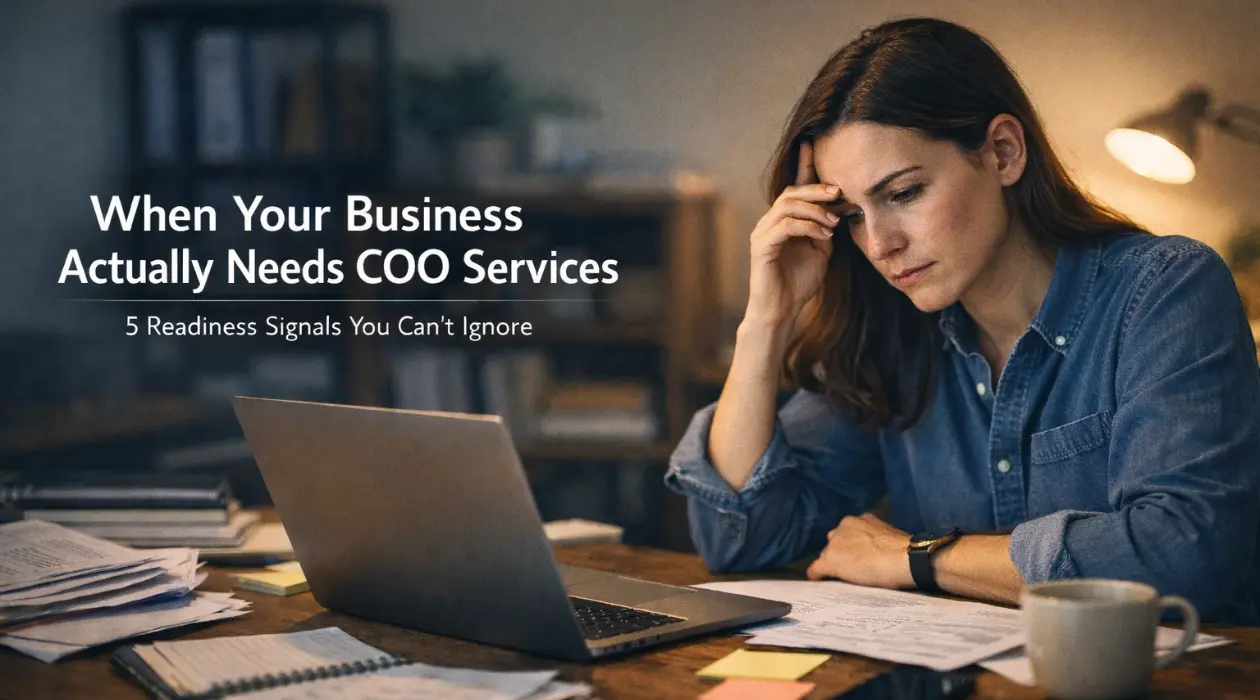
When Your Business Actually Needs COO Services: 5 Readiness Signals You Can’t Ignore
You’re generating real revenue. Your team has grown beyond just you and maybe a couple of people. Customers are buying what you’re selling, and on paper, everything looks like it’s working.
But behind the scenes? It’s chaos.
You’re constantly putting out fires. Your team keeps asking questions that shouldn’t need to be asked. Simple tasks take way longer than they should. And you’re spending so much time managing day-to-day operations that you barely have time to think about actually growing the business.
This is the reality for most businesses generating between $20,000 and $100,000 monthly with teams of 2-20 people. You’ve proven the business works, but you haven’t built the operational backbone to support where you’re going. That’s where COO services come in.
But here’s what trips most business owners up: figuring out when you actually need COO services versus when you just need to push through a rough patch.
Let me walk you through the five clearest signals that your business is ready for professional COO services – and what happens when you ignore them.
Signal #1: Revenue Is Strong But Operations Can’t Keep Up
The first and most obvious sign you need COO services is this: your business is making money, but your operations are breaking under the weight of that success.
You’re consistently hitting $30,000, $50,000, or $80,000 in monthly revenue. That’s not luck. That’s proof your business model works. But while revenue has climbed, your operational systems are still running like they did when you were doing $10,000 a month.
Why This Revenue Range Demands Better Operations
There’s a specific reason why businesses in the $20,000-$100,000 monthly revenue range need professional COO services more than anyone else. You’re past the startup phase where everything is held together with duct tape and hustle. But you’re not yet at the scale where a full-time Chief Operating Officer makes financial sense.
Professional COO services bridge this gap. They bring executive-level operational expertise to your business without the $150,000+ salary commitment of a full-time hire. You get the systems, the strategic thinking, and the operational leadership your revenue level demands, delivered in a way that actually fits your current budget.
When you engage COO services at this stage, you’re not just fixing current problems. You’re building the operational foundation that will support your next phase of growth.
The Hidden Cost of Revenue Without Operations
Here’s what most business owners don’t realize until it’s too late: when your operations can’t match your revenue, you’re actively losing money every single day.
It shows up in inefficiency – team members wasting hours on tasks that should take minutes because there’s no documented process. It appears in mistakes that have to be redone because there’s no quality control system. It manifests in opportunities you can’t pursue because you’re already maxed out operationally.
One client came to us generating $65,000 monthly but spending approximately 30 hours weekly just managing operational problems. At an owner value of $200/hour, that’s $312,000 annually in opportunity cost. Professional COO services cost a fraction of that while eliminating the operational drain that was consuming her time.
That’s the math that makes COO services make sense. You’re not paying for overhead. You’re reclaiming capacity and eliminating the hidden costs of operational dysfunction.
Signal #2: DIY Operations Aren’t Working Anymore
The second signal is harder to admit but just as clear: you’ve tried to fix your operations yourself, and it’s not working.
You’ve bought the project management software everyone recommends. You’ve read the books about building systems. You’ve attended workshops on creating standard operating procedures. Maybe you’ve even hired a consultant who gave you a beautiful process map that’s now gathering dust in a folder somewhere.
And your operations are still a mess.
When DIY Stops Being Strategic
There comes a point where trying to build your own operational systems stops being scrappy and starts being expensive. That point is usually right around when your business crosses $25,000-$30,000 in monthly revenue with a team of more than 3-4 people.
At this stage, operations become too complex for a generalist approach. You need someone who knows how to build operational infrastructure for businesses at your specific stage. That’s what professional COO services provide – expertise that’s been built across dozens of businesses in situations exactly like yours.
The skills that made you successful at starting a business aren’t the same skills needed to systematize and scale it. Being great at sales doesn’t make you great at process optimization. Being creative with your product doesn’t automatically translate to operational efficiency.
Professional COO services bring a skillset you don’t have and frankly, don’t need to develop. Let someone whose entire career has been building operational systems do what they do best, while you focus on what you do best.
Why This Isn’t About Failure
If you’ve tried to fix your operations and it hasn’t worked, that doesn’t mean you’re bad at business. It means you’ve reached the limit of what one person can effectively manage while also driving revenue, managing clients, leading a team, and handling everything else.
Every business owner who eventually brings in professional COO services says the same thing: “I wish I’d done this sooner.” They spent months, sometimes years, trying to solve operational problems on their own when COO services could have resolved everything in weeks.
The business owners who thrive aren’t the ones who refuse help. They’re the ones who recognize when specialized expertise will solve problems faster and better than DIY attempts. That’s not weakness – that’s strategic thinking.
Signal #3: Your Team Keeps Asking for Structure and Systems
The third signal comes directly from your team: they’re actively asking for more structure, better processes, and clearer systems.
This shows up in specific ways. Someone asks “Is there a process for this?” and you don’t have a good answer. Different team members handle the same task completely differently and get inconsistent results. People keep asking the same questions because nothing is documented. New hires take forever to onboard because there’s no systematic training program.
When your team asks for structure, they’re not complaining about your leadership. They’re giving you critical business intelligence about what your operations need to function better.
Why Team Feedback Matters
Your team experiences operational gaps every single day. They’re working inside the chaos. They see firsthand what happens when processes don’t exist, standards aren’t documented, and there’s no systematic approach to how work gets done.
When they ask for structure, they’re telling you exactly what would help them do better work. And they’re probably being more diplomatic than they feel, because most people don’t want to directly tell their employer that things are messy.
This is where COO services deliver immediate value. Professional COO services can hear these requests objectively and build the operational framework your team needs – without the emotional complexity of you having to admit things aren’t working.
What Operational Structure Actually Means
When we talk about the structure that COO services provide, we’re talking about concrete systems that make work easier:
Documented processes for every recurring task so people aren’t constantly reinventing the wheel. Clear role definitions that specify who’s responsible for what, eliminating confusion and overlap. Standard operating procedures that ensure consistent quality regardless of who’s doing the work. Training systems that get new team members productive quickly instead of stumbling through tribal knowledge.
This isn’t bureaucracy. This is giving people the frameworks they need to do excellent work without constantly wondering if they’re doing it right.
Businesses that bring in professional COO services see an immediate boost in team morale. People feel more confident when they know what’s expected, how to do things right, and where to find answers. That confidence translates directly into better performance and lower turnover.
What Happens When You Ignore Their Requests
If you ignore your team’s requests for operational structure, the best people leave. They get frustrated working in chaos and find employers who have their operations together. The people who stay become resigned to the mess, and that resignation becomes embedded in your company culture.
You end up with a team that’s learned to work around your operational gaps instead of fixing them. And those workarounds become permanent, making the gaps bigger and harder to address over time.
Bringing in COO services when your team asks for structure isn’t just solving their complaints. It’s showing them you take their professional needs seriously and you’re committed to building a business worth working for.
Signal #4: You’re Running the Business Instead of Building It
The fourth signal is deeply personal: you’ve become a full-time operational firefighter instead of a business builder.
Your typical day looks like this: responding to urgent messages, solving immediate problems, answering random questions, dealing with customer issues that shouldn’t have happened in the first place, trying to figure out why the same problems keep recurring over and over.
By the time you finish putting out fires, you’re too exhausted to work on anything strategic. You’re running in place instead of moving forward.
This is what operational chaos looks like from the inside. And it’s exactly what professional COO services are designed to fix.
The Real Cost of Firefighting
When you’re constantly managing operational fires, you’re working in the most expensive possible way. Every problem you personally solve costs whatever your time is worth – which, as the business owner, should be valued pretty high.
Let’s do the math. If your time is worth $200/hour (conservative for someone generating $50,000+ monthly), and you spend 20 hours weekly on operational firefighting, that’s $4,000 weekly. That’s $16,000 monthly, nearly $200,000 annually in high-value time consumed by tasks that shouldn’t require owner attention.
Professional COO services typically cost $5,000-$8,000 monthly for businesses at this stage. Even if we’re generous and say $10,000 monthly, you’re still saving $72,000+ annually in reclaimed owner time. And that doesn’t count the revenue growth you’ll generate by focusing on strategic work instead of operational fires.
What Strategic Work Actually Means
When operational chaos consumes your schedule, you lose access to strategic thinking. Strategic work is the high-value activity that actually grows businesses: identifying new market opportunities, developing strategic partnerships, refining your offerings, building systems that scale, planning for the future instead of just reacting to today.
But strategic work requires mental space, uninterrupted time, and the ability to think beyond immediate problems. You can’t do that when you’re drowning in operational fires.
This is where COO services deliver their highest return on investment. Professional COO services take operational management completely off your plate. They build the systems that prevent fires from starting. They handle the day-to-day operational decisions so you can focus on the decisions only you can make.
The Business You’re Not Building
Here’s the hardest truth: while you’re managing operational chaos, there’s a version of your business you’re not building. A more profitable version. A more scalable version. A version that runs smoothly enough that you could actually take a vacation without everything falling apart.
Every day you spend as the chief firefighter is another day that better version of your business doesn’t exist.
When business owners finally engage professional COO services and reclaim their time, they’re often shocked by what they’d been missing. Opportunities they didn’t see because they were too busy. Strategic moves they didn’t make because they didn’t have the bandwidth. Growth they didn’t pursue because current operations were barely holding together.
Quality COO services don’t just fix your operations. They give you back the capacity to build the business you actually want to run.
Signal #5: Growth Requires Infrastructure You Don’t Have
The fifth signal is forward-looking: you can see where your business needs to go, but your current operational setup can’t get you there.
Maybe you want to expand your team but you know onboarding is a disaster. Maybe you have opportunities for new revenue streams but you’re already maxed out operationally. Maybe clients are asking for services you could deliver, but you don’t have the internal systems to fulfill them consistently.
This gap between where you are and where you’re trying to go is exactly what professional COO services bridge.
Why Growth Requires Operational Infrastructure
Here’s what stops most businesses in the $20,000-$100,000 monthly revenue range from scaling to $150,000+: operational infrastructure. Or rather, the lack of it.
You can hustle your way to $50,000 monthly. You can wing it and make $75,000 work. But you cannot chaos your way to sustained $150,000+ monthly revenue. Growth at that level requires systems, processes, documented procedures, clear role definitions, and operational frameworks that work whether or not you’re personally involved.
Professional COO services build that infrastructure before you need it, so growth doesn’t break your business.
The Build vs. Buy Decision
You have two options when you need operational infrastructure: build it yourself or bring in COO services that have already built it dozens of times.
Building it yourself means months of trial and error, learning from mistakes, implementing things incorrectly and having to redo them, and pulling your attention away from revenue generation to focus on operational development. It means slow progress and high opportunity cost.
Engaging professional COO services means getting operational infrastructure built correctly the first time, in weeks instead of months, by people who’ve done it repeatedly. It means fast implementation and immediate benefit.
For businesses with proven revenue looking to scale, the math is straightforward. The investment in quality COO services pays for itself through faster growth, fewer operational mistakes, and your ability to focus on revenue instead of infrastructure.
What Operational Infrastructure Includes
When we talk about the operational infrastructure that COO services provide, we’re talking about the backbone systems that allow businesses to scale:
Documented processes for every recurring task so operations don’t depend on any single person. Role definitions that clarify responsibilities and eliminate overlap. Standard operating procedures that ensure consistent quality across all work. Training systems that onboard new team members efficiently. Performance tracking that shows what’s working and what needs adjustment. Communication frameworks that keep everyone aligned. Project management systems that move work forward predictably. Quality control processes that catch problems before they reach customers.
None of this is glamorous. All of it is essential.
And professional COO services bring the expertise to build it right, tailored to your specific business, without the massive investment of a full-time executive hire.
Understanding Different Types of COO Services
Before you start evaluating whether COO services make sense for your business, it’s important to understand that “COO services” isn’t a one-size-fits-all offering. There are several different models, each designed for different business needs and stages.
Fractional COO Services
Fractional COO services are the most common model for businesses generating $20,000-$100,000 monthly. You get executive-level operational expertise on a part-time basis – typically 5-15 hours weekly, depending on your needs.
This model delivers maximum value at the stage where you need it most. You get strategic thinking, systems-building knowledge, process optimization skills, and operational leadership from a seasoned professional, but you only pay for the hours you actually need.
For most businesses in the “teenage years,” fractional COO services are the perfect fit. You need expert operational support but not 40 hours weekly of it, and you can’t afford (or justify) a $150,000+ full-time salary.
Interim COO Services
Interim COO services work best when you have a specific transition period or project that needs operational leadership. Maybe your previous operations leader left and you need coverage while searching for a replacement. Maybe you’re preparing for a merger or acquisition and need temporary operational expertise. Maybe you’re launching a new product line that requires focused operational support for 3-6 months.
Interim COO services provide intensive operational leadership for a defined period, then transition out when the project is complete or the permanent hire is in place.
Project-Based COO Services
Some COO services work on a project basis rather than an ongoing retainer. You might engage these services to solve a specific operational challenge – implementing a new ERP system, building out your standard operating procedures, designing your organizational structure for the next growth phase, or conducting an operational audit.
Project-based COO services deliver defined outcomes within a specific timeframe, then conclude when the project is complete.
Ongoing COO Services
For businesses that need consistent operational leadership but can’t justify a full-time hire, ongoing COO services provide continuous support. This typically looks like a retained relationship where the COO services provider works with your business month after month, providing strategic operational guidance, managing implementation of systems, and serving as a trusted advisor to the CEO.
This model works well for businesses that have complex operations, are in sustained growth mode, or simply benefit from having senior operational expertise consistently available.
What Professional COO Services Actually Do
Let’s get specific about what happens when you engage professional COO services. What does the work actually look like? What changes? What stays the same?
Operational Assessment and Strategy
Quality COO services start with comprehensive operational assessment. They’re looking at how work actually flows through your business, where bottlenecks exist, what systems are missing, which processes are broken, and where the highest-impact improvements can be made.
This assessment phase typically takes 2-4 weeks and results in a clear operational strategy – a roadmap for transforming your operations from chaotic to systematic.
Systems Design and Implementation
The core work of COO services is designing and implementing the operational systems your business needs. This includes:
Process documentation that captures how work should be done. Workflow design that eliminates bottlenecks and inefficiencies. Role clarity that defines responsibilities and accountabilities. Communication systems that keep information flowing. Project management frameworks that ensure work moves forward. Quality control mechanisms that maintain standards. Performance metrics that track what matters.
Professional COO services don’t just design these systems in theory. They implement them in practice, working alongside your team to embed new ways of working into daily operations.
Team Development and Training
Strong COO services include team development as a core component. They train your team on new processes and systems. They develop your managers’ leadership capabilities. They create training programs for new hires. They build accountability frameworks that help people take ownership of their work.
The goal is operational excellence that outlives the engagement – systems and capabilities that become part of your business permanently.
Ongoing Optimization
Operations aren’t “set it and forget it.” Professional COO services include continuous improvement – regularly assessing what’s working, identifying what could work better, and optimizing systems as your business evolves.
This ensures your operational infrastructure grows with your business instead of becoming obsolete.
The Investment in COO Services: What It Actually Costs
Let’s talk money. What do professional COO services actually cost, and how do you know if it’s worth the investment?
Typical Pricing Models
COO services typically use one of three pricing models:
Monthly Retainer: Most fractional and ongoing COO services charge a monthly retainer, typically ranging from $5,000-$15,000 depending on hours committed, complexity of operations, and seniority of the COO services provider. For businesses generating $50,000 monthly, expect to invest $6,000-$10,000 monthly for comprehensive COO services.
Hourly Rates: Some COO services charge hourly, typically $150-$400/hour depending on experience level and expertise. This works well for project-based work or businesses that need very limited support.
Project-Based Fees: For defined projects like operational audits or system implementations, COO services might charge a flat project fee, typically $15,000-$50,000+ depending on scope.
How to Calculate ROI
The return on investment for quality COO services comes from three sources:
Reclaimed owner time: Calculate how many hours weekly you currently spend on operational firefighting. Multiply by your hourly value. That’s your opportunity cost. Professional COO services should reclaim at least 50-70% of this time.
Operational efficiency gains: Estimate how much team time is currently wasted on inefficiency – duplicated work, unclear processes, searching for information. Professional COO services typically reduce this waste by 30-50%, translating directly to labor cost savings.
Revenue growth enablement: Calculate how much additional revenue you could generate if you had 15-20 hours weekly to focus on business development instead of operational fires. That’s the growth COO services enable.
For most businesses, the ROI is 3-5X within the first year. The investment pays for itself through efficiency gains alone, before you even count the revenue growth.
When COO Services Don’t Make Financial Sense
There are scenarios where COO services don’t make financial sense yet:
- If you’re generating less than $15,000-$20,000 monthly, you probably need to focus on revenue generation first
- If you have fewer than 2-3 team members, you likely don’t have enough operational complexity yet
- If your business model is still in validation phase, operational systems are premature
But if you’re generating $25,000+ monthly with 3+ team members and experiencing any of the five readiness signals, COO services will deliver positive ROI.
How to Choose the Right COO Services for Your Business
Not all COO services are created equal. Here’s how to evaluate options and find the right fit for your specific needs.
Industry Experience vs. Operational Expertise
There’s a common debate: should you prioritize COO services with deep experience in your specific industry, or COO services with strong operational expertise regardless of industry?
The answer depends on your industry’s complexity. If you’re in a highly regulated industry (healthcare, finance, legal) or a technically complex field where domain knowledge matters, industry experience has value. But for most service-based businesses, e-commerce, agencies, and professional services firms, operational expertise matters more than industry familiarity.
Good operational systems transcend industry. Process optimization, workflow design, team development, and systems thinking work the same whether you’re selling software or consulting services.
Track Record and References
Quality COO services should be able to demonstrate a track record of results. Ask for:
- Case studies showing specific operational transformations
- References from businesses at a similar stage and revenue range
- Examples of systems they’ve built and results they’ve delivered
- Metrics showing efficiency gains, cost reductions, or revenue growth
Be wary of COO services that talk in generalities or can’t point to concrete results.
Communication Style and Cultural Fit
You’ll be working closely with whoever provides your COO services. Communication style and cultural fit matter enormously. Some COO services operate in a very corporate, formal way. Others are more collaborative and casual. Some are directive and tell you what to do. Others are consultative and work with you to find solutions.
There’s no right answer, but there is a right fit for your business. During the vetting process, pay attention to how they communicate, how they make you feel, whether they listen or just talk, and whether their style meshes with your company culture.
Scope and Flexibility
Make sure you’re clear on what’s included in the COO services engagement:
- How many hours monthly?
- What specific deliverables?
- What’s included vs. what costs extra?
- How flexible is the scope if needs change?
- What happens if you need more or less support?
Quality COO services should be transparent about scope and flexible enough to adjust as your needs evolve.
Making the Decision: Is Your Business Ready for COO Services?
If you’ve read this far, you probably already know whether your business needs professional COO services.
You’re generating revenue that proves your business model works. You’ve tried to fix operations yourself and it’s not working. Your team is asking for structure and systems. You’re drowning in operational chaos. And you can see that the next level of growth requires infrastructure you don’t have.
These aren’t theoretical concerns. They’re the daily reality of running a business that’s outgrown DIY operations but hasn’t yet built professional operational infrastructure.
COO services aren’t a luxury at this stage. They’re the difference between staying stuck in operational chaos and building a business that actually scales.
What Happens Next
If you’re ready to explore professional COO services, the next step is a straightforward conversation about your specific operational challenges, what success would look like, and whether this type of support makes sense for where your business is right now.
No pressure, no hard sell – just an honest assessment of whether COO services could transform your operations the way they have for thousands of other businesses in the teenage years.
Because here’s what happens when businesses recognize these readiness signals and act on them: they don’t just fix their operations. They unlock growth they didn’t know was possible.
They go from operational chaos to systematic execution. From firefighting to strategic building. From maxed out to scalable. From stressed about operations to confident in their infrastructure.
Your business has proven it can generate revenue. Now it’s time to build the operational backbone that lets that revenue grow without breaking everything in the process.
That’s what professional COO services do. And if you’re seeing these five signals, that’s exactly what your business needs right now.
Frequently Asked Questions About COO Services
What’s the difference between COO services and hiring a consultant?
COO services provide hands-on operational leadership and implementation, not just advice. A consultant typically analyzes your situation and provides recommendations, then leaves you to implement. Professional COO services stay engaged to build systems, lead implementation, and ensure changes actually happen. It’s the difference between someone telling you what to do and someone doing it with you.
How long do businesses typically engage COO services?
Most businesses work with COO services for 6-18 months initially for operational transformation. Some maintain ongoing fractional COO services indefinitely, while others transition to full-time operational leadership once revenue supports it. The relationship typically evolves based on business needs and growth trajectory.
Can COO services work remotely?
Absolutely. Most COO services work is done remotely through video calls, project management platforms, and collaborative tools. Since the focus is on building systems and providing strategic operational leadership rather than managing daily tasks, physical presence isn’t required for effectiveness.
What if I already have an operations manager?
COO services operate at a different level than operations management. An operations manager typically executes within existing systems. Professional COO services design those systems, provide strategic operational leadership, and work at an executive level. The two roles can work together very effectively – COO services building strategy and systems, operations managers executing within them.
How do I know if I need COO services versus just hiring another team member?
If you’re adding capacity to execute existing processes, hire a team member. If you need someone to build the operational systems and infrastructure in the first place, you need COO services. Team members work within systems; COO services build the systems.
What happens to the operational systems if we stop working with COO services?
Quality COO services build systems that outlive the engagement. Everything gets documented, team members get trained, processes become embedded in operations. The infrastructure they build becomes part of your business permanently, whether you continue with COO services or eventually transition to full-time leadership.
How much do professional COO services cost?
COO services typically range from $5,000-$15,000 monthly for fractional ongoing support, depending on hours committed, complexity, and seniority. Interim or project-based COO services may cost more during intensive phases. For most businesses generating $50,000+ monthly, expect to invest $6,000-$10,000 monthly for comprehensive operational support.
What if my business is too small for COO services?
If you’re generating less than $20,000 monthly with fewer than 3 team members, you might be better served by focusing on revenue growth first. But if you’re at $25,000+ monthly with 3+ people and experiencing operational chaos, you’re not too small – you’re exactly the right size for professional COO services.
Let’s have a conversation about whether professional COO services make sense for where your business is right now.
Related Blogs
- Founder Bottleneck: The Hidden Barrier Killing Your Growth
- 10 Signs Your Business Has Outgrown DIY Operations
- Why Hiring More People Isn’t Fixing Your Operational Problems
- The Difference Between a Rough Patch and a Structural Operations Problem
- When Hustle Stops Working: The Operational Ceiling Most Founders Hit
- Fractional COO vs Full-Time COO: Which One Fits Your Stage?
- Why Operations Consultants Fail Without Executive Ownership
- Should You Hire an Ops Manager or a COO First?
- The Real Cost of “Figuring Operations Out Later”
- Why Small Teams Need Executive Operations Before More Staff
- The Real Cost of Broken Operations (And Why It’s Invisible)
- Why Revenue Growth Makes Operational Chaos Worse, Not Better
- Scaling Past $100K/month: 5 Proven Ways to Stop Founder Bottlenecks
- Operational Drag Reduction: 7 Brutal Ways Debt Destroys Teams
- What Changes in the First 90 Days After Hiring COO Services
- How Founders Get Their Time Back Without Losing Control
- From Firefighting to Strategy: What Actually Shifts
- How Businesses Scale Past $100K Without Burning the Founder Out
- What COO Services Actually Do Week to Week
- What a Fractional COO Builds First (And Why It Matters)
- How to Prepare Your Business Before Bringing in COO Services
- The First 30 Days of Operational Transformation: What to Expect