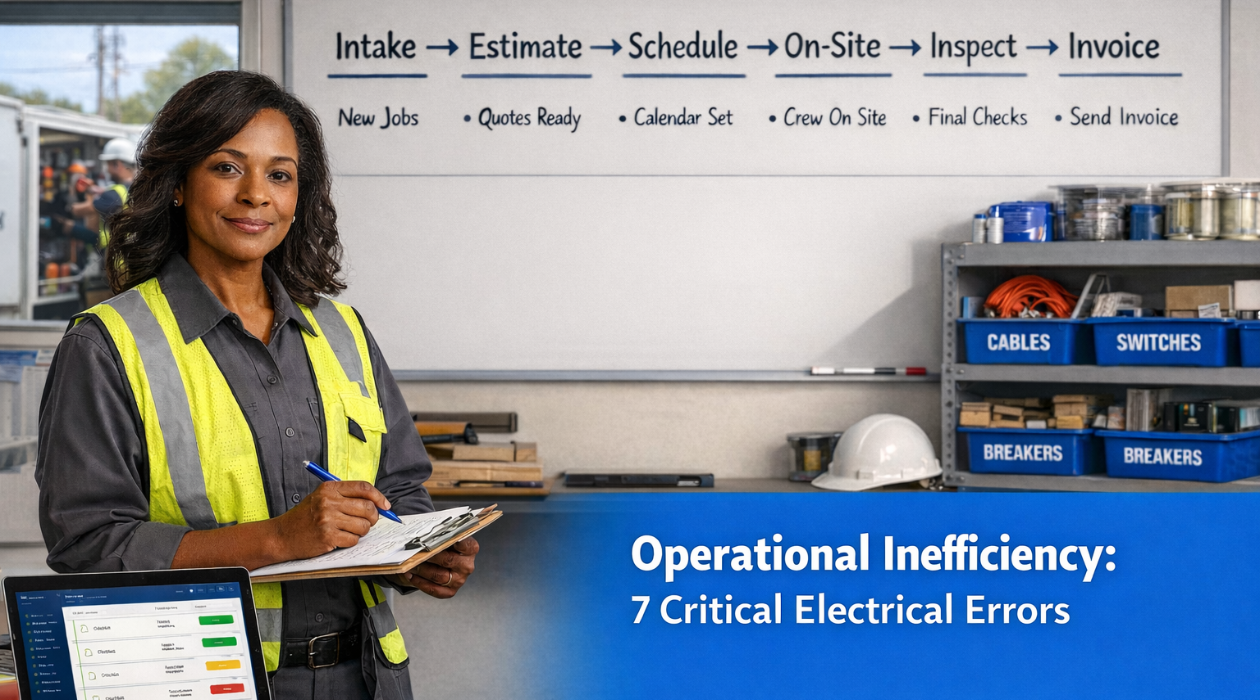
Operational Inefficiency: 7 Critical Electrical Errors
Your electrical business hit $40K in monthly revenue six months ago. Today? Still $40K.
Not because the work isn’t there. Not because your crew can’t handle it. You’re stuck because operational inefficiency in electrical business has become your full-time job instead of the actual electrical work.
You’re answering the same questions five times a day. Chasing down job site photos. Recreating estimates because you can’t find the template. Scheduling jobs in your head because nothing’s written down.
This isn’t a work ethic problem. This is an operational inefficiency in electrical business problem, and you’re the one creating it.
Let’s fix that.
The Real Cost of Operational Inefficiency in Electrical Business
Operational inefficiency in electrical business doesn’t just slow you down. It costs you real money, real growth, and real freedom.
Here’s what it actually looks like:
You’re leaving $50K-$150K on the table annually because you can’t handle more jobs with your current chaos. Jobs you could easily take if your operations weren’t held together with duct tape and hope.
Your best electricians are quitting because they spend half their day tracking you down for answers instead of doing actual electrical work. When they can’t get clear direction, they leave for companies that have their act together.
You’re working 60-hour weeks managing operational fires instead of growing the business. Every evening and weekend disappears into administrative quicksand.
Your profit margins are shrinking because jobs run over, materials get ordered twice, and you’re paying people to wait for information that should be at their fingertips.
Operational inefficiency in electrical business compounds. Every day without systems makes the next day harder. Every workaround becomes the “process.” Every exception becomes the rule.
Clarity Engine Ops works with electrical contractors trapped in this exact cycle. The pattern is consistent: revenue plateaus between $30K-$80K monthly because operational inefficiency in electrical business blocks every growth attempt. You can’t scale chaos.
Warning Sign #1: You’re the Bottleneck for Every Decision
Your phone buzzes 47 times before lunch. Every single notification needs YOU.
- “Boss, what’s the code for this panel upgrade?”
- “Where’s the permit paperwork?”
- “Customer wants to add outlets, what do I charge?”
- “We’re out of wire, should I go get some?”
- “What time tomorrow?”
This is operational inefficiency in electrical business in its purest form. You’ve become the central processing unit for your entire company.
Your electricians can’t make decisions because you’ve never documented the standards. They don’t have a rate sheet. No material ordering system. No documented processes for common scenarios.
Your office staff can’t schedule jobs because only you know which crews can handle which work and who’s actually available.
Your estimators can’t close deals because only you can answer technical questions, even on basic residential work you’ve done 500 times.
Every decision flows through you. Every question waits for you. Every job stalls until you weigh in.
The fix isn’t working harder. The fix is building decision-making systems that work without you.
Clarity Engine Ops helps electrical contractors document decision-making frameworks – pricing matrices, scope-of-work templates, material ordering protocols, and crew capability matrices. These systems don’t replace your expertise; they scale it beyond your personal bandwidth.
Here’s what decision-making systems look like:
- Pricing matrices that let anyone quote standard work accurately
- Scope documentation that defines what’s included in common jobs
- Authority levels so electricians know what they can decide on-site
- Escalation pathways for the decisions that actually need you
- Material ordering systems with pre-approved suppliers and quantity standards
When these systems exist, your phone stops buzzing every five minutes. When they don’t exist, operational inefficiency in electrical business ensures you’ll never have a day off.
Warning Sign #2: Your Jobs Have No Consistent Process
Job #1: Your lead electrician wings it, finishes under budget, customer loves it.
Job #2: Different electrician, same scope. Runs 20% over, customer complains about communication gaps.
Same company. Same type of work. Completely different outcomes.
This is operational inefficiency in electrical business created by process absence. You’re running on individual talent instead of repeatable systems.
Here’s what no consistent process actually costs you:
Your profit margins swing wildly because every electrician approaches jobs differently. One guy brings exactly what he needs. Another makes three trips to the supply house at $45/hour in labor costs.
Your quality is inconsistent because there’s no standard for how work gets done. Customer satisfaction depends entirely on which crew shows up.
Your training takes forever because new electricians can’t learn “the way we do things” when there isn’t a consistent way things get done.
You can’t scale because adding new crews means adding new chaos. Each person invents their own system.
Operational inefficiency in electrical business thrives in this environment. Without documented processes, you’re rebuilding the wheel on every single job.
Clarity Engine Ops works with electrical contractors to document job processes from first call to final invoice – creating repeatable workflows that maintain quality while reducing the mental load on everyone involved.
Here’s what consistent job processes include:
- Pre-job checklists (permits pulled, materials staged, customer expectations confirmed)
- On-site protocols (daily photo documentation, progress updates, cleanup standards)
- Material management (standard tool/material lists for common jobs)
- Communication cadences (when and how customers get updates)
- Quality checkpoints (inspection standards before calling a job complete)
- Close-out procedures (final walkthrough, invoice submission, follow-up scheduling)
When you have consistent processes, your newest electrician can deliver the same quality as your 15-year veteran. When you don’t, operational inefficiency in electrical business guarantees every job is a custom adventure.
Warning Sign #3: Information Lives in Your Head (And Nowhere Else)
Quick test: Could your business run for two weeks if you disappeared tomorrow?
If you hesitated, that’s operational inefficiency in electrical business disguised as “being indispensable.”
Critical information trapped in your head:
- Customer history and preferences (who needs extra communication, who pays slowly, who tips well)
- Job site details and access codes (gate combinations, key locations, property quirks)
- Supplier relationships and pricing (who gives you the best deal, who delivers fastest)
- Equipment maintenance schedules (when trucks need service, when tools need calibration)
- Crew capabilities and certifications (who’s qualified for what work, who’s learning what)
When this information lives only in your head, operational inefficiency in electrical business becomes systemic. Every question requires you. Every new situation needs your context.
Your team constantly interrupts you to access information that should be documented. “What’s the code for the Johnson property?” “Which supplier do we use for panels?” “Has this customer paid their last invoice?”
You can’t delegate effectively because delegation requires context and background that doesn’t exist anywhere except your memory.
You can’t take time off because the business grinds to a halt without access to your mental database.
New hires take months to get productive because there’s no knowledge base to accelerate their learning.
This creates massive operational inefficiency in electrical business. You become the human database instead of the strategic leader.
Clarity Engine Ops helps electrical contractors build knowledge management systems – centralized documentation that captures critical information and makes it accessible to the entire team without bottlenecking through the founder.
Here’s what gets documented:
- Customer relationship notes in your CRM (accessible to everyone who needs them)
- Job site information (access codes, parking, property details, special requirements)
- Supplier database (contact info, pricing agreements, lead times, preferred vendors)
- Equipment tracking (maintenance schedules, calibration dates, replacement timelines)
- Team capability matrix (certifications, specializations, training status, advancement paths)
- Standard operating procedures (how we do common tasks, documented step-by-step)
When information is documented and accessible, operational inefficiency in electrical business drops dramatically. People can find answers without tracking you down.
Warning Sign #4: You’re Doing $15/Hour Work at a $150/Hour Opportunity Cost
You spent 90 minutes this morning organizing material receipts.
Yesterday you spent two hours scheduling next week’s jobs on a whiteboard that three people need to interpret.
Last week you personally drove to the supply house because “it’s faster than explaining what we need.”
Every hour you spend on administrative work is an hour you’re not spending on the things that actually grow your electrical business. This is operational inefficiency in electrical business disguised as “getting stuff done.”
Here’s the brutal math:
Your time is worth roughly $150-$300 per hour when you’re doing owner-level work (strategy, sales, key relationship building, major problem-solving).
Most administrative tasks could be handled by someone making $15-$25 per hour (scheduling, data entry, basic customer communication, material organization).
When you personally handle low-value tasks, you’re burning $125-$275 per hour in opportunity cost. Do that for 20 hours weekly and you’re leaving $130,000-$286,000 annually on the table.
That’s not theoretical money. That’s real revenue you could capture if operational inefficiency in electrical business wasn’t forcing you into administrative quicksand.
Clarity Engine Ops helps electrical contractors audit their time allocation and build delegation systems that free founders from low-value work without creating new chaos in the handoff.
What you should be doing with your time:
- Sales and business development (meeting with commercial clients, building contractor relationships)
- Strategic planning (market expansion, service line additions, competitive positioning)
- Key hiring decisions (finding and recruiting top electricians)
- Major problem-solving (addressing systemic issues, not daily fires)
- Financial strategy (pricing optimization, profitability analysis, investment planning)
What you’re probably doing instead:
- Scheduling jobs manually
- Chasing down paperwork
- Organizing materials
- Answering repetitive questions
- Recreating estimates
- Following up on invoices
- Coordinating with suppliers
The second list represents operational inefficiency in electrical business. These tasks need to happen, but they don’t need YOU to happen.
Building delegation systems requires:
- Clear documentation so someone else can handle tasks correctly
- Defined ownership so everyone knows who’s responsible for what
- Quality standards so you’re confident in the output
- Communication protocols so you stay informed without micromanaging
- Training processes so new people can get productive quickly
When you eliminate operational inefficiency in electrical business through proper delegation, you reclaim 15-25 hours weekly for high-value owner activities.
Warning Sign #5: Your Growth Creates More Chaos, Not More Profit
You landed three big commercial jobs last month. Great news, right?
Except now you’re working 70-hour weeks, your crews are confused about priorities, materials are getting ordered wrong, and your profit margin is somehow lower than when you were smaller.
This is the paradox of operational inefficiency in electrical business. Growth amplifies chaos when systems don’t exist.
What happens when you scale operational chaos:
Revenue increases 40% but profit only increases 10% because operational inefficiency in electrical business means money leaks everywhere.
Customer complaints spike because your communication systems couldn’t scale with the workload.
Quality becomes inconsistent because you’re rushing to keep up rather than maintaining standards.
Your team gets frustrated because they don’t have clear direction amid the chaos.
You start turning down work not because you lack capacity, but because your operational inefficiency in electrical business can’t handle more volume.
The real tragedy? You have the talent. You have the market demand. You have the technical expertise. What you don’t have are the operational systems to capture the opportunity in front of you.
Clarity Engine Ops specializes in building operational infrastructure before growth rather than after chaos – implementing scalable systems that turn revenue increases into actual profit instead of just more problems.
Here’s what scalable operations look like:
- Job management systems that handle 5 projects or 50 with the same clarity
- Communication protocols that keep everyone informed without constant meetings
- Capacity planning tools that show exactly how much work you can handle
- Quality control checkpoints that maintain standards regardless of volume
- Resource allocation processes that optimize crew assignments
- Financial tracking that shows job-level profitability in real time
When you have these systems, growth creates profit instead of chaos. When you don’t, operational inefficiency in electrical business ensures that bigger just means more broken.
The growth test is simple: Can your business handle 50% more revenue without you working proportionally more hours?
If the answer is no, operational inefficiency in electrical business is the constraint, not market demand.
Warning Sign #6: You Have No Idea Which Jobs Actually Make Money
You just closed out a residential panel upgrade. Felt like a good job. Customer paid on time. Crew finished in the estimated timeframe.
But did you actually make money? Or did hidden costs eat your margin?
Most electrical contractors have no idea. They know revenue. They see the bank account. But they can’t tell you job-level profitability.
This is operational inefficiency in electrical business at the financial level. Without real-time profit tracking, you’re flying blind.
Here’s what you’re probably missing:
- Actual labor hours versus estimated hours (Did a 12-hour job take 16 hours?)
- Material costs versus material budget (Did you order extra wire you didn’t need?)
- Equipment costs (Rental fees, fuel, wear and tear on company vehicles)
- Administrative overhead allocation (Permit fees, inspection costs, office time)
- Hidden time costs (Multiple trips to supply house, customer change orders, rework)
Without tracking these, you might think you made 30% margin when you actually made 8%. That’s operational inefficiency in electrical business destroying your profitability in invisible ways.
Why this matters more than you think:
You’re bidding future jobs based on guesswork instead of data. If you don’t know what jobs actually cost, you can’t price accurately. You end up either overpricing (losing bids) or underpricing (winning unprofitable work).
You’re investing time in the wrong services. Maybe your commercial work has 35% margins while your residential remodels barely break even. Without data, you can’t make strategic decisions about where to focus.
You can’t identify operational inefficiency in electrical business at the job level. Maybe one electrician consistently runs over budget while another comes in under. Without tracking, you can’t coach improvement.
Your cash flow suffers because you’re doing high-revenue, low-margin work instead of right-sized, high-margin work.
Clarity Engine Ops implements job costing systems for electrical contractors that track actual costs against estimates, revealing exactly where money is made and lost. This transforms operational inefficiency in electrical business into operational intelligence.
What job-level profit tracking includes:
- Time tracking by job and task (actual labor hours captured daily)
- Material tracking (costs assigned to specific jobs, not lumped together)
- Equipment cost allocation (vehicle use, tool rental, equipment depreciation)
- Overhead distribution (administrative costs allocated proportionally)
- Change order tracking (additional work captured and billed appropriately)
- Profit analysis reporting (margin by job type, customer, crew, service line)
When you know which jobs make money, you can systematically eliminate operational inefficiency in electrical business by doing more of what’s profitable and less of what isn’t.
Warning Sign #7: Your Team Doesn’t Know What Success Looks Like
Pop quiz for your electricians: What makes a job successful?
You’ll get seven different answers from seven different people.
“Customer’s happy.” “Finished on time.” “No safety incidents.” “Came in under budget.” “No callbacks.”
They’re all right. And they’re all incomplete. This is operational inefficiency in electrical business created by undefined success metrics.
When your team doesn’t know what success looks like:
Everyone optimizes for different things. One electrician rushes to finish on time but creates quality issues. Another focuses on perfection but blows the timeline and budget. A third prioritizes customer communication but neglects documentation.
You can’t hold people accountable because expectations aren’t clear. How can someone hit a target they can’t see?
You waste time in post-job debriefs arguing about whether a job went well when you haven’t defined “well.”
Your training is ineffective because new electricians don’t know what standards they’re being trained to meet.
Operational inefficiency in electrical business multiplies because everyone’s working hard in slightly different directions instead of aligned toward common goals.
Clarity Engine Ops helps electrical contractors define clear success metrics across quality, timeline, budget, safety, customer satisfaction, and team development. When everyone knows what success looks like, operational inefficiency in electrical business decreases dramatically.
Here’s what defined success metrics include:
Quality standards:
- Zero code violations
- Zero callbacks within 90 days
- Customer final walkthrough approval rating above 4.5/5
- Photo documentation completed before leaving job site
Timeline standards:
- 90% of jobs completed within estimated timeframe
- Customer notified within 2 hours if delays expected
- Daily progress updates logged in job management system
Budget standards:
- Actual costs within 10% of estimate
- Material waste under 5%
- Labor hours within 15% of quote
Safety standards:
- Zero OSHA recordable incidents
- Daily safety briefings completed
- All required PPE used on every job
Customer satisfaction standards:
- Job site cleaned to “better than we found it” standard
- All customer questions answered same-day
- Post-job follow-up completed within 48 hours
Team development standards:
- Apprentices receive documented coaching weekly
- Skills development plans updated monthly
- Certification progress tracked and supported
When success is defined, people can achieve it consistently. When it’s vague, operational inefficiency in electrical business is the default state.
Building Systems That Actually Work (Without Becoming a Corporate Nightmare)
You’ve read this far because operational inefficiency in electrical business is costing you real money, real time, and real sanity.
Here’s what you’re probably thinking: “This all sounds great, but I don’t want to turn my electrical business into some bureaucratic nightmare where we need three approvals to order a circuit breaker.”
Fair concern. Wrong conclusion.
Good systems create freedom, not bureaucracy. They eliminate the need for constant check-ins because everyone knows the process. They reduce decisions rather than adding approval layers.
Here’s how to build systems that work:
Start with the biggest pain point (probably scheduling, customer communication, or job profitability tracking). Don’t try to systematize everything at once. Fix one thing, prove it works, then move to the next.
Document while doing, not instead of doing. Next time you complete a common task (panel upgrade, service call, estimate creation), record the steps. That’s your initial process. Refine it over time.
Get input from the people doing the work. Your best electrician probably has better ideas about efficient job processes than you do. Systems work when they’re built with frontline input, not mandated from above.
Make it dead simple. If your process requires a flowchart with 17 decision points, it’s too complicated. The best systems are obvious, not clever.
Use technology that fits your complexity level. A $50/month job management app might solve 80% of your operational inefficiency in electrical business. Don’t overcomplicate with enterprise software when you’re running eight electricians.
Test, measure, refine. Implement a system for 30 days. Measure the impact. Adjust based on reality. Repeat.
Clarity Engine Ops works with electrical contractors through a systematic transformation process – starting with operational assessment, implementing high-impact systems first, then building out comprehensive infrastructure that scales with growth.
The transformation typically follows this path:
Weeks 1-4: Assessment and Quick Wins
- Identify top three sources of operational inefficiency in electrical business
- Document current state (messy as it is)
- Implement one high-impact system (usually scheduling or job tracking)
- Measure baseline metrics (time spent on admin, job profitability, customer satisfaction)
Weeks 5-8: Core Systems Implementation
- Build job management workflows
- Create customer communication protocols
- Implement financial tracking systems
- Develop decision-making frameworks
Weeks 9-12: Training and Refinement
- Train team on new systems
- Gather feedback and adjust
- Document all processes
- Establish ongoing improvement rhythm
The goal isn’t perfection. The goal is progress. Eliminating operational inefficiency in electrical business is a journey, not a destination.
What Happens When You Fix Operational Inefficiency in Electrical Business
Let’s get specific about outcomes.
Within 90 days of implementing proper systems:
Your admin time drops from 25 hours weekly to 8 hours weekly. That’s 17 hours back for sales, strategy, or (radical thought) time off.
Job profitability increases 8-15% because you’re not bleeding money through inefficiency. Same revenue, significantly better margin.
Customer satisfaction scores improve because communication is consistent and expectations are clear.
Your best electricians stop complaining about chaos and start focusing on excellent work.
You can actually take a vacation without your phone exploding with questions only you can answer.
Growth becomes possible again because you have operational capacity to handle more volume.
Within 6-12 months of fixing operational inefficiency in electrical business:
You’ve added $150K-$400K in annual revenue because you can handle more jobs without adding more chaos.
Your team has grown (carefully, with systems to support new people) from 6 electricians to 10-12.
You’ve delegated most daily operations to a lead electrician or operations manager who has the systems to succeed.
Your profit margin has increased 5-10 percentage points because operational efficiency translates directly to bottom line.
You’re working ON the business (strategy, growth, key relationships) instead of IN the business (daily firefighting).
You have actual data to make decisions (which services are most profitable, which customers are worth pursuing, where to invest next).
This isn’t theoretical. This is what happens when electrical contractors stop tolerating operational inefficiency in electrical business and build systems that actually work.
The Decision Point
You have two paths forward.
Path One: Keep doing what you’re doing.
Accept that operational inefficiency in electrical business is “just how it is” in the trades. Keep answering your phone 47 times a day. Keep working 60-hour weeks. Keep watching your revenue plateau while competitors scale past you.
This path is comfortable because it’s familiar. It’s also expensive, exhausting, and limiting.
Path Two: Fix your operations.
Acknowledge that operational inefficiency in electrical business is a choice, not a destiny. Build systems that let your business run without constant founder intervention. Reclaim your time. Scale your expertise. Grow profitably.
This path requires effort upfront. It also creates freedom, profitability, and actual business value.
You don’t have to figure this out alone.
Clarity Engine Ops specializes in helping electrical contractors eliminate operational inefficiency in electrical business through systematic transformation. We’ve worked with dozens of electrical companies stuck exactly where you are right now, and we know the specific systems that work in this industry.
We don’t give you generic business advice. We build custom operational infrastructure for your electrical business – job management workflows, communication protocols, profitability tracking, decision-making frameworks, and team development systems.
The result: Your electrical business runs smoothly whether you’re on-site or on vacation. Your team knows what to do without constant check-ins. Your profit margins improve. Your growth becomes sustainable.
If you’re tired of operational inefficiency in electrical business blocking your growth, let’s talk. Book a free consultation at ClarityEngineOps.com and we’ll diagnose your specific operational gaps and show you exactly how to fix them.
Frequently Asked Questions
How long does it take to fix operational inefficiency in electrical business?
Most electrical contractors see significant improvement within 90 days. Quick wins (like better scheduling systems) happen in weeks 1-4. Core operational transformation takes 8-12 weeks. Full systematic maturity develops over 6-12 months as systems are refined and embedded.
Can I fix operational inefficiency in electrical business without hiring more people?
Absolutely. Most operational improvements reduce the need for people rather than requiring more. Better systems mean your current team operates more efficiently. You might eventually hire, but it should be for growth rather than fixing chaos.
What’s the biggest mistake electrical contractors make when trying to reduce operational inefficiency in electrical business?
Trying to fix everything at once. Focus on your biggest constraint first (usually scheduling, communication, or profitability tracking), prove it works, then expand. Systematic improvement beats scattered effort every time.
How much does it cost to eliminate operational inefficiency in electrical business?
DIY approaches cost only your time (expect 10-15 hours weekly for 3-6 months). Working with a fractional COO like Clarity Engine Ops typically runs $10,000 for transformation or $2,750-$16,000 monthly for ongoing support, with ROI typically 3-5x within the first year through improved profitability and increased capacity.
Will my electricians resist new systems designed to reduce operational inefficiency in electrical business?
Some initial resistance is normal. The key is involving them in system design and showing quick wins. When electricians see systems make their jobs easier (not harder), adoption happens naturally. Most resistance comes from poorly designed systems imposed top-down rather than built collaboratively.
What technology do I need to fix operational inefficiency in electrical business?
Start simple. A good job management app ($50-200/month), a CRM for customer tracking ($25-75/month), and basic accounting software ($30-60/month) covers 80% of needs. Don’t invest in complex enterprise software until you’ve proven the basics work.
How do I know if operational inefficiency in electrical business is my real problem versus something else?
If your revenue has plateaued despite strong demand, you’re working more hours than ever, your team constantly needs your input, and you can’t take time off without chaos, operational inefficiency is the constraint. If you’re losing bids due to pricing or lack of qualified electricians, that’s a different problem.
Can I reduce operational inefficiency in electrical business while still growing?
Yes, but it’s harder. Ideally you stabilize operations before major growth pushes. If you must grow simultaneously, implement one system at a time and ensure it’s working before adding volume. Growing operational chaos just creates bigger chaos.
Take the Next Step
Operational inefficiency in electrical business doesn’t fix itself. It compounds.
Every day you tolerate broken systems is a day you’re working harder than necessary, leaving money on the table, and limiting your business’s potential.
You’ve built a successful electrical business through technical expertise and hard work. Now it’s time to build the operational infrastructure that lets that business scale.
Schedule a free operational assessment with Clarity Engine Ops. We’ll analyze your specific sources of operational inefficiency in electrical business, identify your highest-impact improvements, and show you exactly what systematic transformation looks like for your company.
Stop fighting operational chaos. Start building operational excellence.