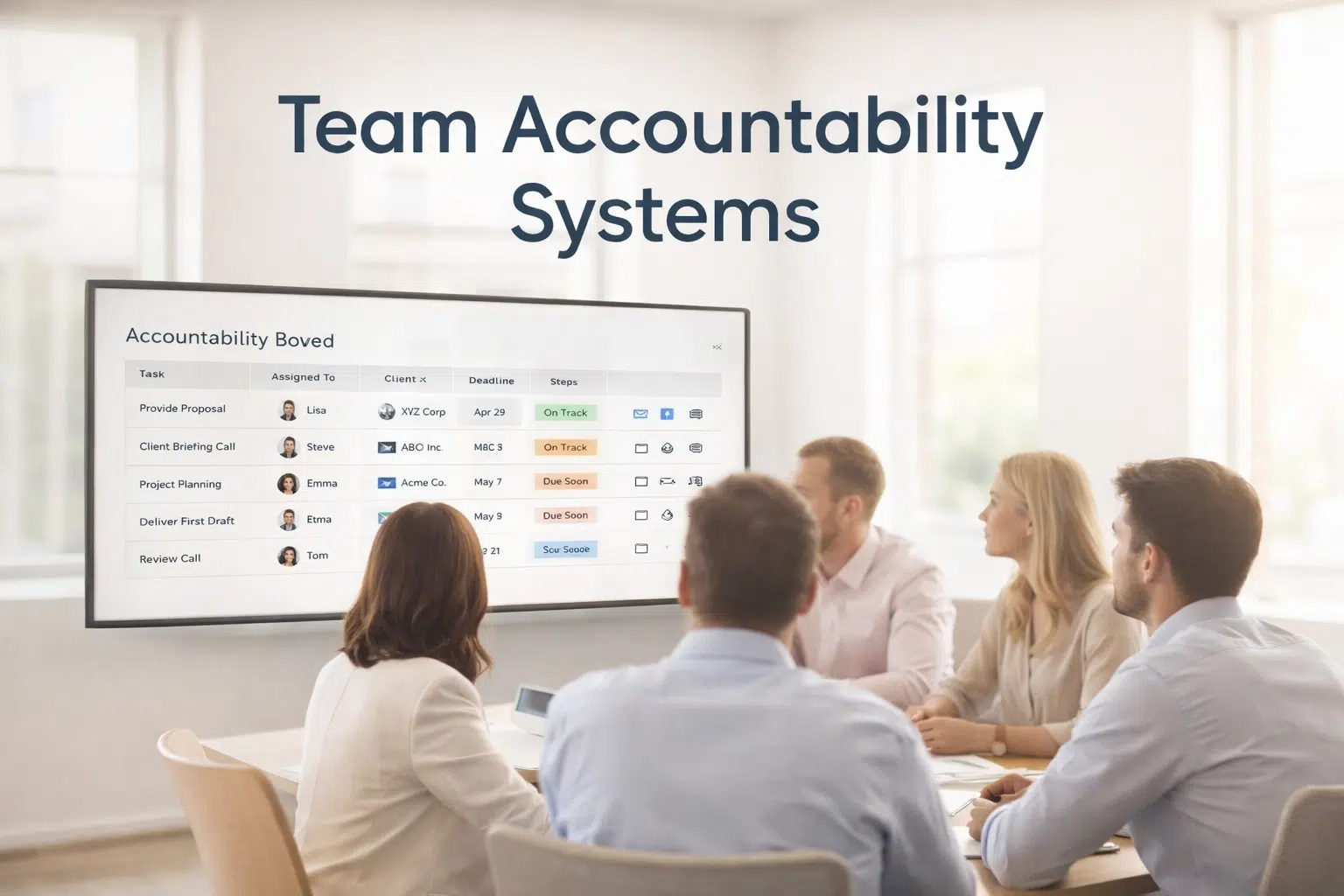
Team Accountability Systems: 7 Ways to Stop Client Questions
I am tired of being the person everyone looks to when a client has a simple question that my team should already know how to handle.
Let me be direct. Your client question problem is not a communication problem. It is an ownership problem. If your team keeps kicking basic questions up to you, your business needs Team Accountability Systems now. Not later. Now. You can change this in 12 weeks or less if you stop relying on memory, good intentions, and random follow-up.
Here is what nobody tells you. Client questions do not pile up because your team is lazy. They pile up because there is no clear ownership, no repeatable handoff, and no real structure for follow-through. I have seen this pattern dozens of times. A business grows, more clients come in, more team members touch the work, and suddenly nobody is fully responsible for what the client sees. That is where Team Accountability Systems become the fix.
The reality: when nobody owns the answer, the question lands on you. When nobody owns the process, the work gets delayed. When nobody owns the follow-up, the client asks again. That is why Team Accountability Systems matter so much. They stop repeat questions by making expectations visible, responsibilities clear, and action steps impossible to ignore.
The Pattern: Why Client Questions Keep Landing on You Without Team Accountability Systems
What does it look like when you do not have Team Accountability Systems? It looks like missed updates, confused clients, and a founder who gets pulled into things that should never reach their desk. You feel like you are always checking, reminding, and cleaning up after preventable mistakes.
The pattern is simple. A client asks for an update. Your account manager thinks the project lead will answer. The project lead assumes admin already sent the file. Admin thinks someone else already handled it. So the client waits. Then they ask again. Then they ask you. That is what happens when Team Accountability Systems are missing.
This is normal in growing service businesses. But it is not sustainable. Without Team Accountability Systems, your team keeps reacting instead of owning. Your clients lose confidence. Your team loses clarity. And you become the default answer machine.
When I work with clients through a Clarity Operational Partnership, this is one of the first patterns I look for. I want to know where ownership gets fuzzy, where deadlines get soft, and where client communication falls apart. If the work touches three people but belongs to nobody, Team Accountability Systems are the solution.

System 1: Team Accountability Systems Start with Clear Role Ownership
The first layer of Team Accountability Systems is simple. Every recurring client task needs one owner. Not three people. Not “the team.” One owner. That person can pull in help, but they own the outcome.
Most businesses skip this step. They assume roles are obvious. They are not. If you want fewer client questions, your team needs clear ownership for onboarding, updates, approvals, billing responses, deliverables, and next steps. Team Accountability Systems work because they remove the gray area.
What it looks like:
- One named owner for each client-facing process
- A backup owner when the main person is out
- A visible task list tied to real names, not departments
What you provide:
- A basic ownership map for every stage of the client journey
- A short responsibility chart your team can review in minutes
Goal: Every client-facing task has a clear owner before the client ever has to ask.
System 2: Team Accountability Systems Need a Central Source of Truth
If your team has to dig through Slack, email, text messages, and random notes to answer a client question, you do not have Team Accountability Systems. You have scattered information and crossed fingers.
Your team needs one place to find the current status, next step, key files, timeline, and owner. That is how Team Accountability Systems stop repeat questions. The answer should already exist before the client asks. The team should know where to find it. Fast.
I often see businesses where the founder has the clearest picture because all the context lives in their head. That is a huge risk. Real Team Accountability Systems pull knowledge out of your brain and put it into a shared, usable system. That way your team can answer confidently without checking with you first.
The reality: clients ask more questions when your team sounds unsure. A central source of truth fixes that. It gives your team confidence. It gives your clients consistency. And it makes Team Accountability Systems real instead of theoretical.
System 3: Team Accountability Systems Depend on Proactive Client Updates
One of the biggest reasons clients keep asking questions is simple. They do not know what is happening. If your team only updates clients when someone remembers, you need Team Accountability Systems around communication cadence.
You should not wait for a client to ask for a status update. Your team should send it first. That one habit changes everything. It lowers anxiety, cuts down inbox noise, and keeps the work moving. Strong Team Accountability Systems make proactive updates part of the job, not an optional extra.
What happens:
- Clients stop chasing updates
- Team members stop guessing who should reply
- Small issues get caught before they become trust problems
A simple update can include:
- What was completed this week
- What is happening next
- What the client needs to provide
- Any blocker and who owns fixing it
That is one of the easiest ways Team Accountability Systems reduce client questions fast.

System 4: Team Accountability Systems Require Channel Rules and Response Standards
If clients can message anyone on anything at any time, your team will stay reactive. Team Accountability Systems need channel rules. Without them, nobody knows where work belongs or who should respond.
You need simple standards:
- Project questions go in the project tool
- Formal approvals go through email
- Urgent issues follow one defined path
- Internal handoffs happen in one shared place
You also need response standards. Not vague expectations. Real ones. For example:
- Client messages are acknowledged within 4 business hours
- Full answers are delivered within 24 business hours
- If another department owns the task, the assigned owner still updates the client
This is where Team Accountability Systems protect your team from confusion. Everyone knows the path. Everyone knows the promise. Everyone knows who has to close the loop.
The honest answer: if your team is using five channels with no rules, client questions will keep multiplying. That is why channel control is a core part of Team Accountability Systems. You can read more in our guide on how to fix chaotic operations in 12 weeks.
System 5: Team Accountability Systems Work Best with a Repeat-Question Library
If the same client questions keep coming up, your team should not keep answering them from scratch. Team Accountability Systems should include a simple repeat-question library. This can live in Notion, Google Docs, your CRM, or your client portal. The tool matters less than the habit.
The pattern: your team answers the same billing question twelve different ways. Or they explain the same approval step over and over. That creates inconsistency. It slows down response time. It also makes training harder. Team Accountability Systems fix this by giving your team approved answers they can reuse.
What to include:
- Billing and invoice questions
- Timeline and delivery questions
- File access questions
- Revision policy questions
- Approval and sign-off steps
When the answer is documented, your team can move faster. When your team moves faster, clients ask fewer follow-up questions. That is what Team Accountability Systems are supposed to do.
System 6: Team Accountability Systems Get Stronger with Structured Meetings
Meetings create confusion when they are loose. Strong Team Accountability Systems make meetings useful by forcing clarity before, during, and after the call.
Here is the mistake I see all the time. A team meets with a client, has a good conversation, and leaves with a pile of vague verbal agreements. Then nobody is fully sure who owns what. Then the client follows up with more questions. That is not a client issue. That is a missing Team Accountability Systems issue.
Every client meeting should produce:
- A clear agenda before the meeting
- A note taker during the meeting
- An action list after the meeting
- Named owners for each next step
- A deadline tied to each task
Not fancy. Just clear. This is how Team Accountability Systems turn meetings into movement instead of more confusion.
System 7: Team Accountability Systems Need an Escalation Path
What happens when something goes wrong? If every issue jumps straight to you, then your business still depends on you. Real Team Accountability Systems include a clear escalation path so your team knows what to solve, what to flag, and what actually needs leadership involvement.
You need levels. For example:
- Level 1: Team member resolves common issue
- Level 2: Manager steps in if timeline, scope, or client trust is at risk
- Level 3: Founder steps in only for high-risk decisions or major relationship repair
I build this into client operations all the time. When we set up Team Accountability Systems properly, your team can handle far more without panic. They do not need to guess when to escalate. They know. That is one reason a Clarity Operational Partnership helps so much. We do not just talk about ownership. We build it into the way your team works.

Why Team Accountability Systems Are Hard to Build on Your Own
You might think you can tell your team to “be more accountable” and get a better result. You will not. Accountability without structure becomes blame. Accountability with structure becomes consistency. That is why Team Accountability Systems matter.
This is where The Clarity Transformation comes in. We look at how client work moves through your business, where ownership breaks down, and which repeat questions are exposing bigger operational gaps. Then we fix the real issue. We build Team Accountability Systems that your team can actually use day to day.
The honest answer: most founders are too close to the problem to solve it cleanly. You know too much. You fill in too many gaps automatically. You rescue too fast. That is why Team Accountability Systems often need outside eyes and hands-on implementation.
When you bring in a Clarity Operational Partnership, we help define roles, build follow-up systems, create documentation, and train your team to own the client experience. This is not advice from the sidelines. It is real implementation. And it is exactly how Team Accountability Systems stick.
The Logic: Why Team Accountability Systems Matter More as You Grow
When you are scaling from 50K to 100K a month, weak ownership gets expensive fast. At lower revenue, you can cover cracks with hustle. At higher revenue, those cracks turn into delays, mistakes, and frustrated clients.
That is why Team Accountability Systems are not optional at the next stage. They help you serve more clients without turning every issue into a founder problem. They also make your business stronger if you want to grow, hire, or eventually sell. Buyers do not want a business that runs on memory and heroics. They want one built on Team Accountability Systems.
Implementing Team Accountability Systems with Clarity Ops Engine
The process inside The Clarity Transformation is practical. We do not spend months talking in circles. We identify where client questions are coming from, where ownership is falling apart, and which systems your team needs first. Then we start building.
Phase 1:
- Audit recurring client questions
- Map broken handoffs
- Identify missing ownership points
Phase 2:
- Build or clean up your source of truth
- Assign task ownership
- Set communication standards
- Create follow-up workflows
Phase 3:
- Train your team
- Test the new process
- Adjust weak points
- Lock in the new rhythm
That is how Team Accountability Systems move from concept to daily practice. This hands-on work is also why a Clarity Operational Partnership feels different from traditional consulting. We are not dropping off a slide deck. We are helping your business run better.
By the end of The Clarity Transformation, your team should know who owns what, where answers live, how updates happen, and when something needs escalation. That is what good Team Accountability Systems create. Less chasing. Fewer repeat questions. More trust.

Frequently Asked Questions about Team Accountability Systems
What are Team Accountability Systems?
Team Accountability Systems are the structures that make ownership clear across your business. They define who owns tasks, where information lives, how follow-up happens, and when issues get escalated.
How do Team Accountability Systems stop client questions?
Team Accountability Systems reduce client questions by making updates proactive, answers easy to find, and responsibilities clear. Clients ask fewer questions when your team already knows who handles what and when.
Can a small business use Team Accountability Systems?
Yes. Team Accountability Systems are especially useful for small businesses because you cannot afford confusion. Even a team of 3 to 8 people benefits from simple ownership rules and documented follow-through.
How long does it take to build Team Accountability Systems?
You can see early results in 2 to 4 weeks, especially if you fix ownership and update cadence first. Full Team Accountability Systems usually take about 12 weeks to build, test, and reinforce across the team.
What is the biggest mistake when building Team Accountability Systems?
The biggest mistake is assuming people know what they own. Team Accountability Systems fail when ownership is implied instead of defined. If it is not written down, assigned, and tracked, it is probably not real.
The Cost of Ignoring Team Accountability Systems
You have a choice. You can keep answering avoidable client questions, checking on work that should already be handled, and stepping into problems your team should be able to solve. Or you can build Team Accountability Systems that make ownership clear and execution consistent.
If you are ready to fix the bottlenecks behind repeat client questions, I can help. Through The Clarity Transformation, we build the systems, documentation, and team habits that make accountability real. We also use Team Accountability Systems to reduce founder dependency and create smoother client delivery.
You do not need more reminders. You need a better operating system. That is exactly what a Clarity Operational Partnership is built to support.
Goal: Turn client communication from a constant interruption into a controlled, team-owned process.
Ready to fix the real problem? Book your free 30-minute operational audit here and let’s get to work.
Related Blogs:
- How a Fractional COO Fixes Client Communication Bottlenecks
- When a Client Communication Problem Is Really an Operations Problem
- From Founder-Dependent to System-Dependent: The B2B Growth Shift
- Recurring Client Questions: 7 Highly Effective Ways to Fix
- The Real Reason Your Team Avoids Ownership
- How to Build Team Accountability Systems That Actually Work
- Why Your Business Feels Like Constant Follow-Up
- How to Eliminate the “Someone Else Will Handle It” Problem
- The Hidden Cost of Weak Ownership in Your Team
- How to Assign Clear Responsibility for Every Client Task
- Why Your Team Gets Stuck Waiting on Each Other
- How to Build a System Where Every Task Has an Owner
- The Link Between Ownership and Client Experience
- Why Your Clients Keep Asking for Updates
- How to Build Proactive Update Systems That Reduce Questions
- Why Waiting for Client Questions Slows Everything Down
- How to Create a Consistent Communication Cadence
- The Role of a Central Source of Truth in Accountability
- How to Build a System Your Team Can Trust for Answers
- Why Your Team Can’t Find the Information They Need
- How to Eliminate Scattered Client Data Across Tools
- The Importance of Channel Rules in Team Accountability
- How to Define Where Communication Should Happen
- Why Too Many Channels Create Confusion
- How to Build Clear Response Time Standards
- The Role of Repeat-Question Libraries in Efficiency
- How to Stop Answering the Same Questions Over and Over
- Why Your Team Gives Inconsistent Answers to Clients
- How to Build a Library of Approved Responses
- The Importance of Structured Meetings for Accountability
- How to Turn Client Calls Into Clear Action Plans
- Why Your Meetings Don’t Lead to Execution
- How to Build Better Follow-Up Systems After Calls
- The Role of Escalation Paths in Team Ownership
- How to Define When Issues Should Reach Leadership
- Why Your Team Escalates Everything to You
- How to Build Confidence Through Clear Boundaries
- The Most Common Mistakes in Team Accountability Systems
- How to Transition From Reactive to Ownership-Based Operations
- Why Your Growth Is Limited by Lack of Accountability
- How to Build a Business That Runs Without Constant Oversight
- The Real ROI of Strong Team Accountability Systems