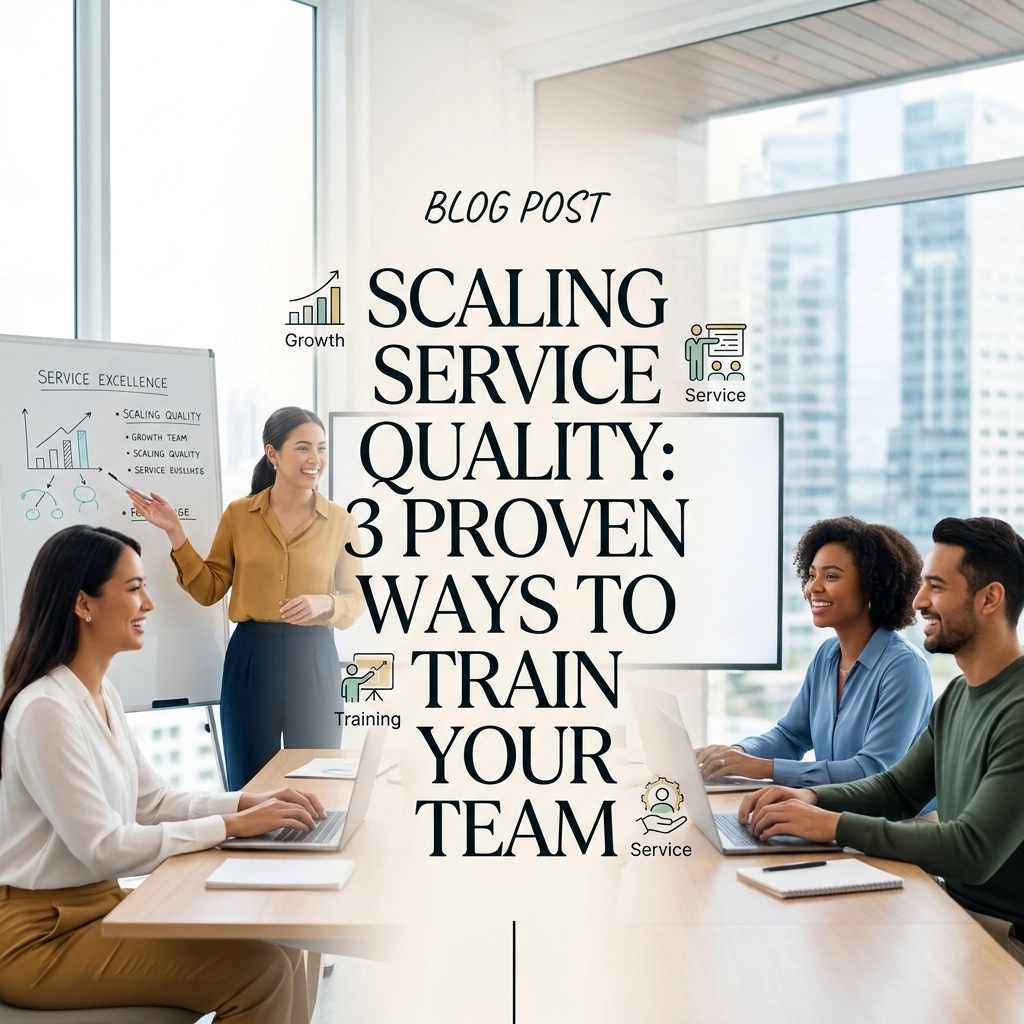
Scaling Service Quality: 3 Proven Ways to Train Your Team
You are currently the only person in your company who knows how to talk to a client without making a mistake, and that is why you cannot take a vacation without your phone ringing every ten minutes.
Let me be direct. If your business depends on you personally answering every complex client question, you do not have a company. You have a high-paying customer service job. I have seen this pattern dozens of times. A founder builds a great reputation for high-level service, but when they try to hire a team, the quality falls off a cliff. This failure in scaling service quality is what keeps most service businesses stuck at seventy-five thousand dollars a month. You feel like you have to choose between growth and your reputation.
The reality is that you are the bottleneck. You have all the knowledge in your head, and you have no system for moving it into the heads of your employees. Without a repeatable training framework, scaling service quality is impossible. You will continue to hire people who “don’t care as much as you do” until you fix the way you transfer your expertise. This takes exactly twelve weeks to fix if you stop trying to do it all yourself. This is the core of what we solve at Clarity Ops Engine.

The Problem: Why Your Service Fails When You Are Not Looking
Most founders think they have a people problem. They believe they just cannot find “good help” these days. The truth is usually different. The truth is that you have an operations problem. When you are small, you provide quality through sheer force of will. You work harder, stay later, and fix every mistake your team makes. This does not work when you are scaling service quality across a growing team.
The pattern I see consistently is a lack of documented standards. Your team is guessing. They are trying to mimic your personality instead of following a process. Personality does not scale. Processes do. If you want to stop answering client emails at midnight, you have to build a system that makes scaling service quality a mathematical certainty rather than a lucky break.
The Cost of the Hero Operator Trap
When you act as the Hero Operator, you kill your profit margins. You spend your time doing fifty-dollar-an-hour work instead of five-hundred-dollar-an-hour strategy work. This prevents scaling service quality because you are too busy reacting to crises. Every time a technician or an admin staff member makes a mistake, you step in to save the day. This teaches your team that they do not need to learn. They know you will always be the safety net.
The math of this trap is brutal. If you spend four hours a day fixing client communication issues, you are losing twenty hours a week of CEO time. Over a year, that is a thousand hours of growth you have sacrificed. You are paying a massive “incompetence tax” because you have not invested in scaling service quality through training. This is why your bank account feels smaller than it should even as your revenue grows.
Red Flags Your Service Quality is Not Scalable
You can tell if you are struggling with scaling service quality by looking at a few simple markers. Do clients ask for you by name even when they have been assigned a project manager? Do you have to proofread every outgoing email before it is sent? Is your team afraid to make a decision without your approval? These are all signs that your business is fragile.
Another red flag is a high turnover rate among your best clients. If clients stay when you are the lead but leave when you hand them off, your method of scaling service quality is broken. You are selling yourself, not a service. You need to move from a “Me-Centered” business to a “System-Centered” business. This is the first step in The Clarity Transformation.
1. Implement Communication Frameworks for Scaling Service Quality
The first way to start scaling service quality is to stop using scripts and start using frameworks. Scripts are rigid. They break as soon as a client asks something unexpected. Frameworks are flexible. They give your team a mental map of how to handle a conversation without you. This allows for scaling service quality because it empowers your team to think for themselves within a safe boundary.
I recommend starting with five basic frameworks. These cover eighty percent of all client interactions. When you teach these, you are actually scaling service quality because you are giving your team a repeatable way to succeed. They stop asking “What do I say?” and start asking “Which framework applies here?” This shifts the mental load from you to the system.

The Acknowledge-Assess-Act Loop
This is the most basic tool for scaling service quality during a conflict. Most employees either get defensive or over-promise when a client is unhappy. This framework stops that. First, they acknowledge the client’s feeling without admitting fault. Second, they assess the facts by asking three specific questions. Third, they act by giving a clear timeline for a resolution.
By using this loop, you are scaling service quality because every complaint is handled with the same level of professionalism. The client feels heard, and the team member stays calm. You no longer have to step in to de-escalate situations because the framework does it for you. This is a key part of the Clarity Operational Partnership approach to team management.
The “Ask One, Teach One” Escalation
This framework is specifically for internal scaling service quality. It prevents the “Decision Queue” where everyone waits for you to tell them what to do. If an employee has a question, they must come to you with a proposed solution first. You then either approve the solution or teach them why a different one is better. Once taught, they are responsible for teaching that answer to the rest of the team.
This creates a self-healing system. You are scaling service quality by turning every question into a permanent asset. You are not just giving a fish. You are building a library of how to fish. Over time, the number of questions reaching your desk will drop by seventy percent. This is how you reclaim your time while scaling service quality.
2. Use Structured Role-Play for Scaling Service Quality
The second proven way to train your team is through high-frequency role-play. Most business owners hate role-play. They think it is awkward. The reality is that if your team is not practicing with each other, they are practicing on your paying clients. That is an expensive way to learn. If you are serious about scaling service quality, you must make practice a mandatory part of the job.
Role-play allows you to simulate high-pressure situations. This is vital for scaling service quality because it builds muscle memory. When a client gets aggressive about a price increase or a delay, your team will not freeze. They will go back to their training. You are scaling service quality by ensuring that the standard of care remains high even when things go wrong.

Building a Scenario Library
To start scaling service quality through role-play, you need a library of scenarios. These should be based on real situations that have happened in your business. I have seen this work dozens of times. You take the three worst client calls from last month and turn them into training scripts. You play the role of the difficult client. Your team practices using the frameworks you have given them.
This creates a “standardized response” for the most common issues. You are scaling service quality by removing the guesswork. Your team knows exactly what the “Gold Standard” looks like because they have seen you demonstrate it in a safe environment. This is a foundational element of The Clarity Transformation.
The Math of Training Frequency
If you want to see results in scaling service quality, you cannot do a one-day workshop once a year. You need ten minutes of practice every day. I recommend a “Morning Stand-up” where one team member handles a sixty-second scenario. This keeps the skills fresh. You are scaling service quality by making it a daily habit rather than a special event.
The logic is simple. A team that practices for fifty hours a year will always outperform a team that practices for zero hours. If your competitors are not training, you win by default. You are scaling service quality through superior preparation. This is how small teams beat larger, disorganized companies every single time.
3. Continuous Performance Monitoring for Scaling Service Quality
The third way to ensure you are scaling service quality is to implement a feedback loop. You cannot manage what you do not measure. If you are not looking at the results of your training, you are just hoping for the best. Hope is not an operational strategy. You need data to prove that you are scaling service quality successfully.
This does not mean you have to micromanage. It means you need a scorecard. A scorecard allows for scaling service quality by showing you exactly where the system is breaking down. If your response time is up but your client satisfaction is down, you know exactly where to focus your next training session. This is the “Engine” part of Clarity Ops Engine.

The Client Response Scorecard
To monitor scaling service quality, you should track three key metrics. First, track “Time to First Response.” Clients care about speed. Second, track “Resolution Rate on First Contact.” This measures how helpful your team is. Third, track “Net Promoter Score” or a simple “Thumbs Up/Down” from the client after the interaction.
When you have these numbers, you are scaling service quality with precision. You don’t have to guess who needs help. The data tells you. You can give praise where it is due and correction where it is needed. This creates a culture of accountability that is essential for scaling service quality in a remote or hybrid environment.
Monthly Knowledge Assessments
Every month, you should test your team on your core processes. This sounds corporate, but it is necessary for scaling service quality. It can be a simple five-question quiz about your latest service updates or communication frameworks. If people are failing the quiz, your documentation is probably too complicated.
By testing regularly, you are scaling service quality by preventing “Knowledge Drift.” Knowledge Drift is what happens when employees start making up their own rules because they forgot the original ones. You stop the drift by reinforcing the standard. This is a key service offered in a Clarity Operational Partnership.
How Clarity Ops Engine Fixes Your Training Gaps
Most founders try to build these systems themselves and fail. They get busy with a big project and the training stops. Or they write a fifty-page manual that nobody ever reads. This is why you need a partner who understands the mechanics of scaling service quality. At Clarity Ops Engine, we don’t just give you a list of ideas. We implement the systems for you.
We use a specific process called The Clarity Transformation to extract your expertise. We don’t just “talk” about scaling service quality. We build the frameworks, create the scenario library, and set up the scorecards. We handle the heavy lifting of operations so you can go back to being the CEO. Our goal is to make you irrelevant to the day-to-day client interactions so you can focus on high-level growth.
The Clarity Transformation: A Twelve-Week Roadmap
In the first month, we identify the “Knowledge Gaps” that are preventing scaling service quality. We look at your emails, your call logs, and your current team performance. We find the “Leakage” where money is being lost due to poor service. By the end of month one, we have a clear plan for scaling service quality that fits your specific industry.
In the second month, we build the “Communication Engine.” This includes the frameworks and the documentation needed for scaling service quality. We train your team on these new standards. You start to see the “Decision Queue” at your desk get shorter. You are scaling service quality through hands-on implementation rather than just theory.
By the third month, we are monitoring the results. We set up the scorecards and the feedback loops. You now have a business that is scaling service quality on autopilot. You can step away for a week and know that your clients will receive the same level of care as if you were there. This is the ultimate goal of the Clarity Operational Partnership.

Why Hands-On Implementation Matters
Most consultants just give you a report and leave. That does not help with scaling service quality. You need someone in the trenches with you. We act as your Fractional COO. We make the tough calls, we hold the team accountable, and we ensure the systems are actually used. This is why our method of scaling service quality actually sticks.
If you are tired of being the only one who can talk to clients, you need a different approach. You cannot “work harder” your way out of this problem. You need to build a machine. We are the architects and the mechanics who build that machine for you. We focus on scaling service quality so you can focus on building your legacy.
Scaling Service Quality FAQ
What is the fastest way to start scaling service quality?
The fastest way is to stop answering questions. When an employee asks you a question, tell them to go find the answer in your existing documentation or propose a solution first. This immediate shift starts the process of scaling service quality by forcing the team to think. It might be slower for the first three days, but it saves you hundreds of hours in the long run.
Can I really automate scaling service quality?
You cannot automate the human touch, but you can automate the systems that support it. You can automate the reminders for training, the distribution of scorecards, and the collection of client feedback. By automating the “Admin” of scaling service quality, you free up your team to focus on the actual relationship with the client.
How do I know if my team is ready for scaling service quality?
Your team is ready if they are consistently busy but the business isn’t growing. This usually means they are working hard but inefficiently. They are ready for a system that allows for scaling service quality because they are likely as frustrated by the chaos as you are. A clear framework is a gift to a stressed employee.
Does scaling service quality work for specialized services?
Yes. In fact, it is more important for specialized services like HVAC, Roofing, or Healthcare. In these fields, the technical knowledge is the product. If that knowledge only stays in your head, you can never grow. Scaling service quality in specialized fields requires creating “Decision Trees” that guide technicians through complex problems without needing to call the owner.
How much does it cost to implement a system for scaling service quality?
The cost of implementing a system is always lower than the cost of losing a major client or burning out your best staff. At Clarity Ops Engine, we structure our Clarity Operational Partnership to provide a clear return on investment. We find the “Operational Debt” that is costing you money and use those savings to fund the growth of your systems.
The Logic: Systems are the Only Path to Freedom
You have a choice to make. You can continue to be the Hero Operator, or you can become a System Designer. One path leads to burnout and a business that is impossible to sell. The other path leads to scaling service quality, higher profits, and a life where you are actually in control of your time.
If you are ready to stop being the bottleneck, let’s talk. We have helped dozens of founders move from chaos to clarity. We specialize in scaling service quality for service-based businesses that are stuck at the seventy-five thousand dollar a month mark. The path forward is not more work. It is better operations.
Option 1: Stay the Hero
You can keep doing what you are doing. You can continue to proofread every email and handle every “emergency” call. You will stay at your current revenue ceiling, and your stress will continue to rise. This is the path of most small business owners who never figure out scaling service quality.
Option 2: Build the Engine
You can decide that today is the day you stop being the support staff for your own company. You can invest in scaling service quality by building a team that doesn’t need you. You can reclaim your weekends and finally see the growth you know your business is capable of.
Ready to fix your operations? Book your 30-minute diagnostic call here: https://calendly.com/sdrobinson8/30min
Related Blogs
- The $75K Decision Queue: How to Break the Founder Bottleneck
- 5 Brutal Reasons Your Service Quality Drops When You Hire
- The 12-Week Roadmap to Operational Freedom
- Fractional COO vs. Full-Time: Which One Does Your Scaling Business Need?
- The Founder Bottleneck: 7 Ways You’re Killing Your Own Growth
- Decision Queue Breakdown: 5 Steps to Stop Being the Default Answer
- Why “Good Employees” Fail Without Systems: 6 Hard Truths
- Service-Based SOPs: 10 Must-Have Processes for Scaling
- Client Communication Systems: 5 Frameworks That Replace You
- Operational Drag Reduction: 7 Brutal Ways Debt Destroys Teams
- Training Systems for Small Teams: 8 Ways to Build Consistency Fast
- From Hero Operator to CEO: 6 Shifts That Change Everything
- How to Build a Self-Sufficient Team in 90 Days
- Why Your Team Keeps Asking Questions (And How to Fix It)
- Knowledge Transfer Systems: 5 Ways to Get What’s in Your Head Documented
- Employee Enablement: 7 Ways to Build Confident Decision Makers
- Customer experience metrics: 7 Proven Ways to Boost Profits
- The Real Cost of Micromanagement: 5 Metrics You’re Ignoring
- Team Accountability Systems: 7 Ways to Stop Client Questions
- How to Build a Training Engine That Runs Without You
- Scaling Service Businesses: 9 Operational Mistakes to Avoid
- Customer Retention: 7 Brutal Mistakes Killing Repeat Profits
- The 80/20 of Client Interactions: 5 Frameworks That Cover Most Scenarios
- Why Scripts Fail and Frameworks Win: 7 Practical Examples
- Morning Standups That Actually Work: 5 Structures for Better Teams
- Role-Play Training: 6 Ways to Prepare Teams for Real Client Scenarios
- Building a Scenario Library: 5 Steps to Smarter Training
- Performance Scorecards: 7 Metrics Every Service Business Needs
- How to Measure Service Quality Without Micromanaging
- Net promoter score: 7 powerful ways to boost profit
- Time to First Response: 6 Ways to Improve Without Hiring More Staff
- Resolution Rate Optimization: 5 Ways to Fix Client Issues Faster
- Knowledge Drift: 7 Ways Your Team Forgets What You Taught Them
- Monthly Team Assessments: 5 Simple Ways to Reinforce Standards
- How to Build a Feedback Loop That Improves Performance Weekly
- Fractional COO Systems: 6 Ways They Fix Training Gaps
- Scaling from $75K to $150K Months: 7 Operational Levers
- System-Centered vs Me-Centered Businesses: 5 Key Differences
- Why Founders Struggle to Let Go: 6 Operational Barriers
- How to Replace Yourself in Daily Operations: 8 Step Plan
- Service Quality Breakdowns: 5 Red Flags You Can’t Ignore
- High-Ticket Client Experience: 6 Ways to Maintain Standards at Scale