Emergency Playbook: 7 Essential Rules for Massive Growth
It is 7:00 AM on a Monday and your lead technician just texted saying his truck broke down while your dispatch software is showing a 404 error and three customers are calling about emergency leaks.
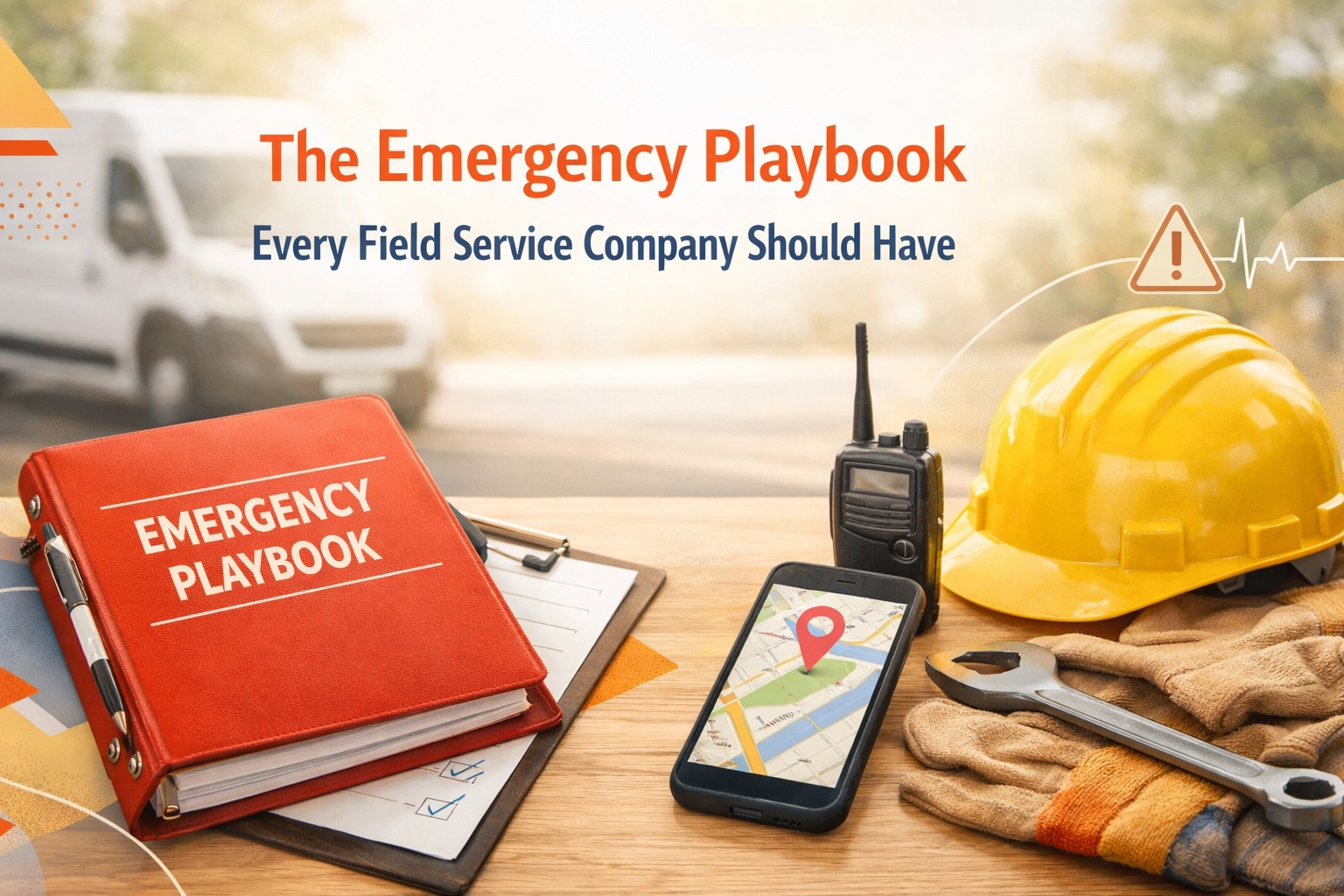
Let me be direct. If your response to this situation involves you personally calling technicians and manually re-routing jobs for three hours, you do not have a business. You have a very stressful, high-paying job that will eventually break you. Here is what nobody tells you about scaling a field service company. You cannot grow past a certain point without a formal Emergency Playbook. This document is the difference between a controlled response and a total operational collapse.
Within the next 12 weeks, you can move from reactive chaos to proactive management. I have seen this pattern dozens of times in HVAC, roofing, and plumbing companies. The owner is the only one who knows what to do when things go wrong. This creates a massive bottleneck that kills your profitability. My recommendation is simple. You must document your crisis response before the crisis happens.
The reality is that an Emergency Playbook is not just for natural disasters. It is for the everyday “fires” that happen in a service business. This includes same-day service requests, software outages, and sudden staffing shortages. If you want to stop being the “Chief Firefighter” in your business, you need a system.
Why Your Business Is Fragile Without an Emergency Playbook
The pattern I see most often is “Management by Adrenaline.” When a problem occurs, everyone looks at the owner. You make a snap decision. The problem gets solved, but no one else learns how to handle it next time. This makes your operations fragile and dependent on your physical presence.
Without a documented Emergency Playbook, your team lacks the authority to make decisions. They wait for your approval because they do not want to get blamed for a mistake. This delay is what I call “Decision Latency.” It is a silent revenue killer. Every minute a technician sits idle or a customer waits for a callback, your margin is eroding.
An Emergency Playbook provides the framework for decentralized decision-making. It tells your office manager and your lead techs exactly what the priorities are. It defines what constitutes a real emergency versus a minor inconvenience. Most importantly, it protects your time so you can focus on high-level strategy.

The 4 Severity Levels of Your Emergency Playbook
I recommend building your Emergency Playbook around a four-tier severity framework. This prevents your team from treating every small hiccup like a five-alarm fire. It forces them to categorize the impact of the issue before they escalate it to you.
Severity Level 1: The Critical Crisis
These are incidents that threaten immediate revenue, safety, or legal compliance. Examples include a total server failure, a multi-tech accident, or a major data breach. In your Emergency Playbook, a Level 1 incident requires an immediate “all-hands” response. The Incident Commander, usually you or your COO, must be notified within five minutes.
Severity Level 2: High Impact Disruptions
This level involves problems that affect a large portion of your operations but are not “business-ending” yet. Think of a localized power outage at your office or three technicians calling out sick simultaneously. Your Emergency Playbook should outline how to triage these jobs. You might decide to prioritize high-margin recurring maintenance over new lead estimates for the day.
Severity Level 3: Moderate Impact Issues
These are isolated problems that disrupt the flow but do not stop the day. A technician losing their tablet or a specific part being backordered falls here. The Emergency Playbook should empower your dispatchers to handle these without calling you. They should have a list of pre-approved “workarounds” they can deploy immediately.
Severity Level 4: Low Impact Cosmetic Errors
These are minor bugs or mistakes that need to be fixed but are not time-sensitive. A typo on a marketing flyer or a slow-loading website page fits this category. Your Emergency Playbook should simply instruct the team to log these issues for a weekly review. They should never interrupt your “deep work” or active field operations.
SOPs for Same-Day Service Requests and Emergencies
One of the biggest sources of chaos in a service business is the “same-day” request. If you do not have a specific Emergency Playbook for these, they will wreck your scheduled route efficiency. You need clear Standard Operating Procedures (SOPs) for how to handle a customer who needs help right now.
The first rule in your Emergency Playbook for same-day requests is the “Triage Script.” Your office staff should not just say “we will try to squeeze you in.” They must follow a specific set of questions to determine if the request is a true emergency. If it is, the Emergency Playbook should dictate which non-essential jobs can be bumped.
You should also have an “Emergency Pricing” section in your Emergency Playbook. True emergencies often require overtime or pulling a tech off another profitable job. Your pricing must reflect this added operational cost. I recommend a flat “Emergency Dispatch Fee” that is non-negotiable for same-day, after-hours calls.

Defined Roles and the Incident Commander
Every Emergency Playbook needs a clear chain of command. When things go wrong, you cannot have three people trying to lead. You need to designate an Incident Commander for different types of crises. This person has the final word on all decisions during the response phase.
The Incident Commander is often the person closest to the problem, not necessarily the owner. For a dispatch software failure, your Office Manager might be the Incident Commander. For a field safety issue, it might be your Head of Production. Your Emergency Playbook must specify these roles so there is no confusion during a high-stress moment.
The logic here is simple. You want to push decision-making down to the lowest competent level. If your Emergency Playbook is well-written, your team should be able to resolve 80% of issues without you. This is a core part of The Clarity Transformation that we implement with our clients. We help you define these roles so you can finally step back from the daily fires.
Communication Templates and Customer Confidence
In a crisis, communication usually breaks down first. Your customers start calling when they do not see a tech arrive on time. Your techs get frustrated because they do not have the right information. Your Emergency Playbook must include pre-written communication templates for every common scenario.
These templates should cover text messages, emails, and phone scripts. If your scheduling software goes down, your Emergency Playbook should have a template that says: “We are currently experiencing a technical delay but your service remains our priority. We will call you within 30 minutes with an updated ETA.”
This proactive communication builds massive trust. It shows the customer that you are in control, even when things are going wrong. Without these templates in your Emergency Playbook, your team will likely say the wrong thing or, worse, say nothing at all. Silence is the fastest way to lose a long-term customer during an operational hiccup.

How a Fractional COO Builds Your Emergency Playbook
You might think you can just sit down and write an Emergency Playbook in a weekend. The reality is that building a truly functional system takes time and an outside perspective. Most owners are too close to the daily chaos to see the recurring patterns. This is where a Clarity Operational Partnership becomes invaluable for your growth.
When we begin The Clarity Transformation, we start by auditing your existing “unwritten” rules. We look at the last five times a major problem occurred and map out how it was handled. Then, we build a formal Emergency Playbook that addresses those specific gaps. We do not just give you a template; we help you implement the behavior changes required to make it work.
A Fractional COO provides the objective “straight” talk you need to hear. If you are the reason your team cannot handle emergencies, we will tell you. Then we will build the Emergency Playbook that gives them the tools they need to succeed without you. This level of operational maturity is what allows you to scale from 5 trucks to 20 trucks without losing your mind.
Manual Operations When Technology Fails
Every modern field service company relies on software. But what happens when that software disappears? Your Emergency Playbook must include a “Manual Operations” section. This is your “Break Glass in Case of Emergency” protocol for when your CRM or GPS tracking goes dark.
Your Emergency Playbook should require a weekly printout of your technician’s phone numbers and your current customer list. If your cloud software fails, your dispatcher should be able to open a physical folder and start calling. This prevents your entire company from grinding to a halt because of a localized internet outage or a software bug.
We emphasize this during a Clarity Operational Partnership because technology is a tool, not a crutch. Your Emergency Playbook ensures that your business logic exists outside of your software. By documenting these manual workarounds, you create a level of operational resilience that your competitors simply do not have.

The Post-Incident Review Process
The final piece of an effective Emergency Playbook is the “Post-Mortem” or Post-Incident Review. Every time you have to use the playbook for a Severity 1 or 2 issue, you must meet to discuss what happened. You ask three simple questions: What went well? What broke? How do we update the Emergency Playbook to prevent this?
This is how your Emergency Playbook becomes a living document. It should never be a static binder that sits on a shelf. It should be a constantly evolving set of instructions that gets smarter with every crisis. I recommend doing these reviews within 48 hours of the incident while the details are still fresh.
This process is a fundamental pillar of The Clarity Transformation. We teach your team how to analyze their own performance without playing the blame game. When you focus on improving the Emergency Playbook rather than punishing individuals, you create a culture of continuous improvement. This is how you build a sellable, world-class service organization.
Scaling Through Systemized Crisis Management
At some point, growth feels like a series of never-ending emergencies. You hire more people, you buy more trucks, and suddenly there are more things to break. If you do not have an Emergency Playbook, this growth will eventually feel like a trap. You will be busier than ever but less profitable because you are constantly reacting.
The truth is that you cannot scale chaos. You can only scale systems. Your Emergency Playbook is the ultimate “safety net” for your growth. It allows you to take bigger risks and take on larger jobs because you know your team can handle the inevitable hiccups. It gives you the peace of mind to actually take a vacation without checking your email every ten minutes.
If you are ready to stop the reactive cycle, a Clarity Operational Partnership is the fastest path forward. We provide the hands-on implementation support to build your Emergency Playbook and your overall operational infrastructure. We do not just tell you what to do; we work alongside you to make it a reality. This is how we help businesses go from “busy but broke” to “profitable and predictable.”

Emergency Playbook FAQ
How long does it take to create a full Emergency Playbook?
The initial draft of an Emergency Playbook can be created in about 2 to 4 weeks. However, it takes about 90 days to fully train your team and refine the procedures through real-world application. This is a primary focus during the first phase of our consulting engagements.
Should I include my technicians in the creation of the Emergency Playbook?
Yes, absolutely. Your field technicians are the ones who see the “boots on the ground” emergencies first. Their input on what works and what doesn’t is critical for making the Emergency Playbook practical rather than just theoretical.
What is the most common mistake when writing an Emergency Playbook?
The most common mistake is making it too complicated. If your Emergency Playbook is a 200-page manual, no one will read it during a crisis. It should consist of one-page checklists and clear “if-then” statements that anyone can follow under pressure.
How often should we update the Emergency Playbook?
You should review your Emergency Playbook at least quarterly. You should also update it immediately after any major operational change, such as switching software providers or moving into a new service region.
Can I use a generic Emergency Playbook template for my industry?
You can use a template as a starting point, but every business has unique bottlenecks. A generic Emergency Playbook will not account for your specific team’s strengths or your local market challenges. Customization is where the real value lies.
Build Your Emergency Playbook for Long Term Success
You have two choices. You can continue to be the only person who knows how to fix your business when it breaks. Or you can build an Emergency Playbook that empowers your team to handle the heat. One path leads to burnout and a plateaued business. The other path leads to freedom and scalable growth.
If you are tired of the constant fires, let’s talk about how to build your operational foundation. We specialize in helping service business owners like you move from chaos to clarity. Whether you need a full operational overhaul or just a better way to handle daily crises, we are here to help.
The first step is a simple conversation. We will look at your current “bottlenecks” and see if an Emergency Playbook is the right priority for your current stage of growth. Stop letting the daily emergencies dictate your future. It is time to take control of your operations.
Ready to stop the chaos and start scaling? Book your consultation with Clarity Ops Engine today.
Book Your Consultation Here
Related Blogs
- How to Document Your First Business Process in 60 Minutes
- Operational Dashboards: Measuring What Actually Changes Behavior
- The 70-80 Percent Rule for Roofing Contractors Who Want Less Chaos
- Decision Latency: The Silent Revenue Killer
- Process Mapping for Small Businesses (Step-by-Step Guide)