7 Powerful Regional Roofing Operator Systems to Scale Fast
You are working eighty hours a week and your profit margins are actually thinner than they were when you had just two guys and a truck.
Let me be direct. If you want to move from being a local roofer to a regional powerhouse, your current way of working will kill your business. You cannot outwork a bad process. Most contractors try to scale by simply doing more of what they are already doing. They buy more trucks, hire more crews, and chase more leads. Then they wonder why they are more stressed and less profitable than ever before. Here is the truth about regional roofing operator systems. Without them, you are not building a business. You are just building a bigger cage for yourself.
I have seen this pattern dozens of times. A roofing company hits a certain revenue ceiling, usually around the two million dollar mark, and everything starts to break. The owner is the only person who knows how to estimate correctly. The office manager is the only one who knows where the permits are. The crews are waiting around for instructions every morning. This is the founder bottleneck. To break through it, you need to stop thinking like a roofer and start thinking like an operator.
Within the next twelve weeks, you can have a business that runs without your constant intervention. But you have to be willing to stop the chaos and install the right regional roofing operator systems. This is the only way to expand geographically without losing your mind or your money.
The Problem: Why Local Success Leads to Regional Failure
The reality is that what got you to seven figures will not get you to ten figures. When you are a local roofer, you can manage by personality. You know every customer. You see every job site. You can fix mistakes with a phone call or a quick visit. You are the glue holding the entire operation together.
When you decide to become a regional operator, that glue dries up. You cannot be in three counties at once. You cannot oversee five different crews in five different cities. If your business relies on your personal oversight to stay profitable, you are stuck. This is where most roofing companies fail. They try to expand their reach before they have hardened their core.
The pattern is always the same. A company opens a second location or starts taking jobs two hours away. Suddenly, travel costs eat the profit. Materials do not show up on time because the supplier is different. The quality of the work drops because the new crews do not understand your standards. The owner spends all their time driving between sites trying to put out fires. This is the high cost of not having regional roofing operator systems in place before you grow.

System 1: The Centralized CRM for Regional Control
The first of the regional roofing operator systems you must master is your data management. You cannot run a regional company off of whiteboards and sticky notes. You need a single source of truth that tracks every lead, every quote, and every customer interaction regardless of location.
A proper CRM system allows you to see the health of your entire region from one dashboard. You should be able to see exactly how many leads are coming in from each zip code. You should know the closing rate of every salesperson on your team. Without these regional roofing operator systems, you are flying blind. You are making decisions based on your gut feeling instead of hard data.
What it looks like:
Your CRM should be the heartbeat of the company. Every phone call is logged. Every photo of a damaged roof is uploaded instantly. Every contract is signed digitally and filed automatically.
Why it happens:
Most roofers resist this because they think it is too much paperwork. They think their guys will not use it. The reality is that if your team cannot follow a simple digital process, they will never be able to handle the complexity of a regional expansion.
How to handle it:
Choose a platform like JobNimbus or AccuLynx and commit to it. Make it a non-negotiable part of the job. If the data is not in the CRM, the job does not exist. This is the foundation of all regional roofing operator systems.
System 2: Standardized Production and Project Management
Scaling a roofing business requires that every roof is installed the exact same way, whether it is ten miles or two hundred miles from your office. This requires robust regional roofing operator systems for production. You need a digital paper trail for every project.
When you move to a regional model, you lose the ability to walk the roof every day. You must replace your physical presence with a system of checks and balances. This means standardizing your Work Breakdown Structure for every job. You need to know exactly what happens on day one, day two, and day three.
The truth is that most roofing delays are caused by poor communication, not poor weather. If the materials are not ordered three days in advance, the crew sits idle. If the permit is not posted, the job stops. These are operational failures. Implementing regional roofing operator systems for project management ensures that these details are handled automatically by the system, not by your memory.

System 3: Financial Control and Job Costing
One of the most dangerous things you can do is grow a roofing company that does not understand its numbers. I have seen companies do ten million in revenue and still go broke because they did not have regional roofing operator systems for financial tracking.
You must know your job costing to the penny. This means tracking labor, materials, commissions, and overhead for every single project. When you are local, you might be able to survive on a general sense of profit. When you are regional, a five percent error in estimating can put you out of business in six months.
The logic:
Regional expansion brings new costs. You have more fuel, more wear and tear on vehicles, and potentially higher labor rates in different markets. If your regional roofing operator systems do not account for these variables, your profit will evaporate.
Goal: To have real time visibility into the profitability of every crew and every territory.
System 4: The People and Recruitment Engine
You are no longer in the roofing business. You are in the people business. To scale, you need a system for finding, hiring, and training talent. You cannot wait until you have a big contract to start looking for a crew. You need a constant pipeline of applicants.
Effective regional roofing operator systems include a standardized onboarding process. Every new hire should go through the same training. They should read the same safety manuals. They should understand your brand standards from day one. If you hire a crew and tell them to just go do what they know, you are asking for a lawsuit or a bad review.
The reality:
You will always have turnover. That is the nature of construction. The difference between a struggling local roofer and a successful regional operator is how they handle that turnover. A regional operator has a system that makes individual employees replaceable because the process is the star, not the person.
System 5: Automated Marketing and Lead Generation
You cannot rely on word of mouth to fuel a regional expansion. Word of mouth is slow and unpredictable. To grow, you need regional roofing operator systems that generate leads on demand. This means diversifying your marketing channels.
You should have a system for canvassing, a system for digital ads, and a system for referral management. Each of these should be tracked individually. If you spend five thousand dollars on ads in a new territory, you need to know exactly how many roofs that investment produced.
Many contractors make the mistake of spending a lot of money on marketing before they have the regional roofing operator systems to handle the leads. If your office cannot answer the phone within three rings, you are throwing your marketing budget in the trash. Lead response time is the single biggest predictor of sales success in the roofing industry.

System 6: Communication and Reporting Cadence
As you grow, communication becomes your biggest hurdle. How do you know what is happening in a satellite office three hours away? You do it through a structured reporting cadence. This is one of the most overlooked regional roofing operator systems.
You need daily huddles with your project managers. You need weekly leadership meetings to review the numbers. You need monthly strategy sessions to look at the big picture. This is not just about talking. It is about reviewing the data provided by your other regional roofing operator systems.
The pattern:
In a local shop, you talk to everyone in the parking lot at 6:00 AM. In a regional company, that is impossible. You must replace the parking lot chat with a digital reporting system. This ensures that information flows up from the field to the office without being filtered or forgotten.
System 7: Quality Control and Warranty Management
Your reputation is your most valuable asset. When you scale, your reputation is at the mercy of people you might only see once a month. This is why you must have regional roofing operator systems for quality control.
Every job must have a final inspection checklist. Photos of the completed work, the flashing, the underlayment, and the cleaned up job site must be uploaded to the CRM before the crew gets paid. This creates accountability. If a crew knows that their pay is tied to the quality of their documentation, the quality of their work will improve.
Furthermore, you need a system for handling warranty claims. If a roof leaks a year later, how is that handled? Does it get lost in a pile of paperwork, or is there a clear process for scheduling a repair? Proper regional roofing operator systems ensure that your customers are taken care of long after the initial check has cleared.
Phase 1: The Stabilization Period (Weeks 1-4)
Before you can grow, you have to stop the bleeding. The first four weeks of implementing regional roofing operator systems are about identifying the bottlenecks in your current operation. We look at your cash flow. We look at your lead conversion. We look at your current crew capacity.
The reality check:
You might find that your current business is actually losing money on twenty percent of its jobs. You cannot scale a loss. We must fix the pricing and production issues in your home territory before we even think about moving to a new one.
During this phase, we document every process you currently have. We create the first version of your Standard Operating Procedures. This is the manual for how your company operates. If it is not written down, it does not exist in the world of regional roofing operator systems.
What you won’t have:
You will not have a hands off business in four weeks. You will, however, have a clear map of where the bodies are buried and a plan to dig them up.
Phase 2: The Optimization Period (Weeks 5-8)
Once we have stabilized the core, we start optimizing. This is where we install the software and the tracking mechanisms required for regional roofing operator systems. We move your data into a centralized CRM. We set up automated reporting. We train your staff on the new way of working.
This is often the hardest part for the owner. You have to let go. You have to stop being the person who answers every question and start being the person who directs people to the system. If an employee asks you how to handle a specific situation, your answer should be: What does the SOP say?
The logic:
If you continue to be the source of all answers, your team will never learn to use the regional roofing operator systems. You will remain the bottleneck. By forcing the team to use the systems, you are building the muscles they need to operate independently in a new region.

Phase 3: The Expansion Period (Weeks 9-12)
Now we are ready to grow. With your regional roofing operator systems in place and your team trained, we can start looking at new territories. We use the data from your home market to predict success in the new market. We know exactly how much a lead will cost. We know exactly what our margins will be.
Expansion is no longer a gamble. It is a calculated move. We hire a local project manager for the new territory and put them through your standardized training. We set up the local suppliers and add them to your procurement system. We turn on the marketing engine for the new zip codes.
Success metrics:
By the end of week twelve, you should see a decrease in the number of hours you spend on the phone. You should see an increase in your net profit margin. Most importantly, you should have the confidence that your business can handle more work without breaking. This is the power of regional roofing operator systems.
The Founder Bottleneck: Why You Can’t Scale Alone
Most roofing owners are excellent at roofing and mediocre at operations. That is normal. You started this business because you were good with your hands or good at sales. But the skills that make a great roofer are not the same skills that make a great regional operator.
The founder bottleneck occurs when every decision has to go through you. Should we buy this ladder? Ask the owner. Can we give this customer a five percent discount? Ask the owner. Should we hire this guy? Ask the owner. When you are the only decision maker, you are the limit on your company’s growth.
Implementing regional roofing operator systems is the only way to break this bottleneck. You have to delegate authority, not just tasks. You have to give your team the tools and the guidelines they need to make decisions without you. This is what a Fractional COO does. We don’t just tell you what to do. We build the systems that allow your team to do it.
The Truth About Regional Roofing Operator Systems and Profit
Scale for the sake of scale is a vanity project. If you double your revenue but triple your stress and keep the same profit, you have failed. The goal of regional roofing operator systems is to increase your profit while decreasing your personal workload.
This happens through efficiency. When your crews don’t have to wait for instructions, you save on labor. When your materials are ordered correctly, you save on waste. When your sales process is standardized, you close more jobs at a higher price. These small improvements, multiplied across a regional operation, lead to massive increases in the bottom line.
The math:
A local roofer might have a ten percent net profit. By installing proper regional roofing operator systems, that same company can often hit fifteen or twenty percent. On a five million dollar business, that is an extra five hundred thousand dollars in your pocket every single year.
Reality Check: You Can’t Do This Yourself
You might think you can build these regional roofing operator systems on your own. You can try. But here is what usually happens: you start writing an SOP, get interrupted by a phone call about a leaking roof, and never get back to it. Or you buy a fancy CRM but never take the time to set it up correctly, so your team just ignores it.
Building an operational engine is a full time job. You already have a full time job running your company. This is why many successful contractors bring in an expert to handle the heavy lifting. A Fractional COO provides the high level strategy and the hands on implementation required to install regional roofing operator systems quickly and correctly.
We don’t just give you a template and wish you luck. We embed ourselves in your business. We talk to your crews. We audit your financials. We set up your software. We make sure the systems actually work in the real world, not just on paper.

What a Fractional COO Provides for Your Growth
When you partner with Clarity Ops Engine, you are getting more than just advice. You are getting an operational partner who is committed to your regional expansion. We bring the blueprints for regional roofing operator systems that have been tested and proven in the field.
What you provide:
You provide the vision and the technical expertise. You know roofing better than anyone. You provide the leadership to get your team on board.
What we provide:
We provide the structure. We build the CRM workflows. We write the job descriptions. We create the financial dashboards. We manage the project of transforming your business from a local shop into a regional machine.
The honest answer:
Not every roofing company is ready for this. If you are still struggling to pay your bills every month, you aren’t ready for regional expansion. But if you have a solid foundation and you are tired of being the only thing standing between your business and its potential, then it is time to install regional roofing operator systems.
Red Flags You Are Not Ready for Regional Expansion
Before you spend a dollar on a new office or a new truck, look for these warning signs. If any of these are true, your current regional roofing operator systems are non-existent or broken.
- You don’t know your exact profit margin on your last five jobs.
- Your crews call you more than five times a day with basic questions.
- You have more than three outstanding customer complaints that haven’t been addressed.
- You are the only person in the company who can accurately bid a complex job.
- You are working more than sixty hours a week just to keep things moving.
If you recognize these patterns, stop. Do not expand. You will only be expanding your problems. You need to stabilize your core before you grow. You need to focus on your regional roofing operator systems today so you can have a bigger business tomorrow.
How Clarity Ops Engine Fixes the Chaos
We use a specific process to move you from chaos to clarity. It starts with an operational audit where we look at every part of your business. We identify where the money is leaking out and where the bottlenecks are slowing you down.
Next, we move into the implementation phase. This is where we build the regional roofing operator systems tailored to your specific goals. We don’t believe in one size fits all solutions. Your business is unique, and your systems should reflect that.
Finally, we provide ongoing support. We don’t just walk away once the systems are installed. We make sure they stay installed. We help you hire the right people to run the systems. We help you adjust the systems as you grow. Our goal is to make ourselves unnecessary by building a business that is truly self sustaining.
Your Path Forward: Two Options
At this point, you have a choice. You can keep doing what you are doing. You can keep being the hardest working person in your company. You can keep hoping that things will get easier once you hit that next revenue milestone. But deep down, you know that hope is not a strategy. Or you could choose a different path.
Option 1: Continue the DIY approach. You can try to piece together your own regional roofing operator systems during your nights and weekends. It might take you two years, and you might make a lot of expensive mistakes along the way.
Option 2: Partner with a professional. You can bring in a Fractional COO to install proven regional roofing operator systems in the next ninety days. You can get your time back. You can grow your profit. You can finally build the regional powerhouse you have always envisioned.
The logic is simple. You wouldn’t hire an amateur to install a complex commercial roof. Why would you try to build a complex regional business without expert help?
The smartest roofers don’t just work harder. They build systems that work for them.
If you are ready to stop being a local roofer and start being a regional operator, let’s talk. We can look at your current numbers and see exactly where the opportunities are for your business.
Book your 30-minute operational strategy call here
Related Blogs
- Roofing Contractor Geographic Growth Strategies
- Documenting Roofing Business Processes
- Roofing Company Scaling Systems for Profit
- Roofing Project Management Software Systems
- Roofing Company Operational Cost Management
- Roofing Contractor Geographic Growth Strategies That Actually Work
- How to Expand a Roofing Company Into New Territories Without Chaos
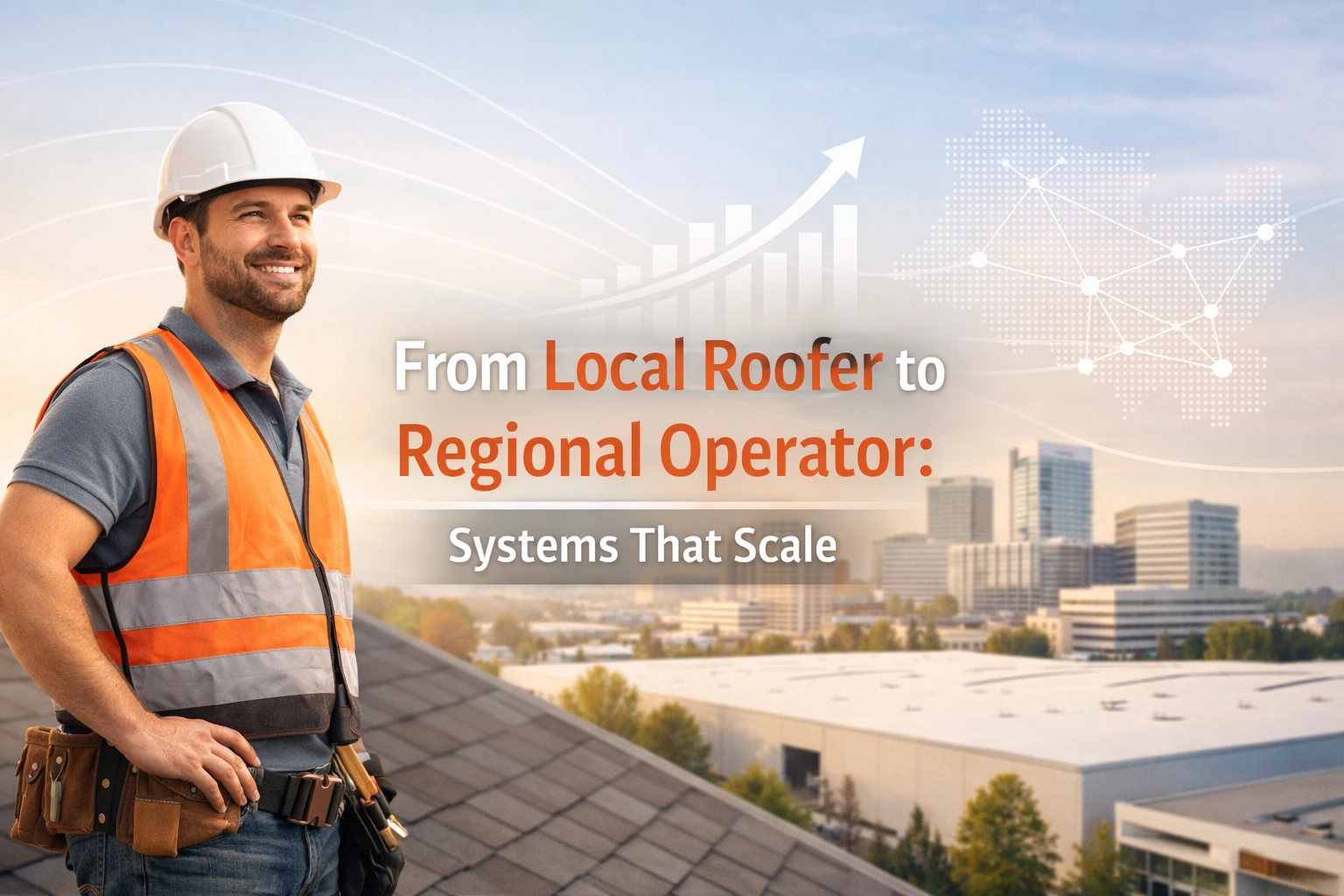
- From Local Roofer to Regional Operator: The Systems That Make It Possible
- Why Most Roofing Companies Fail When Opening a Second Market
- How to Scale a Roofing Company Across Counties Without Losing Control
- How to Document Roofing Business Processes for Multi-Location Growth
- Roofing SOPs Every Regional Operator Needs
- How to Standardize Roofing Production Across Multiple Crews and Markets
- Extracting Founder Tribal Knowledge: 5 Steps to Scale
- The Roofing Operations Manual for Companies Ready to Scale
- Roofing Project Management Software Systems for Regional Companies
- Why Roofing Companies Need a Centralized CRM Before They Expand
- How to Build a Roofing Data System That Supports Multi-Market Growth
- The Single Source of Truth Every Growing Roofing Company Needs
- How Roofing Dashboards Help Operators Control Multiple Territories
- Roofing Company Operational Cost Management Across Multiple Markets
- Why Roofing Companies Cannot Scale Without Better Job Costing
- How to Protect Profit Margins During Roofing Expansion
- Roofing Territory Profit Tracking: Which Markets Actually Make Money?
- Why Revenue Growth Means Nothing Without Regional Financial Visibility
- The Roofing Recruitment Engine: How Regional Operators Build Talent Pipelines
- How to Train Roofing Teams to Follow the Same Standards Everywhere
- Why Roofing Companies Need Better Onboarding Before They Grow
- The Leadership Structure Regional Roofing Companies Need
- How to Build a Roofing Team That Does Not Depend on the Owner
- Roofing Reporting Systems That Keep Multi-Crew Companies Aligned
- How Daily Huddles and Weekly Reviews Improve Roofing Operations
- The Roofing RACI Matrix for Multi-Location Businesses
- How to Build Accountability Into Regional Roofing Operations
- Why Parking-Lot Management Fails Growing Roofing Companies
- The Founder Bottleneck in Roofing: Why Expansion Breaks Owner-Led Companies
- How a Fractional COO Helps Roofing Companies Scale Regionally
- Why Roofing Owners Cannot Outwork a Broken Operating System
- The Shift From Roofer to Operator: What Has to Change
- How to Grow a Roofing Company Without Becoming the Full-Time Firefighter