5 Expert Tips for Scaling Service Quality
You just landed three new high-ticket clients and instead of celebrating you are terrified because you know the current team is already at their limit and the next project is going to be the one where the wheels finally fall off.
Let me be direct. Most service businesses fail at the $50K to $100K per month mark because they try to grow by working harder rather than by scaling service quality through systems. Here is what nobody tells you: your current success is likely built on your personal heroics. You are the one who double-checks every email. You are the one who catches the mistakes before they reach the client. You are the one who solves the technical fires. That does not scale. If you want to grow without watching your reputation tank, you need a different approach.
I have seen this pattern dozens of times. A business grows, the founder gets stretched thin, and suddenly the five-star reviews turn into three-star complaints about communication and missed deadlines. The reality is that scaling service quality requires moving from a person-dependent model to a process-dependent model. You cannot just hire your way out of this. In fact, hiring more people into a broken system just creates a more expensive broken system.
In the next 12 weeks, you could have a business that runs predictably whether you are in the office or on vacation. But first, you have to understand the mechanics of scaling service quality as your volume increases.
Why Scaling Service Quality Feels Impossible After $50K Per Month
The pattern is predictable. When you were at $20K per month, you could see everything. You knew every client by name. You knew every job status. As you grow, that visibility vanishes. You start hearing about problems three days after they happen. This is the point where most founders get stuck. They try to micromanage, which leads to burnout, or they step back and watch the quality drop.
The truth: scaling service quality is not about you being more involved. It is about you being less involved in the day-to-day and more involved in the system design.
What it looks like:
- Client emails going unanswered for 24 hours.
- Technicians arriving at jobs without the right parts.
- Invoices being sent out with errors.
- The same mistake happening three times in one month.
Why it happens:
- Lack of centralized communication.
- No documented standards for “done.”
- Decisions are made based on “vibes” rather than data.
- Over-reliance on “A-players” who are now overworked.
How to handle it:
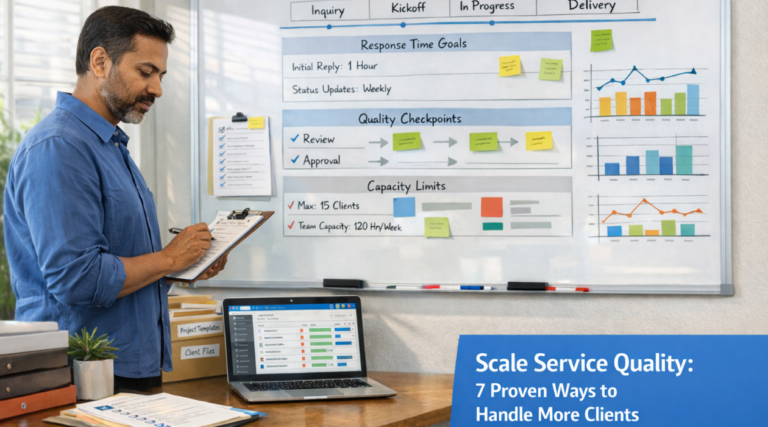
You must implement a rigid operational framework that protects the client experience. This starts with scaling service quality through intentional documentation and specialized roles.

Tip 1: Document Your Non-Negotiables for Scaling Service Quality
You might think your team knows what a good job looks like. They do not. Everyone has a different definition of quality. If you do not define it, you cannot expect them to hit it. Scaling service quality starts with a 68-page operations manual that outlines every touchpoint. This is not just a list of tasks. It is a standard of excellence.
The reality: if it is not written down, it does not exist. You are currently holding the “standard” in your head. When you hire someone new, you give them a “ride-along” and hope they absorb your brain by osmosis. They won’t.
What you provide:
- A clear definition of a “Perfect Visit” or “Perfect Project.”
- Checklists that must be completed and uploaded before a job is marked closed.
- A standardized communication cadence (e.g., “We update the client every Tuesday at 10 AM regardless of progress”).
Goal: To ensure that every client receives the same level of service regardless of which technician or project manager is assigned to the account.
When you focus on scaling service quality through documentation, you reduce the “re-work” that eats your margins. I have found that businesses without documented standards spend roughly 15-20% of their labor costs on fixing mistakes that should have never happened. That is $3,000 to $8,000 a month in pure waste.
Tip 2: Build Specialized Roles to Protect Standards
One of the biggest mistakes I see is the “Generalist Trap.” You have a technician who also does sales, handles their own scheduling, and follows up on payments. As you scale, this person becomes a bottleneck. They are too busy doing “admin” to focus on the technical work that requires high quality.
To succeed at scaling service quality, you must narrow the focus of your team members.
The logic:
Specialization breeds expertise. Expertise breeds quality. When a person only has to worry about one part of the process, they can master it. This is how you maintain high standards while adding more clients.
The pattern:
- $50K/month: Everyone does everything.
- $100K/month: You hire a dedicated Dispatcher or Project Coordinator.
- $250K/month: You have a dedicated Quality Assurance (QA) role.
By separating the “doing” from the “managing,” you ensure that someone is always watching the quality. Scaling service quality requires a second set of eyes. If the person doing the work is also the one checking the work, things will get missed. They are too close to it.

Tip 3: Automate the Routine to Humanize the Complex
Automation is not about replacing people. It is about freeing your people to do the high-value work that maintains your reputation. When you are scaling service quality, you need your team focused on the complex problems, not on sending “we are on our way” texts manually.
Red flags you are not ready for this:
- Your team spends more than 2 hours a day on data entry.
- Clients have to call to ask for status updates.
- You are using three different apps that do not talk to each other.
The honest answer: you are probably suffering from “Administrative Burden.” This is where the cost of managing the work starts to outweigh the profit from the work itself. By implementing a project management system like those found at https://clarityopsengine.com/project-management-systems, you can automate the status updates and reminders. This ensures scaling service quality stays consistent without adding more headcount.
What you won’t have:
- Forgotten follow-ups.
- Missed appointment windows.
- Inconsistent client onboarding.
Tip 4: Measure What Actually Matters (KPIs)
You cannot manage what you do not measure. If you are serious about scaling service quality, you need a dashboard that tells you the truth, not just your bank balance. Most contractors look at revenue and think they are doing great. Then they realize their callback rate is 15% and they are losing all their profit to warranty work.
Success metrics for scaling service quality:
- Callback Rate: How many jobs require a second visit to fix an error?
- First Contact Resolution: How often is the problem solved on the first call?
- Client Satisfaction Score (CSAT): Are they actually happy, or just quiet?
- Revenue Per Tech: Is quality dropping because you are overworking your team?
Check out how we look at metrics like https://clarityopsengine.com/true-billable-hours to see the difference between “busy” and “productive.” If your team is too busy to follow the SOPs, your scaling service quality efforts will fail. You must manage team capacity. The math is simple: if your team is at 95% capacity, quality will drop. You need to aim for 70-80% capacity to allow for the unexpected fires that always happen in service businesses.

Tip 5: The Feedback Loop for Scaling Service Quality
Scaling is not a “set it and forget it” activity. It is a constant cycle of monitoring and adjusting. You need a formal feedback loop where the field team can tell the office what is breaking, and the office can tell the field team where the client complaints are coming from.
The reality check: your team knows where the systems are breaking. They just might not be telling you because they don’t think you will do anything about it.
How to build the loop:
- Weekly Operations Meeting: Focus on “What went wrong this week?” and “How do we stop it from happening again?”
- Post-Project Debriefs: For every job over $10K, have a 15-minute meeting to discuss the quality markers.
- Client Surveys: Automate a survey 24 hours after every job.
Scaling service quality is about identifying the “Operational Debt” you are accruing. Operational debt is the shortcuts you take today that you will have to pay for with interest tomorrow. If you skip the documentation now, you will pay for it with a lost client next month.
Moving From Founder-Led to System-Led Quality
At some point, you have to decide if you want to be a technician or a business owner. A technician does the work. A business owner builds the system that does the work. Scaling service quality is the primary job of the business owner.
Here is the logic:
If you are the only one who can ensure quality, you don’t have a business. You have a high-paying job that you can never leave. To scale past $100K per month, you must extract the processes you do on autopilot and put them into a framework like https://clarityopsengine.com/raci-the-accountability-framework. This assigns clear accountability so everyone knows who is responsible for scaling service quality at every stage of the project.

Common Mistakes in Scaling Service Quality
I have seen these errors lead to business failure:
- Hiring a “manager” to fix the problem without giving them a system to manage.
- Buying expensive software and expecting it to solve the quality issues (software only amplifies what is already there).
- Focusing on “Speed” over “Accuracy.”
- Ignoring the “Loaded Labor Rate” which you can learn more about at https://clarityopsengine.com/job-costing-for-electrical-contractors.
If you do not know your numbers, you will try to solve quality issues by throwing money at them. That is how you end up with a $2M business that makes $0 in profit. Scaling service quality must be profitable. It should reduce your costs by eliminating waste, not increase them through unnecessary overhead.
The First 90 Days of Systemizing Quality
If you decide today to focus on scaling service quality, here is what the next three months look like.
Phase 1: Week 1-4 (The Audit)
You track every mistake, every callback, and every client complaint. You look for patterns. You realize that 80% of your quality issues come from 20% of your processes. You start documenting those first.
Phase 2: Week 5-8 (The Implementation)
You roll out the new SOPs. You train the team. You get pushback. This is normal. People hate change. You hold the line. You show them how scaling service quality makes their jobs easier because they have fewer angry clients to deal with.
Phase 3: Week 9-12 (The Optimization)
You look at the data. Your callback rate starts to drop. Your revenue per tech starts to stabilize. You are no longer the bottleneck. You have successfully moved toward scaling service quality as a permanent part of your company culture.
How Clarity Ops Engine Fixes the Quality Gap
You can try to do this yourself. You can spend the next 18 months trial-and-erroring your way through system design. Or you can use a proven framework. At Clarity Ops Engine, we specialize in the “Fractional COO” model. We don’t just give you a report and walk away. We get into the guts of your business and build the systems for scaling service quality with you.
What we do:
- We conduct a Technology Audit to kill the tools that are slowing you down.
- We build your RACI matrix so accountability is clear.
- We help you move from “Hero” to “System.”
- We implement the project management structures found at https://clarityopsengine.com/business-operations-strategy.
The reality is that you are probably too busy running the business to build the systems for the business. That is where we come in. We provide the operational “engine” so you can focus on the vision. Scaling service quality is the core of what we do for our clients.

Is Your Business Ready for Scaling Service Quality?
Prerequisites for this transformation:
- You must be doing at least $50K in monthly revenue.
- You must be willing to let go of “how things have always been done.”
- You must be committed to the long-term health of the business over short-term ego.
If you are tired of the chaos and ready to build a business that can actually grow without you, let’s talk. You can book a 30-minute strategy session directly on my calendar here: https://calendly.com/sdrobinson8/30min.
We will look at your current bottlenecks and determine if scaling service quality is the missing piece of your puzzle. Don’t wait until a major client leaves or your best technician quits. The best time to build the system was six months ago. The second best time is today.
Success Metrics After Scaling Service Quality
When you get this right, the results are tangible. I have seen clients go from 60-hour weeks of pure stress to 40-hour weeks of strategic growth.
The math:
Scenario A (The Chaos Model):
- 10 Clients
- 3 Callbacks
- $2,000 in lost profit
- 15 hours of founder time spent on “fixing”
Scenario B (The Scaling Service Quality Model):
- 20 Clients
- 1 Callback
- $400 in lost profit
- 2 hours of founder time spent on “monitoring”
Which business would you rather own? The one that breaks when you grow, or the one that gets stronger? Scaling service quality is the only way to achieve Scenario B. It requires discipline, but the ROI is infinite because it allows you to finally step out of the day-to-day operations.
Final Thoughts on Scaling Service Quality
Look, I know it feels overwhelming. You have a mountain of work and I am telling you to add “system building” to your plate. But the truth is, you are already doing the work. You are just doing it in the most inefficient way possible: by repeating yourself every single day.
By focusing on scaling service quality, you are choosing to do the work once. You document the process once. You build the automation once. You set the KPI once. Then the system works for you.
The pattern of growth is clear. You can stay stuck at your current revenue, constantly fighting fires, or you can commit to scaling service quality and finally see what your business is capable of.
The logic is simple. The implementation is hard. That is why we are here. Whether it is through a business systems consultant at https://clarityopsengine.com/business-systems-consultant or a full Fractional COO engagement, we can help you bridge the gap.
Ready to stop being the bottleneck? Book your 30-minute session here: https://calendly.com/sdrobinson8/30min.
Let’s get to work on scaling service quality for your business.
Related Blogs
- Scaling Operations: Hero Operator vs System
- Operational Efficiency for Callback Costs
- The Accountability Framework: RACI Explained
- Why Your Business Can’t Scale Without You
- Scaling Operations: Hero Operator vs System Builder
- Why Your Business Can’t Scale Without You (And How to Fix It)
- Operational Drag Reduction: 7 Brutal Ways Debt Destroys Teams
- The 12-Week Operations Reset for Service Companies
- Founder Bottlenecks: The Real Reason Quality Drops After Growth
- Callback Costs: The Silent Profit Killer in Service Businesses
- How to Calculate the True Cost of a Callback
- True Billable Hours vs Busy Work: What Actually Drives Quality
- Revenue Per Technician: The KPI That Predicts Burnout
- Why 95% Capacity Destroys Service Quality
- How to Write a “Perfect Visit” SOP for Field Service Teams
- The 68-Page Operations Manual: What Should Actually Be Inside
- The Difference Between Checklists and Real Systems
- Process Before People: Why Hiring Won’t Fix Your Chaos
- The 20% of Processes Causing 80% of Your Quality Problems
- The Generalist Trap: Why Everyone Doing Everything Fails at Scale
- When to Hire a Dispatcher, Project Manager, or QA Lead
- The RACI Framework Explained for Service Businesses
- Accountability vs Responsibility: Why Your Team Is Confused
- Building a QA Role Before You “Think” You Need One
- Technology Audit: Are Your Tools Helping or Hurting Service Quality?
- Automate the Routine, Humanize the Complex
- The Administrative Burden Tax in Growing Companies
- Why Software Doesn’t Fix Broken Systems
- Centralized Communication Systems for Service Teams
- Scaling from $50K to $250K per Month Without Losing Your Reputation
- The Profit-Quality Balance: How to Improve Both at the Same Time
- Service Quality Benchmarks by Revenue Stage
- The 90-Day Systemization Plan for Service Businesses
- From Chaos to Predictable Growth: The Fractional COO Playbook