4-Tier Emergency Triage Framework: Stop Your Chaos
You are staring at a dispatch board that looks like a game of Tetris played by someone who hates you. Your phone is ringing off the hook with same-day service requests and your best technician just texted to say he is three hours behind because a simple fix turned into a nightmare. You know you are losing money every time a high-value emergency call gets pushed to tomorrow while a tech spends four hours on a routine tune-up that could have waited. The stress is not just yours. It is vibrating through your dispatcher and burning out your field crew.
Let me be direct. If your dispatching strategy is still “first come, first served,” you are not running a business. You are running a charity for the loudest customers. You need a system that removes the emotion from the schedule and replaces it with logic. The solution is the 4-Tier Emergency Triage Framework for Field Service.
I have seen this pattern dozens of times in service businesses doing $50K to $100K a month. You feel like you have to say yes to everyone because you are afraid of losing a lead. The reality is that by saying yes to the wrong same-day service requests, you are actually saying no to your profitability and your sanity.
Here is what nobody tells you. You do not need more technicians to solve your scheduling nightmare. You need better dispatcher scheduling SOPs that allow your team to make split-second decisions without calling you for permission. You can implement the 4-Tier Emergency Triage Framework for Field Service in your business starting tomorrow. Within 30 days, your “emergency” stress levels will drop by half.
Why Your Current Dispatching Is Bleeding Money
The pattern is always the same. A customer calls at 10:00 AM with a broken AC unit. They are frustrated. Your dispatcher looks at the schedule and sees a 2:00 PM slot. They slot the customer in. Then, at 11:00 AM, a commercial client calls because their server room cooling system is down. This is a $5,000 emergency. But your dispatcher says, “Sorry, we are fully booked today.”
This is a failure of HVAC dispatch optimization. You just traded a high-margin, high-priority emergency for a standard residential repair. When you do not use the 4-Tier Emergency Triage Framework for Field Service, you lose control of your revenue.
The reality: Your dispatcher is currently acting as a secretary, not a strategist. Without a 4-Tier Emergency Triage Framework for Field Service, they have no authority to move jobs around. They are stuck in a rigid calendar that does not account for the volatility of field service.
What happens:
- Technicians get sent to non-urgent jobs while “true” emergencies go to your competitors.
- High-value clients feel ignored because you do not have a “Fast Track” for their needs.
- Your profit margins shrink because you are not prioritizing the jobs with the highest urgency and highest price points.
- Stress levels skyrocket because every call feels like a fire that needs to be put out.
The 4-Tier Emergency Triage Framework for Field Service changes the conversation. It creates a hierarchy of needs. It allows for HVAC dispatch optimization that actually makes sense for the bottom line. This is the core of what we do during The Clarity Transformation. We stop the bleeding by installing systems that make the “right” decision the “easy” decision.

The 4-Tier Emergency Triage Framework for Field Service Explained
To fix your schedule, you have to categorize every call before it touches the calendar. You cannot treat a leaking water heater the same way you treat a squeaky faucet. You need to train your team on the 4-Tier Emergency Triage Framework for Field Service. This framework is the backbone of all effective dispatcher scheduling SOPs.
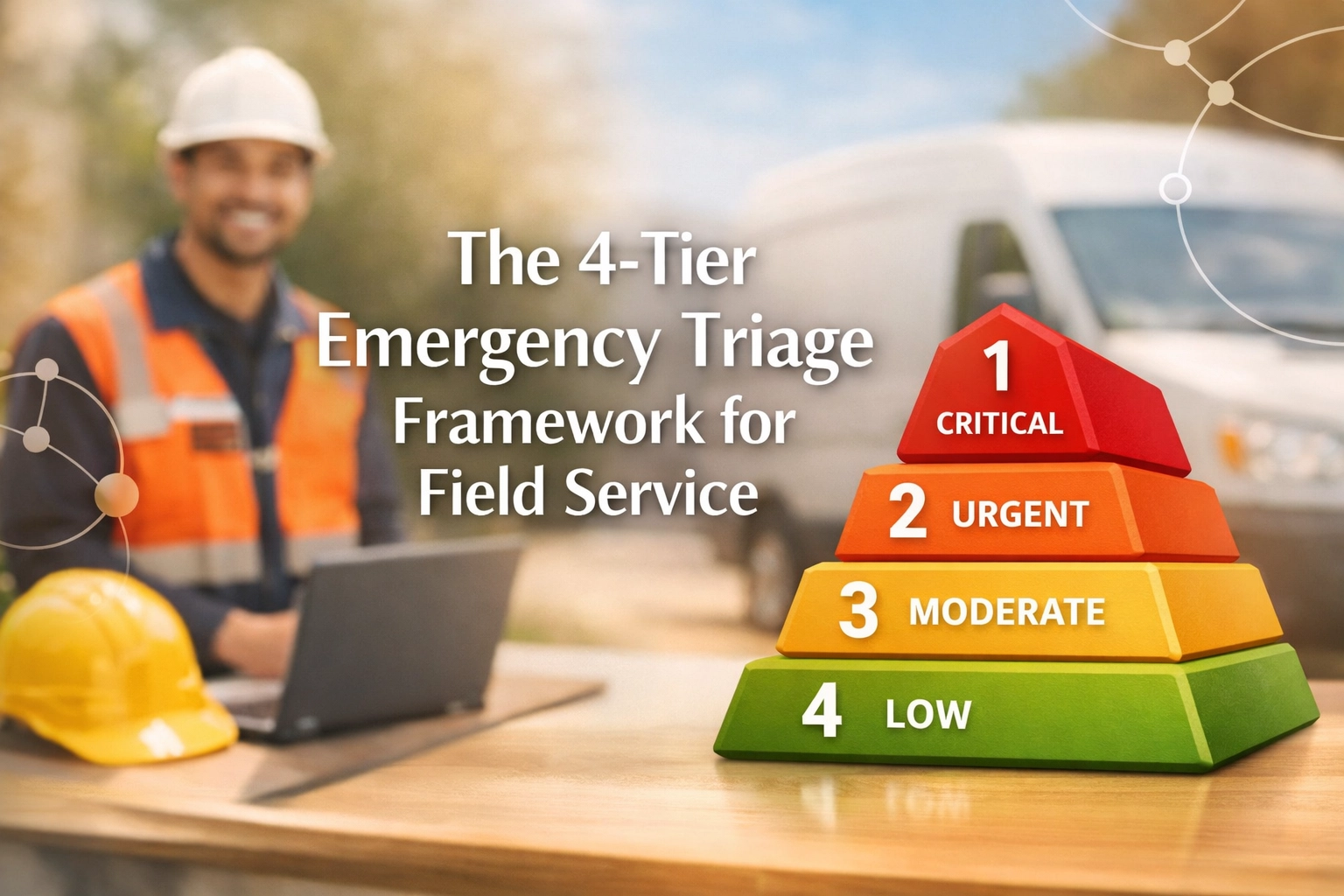
Tier 1: Red (Immediate Life and Safety)
This tier is for situations that involve immediate danger to people or property. Think gas leaks, electrical sparking, or a total HVAC failure in a nursing home during a 100-degree heatwave.
The logic: These are not just same-day service requests. These are “drop everything and go” requests. You must have a provision in your dispatcher scheduling SOPs that allows for Tier 1 calls to bump any Tier 3 or Tier 4 job immediately.
What you provide: A technician on-site within 2 to 4 hours, no exceptions. You charge a premium “Emergency Response Fee” for this tier. Using the 4-Tier Emergency Triage Framework for Field Service ensures these high-stakes jobs are handled first.
Tier 2: Orange (High Priority and High Hardship)
Tier 2 calls are for customers who have a total system failure but are not in immediate physical danger. A family with small children and no heat in 40-degree weather is a Tier 2. A commercial kitchen with a failing walk-in cooler is a Tier 2.
The goal of HVAC dispatch optimization is to clear the way for these high-value repairs. These customers are willing to pay for speed. If you do not have the 4-Tier Emergency Triage Framework for Field Service in place, these people will call the next company on Google.
The reality: Your dispatcher scheduling SOPs should reserve “flex slots” specifically for Tier 2 same-day service requests. If you fill your board 100 percent with routine maintenance, you leave no room for the high-margin Tier 2 emergencies.
Tier 3: Yellow (Standard Service and Partial Failure)
This is your “bread and butter” work. The system is working, but not well. Or, one zone of a house is down, but the rest is fine. These are not true same-day service requests, though the customer might wish they were.
Success metrics for Tier 3: Scheduling within 24 to 48 hours. These jobs provide the steady volume that keeps your crews busy, but they should never stand in the way of a Tier 1 or Tier 2 emergency. When you follow the 4-Tier Emergency Triage Framework for Field Service, you explain to these customers that they are on the “Standard Priority” list.
Tier 4: Blue (Routine Maintenance and Estimates)
These are the lowest priority. Tune-ups, filter changes, and non-urgent estimates. These jobs are the most flexible.
In a proper Clarity Operational Partnership, we teach owners to use Tier 4 jobs as “filler.” If an emergency comes in, Tier 4 is the first thing to be rescheduled. Your dispatcher scheduling SOPs must include scripts for calling these customers and moving their appointments without making them feel undervalued.
The 4-Tier Emergency Triage Framework for Field Service is not just about moving boxes on a screen. It is about protecting your technicians from being spread too thin. It is about ensuring that HVAC dispatch optimization actually serves the business goals.

Implementing Dispatcher Scheduling SOPs Without a Mutiny
You might think your dispatcher will resist this. You might think your customers will be angry if they get moved. The honest answer: They are already angry because you are constantly late and over-promised.
When you implement the 4-Tier Emergency Triage Framework for Field Service, you are giving your team a shield. Instead of saying, “I do not know if we can fit you in,” they can say, “Based on our 4-Tier Emergency Triage Framework for Field Service, we have you at a Tier 3 priority. We can be there tomorrow morning. Or, if you want to upgrade to a Tier 2 Priority for an emergency fee, we can be there this afternoon.”
This is how you handle same-day service requests with professionalism instead of panic.
The steps to roll out these dispatcher scheduling SOPs are:
- Define the Tiers: Use the 4-Tier Emergency Triage Framework for Field Service to define exactly what qualifies for each level.
- Script the Conversations: Give your dispatcher the exact words to use for each tier.
- Set the Pricing: Tier 1 and Tier 2 must have higher dispatch fees. This filters out the people who are not actually in an emergency but are just impatient.
- Build Flex Time: Never book your technicians to 100 percent capacity with Tier 4 work. Leave 15 to 20 percent of the day open for the 4-Tier Emergency Triage Framework for Field Service to function.
This is a key component of a Clarity Operational Partnership. We do not just give you a PDF and walk away. We help you train the dispatcher and monitor the results. We look for HVAC dispatch optimization opportunities that your competitors are missing because they are too busy “fighting fires.”
What you won’t have: A dispatcher crying in the break room because three different customers are screaming at them at once. The framework provides the answer for them.
Goal: To move from a “reactive” dispatching model to a “strategic” one using the 4-Tier Emergency Triage Framework for Field Service.

HVAC Dispatch Optimization: Moving From Reactive to Proactive
Most HVAC owners are stuck in the “Reactive” phase. A call comes in, you react. A tech gets stuck, you react. The 4-Tier Emergency Triage Framework for Field Service is the first step toward becoming “Proactive.”
Proactive HVAC dispatch optimization means you are looking at the weather forecast and the historical data to predict when the same-day service requests will spike. You use the 4-Tier Emergency Triage Framework for Field Service to clear the deck before the heatwave hits.
The math: If your average Tier 4 tune-up is $150 and your average Tier 2 emergency repair is $850, every time you choose a Tier 4 over a Tier 2, you are losing $700. If that happens three times a week, you are losing over $100,000 a year.
Can you implement the 4-Tier Emergency Triage Framework for Field Service yourself? Yes. But most owners struggle because they are too close to the daily chaos. They lack the objective perspective to build the dispatcher scheduling SOPs that stick. That is why The Clarity Transformation is designed to take the heavy lifting off your plate.
Common findings: Owners who try to DIY this often cave the first time a “long-time customer” calls with a Tier 4 request and demands Tier 1 service. Without a Clarity Operational Partnership, there is no one to hold the line and remind you that your system exists for a reason.
Success metrics for HVAC dispatch optimization:
- Response time for Tier 1 calls under 3 hours.
- Emergency fee capture rate over 90 percent.
- Technician billable hours increased by 15 percent.
- Customer satisfaction scores (NPS) remaining stable even during peak season.
The 4-Tier Emergency Triage Framework for Field Service is the only way to scale without adding massive amounts of overhead. It allows you to do more with the team you already have.

How The Clarity Transformation Fixes Your Operations
Operational chaos is not a personality trait. It is a lack of systems. When we work with clients through The Clarity Transformation, we look at the entire lifecycle of a job. Dispatching is often the biggest bottleneck.
We start with an audit of your current same-day service requests and how they are handled. We usually find that 30 to 40 percent of the “emergencies” are actually Tier 3 or Tier 4 issues that the dispatcher was bullied into scheduling early.
By installing the 4-Tier Emergency Triage Framework for Field Service, we create a clear path for growth. We build out the dispatcher scheduling SOPs that allow you to step back. You should not have to be the one deciding who gets the 2:00 PM slot.
The logic: If you are the one making dispatching decisions, you are the bottleneck. A Clarity Operational Partnership focuses on removing you from the day-to-day “triage” so you can focus on high-level strategy and growth.
Timeline for implementation:
- Week 1 to 2: Audit current dispatching and define the 4-Tier Emergency Triage Framework for Field Service categories.
- Week 3 to 4: Create and test dispatcher scheduling SOPs and scripts.
- Week 5 to 8: Train the team and implement the pricing changes for Tier 1 and Tier 2.
- Week 9 to 12: Refine HVAC dispatch optimization based on real-world data and tech feedback.
The reality check: If you are not willing to say “no” or “not right now” to a Tier 4 customer, the 4-Tier Emergency Triage Framework for Field Service will not work. You have to be committed to the system to see the profit.

FAQ: Frequently Asked Questions About the 4-Tier Emergency Triage Framework for Field Service
What if a Tier 4 customer gets angry because they are rescheduled?
This is why scripts are vital. You do not just “cancel” them. You explain that your company prioritizes life and safety emergencies, and today you have a Tier 1 situation. Most reasonable people understand “safety.” For those who do not, you have to decide if a $150 customer who demands $1,000 worth of attention is a customer you actually want to keep.
How do I decide the pricing for Tier 1 and Tier 2 same-day service requests?
Look at your competitors, then look at your “fully loaded” labor rate. Tier 1 should be at least 2x your standard dispatch fee. Tier 2 should be at least 1.5x. This ensures the 4-Tier Emergency Triage Framework for Field Service also acts as a profit engine, not just a scheduling tool.
Can this framework work for plumbing or electrical too?
Absolutely. While we focus on HVAC dispatch optimization, the logic applies to any trade. A Tier 1 plumbing call is a major leak flooding a house. A Tier 1 electrical call is a burning smell from the panel. The 4-Tier Emergency Triage Framework for Field Service is universal for field service.
Does the 4-Tier Emergency Triage Framework for Field Service require special software?
No. You can implement this in ServiceTitan, Housecall Pro, or even a paper calendar if you have to. It is a logic framework, not a software feature. However, most modern Field Service Management (FSM) software allows you to “tag” jobs by priority, which makes the 4-Tier Emergency Triage Framework for Field Service even easier to manage visually.
How do we handle the “VIP” customer who is technically a Tier 4?
In your dispatcher scheduling SOPs, you can create a “VIP Clause.” If a customer spends more than a certain amount with you annually, they might automatically jump from Tier 4 to Tier 3. But Tier 1 and Tier 2 safety/hardship issues should still take priority for the sake of liability and ethics.
Stop the Scheduling Chaos Today
The path to a $100K+ month business is not paved with more hard work. It is paved with better systems. The 4-Tier Emergency Triage Framework for Field Service is a foundational system that protects your time, your team, and your profits.
You have two choices. You can keep letting your schedule be dictated by whoever calls the most times in an hour. Or, you can take control with the 4-Tier Emergency Triage Framework for Field Service.
If you are tired of the constant “firefighting” and want to see how The Clarity Transformation can install this system for you, let’s talk. We specialize in taking the operational burden off your shoulders so you can actually enjoy the business you built.
Stop the chaos and book your 30-minute Clarity Consultation here
Look, your business will either run on your adrenaline or it will run on your systems. Adrenaline runs out. Systems don’t. The 4-Tier Emergency Triage Framework for Field Service is the system you need right now to handle same-day service requests and achieve true HVAC dispatch optimization.
Ready for a change? Let’s build your Clarity Operational Partnership and get your dispatching under control once and for all.
Related Blogs
- The Foreman Playbook: Standardizing Execution Across Crews
- How to Document Your First Business Process in 60 Minutes
- Operational Leadership Without a $200K Salary
- Scaling Past $100K a Month: The Operational Hurdles