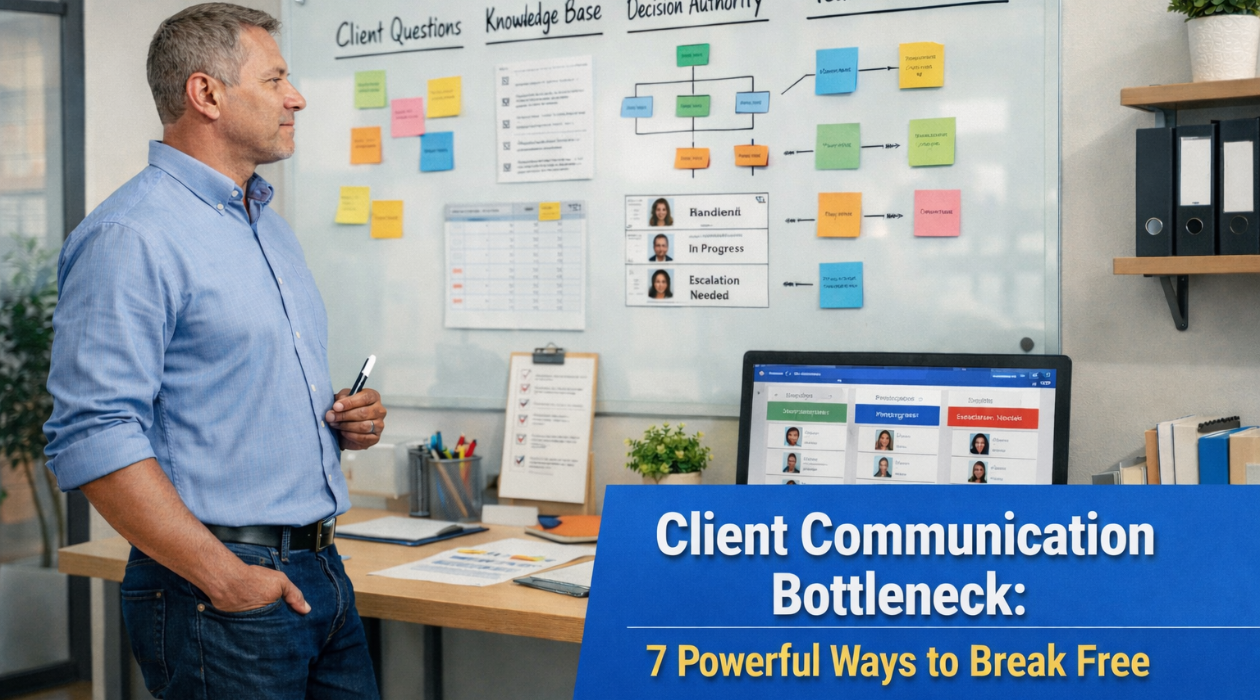
Client Communication Bottleneck: 7 Powerful Ways to Break Free
You’re in back-to-back meetings, but your phone won’t stop buzzing. Three team members need answers for three different clients. Right now.
This is the client communication bottleneck in action. You’ve built a successful B2B company, hired good people, but somehow you’re still the only person who can answer client questions. Your team forwards emails to you. They interrupt your lunch. They apologize for bothering you, then ask anyway.
The client communication bottleneck doesn’t just waste your time. It caps your revenue at whatever you personally can handle. It frustrates clients who wait for responses. It demoralizes your team who feel incapable.
Here’s what most business owners don’t realize: This isn’t a people problem. It’s a systems problem. And systems problems have systematic solutions for the client communication bottleneck.
Why the Client Communication Bottleneck Happens (And Why It’s Not Your Fault)
The client communication bottleneck exists in nearly every B2B company between $20K and $100K monthly revenue. You’re not alone, and you didn’t create this problem through incompetence.
You created it through success.
When you started, being the answer person made sense. You knew the product. You understood client needs. You could pivot quickly. Direct client communication built relationships and revealed product insights.
But that scrappy startup advantage becomes a scaling liability. Now you’re trapped in what operations experts call “founder dependency syndrome,” and the client communication bottleneck is choking your growth.
The Hidden Costs You’re Already Paying
- Revenue ceiling: You can only serve as many clients as you can personally support
- Team infantilization: Employees never develop expertise because you’re always the expert
- Client frustration: Response times stretch when you’re the single point of failure
- Strategic time theft: Hours spent answering questions steal time from business development
- Burnout trajectory: The bottleneck intensifies as you grow, not diminishes
Clarity Engine Ops works with B2B companies experiencing this exact client communication bottleneck. The pattern is universal: capable team, growing client base, founder drowning in “quick questions” that consume entire days.
The solution isn’t working harder or hiring faster. It’s building systems that transfer knowledge from your head into your team’s hands.
System 1: Create a Client Knowledge Base (Not Just FAQ Documents)
Most business owners think documentation means creating FAQ documents. Wrong.
A real knowledge base for the client communication bottleneck is a living, searchable system your team actually uses. Not a shared drive where Word documents go to die.
What to Document First
Don’t try to document everything. Start with the questions you answered in the last two weeks:
- Common technical questions (How does X feature work? Can we integrate with Y?)
- Process questions (What’s the timeline? Who do I contact about Z?)
- Scope questions (Is this included? Do we offer that service?)
- Problem-solving frameworks (When clients experience A, here’s how we troubleshoot)
- Pricing and proposal logic (How we calculate quotes, what variables matter)
The format matters more than the content. Use searchable tools like Notion, Confluence, or even a well-organized Google Doc with a table of contents. Your team needs to find answers in 30 seconds, not 30 minutes.
The “Answer Once, Document Twice” Rule
Every time you answer a client question, ask yourself: “Will someone ask this again?”
If yes, document it immediately. Not later. Not when you have time. Right then.
This is where most client communication bottleneck solutions fail. Business owners recognize the problem, plan to document, then get busy and never do it. The bottleneck persists.
When Clarity Engine Ops implements knowledge transfer systems, we build documentation directly into your workflow. Not as extra work, but as part of how you already answer questions. You respond to the client, then your system automatically prompts documentation.
System 2: Implement Decision-Making Authority Levels
Your team forwards every client question to you because they don’t know which decisions they can make independently.
Create explicit authority levels. Written down. Shared with everyone.
Sample Authority Framework
Level 1 – Team Member Decides Independently:
- Standard service delivery questions
- Routine scheduling changes
- Information already in knowledge base
- Problems with documented solutions
Level 2 – Team Member Decides, Then Notifies You:
- Minor scope adjustments (under $500 or 5 hours)
- Timeline extensions (under 1 week)
- Resource allocation within approved budget
- Standard process exceptions
Level 3 – Team Member Proposes, You Approve:
- Pricing for non-standard requests
- Significant scope changes
- New service offerings
- Client escalations requiring relationship management
Level 4 – You Decide:
- Strategic account decisions
- Major contract negotiations
- New market or service launches
- Situations with significant financial or reputational risk
This framework eliminates 60-70% of the client communication bottleneck immediately. Not because your team suddenly knows more, but because they know what they’re allowed to decide.
Clarity Engine Ops creates customized decision authority matrices for each client based on their specific service model, risk tolerance, and team experience levels. Cookie-cutter frameworks don’t work. Your authority levels need to match your actual business.
System 3: Train Your Team on Client Communication (Not Just Product Knowledge)
Here’s the mistake: You train people on what you do, not how you communicate about what you do.
Product knowledge doesn’t break the client communication bottleneck. Communication confidence does.
What Effective Client Communication Training Covers
Tone and relationship management:
- How formal or casual to be with different client types
- When to escalate vs. when to handle directly
- How to deliver bad news or difficult information
- Your brand voice in client interactions
Problem-solving frameworks:
- How you diagnose client issues (not just solutions, but your diagnostic process)
- Questions to ask before proposing solutions
- When to offer workarounds vs. when to fix root causes
- How to handle requests outside scope
Communication templates:
- Email structures for common scenarios
- Phone script frameworks (not scripts, frameworks)
- Slack/Teams response patterns
- Meeting agenda templates
Your team isn’t incompetent. They’re uncertain. Uncertainty creates the client communication bottleneck because uncertain people defer to the person who seems certain (you).
The Shadow-Document-Practice Method
Have team members shadow you during client interactions for one week. They don’t participate, they just observe and take notes.
Week two, they document what they observed. What questions did clients ask? How did you respond? What was your decision-making process?
Week three, they handle client questions while you observe. You provide real-time coaching.
Week four, they’re independent with scheduled check-ins.
This method transfers tacit knowledge (the stuff in your head that you don’t even know you know). That’s the knowledge creating your client communication bottleneck.
System 4: Build Client Communication Channels That Don’t Route to You
If every client communication channel leads to your inbox, you’ll always have a client communication bottleneck.
Redesign the channels themselves.
Effective Channel Architecture
Shared team inbox for client questions:
- Tools like Front, Help Scout, or Zendesk
- Questions come to the team, not to you
- You can monitor without being the first responder
- Creates accountability and response time metrics
Project management tools with client access:
- Clients ask questions directly in project context
- Team members assigned to projects can respond
- You see questions but aren’t expected to answer
- Reduces email volume dramatically
Office hours or scheduled check-ins:
- Clients know when they can reach team members
- Reduces random interruptions
- Creates space for thoughtful responses
- Makes client communication predictable instead of chaotic
Client-facing knowledge base:
- Clients can self-serve common questions
- Reduces volume of questions to your team
- Shows clients you’re organized and professional
- Provides 24/7 support without human intervention
The goal isn’t to avoid clients. The goal is to create client communication paths that don’t require you personally.
Clarity Engine Ops implements client communication infrastructure as part of operational transformation programs. We don’t just recommend tools. We configure them, train your team, migrate your clients, and monitor adoption until the new channels become the default.
System 5: Create Standard Responses for Common Client Questions
You don’t need to craft unique responses to questions you’ve answered 47 times.
Standard responses aren’t impersonal. They’re efficient.
What Makes Standard Responses Actually Useful
Customization fields:
- Client name, project name, specific details
- Personalization without reinventing the wheel
- Takes 30 seconds instead of 15 minutes
Multiple versions for different contexts:
- Formal vs. casual tone
- New client vs. established relationship
- Simple version and detailed version
- Problem acknowledgment vs. solution only
Easy access:
- Text expander tools (TextExpander, aText, PhraseExpress)
- Email template libraries in Gmail or Outlook
- Shared response database in your knowledge base
- Slack saved responses or canned replies
The client communication bottleneck often persists because team members spend 20 minutes crafting the perfect email for a routine question. Standard responses give them permission to respond quickly and confidently.
The Questions You’re Definitely Answering Repeatedly
Track your sent emails for one week. You’ll find you’re answering the same 10-15 questions over and over:
- Timeline questions (When will this be done?)
- Process questions (What happens next?)
- Access questions (How do I log in / find / use X?)
- Scope questions (Is this included?)
- Change request questions (Can we modify / add / remove X?)
Create standard responses for each. Your team uses them. The client communication bottleneck shrinks immediately.
System 6: Implement Weekly Knowledge Transfer Sessions
One-time training doesn’t break the client communication bottleneck. Continuous knowledge transfer does.
Schedule weekly 30-minute sessions where you transfer specific knowledge to your team.
Effective Knowledge Transfer Session Structure
Week 1: Recent client questions review
- What questions came up this week?
- How were they handled?
- What could be improved?
- What new scenarios should be documented?
Week 2: Role-play difficult scenarios
- Upset client situations
- Scope creep conversations
- Pricing objections
- Technical problem troubleshooting
Week 3: Client communication case studies
- Real examples from your work
- What the client actually needed vs. what they asked for
- How you navigated the conversation
- Decision points and why you chose that path
Week 4: Team member presentations
- Someone from team teaches something they learned
- Reinforces knowledge and builds confidence
- Reveals gaps you didn’t know existed
- Creates culture of shared expertise
This creates a learning loop. Your team gets smarter. You answer fewer questions. The client communication bottleneck loosens week by week.
Clarity Engine Ops facilitates these knowledge transfer sessions during our Clarity Operational Partnership engagements. We’re not replacing you as the expert. We’re building the system that multiplies your expertise across your team.
System 7: Give Your Team Permission to Make Mistakes (With Guardrails)
The final piece of the client communication bottleneck puzzle: Your team doesn’t answer client questions because they’re afraid of screwing up.
That fear is probably justified. You haven’t explicitly given them permission to make mistakes.
The Mistake Budget Framework
Tell your team: “You each have a budget of [X] small mistakes per month. Use them to learn.”
What qualifies as a “small mistake”:
- Doesn’t cost more than $[amount] to fix
- Doesn’t violate client contract terms
- Doesn’t create legal or compliance issues
- Doesn’t damage your brand reputation
This gives team members psychological safety to try. To answer client questions even when they’re 80% confident instead of 100% confident.
The After-Action Review Process
When mistakes happen (and they will), conduct simple after-action reviews:
- What happened?
- What was the impact?
- What did we learn?
- What will we do differently?
- What needs to be documented?
No blame. No defensiveness. Just learning and system improvement.
The client communication bottleneck persists when team members are paralyzed by perfectionism. Permission to make bounded mistakes removes the paralysis.
At Clarity Engine Ops, we help clients establish mistake budgets and after-action review processes that build team confidence while protecting business interests. The goal is empowered employees who can handle clients independently, not dependent employees who need constant approval.
How Long Does It Take to Break the Client Communication Bottleneck?
You won’t fix this overnight. But you’ll see improvement immediately.
Week 1-2: Implement decision authority levels and start documentation. 20-30% reduction in questions.
Week 3-4: Deploy standard responses and train team on communication frameworks. 40-50% reduction.
Week 5-8: Restructure communication channels and establish knowledge transfer rhythm. 60-70% reduction.
Week 9-12: Refine systems based on what’s working. 70-80% reduction.
You’ll never eliminate every client question. Nor should you. Strategic client relationships require your involvement.
But breaking the client communication bottleneck means the difference between answering 50 questions per day and answering 5. Between spending 6 hours on client questions and 45 minutes.
That’s the difference between being trapped in operations and leading your business.
When DIY Isn’t Enough: Getting Expert Help
You can implement these systems yourself. Many business owners do.
But here’s what we see consistently: Business owners know what to do. They don’t have time to do it.
You’re already answering client questions all day. When exactly are you supposed to build knowledge bases, train team members, restructure communication channels, and facilitate weekly knowledge transfer sessions?
Clarity Engine Ops exists specifically to solve this problem. We implement these client communication bottleneck solutions for you while you keep running your business. Our Clarity Transformation program takes 12 weeks and delivers fully operational systems your team actually uses.
We don’t consult and disappear. We build, implement, train, and stay until your team is confident and capable.
For B2B companies generating $20K-$100K monthly revenue with 2-20 employees, fractional COO support makes the difference between knowing what to do and actually having it done.
Your Client Communication Bottleneck Breaking Action Plan
Start here:
This week:
- Track every client question that comes to you for 5 days
- Identify the 10 most common questions
- Create authority level framework (even if rough)
Next week:
- Document answers to those 10 common questions
- Share documentation with team
- Announce decision authority levels
Week 3:
- Create 3-5 standard response templates
- Train team on documentation and templates
- Schedule first weekly knowledge transfer session
Week 4:
- Implement one new communication channel (shared inbox or project management tool)
- Review what’s working and what needs adjustment
- Add 5 more questions to documentation
You don’t need perfect systems. You need functioning systems that remove you from the center of every client conversation.
The client communication bottleneck breaks one documented answer, one empowered decision, one confident team member at a time.
FAQ
How long does it take to train team members to answer client questions independently?
Most team members can handle 60-70% of client questions within 2-3 weeks of proper training and documentation. Full confidence typically takes 6-8 weeks of consistent practice with real client interactions.
What if my clients specifically request to work with me, not my team?
This is a positioning issue, not a capability issue. Set expectations upfront that clients work with a team. Introduce team members early and frame their involvement as added value, not substitution.
How do I document knowledge that’s in my head but hard to explain?
Use the “shadow-document-practice” method. Have team members observe you with clients, document what they see, then practice while you coach. Tacit knowledge transfers through observation and practice, not written manuals alone.
What if my team makes mistakes when answering client questions?
Mistakes are part of learning. Create a mistake budget system and after-action review process. Small, bounded mistakes are acceptable and necessary for team growth.
Should I review every client communication before my team sends it?
Only initially. Review for the first 2-3 weeks, then spot-check. If you review everything forever, you’ve just moved the client communication bottleneck from answering to reviewing.
What tools do I actually need to break the client communication bottleneck?
Start simple: shared inbox tool, documentation platform (Notion/Google Docs), and text expander for standard responses. Don’t over-invest in tools before establishing processes.
How do I know which client questions my team should handle vs. which need me?
Use the authority level framework. If it’s routine, documented, or low-risk, team handles it. If it’s strategic, high-value, or involves major decisions, you handle it.
What if my industry is too technical or complex for team members to answer questions?
Technical complexity isn’t the issue. Lack of frameworks and documentation is. Even highly technical businesses can create decision trees, troubleshooting guides, and response frameworks that enable team independence.
How many hours per week should I spend on knowledge transfer?
30-60 minutes weekly for structured knowledge transfer sessions, plus documenting answers as you work. It feels like extra work initially but saves 5-10+ hours weekly within a month.
Can I break the client communication bottleneck if I’m a solopreneur with contractors?
Yes, but contractors need even clearer systems than employees. They have less context and less time. Strong documentation, decision frameworks, and standard responses are essential for contractor teams.
Take the First Step
Break your client communication bottleneck starting today.
You’ve diagnosed the problem. You understand the systems. Now it’s about execution.
If you’re ready to implement these solutions with expert guidance, Clarity Engine Ops specializes in operational transformation for B2B companies experiencing exactly this challenge.
Our Clarity Transformation program delivers documented systems, trained teams, and operational freedom in 12 weeks. No more being the only person who can answer client questions.
30 minutes to assess your specific client communication bottleneck and create a custom action plan.
Your team is capable. Your clients deserve fast responses. You deserve to work on strategy instead of answering the same questions 50 times per week.
The client communication bottleneck ends when you build systems that multiply your knowledge instead of monopolizing your time.
Keep Reading:
- Extracting Processes: 7 Brutal Truths to Stop Wasting Time
- Business Process Consultant for Small Business: 5 Big Reasons
- Scaling Service Quality: 3 Proven Ways to Train Your Team
- Client Communication Training Systems: 5 Best Ways to Scale
- Client Experience Without Founder: 5 Ways to Stop Stress
- Business Process Consultant for Small Business: 5 Big Reasons
- Reduce Client Response Time: 5 Tactics to Boost Profits
- Systemize Business: 10 Fast Ways to Fix Client Chat
- B2B Client Communication Framework: 7 Tools for Success
- Stop Answering Client Emails: 7 Ways to Escape Chaos Fast
- Weekly Knowledge Transfer Rhythm: 5 Proven Steps for Incredible Support
- Stop Forwarded Client Questions: 5 Fixes for Burnout
- Scaling Client Interaction Systems: 3 Secrets for Growth
- Transition From Answerer to Architect: 5 Brutal Truths
- Operational Ownership: 5 Brutal Reasons Your Team Fails
- Client Knowledge Base: 7 Secrets for Amazing Results
- Ineffective FAQ Document Fixes: 3 Reasons You Fail
- Founder Knowledge Transfer: 9 Steps for Fast Success
- Documentation System: 3 Tips for Bold Efficiency
- Operationalizing Tacit Knowledge: 3 Growth Tactics
- Building Client Service Confidence: 5 Success Keys
- Product Knowledge: 5 Risks for Terrible Results
- Communication Training: 11 Hacks for Proven Growth
- Team Confidence: 8 Proven Keys for Masterful Scaling
- Operational Drag Reduction: 6 Smart Ways to Escape the Scaling Chaos
- Communication Channels: 6 Tips for Great Freedom
- Shared Inbox Systems: 7 Best Ways to Scale Fast
- Standard Responses: 7 Powerful Ways to Keep Human
- Weekly Knowledge Transfer Rhythm: 5 Proven Steps for Incredible Support
- Operational Debt Signs: Why Your B2B Workflow Still Creates Communication Bottlenecks
- How to Scale a B2B Company: 7 Powerful Secrets to Freedom
- Team Accountability Systems: 7 Ways to Stop Client Questions
- Stuck at $75K/Month: 5 Brutal Truths About Scaling Growth
- Scaling Business Operations: 5 Shifts for B2B Growth
- Part-time COO: 3 Ways to Fix Communication Bottlenecks
- Scaling Service Quality: 3 Vital B2B Growth Secrets
- First 30 Days COO Experience: 5 Bold Wins for Teams
- Operations Consultant for Small Business: 3 Hidden Signs
- Business Growth at $500K: 4 Bold Steps to Freedom
- Knowledge Transfer to Team: 7 Smart Steps to Scale Your Expertise