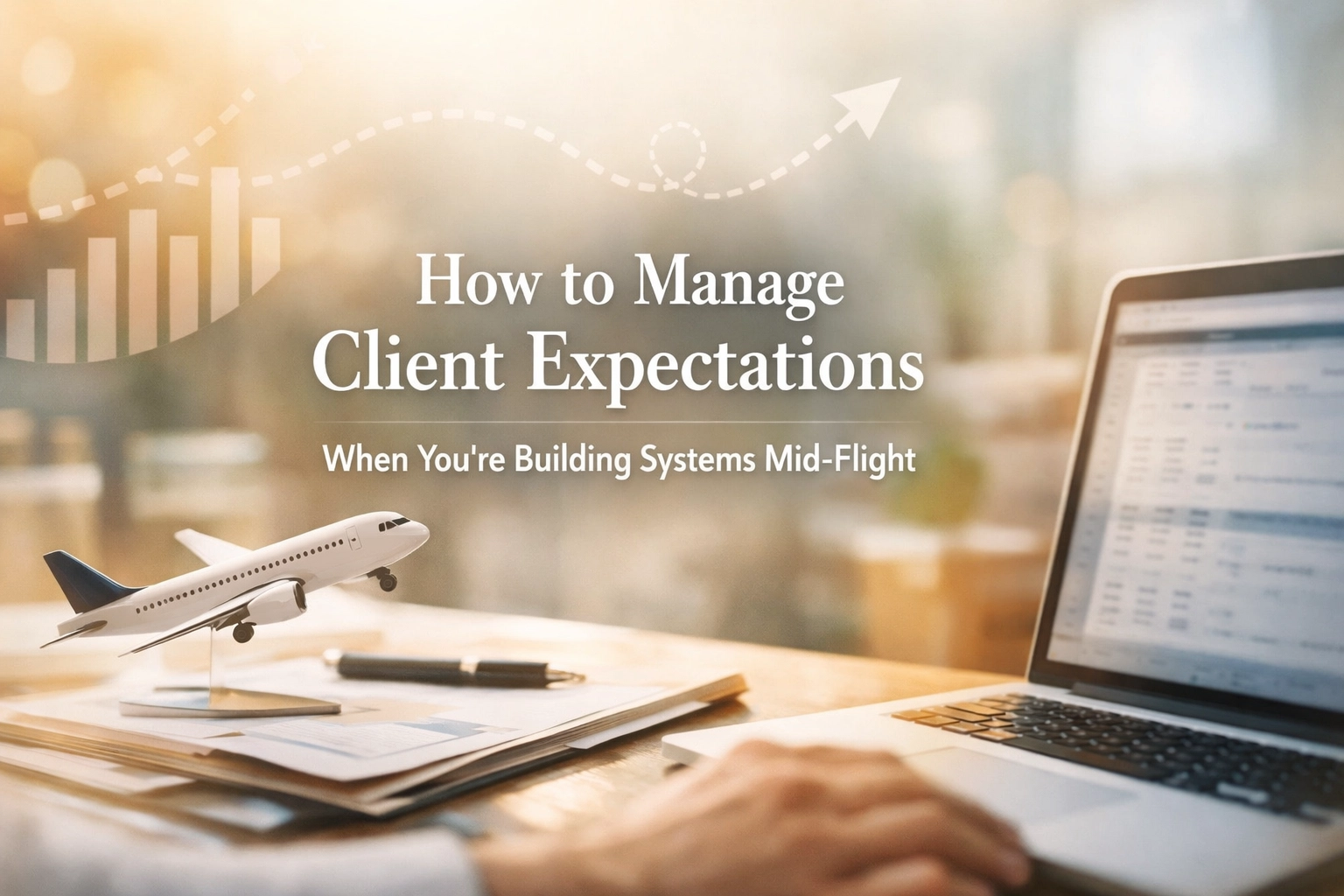
How to Manage Client Expectations When You’re Building Systems Mid-Flight
Your clients are starting to notice the cracks in your operations because you are growing faster than your infrastructure can handle. You feel like you are rebuilding the engine while the plane is at thirty thousand feet. If you don’t find out How to Manage Client Expectations When You’re Building Systems Mid-Flight, you are going to lose the very revenue that is funding your growth.
Let me be direct. Most founders wait too long to build systems. You scaled on grit and heroics until you hit a ceiling. Now you are trying to install processes while simultaneously delivering to high-value clients. It is messy. It is stressful. And if you don’t handle the communication correctly, your reputation will take a hit that no amount of marketing can fix. You can learn How to Manage Client Expectations When You’re Building Systems Mid-Flight in the next 12 weeks if you stop trying to hide the chaos and start leading through it.
The reality is that clients do not care about your internal SOPs. They care about their outcomes. However, when your lack of systems leads to missed deadlines or dropped balls, your internal problem becomes their external problem. This is where most service businesses fail. They try to “fake it until they make it” while the back office is on fire. Here is the truth: honesty about your operational evolution is actually a competitive advantage if you frame it correctly. Knowing How to Manage Client Expectations When You’re Building Systems Mid-Flight is about maintaining trust while you fix the foundation.
The Reality of Operational Debt and Client Friction
When you are scaling from 50K to 100K a month, your old ways of doing things stop working. I have seen this pattern dozens of times. You used to handle every client personally. Now you have a team, but the team does not have a roadmap. This creates “Operational Debt.” You are essentially borrowing from your future efficiency to pay for today’s growth. The cost of that debt is client frustration.
What happens is a breakdown in consistency. One client gets a great experience, and the next one gets a mediocre one because a step was missed. If you want to know How to Manage Client Expectations When You’re Building Systems Mid-Flight, you have to first acknowledge that perfection is off the table. You are in a transition phase.
The pattern is always the same. You realize the chaos is unsustainable. You start building systems. The building process takes time and energy away from delivery. Clients feel the dip in your attention. If you don’t have a plan for How to Manage Client Expectations When You’re Building Systems Mid-Flight, they will assume you have simply stopped caring.
The logic: You cannot build a world-class operation in secret while pretending everything is already perfect.

Phase 1: The Assessment and The Honest Reset
The first step in How to Manage Client Expectations When You’re Building Systems Mid-Flight is to establish a clear baseline. You cannot manage what you have not measured. You need to meet with your team and get an honest assessment of every active project. Where are the bottlenecks? Which clients are actually at risk?
Once you have the internal data, you must perform a “Client Reset.” This does not mean telling them your office is a disaster. It means framing your operational upgrades as a commitment to their long-term success. You tell them: “We are currently implementing new quality control systems to ensure we continue to deliver at the highest level as we grow.” This is a core part of How to Manage Client Expectations When You’re Building Systems Mid-Flight.
What you won’t have:
- An immediate end to all errors.
- A team that perfectly follows new rules on day one.
- Clients who are happy about delays, regardless of the reason.
What you provide:
- A transparent timeline for project updates.
- Direct access to a point of contact who isn’t the “busy” founder.
- A clear explanation of how the new systems will benefit them specifically.
Goal: To stop the bleeding of trust by being the one to bring up the transition before the client complains about it.
The Clarity Transformation is designed to help you navigate this exact reset. We don’t just give you a list of things to do. We step into the chaos with you to stabilize the ship. When you are learning How to Manage Client Expectations When You’re Building Systems Mid-Flight, having an external partner to handle the “engine room” allows you to keep your eyes on the horizon. We help you identify which clients need a proactive conversation and which ones just need to see better results.
Phase 2: Transparent Communication Protocols
Regular, structured communication is the antidote to client anxiety. If a client has to ask “What is the status of my project?” you have already failed at How to Manage Client Expectations When You’re Building Systems Mid-Flight. During a period of internal system building, you must over-communicate.
You need to set up a rhythm. This might be a weekly Friday morning email or a bi-weekly 15-minute sync. Whatever it is, it must be consistent. Consistency is a system in itself. Even if you don’t have all the answers yet, the fact that you show up when you said you would builds the confidence needed for How to Manage Client Expectations When You’re Building Systems Mid-Flight.
The truth: Clients will forgive a lot of internal mess if they never feel ignored.

How to handle it:
- Document every meeting. Send a “Recap and Next Steps” email within 2 hours of any call.
- Use a client-facing project board. Let them see the progress bars.
- Admit mistakes early. If a new system caused a delay, say it. “We are refining our new scheduling process and it caused a 24-hour lag. Here is how we fixed it.”
A Clarity Operational Partnership focuses on building these communication loops. We find that most founders are too “in the work” to remember to update the client. We build the automation and the habits that ensure the client is always in the loop. This is a critical component of How to Manage Client Expectations When You’re Building Systems Mid-Flight. We take the burden of “remembering to talk” off your plate so you can focus on “doing the work.”
Phase 3: Structured Change Management and MVP Thinking
You cannot build the perfect system all at once. If you try to wait until the system is 100% complete before using it, you will fail at How to Manage Client Expectations When You’re Building Systems Mid-Flight. You need to use “Minimum Viable Processes.”
Break your remaining work into clear, achievable phases. If you are a roofing company building a new production system, don’t try to automate the whole thing on Monday. Start with a simple digital checklist for the site foreman. Show the client the checklist. Tell them, “This is our new 20-point quality audit we’re performing on every job site.”
The pattern: Visible progress is better than invisible perfection.
When you implement structured change management, you are also managing scope creep. Many founders allow clients to add extra tasks because they feel guilty about the “internal mess.” This is a mistake. Adding more work to a broken system just breaks it faster. Part of How to Manage Client Expectations When You’re Building Systems Mid-Flight is saying “No” to unrealistic additions so you can protect the integrity of the core delivery.
Success metrics for Phase 3:
- 100% of projects have a defined “Phase” status.
- 0% of scope changes are accepted without a written impact analysis.
- Client satisfaction scores stay stable or increase during the transition.
Goal: To demonstrate ongoing progress through visible, bite-sized improvements.
The Clarity Transformation implements these phased deliveries for you. We don’t believe in “the big reveal” three months from now. We believe in getting the work out of your head and into a working process today. This immediate action is how you truly master How to Manage Client Expectations When You’re Building Systems Mid-Flight. By the time the full system is done, the client has already seen the benefits of the first five iterations.
Why Your Current Approach to Growth is Breaking
You might think that hiring another person will solve the problem. It won’t. If you hire into chaos, you just get more expensive chaos. The reason you are struggling with How to Manage Client Expectations When You’re Building Systems Mid-Flight is that you are still the single point of failure.
Every decision has to go through you. Every client wants to talk to you. This is not a capacity problem; it is a system problem. When you are scaling from 50K to 100K a month, your role must shift from “The Doer” to “The Architect.”

The reality: You cannot be the architect if you are still trying to lay every single brick.
This is where a Clarity Operational Partnership becomes essential. We act as the bridge. While you are maintaining the client relationship and figuring out How to Manage Client Expectations When You’re Building Systems Mid-Flight, we are the ones building the structural integrity in the background. We look at your fleet maintenance, your billing cycles, and your labor efficiency. We fix the things that are causing the delays that upset your clients.
Dealing with the “Messy Middle” of Transformation
There will be a point, usually around week 4 or 5 of building systems, where things feel worse before they feel better. This is the “Messy Middle.” Your team is frustrated with new software. You are frustrated with the time commitment. The client is asking why things look different.
Knowing How to Manage Client Expectations When You’re Building Systems Mid-Flight requires you to be a leader during this time. You have to sell the vision of the future to both your team and your clients.
Common findings during the Messy Middle:
- Communication gaps between the field and the office become more obvious.
- Hidden “Operational Debt” starts to surface (like unbilled work or forgotten follow-ups).
- Clients might push back on new protocols because they liked the “casual” way things used to be.
Look, the “casual” way is why you can’t sleep at night. You have to push through. How to Manage Client Expectations When You’re Building Systems Mid-Flight means being firm about the new standards. “We are moving to this new portal to ensure your documents are never lost again” is a much better frame than “I’m trying this new thing because I’m overwhelmed.”
The Clarity Transformation is built to navigate the Messy Middle. We have seen this hundreds of times. We know exactly where the friction points are. We don’t let you quit when the implementation gets tough. We keep the momentum moving toward the 12-week goal of a streamlined, profitable business.
The Long-Term ROI of Managing Expectations Correctly
If you handle this correctly, you don’t just keep your clients; you turn them into advocates. Clients love seeing a business grow and improve. When they see you proactively fixing your internal engine, it gives them confidence that you will be around for the long haul.
How to Manage Client Expectations When You’re Building Systems Mid-Flight eventually leads to a business that doesn’t require heroics. Imagine a world where:
- You don’t get frantic calls at 8:00 PM because a client is confused.
- Your team knows exactly what to do without asking you.
- Your profit margins increase because you’ve eliminated the “Hand-Off Tax” and labor waste.
This is the promise of a Clarity Operational Partnership. We don’t just give advice; we drive execution. We help you find your real utilization rate and cut the tools that are weighing you down. We turn your “Written Policy” into a “Working Process” that actually produces results.

Frequently Asked Questions About Mid-Flight Systems
Should I tell my clients we are restructuring?
Yes, but frame it as a “Quality Upgrade.” Don’t use words like “chaos,” “mess,” or “struggling.” Focus on the benefits they will receive, such as faster response times or more detailed reporting. How to Manage Client Expectations When You’re Building Systems Mid-Flight is all about the narrative.
What if a client hates the new systems?
Some clients prefer the “old way” because it gave them unfair access to your time. You must decide if you want to run a scalable business or a high-stress boutique. Most clients will adapt if the new system is actually easier for them to use.
How do I handle a major error during a system rollout?
Own it immediately. Do not blame the software or the new process. Say, “We are in the middle of a transition to better serve you, and we missed a step here. Here is how we are making it right and ensuring it doesn’t happen again.” This is the core of How to Manage Client Expectations When You’re Building Systems Mid-Flight.
How much time should I spend on systems vs. client work?
During a transformation, you should aim for a 20/80 split. Spend 20% of your week working on the business and 80% in it. As the systems take hold, you will naturally shift toward 80% on and 20% in.
Can I build systems myself while managing clients?
You can, but it will take three times as long and your risk of burnout is 90%. Hiring a Fractional COO to handle the systems while you handle the clients is the fastest way to stabilize. How to Manage Client Expectations When You’re Building Systems Mid-Flight is much easier when you aren’t the one doing all the heavy lifting.
Stop Flying Blind and Start Building
The choice is yours. You can keep trying to “wing it” and hope your clients don’t notice the falling standards. Or you can take control of your operations and lead your company to the next level. Knowing How to Manage Client Expectations When You’re Building Systems Mid-Flight is the difference between a business that breaks and a business that scales.
You don’t have to do this alone. If you are tired of the constant fire-fighting and you want a partner who will actually do the work of building your systems, let’s talk. We specialize in taking chaotic service businesses and turning them into profit machines in 12 weeks.
Option 1: Keep doing what you’re doing and hope the “Operational Debt” doesn’t bankrupt your reputation.
Option 2: Book a consultation and see how The Clarity Transformation can fix your operations while you keep growing.
Stop guessing and start executing.
Related Blogs
- How to Fix Chaotic Operations in 12 Weeks
- What Does a Fractional COO Do?
- Scaling From 50K to 100K a Month Without Losing Your Mind
- Operational Debt: The Hidden Growth Killer
- Client Expectation Management: 7 Ways to Protect Trust During Growth
- How to Communicate Delays Without Damaging Client Confidence
- Why Clients Panic When Communication Gets Inconsistent
- How to Reset Client Expectations Without Sounding Disorganized
- Client Trust During Operational Change: 5 Rules That Matter Most
- Why Silence Creates More Client Friction Than Bad News
- The Messy Middle of Operational Transformation: What Founders Should Expect
- How to Build Systems While Still Delivering Great Client Work
- Minimum Viable Processes: How to Improve Operations Without Stalling Delivery
- Why Mid-Flight System Changes Feel Worse Before They Work
- How to Roll Out New Processes Without Confusing Clients or Staff
- Operational Drag Reduction: 7 Brutal Ways Debt Destroys Teams
- Scaling Service Quality: 3 Vital B2B Growth Secrets
- On-Time Delivery Systems: 6 Fixes That Calm Client Anxiety
- Why Inconsistent Delivery Makes Good Businesses Look Unprofessional
- How to Stabilize Service Delivery Before You Scale Again
- Client-Facing Project Boards: When Transparency Reduces Stress
- How Better Recaps and Status Updates Reduce Escalations
- Founder Bottleneck: Why Clients Still Depend on You for Answers
- How to Stop Being the Single Point of Failure in Client Delivery
- Why Founders Overprotect Client Communication and Create Chaos
- Leading Through Operational Change Without Losing Clients
- What a Fractional COO Fixes While You Keep Serving Clients
- How a Fractional COO Helps You Build Systems Without Dropping the Ball
- Operational Partnerships: Why Growing Companies Need a Builder, Not Just Advice
- Fractional COO Readiness: 12 Powerful Ways to Fix Chaos
- What to Expect During an Operational Transformation as a Client-Facing Business
- Scaling From 50K to 100K a Month Without Client Experience Slipping
- Why Hiring More People Does Not Fix Broken Client Delivery
- Operational Capacity Audits: Are You Promising More Than You Can Deliver?