Your Slack is a graveyard of “quick question” messages. Your calendar is blocked with “15-minute syncs” that turn into 45-minute approval sessions. Your team can’t ship a pricing page update, approve a customer refund, or change a workflow without you signing off first. You’re not running a SaaS company. You’re running a permission factory.
Let me be direct: if every meaningful decision in your business requires your final approval, you don’t have a team. You have a group of very expensive assistants waiting for you to tell them what’s already obvious.
The bottleneck isn’t your team’s competence. It’s your decision framework. Or more accurately, your complete lack of a decision framework.
Here’s what nobody tells you: the fastest way to kill momentum in a scaling SaaS company is to position yourself as the final judge on every decision. You become the approval machine. The human bottleneck. The reason features ship late, customer issues escalate, and your best employees quietly update their LinkedIn profiles.
The fix isn’t hiring smarter people or communicating better expectations. The fix is installing a decision framework (a simple decision framework your team can follow without you) that removes you from 80% of decisions entirely.
It’s called the 80% Decision Rule. And if you’re stuck approving deployment schedules, pricing exceptions, support escalations, and vendor contracts while your product roadmap collects dust, this is the system that gets you out.
Why SaaS Founders Become Human Approval Machines (No Decision Framework)
You didn’t set out to micromanage every decision. You started by making good calls during chaos. Early-stage SaaS is all fire drills: a pricing experiment tanks conversion, a customer threatens to churn over a bug, a new feature breaks the onboarding flow. You stepped in. You fixed it. You made the call.
Then your team learned the pattern: when in doubt, escalate to the founder.
Now you’re at $50K MRR, $100K MRR, maybe $200K MRR, and you’re still the escalation point for:
- Whether to offer a discount to close a deal
- If the engineering team should prioritize Bug X or Feature Y
- How to respond to a customer complaint about response time
- Whether to approve a $500/month tool subscription
- If a new hire can work remotely full-time
- What messaging to use in the email nurture sequence
- Whether to refund a customer who violated the terms of service
Every single one of these decisions lands in your inbox. Your Slack DMs. Your “quick sync” calendar blocks.
Pattern: Founders think this proves they’re detail-oriented and hands-on. What it actually proves is that you never built a decision framework that allows your team to operate without you, and without a decision framework your team will always escalate to the founder.
And here’s the brutal truth: the more decisions you make, the more decisions you’ll be asked to make. You’re training your team that the safe move is to wait for you.

What the 80% Decision Rule Actually Means (The Decision Framework)
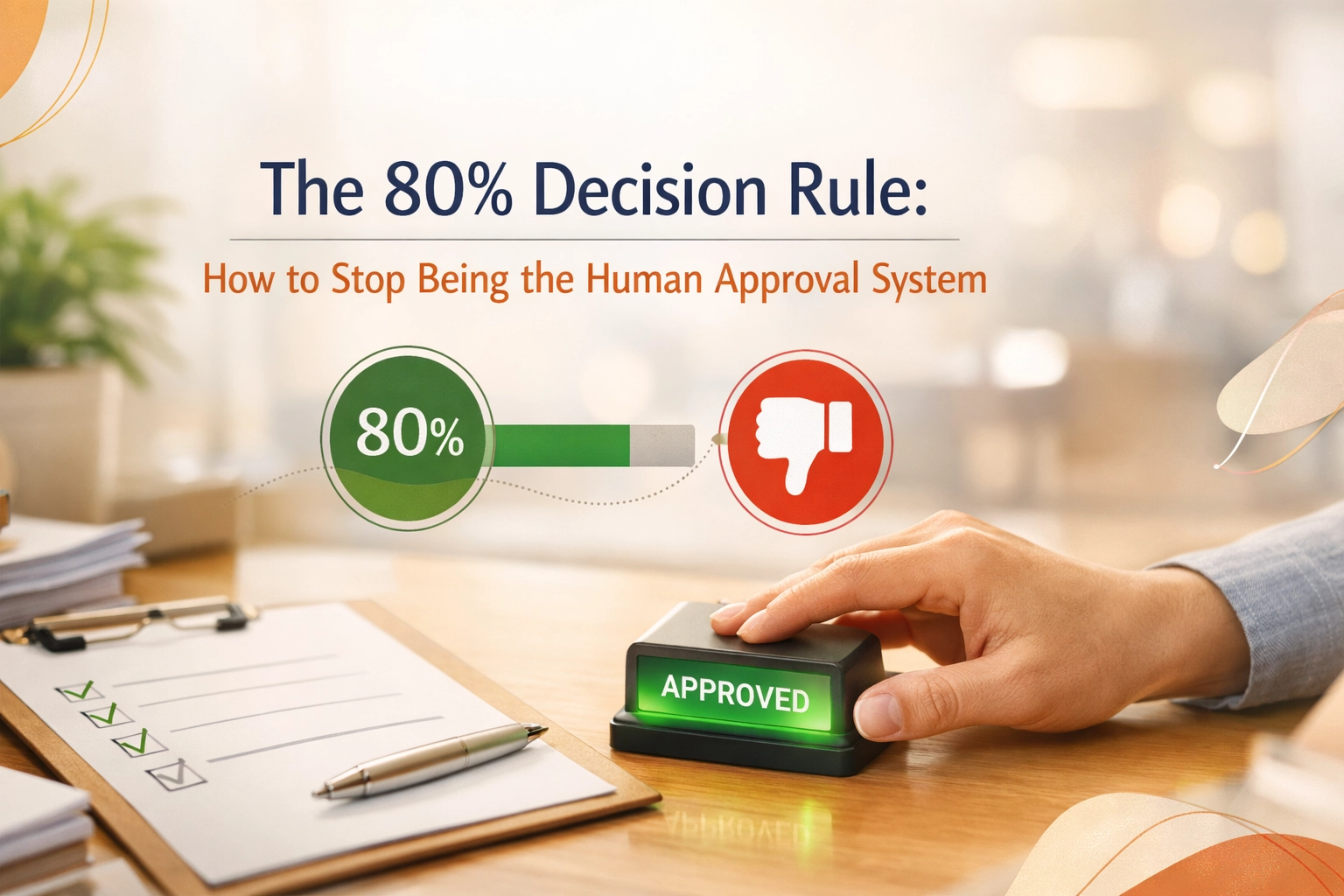
The 80% Decision Rule is a decision framework (a practical decision framework for speed) that says: if someone on your team can make a decision that gets you 80% of the way to the “perfect” outcome, they should make that decision without asking you.
Not 50%. Not “good enough.” Eighty percent.
Here’s the logic: in a SaaS business, you make dozens of material decisions every single week. Most of those decisions are reversible. Almost none of them are existential. And the cost of delaying a decision by three days while waiting for your approval is almost always higher than the cost of making an 80%-good decision immediately.
The 80% rule works because it respects three realities, and each one is supported by a clear decision framework:
Reality 1: Most decisions don’t require perfection. They require momentum.
A decent pricing page launched today beats a perfect pricing page launched in two weeks. An 80% response to a customer complaint sent within two hours beats a 100% response sent three days later after you’ve “had time to review it.”
Reality 2: Your team already knows what the right call is 80% of the time.
They’re not asking because they don’t know. They’re asking because you’ve never given them explicit permission to decide without you through a decision framework. Your approval isn’t adding insight. It’s adding delay. A decision framework replaces guessing with authority.
Reality 3: Chasing 100% on every decision creates analysis paralysis.
The difference between an 80% solution and a 100% solution often requires twice the time, three times the meetings, and five times the mental overhead. Meanwhile, your competitor shipped the 80% version two weeks ago and is already iterating based on customer feedback.
The 80% rule isn’t about lowering standards. It’s about directing your energy toward the 20% of decisions that actually require founder-level judgment and removing yourself entirely from the 80% that don’t by using a decision framework that makes that split obvious.
What an 80% Decision Framework Looks Like in Practice
Let’s get specific. Here’s what the 80% decision framework looks like when you actually install it in a SaaS company:
Phase 1: Map Decision Types and Ownership in Your Decision Framework
You can’t delegate decisions if you don’t know what decisions actually exist in your business. Start by mapping the recurring decisions your team makes weekly:
- Pricing and discount approvals
- Product roadmap prioritization
- Customer support escalations
- Vendor and tool purchases
- Marketing campaign messaging
- Hiring and onboarding logistics
- Feature scope and technical tradeoffs
- Policy exceptions (refunds, SLA breaches, contract terms)
Now assign each decision type to one of three categories:
Founder-only decisions (the 20%): These are decisions with long-term strategic impact, significant financial risk, or brand consequences that can’t be easily reversed. Examples: pivoting your pricing model, sunsetting a product line, hiring a C-level executive.
Delegated decisions with guidelines (the 70%): These are decisions your team can make independently as long as they follow a clear decision-making framework. Examples: approving discounts up to 20%, prioritizing bugs vs features using a scoring rubric, issuing refunds under $500 for clear policy violations.
No-brainer decisions (the 10%): These are decisions so low-stakes or routine that they shouldn’t require any approval process at all. Examples: scheduling a customer call, ordering office supplies, updating help docs.
Most founders discover that 70% to 80% of the decisions currently landing on their desk belong in the “delegated with guidelines” category. That is the whole point of a decision framework: you’ve been approving things that never needed your approval in the first place.
Phase 2: Build Decision Authority Guidelines (Your Decision Framework Rules)
This is where most decision framework efforts fail. Founders say “just make the call” without giving their team any criteria for what “good” looks like inside the decision framework.
Your team doesn’t need permission to decide. They need a decision framework that tells them when to decide and when to escalate inside the decision framework.
Here’s a simple structure:
For pricing decisions:
- Discounts up to 15%: Account Executive decides, logs in CRM
- Discounts 15% to 25%: Requires VP Sales approval
- Discounts above 25%: Requires founder approval
- Annual prepay with custom terms: Always escalate
For product prioritization:
- High-severity bugs affecting more than 10% of users: Ship fix immediately, inform founder after
- Feature requests from paying customers: Product Lead decides based on roadmap fit
- New feature ideas requiring more than 40 dev hours: Founder reviews before sprint planning
- Sunsetting an existing feature: Always escalate
For customer support escalations:
- Refunds under $500 for clear TOS violations: Support Lead approves
- Refunds $500 to $2,000: Requires Customer Success Manager review
- Refunds above $2,000 or policy gray areas: Escalate to founder
- Customer threatening legal action: Always escalate immediately
See the pattern? You’re not telling your team to “use their judgment.” You’re giving them a decision framework with explicit thresholds, criteria, and escalation paths. That is the point of a decision framework.
The magic happens when someone on your team can look at a decision, check the decision framework, and know instantly whether they’re empowered to act or whether it requires escalation.

Phase 3: Install the 80% Question (Decision Framework Enforcement)
Even with clear guidelines, your team will still want to check with you. Old habits die hard.
Here’s the question that breaks the cycle:
“Is your proposed solution 80% as good as the decision I would make?”
If the answer is yes, they make the call. No approval needed. No Slack message. No meeting.
This single question becomes the unlock. It forces your team to stop asking “What would the founder do?” and start asking “Do I know enough to make a solid call here?”
Most of the time, the answer is yes. They just needed explicit permission to act on it.
When someone does escalate a decision to you, ask them: “What would you do if I wasn’t available, and what does the decision framework say?” Listen to their answer. If their proposed solution is 80% as good as yours, send them back to execute it. If it’s not, explain why and use it as a teaching moment for the decision framework.
Over time, your team learns the patterns. The escalations decrease. Your Slack goes quiet. You get your calendar back.
Why the 80% Rule Prevents Analysis Paralysis in SaaS (Decision Framework)
SaaS founders love to optimize. It’s in the DNA. You A/B test email subject lines. You obsess over conversion rates. You track every funnel metric.
But that optimization mindset becomes toxic when applied to every single decision.
Here’s what happens: your Head of Marketing wants to launch a new email sequence. They draft the copy, design the flow, set up the automation. Then they send it to you for “final review” before turning it on.
You read it. It’s good. 80% of the way there. But you notice the subject line could be punchier. The CTA could be clearer. The second email could use a case study instead of a testimonial.
So you send back edits. Your Head of Marketing revises. Sends it back. You find two more tweaks. Another round. Finally, two weeks later, it ships.
Meanwhile, your competitor launched their version in three days, saw mediocre results, killed the underperforming emails, and is already testing version two.
The 80% decision framework prevents this spiral. It forces you to ask: is the marginal improvement worth the delay, and does this decision even belong with you according to the decision framework?
Most of the time, it’s not. An 80% email sequence launched today will teach you more than a 100% sequence launched in two weeks. You can iterate based on real data instead of theoretical perfection.
This applies across your entire business:
- An 80% landing page that goes live this week beats a perfect one that launches next month
- An 80% response to a customer complaint sent in two hours beats a flawless response sent tomorrow
- An 80% prioritization decision made in the sprint planning meeting beats endless debate about the “perfect” roadmap
- An 80% hire who starts next week beats holding out for the unicorn candidate who may never apply
The decision framework isn’t about accepting mediocrity. It’s about accepting that momentum beats perfection in 80% of cases, and your decision framework is what makes “move now” the default.
And here’s the part nobody talks about: when you give your team permission to ship 80% solutions, they’ll often exceed that baseline anyway. If you give people permission to miss the bullseye, it gives them the freedom they need to aim for it through iteration and continuous improvement.
Chasing 100% from the start creates fear. The 80% rule creates momentum.
The Real Cost of Being the Approval Gatekeeper (No Decision Framework)
Let’s do the math on what your approval addiction is actually costing you.
You’re making, conservatively, 30 to 40 decisions per week that could be delegated with a proper decision framework. Each one requires:
- 10 minutes for your team to write up the question and context
- 15 to 30 minutes for you to review and respond
- Another 10 minutes for follow-up clarification
- 24 to 72 hours of delay while the decision sits in your queue
That’s 15 to 20 hours per week of your time spent on decisions that don’t require your judgment. Time you’re not spending on product strategy, customer conversations, fundraising, or the actual CEO work that moves the needle.
But the time cost is only half the problem. The bigger cost is what happens to your team:
Cost 1: Your best people leave. Senior employees don’t want to ask permission to do their jobs. They want autonomy, ownership, and trust. When you require approval for every decision, you’re telling them you don’t trust their judgment. They’ll tolerate it for six months, maybe a year. Then they’ll find a company that actually lets them lead.
Cost 2: Your team stops thinking strategically. Why should your Head of Product develop strong prioritization instincts if you’re going to override them anyway? Why should your Customer Success Manager build conflict resolution skills if every tricky situation gets escalated to you? Your approval dependency doesn’t just slow decisions. It prevents your team from developing the judgment they’ll need when you scale.
Cost 3: Your business becomes fragile. What happens when you’re on vacation? Or sick? Or focused on closing a big partnership deal? Everything grinds to a halt because you’re the single point of failure. You’ve built a business that literally can’t function without you weighing in on pricing exceptions and support tickets.
Cost 4: You miss the actually important decisions. While you’re debating whether to approve a $300 software subscription, you’re not thinking about whether your pricing model is fundamentally broken. While you’re reviewing email copy, you’re not noticing that your churn rate is creeping up. The urgent crowds out the important because you haven’t built a decision framework that protects your time for what actually matters.
This is the founder trap. You think being involved in every decision means you’re hands-on and detail-oriented. What it actually means is that you’re stuck in operator mode when you need to be in CEO mode.

How to Implement the 80% Decision Framework in 30 Days
Switching from approval-based decision-making to a decision framework doesn’t happen overnight. Your team is trained to escalate. You’re trained to swoop in. Breaking the pattern requires deliberate decision framework work.
Here’s the 30-day implementation plan:
Week 1: Decision Audit (Decision Framework Inputs)
Track every decision that lands on your desk for seven days. Use a simple spreadsheet:
- What decision was requested?
- Who asked?
- What was the context?
- How much time did it take you to decide?
- Could this have been decided without you?
At the end of the week, you’ll have a clear picture of where your approval bottleneck actually lives, and what your decision framework needs to cover first. For most SaaS founders, it’s pricing decisions, product prioritization, customer escalations, and vendor approvals.
Week 2: Build Authority Guidelines (Decision Framework Rules)
Take your top 10 to 15 most frequent decision types from the audit. For each one, create a simple decision authority guideline using this format:
Decision Type: [Pricing discount approval]
Who Decides:
- Up to 15%: Account Executive
- 15% to 25%: VP Sales
- Above 25%: Founder
Decision Criteria:
- Discounts based on deal size, prepay terms, competitive situation
- All discounts must be logged in CRM with justification
- Any discount affecting gross margin below 75% requires founder review regardless of percentage
Escalation Trigger:
- Custom contract terms
- Multi-year commitments with non-standard SLA
- Strategic accounts above $50K ARR
Do this for each decision category. Don’t overthink it. Version one doesn’t have to be perfect. It just has to exist.
Week 3: Roll Out and Train
Schedule a team meeting. Walk through the new decision framework. Explain the 80% rule explicitly. Repeat the phrase decision framework until it feels normal.
The language matters. Don’t say: “I’m delegating these decisions because I’m too busy.”
Say: “I’m removing myself from these decisions because you’re closer to the context and can move faster than I can. If your solution is 80% as good as the one I’d make, you’re empowered to execute without asking. Here are the guidelines. Here’s when to escalate. When in doubt, ask yourself: is this 80%? If yes, ship it.”
Make it clear that this is a trust signal, not a burden shift.
Week 4: Enforce the Decision Framework
This is the hard part. When someone escalates a decision that falls within their decision authority, you have to push it back.
Team member: “Should we offer this customer a refund? They’re upset about the outage last week but they didn’t actually lose any data.”
You (old way): “Yeah, issue the refund. Keep them happy.”
You (new way): “Check the decision framework. Does this fall under your authority? If it’s under $500 and it’s our fault, you’re empowered to approve it. What would you do?”
The first few times you do this, it’ll feel awkward. Your team will push back. They’ll say “I just wanted to confirm” or “I wanted to make sure you agreed.”
Hold the line. Redirect them to the decision framework. Ask them what they’d decide. If their answer is 80% good, tell them to execute it, because that is how the decision framework becomes real.
By the end of week four, the pattern changes. Escalations drop. Your Slack quiets down. Decisions happen faster. Your team starts owning outcomes instead of waiting for permission.
What the 80% Decision Framework Looks Like After 90 Days
Three months after implementing the 80% rule with a proper decision framework, here’s what actually changes:
Decisions you used to make weekly:
- Pricing approvals: 12 per week → 2 per week
- Product priority calls: 8 per week → 1 per week
- Customer escalations: 15 per week → 3 per week
- Vendor and tool approvals: 5 per week → 1 per week
- Marketing messaging reviews: 6 per week → 0 per week
Time reclaimed: 15 to 18 hours per week. That’s nearly half a work week back in your calendar for actual CEO work.
Team changes:
- Your Head of Product stops asking “What do you think?” and starts saying “Here’s what we’re doing and why.”
- Your Customer Success team handles 90% of escalations without you.
- Your marketing team ships campaigns and iterates based on data instead of waiting for your blessing.
- Your finance lead approves vendor contracts up to $5K without a Slack message.
Business velocity:
- Features ship faster because prioritization doesn’t wait for your schedule.
- Customer issues resolve in hours instead of days.
- Pricing experiments run weekly instead of monthly.
- Team morale improves because people feel trusted to do their jobs.
And here’s the part that surprises most founders: decision quality doesn’t drop. In fact, it often improves because decisions are made by people closer to the actual context with real-time information instead of stale data filtered through your interpretation three days later.
The 80% rule doesn’t mean 80% quality. It means 80% of your perfect solution executed immediately beats 100% of your perfect solution executed after a week of delay.
When the 80% Decision Framework Breaks (And How to Fix It)
Let’s be honest: this system isn’t magic. There are failure modes.
Failure Mode 1: Your team doesn’t trust the framework.
They’ll say “I checked the decision framework but I wasn’t sure if this situation qualified.” They’ll still escalate everything “just to be safe,” because the decision framework still feels optional.
The fix: The first five times someone escalates something that should be handled at their level, don’t just answer the question. Walk them through the decision framework. Show them how you’d evaluate it using the decision framework. Then ask: “Does that clarify the decision framework, or do we need to update it?” Over time, they’ll learn the pattern.
Failure Mode 2: The guidelines are too vague.
If your decision authority doc says “use good judgment” or “act in the company’s best interest,” you haven’t actually built a decision framework. You’ve written a platitude.
The fix: Add specificity inside the decision framework. Use dollar thresholds, percentage ranges, customer impact tiers, time windows. Make the decision framework concrete enough that someone can evaluate a decision in under 60 seconds.
Failure Mode 3: You override their decisions.
Nothing kills a decision framework faster than a founder who says “you’re empowered to decide” and then reverses every decision they don’t like.
The fix: If someone makes an 80% decision you don’t love, let it stand unless it’s causing actual harm. Use it as a teaching moment for next time and update the decision framework if needed, but don’t undo their call. If you consistently override their judgment, you’re training them to never decide without you again, and your decision framework becomes meaningless.
Failure Mode 4: Edge cases aren’t escalating.
Occasionally, someone will make a decision that should have been escalated and wasn’t. A pricing discount that sets a bad precedent. A product decision that creates tech debt. A customer exception that violates your positioning.
The fix: Treat it as a decision framework update, not a team failure. Ask: “Why did this seem like an 80% decision when it needed escalation? What was missing from the decision framework?” Then update the decision framework to clarify the escalation trigger.
The decision framework is a living document. It should evolve as your business grows and your team learns the boundaries. A useful decision framework gets updated, not worshipped.

Why Most SaaS Founders Resist the 80% Rule (Decision Framework)
Even when founders understand the logic, they resist actually implementing an 80% decision framework. Here are the objections I hear most often:
Objection 1: “But I’m better at these decisions than my team.”
Maybe. But “better” doesn’t matter if it’s not materially better and if the delay costs you more than the quality gain.
Your Head of Product might prioritize features differently than you would. But if their prioritization framework is sound and based on customer data, does it really matter if you’d have ranked item #3 and item #4 differently? The cost of you spending two hours in a prioritization meeting is higher than the marginal value of your “better” ranking.
Objection 2: “I don’t trust my team to make good calls without me.”
Then you have a hiring problem, not a decision framework problem. If you’ve hired people who can’t make solid decisions within their domain, the issue isn’t the decision framework. It’s that you hired the wrong people.
The solution isn’t to micromanage them. It’s to either train them up or replace them with people who can operate autonomously.
Objection 3: “What if they make a mistake?”
They will. That’s how learning happens.
The question isn’t whether they’ll make mistakes. The question is: would you rather have a team that makes small, reversible mistakes quickly and learns from them, or a team that makes no mistakes because they’re paralyzed waiting for your approval?
In SaaS, speed beats perfection. The faster you can test, learn, and iterate, the faster you win. Approval bottlenecks kill speed.
Objection 4: “I like being involved. It helps me stay close to the business.”
Being involved in every decision isn’t staying close to the business. It’s staying stuck in the weeds.
You can stay close to the business by reviewing weekly metrics, joining customer calls, sitting in on product demos, and having strategic one-on-ones with your leadership team. You don’t need to approve pricing exceptions to understand your business.
What you’re actually saying is: “I’m afraid that if I’m not involved in every decision, I’ll lose control.”
That fear is real. But it’s also the thing keeping you from scaling past $200K MRR, $500K MRR, $1M MRR. At some point, you have to choose between control and growth.
The 80% decision framework gives you both. You maintain strategic control through clear guidelines while removing yourself from tactical execution, because the decision framework makes the boundaries obvious.
How Clarity Ops Engine Installs Decision Frameworks That Scale
Building a functional decision framework isn’t a weekend project. It requires mapping your actual decision patterns, understanding where bottlenecks live, and creating guidelines specific enough to be useful but flexible enough to handle edge cases. A real decision framework is what turns “ask the founder” into “follow the rules, then ship.”
Most founders know they need to delegate better. They just don’t know where to start or what the framework should actually look like for their specific business.
This is exactly the type of decision framework infrastructure work we build during a Fractional COO engagement.
Here’s what that looks like in practice:
Week 1-2: Decision Audit and Mapping
We track every decision that lands on your desk for two weeks. We categorize them by type, frequency, time cost, and strategic importance. Then we map which decisions actually require founder judgment and which ones are just landing with you because no one else has been given authority to decide.
Most SaaS founders discover that 70% to 80% of their “approvals” are decisions that could be made faster and better by someone closer to the context.
Week 3-4: Build Authority Matrices
We don’t hand you a generic RACI chart and call it done. We build decision authority guidelines as a practical decision framework tailored to your business model, your team structure, and your risk tolerance.
For a B2B SaaS company, that might mean:
- Pricing authority guidelines based on deal size, discount percentage, and contract terms
- Product prioritization frameworks based on customer impact, effort scores, and strategic fit
- Customer escalation protocols based on ARR, issue severity, and policy compliance
- Vendor approval thresholds based on spend, contract length, and integration complexity
Week 5-6: Roll Out and Reinforcement
We don’t just document the decision framework and hope your team reads it. We run training sessions. We coach your leadership team on how to use the 80% question inside the decision framework. We help you push back the first ten times someone escalates a decision they should own, using the decision framework as the source of truth.
This is where most DIY attempts fail. You announce the new decision framework, your team nods along, and then nothing changes because the old habits are too ingrained and the decision framework is not enforced.
We stay in the execution layer long enough to make sure the new behavior sticks, and the decision framework becomes the default.
Week 7-12: Iterate and Optimize
As your team starts making more decisions autonomously, we track what’s working and what’s creating new bottlenecks in the decision framework. We refine the decision framework rules based on real edge cases. We update escalation triggers in the decision framework when the thresholds are too loose or too tight.
By the end of 12 weeks, you have a living decision framework embedded in how your team actually operates. Not a document that lives in a Google Drive folder no one opens. A usable decision framework shows up in daily behavior.
The result: you get 15 to 20 hours back per week. Your team moves faster. Decisions happen in hours instead of days. And you finally get to do the CEO work that actually requires your brain instead of playing human approval machine.
The Binary Choice for SaaS Founders (Decision Framework)
You can keep running your business the way you’re running it now. You can stay in every decision, approve every pricing exception, review every marketing email, and weigh in on every product priority.
Your team will keep escalating. Your calendar will stay packed with “quick syncs.” Your Slack will stay buried in “can I just run this by you” messages. You’ll work 60-hour weeks and wonder why growth feels so hard.
Or you can install an actual decision framework that removes you from 80% of decisions and protects your time for the 20% that actually need your judgment.
You can teach your team to ask “Is this 80%?” instead of “What would the founder do?”
You can build a business that runs without you being the approval gatekeeper for every choice.
The decision is yours. Just make sure it’s not the 87th decision you’ve made this week that someone else should have owned.
Ready to stop being the human approval system? Book a 30-minute diagnostic call and we’ll show you exactly where your decision bottleneck lives and what framework would fix it: https://calendly.com/sdrobinson8/30min
Related Blogs
- RACI: The Accountability Framework That Stops the “Who Owns This?” Confusion
- Founder Vacation Systems: How to Finally Step Away Without Everything Falling Apart
- How to Fix Chaotic Operations in 12 Weeks
- Business Operations Strategy: The Missing Infrastructure Between You and Scale
- Decision Frameworks for SaaS: How to Stop Being the Approval Gatekeeper
- The Decision Authority Matrix: Who Can Decide What (Without Asking You)
- The 3-Level Decision System: Autopilot, Guardrails, Founder Only
- The 80% Decision Rule in Practice: Examples for Product, Sales, and Support
- How to Write Decision Guardrails Your Team Will Actually Use
- “Use Your Best Judgment” Is Not a System: What to Say Instead
- Delegation Without Regret: How to Make Decisions Reversible by Design
- The Escalation Ladder: When to Decide, When to Consult, When to Escalate
- Founder-Only Decisions: Defining the 20% That Actually Requires You
- How to Reduce Decisions Landing on Your Desk by 70% in 30 Days
- First 30 Days COO Experience: 5 Bold Wins for Teams
- Customer Retention: 7 Brutal Mistakes Killing Repeat Profits
- Why Smart Teams Still Ask Permission (It’s Not Incompetence)
- From CEO to Help Desk: The Hidden Cost of Being Everyone’s Escalation Point
- The “Quick Question” Trap: Why Slack DMs Destroy Scale
- Meetings as Permission Slips: How Sync Culture Replaces Ownership
- The Approval Tax: How Long Decisions Sit Before Work Moves Again
- How to Build a Business That Doesn’t Pause When You’re Offline
- Shipping Faster Isn’t a Sprint Problem — It’s a Decision Problem
- Stop Debating Roadmaps: A Simple Prioritization Framework That Ships
- Bug vs Feature: The Scoring Rubric Product Teams Need
- The “Good Enough” Launch: Why Iteration Beats Perfection in SaaS
- Feature Flags as a Decision System: Ship Small, Decide Faster
- Kill the Committee: How to Remove “Consensus” From Product Decisions
- Decision SLAs: Setting Time Limits on Stalled Choices
- Discount Authority for SaaS: Stop Slack Negotiating Every Deal
- Refund Rules That Protect Margin (Without Escalating Every Ticket)
- Pricing Exceptions: The Framework That Prevents Precedent Creep
- When to Comp a Month: A Customer Success Decision Guide
- Policy Exception Playbooks: Handling Edge Cases Without Founder Pings
- The “$500 Decision” Problem: Why You’re Spending CEO Time on Pennies
- Customer Escalation Tiers: Severity, ARR Impact, and Who Owns It
- RACI for SaaS Teams: Who Owns Decisions, Not Just Tasks
- SOPs for Decision-Making: What to Document (So People Stop Asking)
- The Single Source of Truth for Policies: Where Decisions Should Live
- How to Turn Repeated Founder Answers into Playbooks
- The “Decision Log”: The Simple Practice That Prevents Repeat Debates
- Knowledge Management for SaaS: Stop Losing Context in Slack Threads
- How to Train Leaders to Decide Without You
- The Confidence Gap: Why Managers Escalate When They Know the Answer
- Coaching Through Decisions: How to Correct Without Taking Back Control
- Decision-Making as a Skill: Building Judgment in Product, Sales, and CS
- When Delegation Fails: Fixing Guardrails Instead of Blaming People
- How to Stop Overriding Your Team (Without Lowering Standards)
- Your Calendar Is a Symptom: Replacing Syncs With Systems
- Async Decision-Making: How to Cut Meetings Without Losing Alignment
- Slack Protocols for Scaling Teams: What Belongs in DMs vs Channels
- Approval Workflows Without Meetings: The “One-Page Decision Brief”
- The Weekly Decision Review: Replace Interruptions With a Rhythm
- Stop Using Meetings to Compensate for Missing Authority
- Fractional COO Readiness: 12 Powerful Ways to Fix Chaos
- Accountability Systems: Why Deadlines Slip When Decisions Don’t Move
- Knowledge Management: Stop Being the Human Search Engine
- Scaling vs Cleanup: Why You’re “Busy” but Not Moving
- The RACI + Decision Authority Combo That Ends Confusion